In This Guide
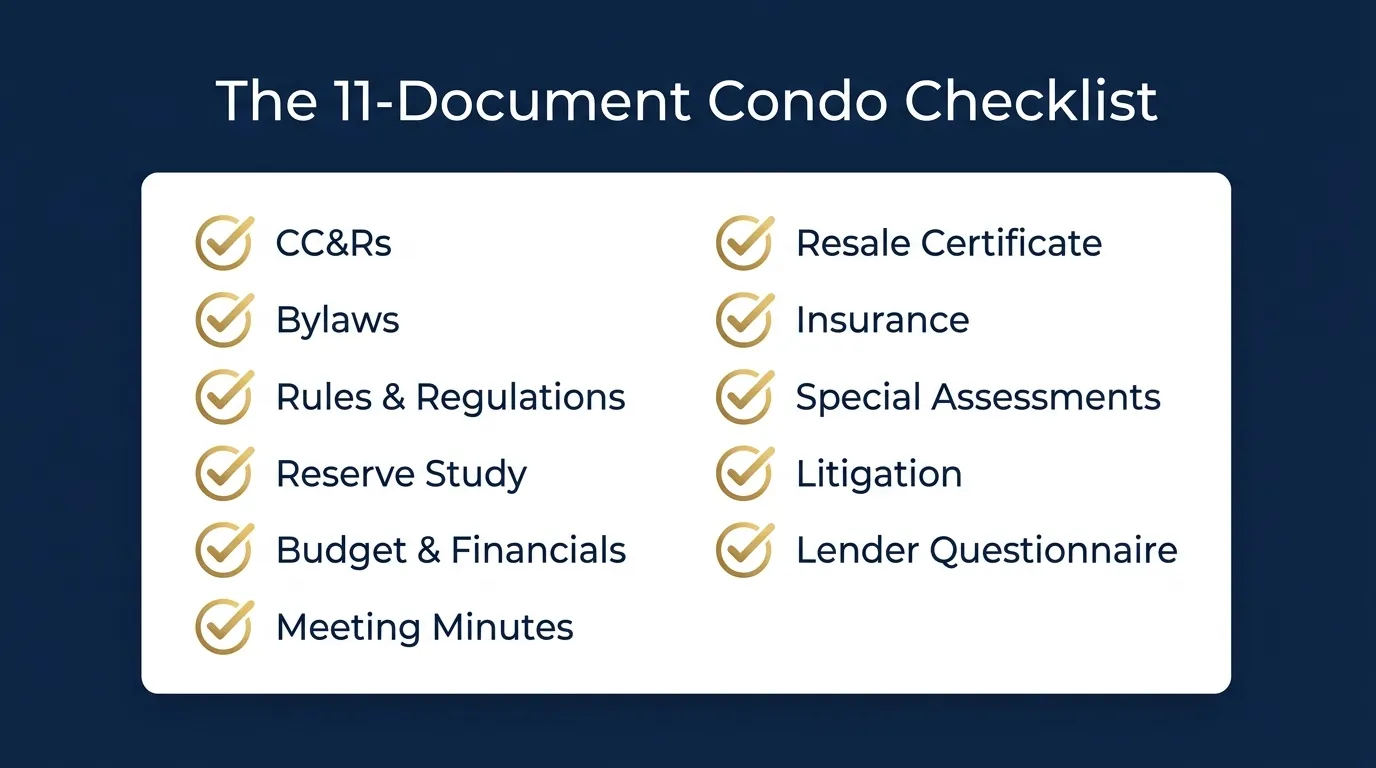
Buying a condo means buying into a small business you do not run. Before you remove contingencies, request and review 11 documents: the CC&Rs, bylaws, rules, reserve study, operating budget and financials, two-plus years of meeting minutes, the resale or estoppel certificate, the master insurance policy, the special-assessment history, any litigation disclosure, and the lender warrantability questionnaire. This guide walks through each one, the specific red flags to look for, the cancellation clock you have in your state, and the 2026 rule changes that can make or break your financing.
The unit looks great. The price works. You are under contract. A few days later the HOA disclosure packet lands in your inbox, and it is several hundred pages: CC&Rs, bylaws, a budget, a balance sheet, a reserve study, two years of meeting minutes, an insurance certificate, and a resale or estoppel certificate. Your agent tells you to "look it over." The clock on your contingencies is already running.
Here is the uncomfortable part. The risks that cost condo buyers the most money, a six-figure special assessment, an underfunded reserve, a building that no longer qualifies for a conventional loan, are almost never visible on the listing. They live in those documents, and they are usually telegraphed months in advance to anyone who knows where to look. Cricket Club owners in North Miami were hit with a roughly $30 million building-wide special assessment, as Highest & Best reported from the Wall Street Journal's account; one owner who listed near $350,000 ended up selling for $110,000. None of that was a surprise to anyone reading the minutes.
This is the complete checklist: what to request, what each document tells you, the red flags in each, the cancellation window you actually have, and how to get through the stack without missing the things that matter. Treat it as your master reference and follow the links into the deeper guides on each topic.
The Condo Due-Diligence Timeline (and Why Your Window Is Short)
A financed condo closes in 30 to 45 days. The association can take 10 to 14 days just to deliver the documents, leaving a tight window that runs concurrently with inspections and financing.
A typical financed condo purchase moves in a predictable sequence: accepted offer, then a due-diligence and inspection period, then the financing and appraisal contingency, then closing. Financed purchases close in about 30 to 45 days, with a 41-day average in late 2025. Inside that, your HOA document review usually has to happen in a short, defined window.
The squeeze is structural. The association can legally take 10 to 14 days just to produce the resale or estoppel certificate and the rest of the package, but your cancellation clock only starts when you receive the documents, and it runs at the same time as your inspection and the start of your financing contingency. A full package can be 200 to 400 pages or more. Many buyers end up with only a few days to read it, which is why so many skip real review and simply hope.
That compression is the entire problem, and it is the reason a short statutory review period fails so many buyers. We cover it in depth in why the 3-day HOA review period fails buyers and how to get HOA documents before you even make an offer. The single best move is to request documents as early as possible, ideally before you go under contract, so the clock is not working against you.
The 11-Document Checklist (and the Red Flags in Each)
Request all 11: CC&Rs, bylaws, rules, reserve study, budget and financials, minutes, resale certificate, insurance, assessment history, litigation disclosure, and the lender questionnaire.
Below is the full package, in roughly the order of how much money each one can save or cost you. For each document: what it is, why it matters, and the red flags worth stopping on.
1. CC&Rs / Declaration
The Covenants, Conditions & Restrictions are the master recorded legal instrument. They run with the land and bind every owner, and they are the document lenders read most closely. The CC&Rs control how you can use the unit, whether and how you can rent it, pet and architectural rules, and how assessments are levied.
Red flags: rental caps or leasing restrictions (especially recently amended ones, which signal an owner-versus-investor fight), a right of first refusal or board approval requirement for buyers, owner-occupancy ratios, and transfer restrictions. Any of these can make a building non-warrantable and block conventional, FHA, or VA financing. Always check the amendment history. See how to find rental restrictions in HOA docs and whether an HOA can ban rentals after you buy.
2. Bylaws
The bylaws are the association's operational rulebook as a corporate entity: voting rights, quorum, board powers, and the procedure for adopting budgets and assessments. They tell you how decisions get made and how easily a board can pass a large special assessment.
Red flags: weak quorum or voting protections, board authority to levy large assessments without an owner vote, and no cap on annual dues increases.
3. Reserve Study
The reserve study is a professional projection of major-component repair and replacement costs and the funding needed to cover them. The headline number is percent funded, the reserve balance divided by the fully funded balance. By the tiers Association Reserves uses, above 70% is strong, 30% to 70% is fair, and below 30% is weak and at real risk of a special assessment. Roughly 74% of associations are funded below 70%.
Red flags: percent funded below 30%, no reserve study at all, deferred maintenance with no funding plan, and in Florida, a building three or more stories with no completed structural integrity reserve study. Learn the mechanics in how to read a reserve study in 5 minutes, what counts as a good percent funded, and what happens when reserves hit zero.
4. Operating Budget and Financial Statements
The annual budget, income and expense statements, and balance sheet show whether the dues actually cover the costs and whether reserves are funded adequately. Review at least two to three years.
Red flags: a delinquency rate at or above 15% of units 60+ days past due (which makes a project Fannie Mae ineligible), reserve contributions below the required minimum, operating deficits, and dues that are far below comparable buildings, which often signals deferred funding rather than a bargain. Dig deeper in how to read an HOA budget: 5 red flags, how to read HOA financial statements, whether low HOA fees are a red flag, and the delinquency rate that can kill your purchase.
5. Meeting Minutes (Board and Annual)
Minutes are the single best forward-looking risk document in the package. Problems show up here months before they become a disclosure or an assessment. Read at least two years of board and annual meeting minutes.
Red flags: repeated references to "legal counsel" (pending litigation), assessments that are "anticipated" or "discussed" but not yet levied, deferred maintenance on roofs, concrete, or elevators, contractor bids, board conflict, and frequent management-company turnover. See 7 meeting-minutes red flags that predict special assessments and how minutes predict an assessment.
6. Resale Certificate / Estoppel / Status Certificate
This is the association-issued snapshot of your account and the corporation's financial and legal state. The name varies by state (Florida calls it an estoppel, Texas a resale certificate), but it confirms amounts owed, reserve adequacy, pending litigation, and budget health.
Red flags: low reserves, a looming or anticipated special assessment, active litigation, and high arrears. In Florida the estoppel must be delivered within 10 business days, with a fee cap and no fee allowed if the association misses the deadline. Read what is inside a condo resale certificate and the HOA transfer fees buyers miss.
7. Insurance (Master Policy + Your HO-6)
The association carries a master policy; you carry an HO-6 unit policy. Most master policies are "bare walls in," stopping at the drywall, which leaves the interior build-out to you. A large master deductible can be split among all owners through a loss assessment.
Red flags: a bare-walls master policy without adequate HO-6 coverage, a high master deductible, loss-assessment coverage left at the roughly $1,000 default instead of raised toward $50,000, and premiums spiking. Florida boards have options when a master-policy renewal spikes, and some California HOAs saw 200% to 500% single-cycle hikes. See the HO-6 insurance gap and how the insurance crisis affects your mortgage.
8. Special Assessment History and Pending Assessments
Look at what has been assessed in the past and what is approved, pending, or being discussed now. Assessments large enough to move the price of a unit are no longer rare: the Cricket Club in North Miami passed a $30 million building-wide assessment, and Aventura's Mediterranean Village reportedly faced assessments as high as $400,000.
Red flags: recent or recurring assessments, an assessment discussed in the minutes but absent from the estoppel, and deferred maintenance with no assessment levied yet (the assessment is coming). Cross-check the estoppel against the minutes, and negotiate who pays any anticipated assessment before you go firm. Read special assessments explained, special-assessment red flags, who pays the assessment at closing, and assessment versus fee increase.
9. Litigation Disclosure
Any disclosure of pending or threatened litigation involving the association matters enormously, because Fannie Mae deems a project ineligible if pending litigation affects safety, structural soundness, habitability, or functional use. That can block financing entirely.
Red flags: construction-defect suits, developer-turnover disputes, contractor claims, and owner class actions. Verify both the estoppel and the minutes, since estoppels sometimes omit threatened but not-yet-filed litigation. See HOA lawsuit red flags and 5 legal risks in HOA properties.
10. Rules and Regulations
Board-adopted rules sit under the authority of the CC&Rs and bylaws, and they are usually longer and updated more often. Day-to-day livability, pets, parking, short-term-rental bans, and fines, often lives here rather than in the CC&Rs.
Red flags: pet weight or breed limits, rental bans or waitlists, aggressive fine schedules, and recently tightened rules that hint at active conflict.
11. Lender Warrantability Questionnaire
The Condominium Project Questionnaire (Fannie Mae Form 1076 / Freddie Mac Form 476) is what your lender sends the association. It determines whether a conventional loan is even possible, and a "no" can surface late and derail closing.
Non-warrantable red flags: delinquency at or above 15% of units 60+ days past due, a single entity owning more than two units (in 5 to 20 unit projects) or more than 20% (in 21+ unit projects), commercial space above 35%, pending litigation affecting safety or structure, significant deferred maintenance, unfunded repairs above $10,000 per unit due within 12 months, and reserves below the minimum. Learn the rules in the 2026 Fannie and Freddie condo rules, what non-warrantable means, red flags that kill FHA and VA loans, and how HOA documents affect financing.
Your Cancellation Clock, State by State
Only some states give condo resale buyers a statutory cancellation window after they receive the documents. Several, including California, Arizona, Colorado, and Illinois, give none.
How much time you have to walk away after reading the documents depends entirely on your state. Some give resale buyers a firm statutory cancellation window; others give none at all and leave you relying on a contractual inspection contingency. The table below covers the major condo states, with the verified rule and the source statute.
| State | Buyer cancellation window | HOA delivery deadline | Key statute |
|---|---|---|---|
| Florida | 7 days resale / 15 days developer | Estoppel 10 business days | §718.503; §718.116 |
| California | None statutory (use contingency) | Within 10 days of request | Civ. §4525 |
| Texas | 6 days (condo) / none (POA) | 10 days | §82.156; §207.003 |
| Virginia | 3 days (unlimited if never delivered) | 14 days | §55.1-2312 |
| Washington | 5 days (if delivered late) | 10 days | RCW 64.90.640 |
| Nevada | 5 calendar days | 10 calendar days | NRS 116.4109 |
| Arizona | None statutory | 10 days after notice | §33-1260; §33-1806 |
| Colorado | None statutory | Status letter on request | §38-33.3-316 |
| Illinois | None statutory | 10 business days | 765 ILCS 605/22.1 |
The takeaway: even in the most protective states, the window is measured in days and runs concurrently with everything else. In states with no statutory window, your only protection is the inspection or due-diligence contingency you negotiated into the contract, so the language of that contingency matters more than buyers realize. Confirm the exact current statute and deadline for your state with a local attorney, since these are amended often.
The 2026 Rule Changes Every Condo Buyer Must Know
Fannie Mae is raising reserve requirements and retiring Limited Review in 2026 and 2027. Florida's structural-safety deadlines and the insurance crisis are reshaping which condos are financeable.
Two thousand twenty-six is a turning point for condo financing and safety rules. Three developments matter most:
Fannie Mae tightened the condo rules (Lender Letter LL-2026-03, issued March 18, 2026). The reserve-funding minimum rises from 10% to 15% of budgeted assessment income for loan applications dated on or after January 4, 2027. The Limited Review path is retired for established projects with more than 10 units for applications dated on or after August 3, 2026, making the more rigorous Full Review mandatory. Freddie Mac issued a matching bulletin the same day. A building that qualifies today may not qualify next year, which affects both your loan and your future resale pool. See the new 15% reserve rule explained.
Florida's structural-safety regime is now in full effect. Buildings three or more habitable stories must complete a structural integrity reserve study (the SIRS deadline was December 31, 2025), and milestone inspections are required at 30 years of age, or 25 years within three miles of the coast, then every 10 years. Reserves for SIRS components can no longer be waived. For 2026 buyers, the SIRS and milestone reports are now part of the resale disclosure package, and an underfunded or missing one is a major red flag. Read the Florida SIRS report explained, milestone inspections in 2026, and whether to buy in the Florida condo crisis.
The condo insurance crisis is driving up dues and assessment risk. Master-policy premiums are up sharply, especially in Florida and California, and that flows straight into higher dues, larger deductibles, and bigger loss-assessment exposure for owners. Factor rising insurance into any building's long-term affordability, not just today's fee.
How to Get Through 300 Pages Without Missing the Money Risk
Screen the whole package quickly for financial and structural risk first, then spend expert time only on the specific legal questions the screen surfaces.
You will not carefully read 300 pages in a few days, and you do not need to. The efficient approach is a two-step sequence. First, run the entire package through a fast screening pass that surfaces the things that actually cost money: percent funded and reserve adequacy, special-assessment signals in the minutes, delinquency rates, rental and use restrictions, insurance gaps, and warrantability concerns.
Second, escalate only what the screen flags. If it turns up a genuine legal question, an ambiguous covenant, a litigation reference, an amendment you do not understand, take that specific issue to a real estate attorney. You are paying for targeted legal judgment instead of hours of someone reading routine documents from scratch. We break down the cost math in how much an HOA document review attorney costs, and why a general chatbot is not a safe substitute in why uploading your CC&Rs to ChatGPT is bad advice.
That screen-first workflow is exactly what GoverningDocs is built for: it reads the entire package, grades the property, and links every finding to the page it came from, so you and, if needed, your attorney know precisely where to look. You can start free with the CC&R analysis tool, reserve study analyzer, and meeting minutes tool, then run a full property report once you are under contract. New to all of this? Start with our first-time condo buyer guide and the broader how to review HOA documents walkthrough.
Frequently Asked Questions
What documents should I review before buying a condo?
Request 11 documents: the CC&Rs, bylaws, rules and regulations, the reserve study, the operating budget and financial statements, at least two years of meeting minutes, the resale or estoppel certificate, the master insurance policy, the special-assessment history, any litigation disclosure, and the lender warrantability questionnaire. Together they tell you whether the building is financially sound, financeable, and free of restrictions that limit how you use the unit.
What is the biggest red flag when buying a condo?
An underfunded reserve combined with deferred maintenance, because it almost always precedes a special assessment. Check percent funded: below 30% is weak. Then read the minutes for any assessment being discussed but not yet levied. Roughly 74% of associations are funded below 70%, so this is the most common and most expensive risk buyers miss.
How long do I have to review condo documents before closing?
It depends on your state. Florida gives resale buyers 7 days after receiving the documents, Nevada and Washington 5 days, Texas 6 days for condos, and Virginia 3 days. California, Arizona, Colorado, and Illinois give no statutory cancellation window, so your only protection is the contractual inspection contingency. Because the association can take 10 to 14 days just to deliver the package, request documents as early as possible.
What is a special assessment and how do I avoid a surprise one?
A special assessment is a one-time charge levied on owners to cover a major expense the reserves cannot, and it can range from a few thousand dollars to six figures per unit. You reduce the risk of a surprise by checking the reserve study, reading two-plus years of minutes for any anticipated assessment, and cross-checking the estoppel against the minutes before you remove contingencies.
What is a non-warrantable condo?
A non-warrantable condo is one that does not meet Fannie Mae or Freddie Mac eligibility rules, so conventional financing is unavailable or limited. Common causes include delinquency at or above 15% of units, a single entity owning too many units, more than 35% commercial space, pending litigation affecting safety, significant deferred maintenance, or reserves below the required minimum. It affects both your loan and every future buyer's.
Do I need an attorney to review condo documents?
Not always. In states where an attorney handles the closing, adding a document review is inexpensive and sensible. Elsewhere it is optional, and the risks that most often cost buyers money are financial rather than legal. A practical approach is to screen the full package quickly for financial and structural risk, then hire an attorney only for the specific legal questions that screen surfaces.
Get Your HOA Documents Analyzed
GoverningDocs analyzes CC&Rs, reserve studies, and meeting minutes, identifying red flags, restrictions, and financial risks so you can buy with confidence. Free. No signup required.
Your first full property report is also free. See what you'll get →
Or get your first full report free →Related Articles
Sources & References
- Association Reserves (percent-funded tiers: weak, fair, strong)
- Association Reserves 2026 Industry Insights Report (74% of associations funded below 70%)
- Fannie Mae Lender Letter LL-2026-03 (reserve minimum 10% to 15% effective January 4, 2027; Limited Review retired August 3, 2026)
- Fannie Mae Selling Guide B4-2.1-03 (ineligible projects: delinquency, single-entity, commercial, litigation, deferred maintenance)
- Highest & Best (reporting the Wall Street Journal: Cricket Club, North Miami, ~$30M building-wide assessment)
- Brosda & Bentley (Aventura Mediterranean Village assessments reported up to $400,000)
- Greene Insurance (what Florida condo boards can do when master-policy premiums spike at renewal)
- CoverageCat (California HOA premium spikes of 200% to 500%)
- PNC (average time to close, 41 days in late 2025)
- Fla. Stat. §718.503 (7-day resale / 15-day developer document review window)
- Va. Code §55.1-2312 (3-day resale certificate cancellation)
- RCW 64.90.640 (Washington WUCIOA resale certificate, 5-day cancellation)
Disclaimer: This article is for educational purposes only and does not constitute legal, financial, or real estate advice. Document-delivery deadlines, cancellation windows, reserve and disclosure requirements, and financing rules vary by state and by the specific transaction, and the figures and examples cited are general ranges or reported cases, not guidance for your situation. Statutes and lender rules referenced are current as of June 2026 and may be superseded. Consult a qualified real estate attorney for guidance specific to your situation.