
In This Guide
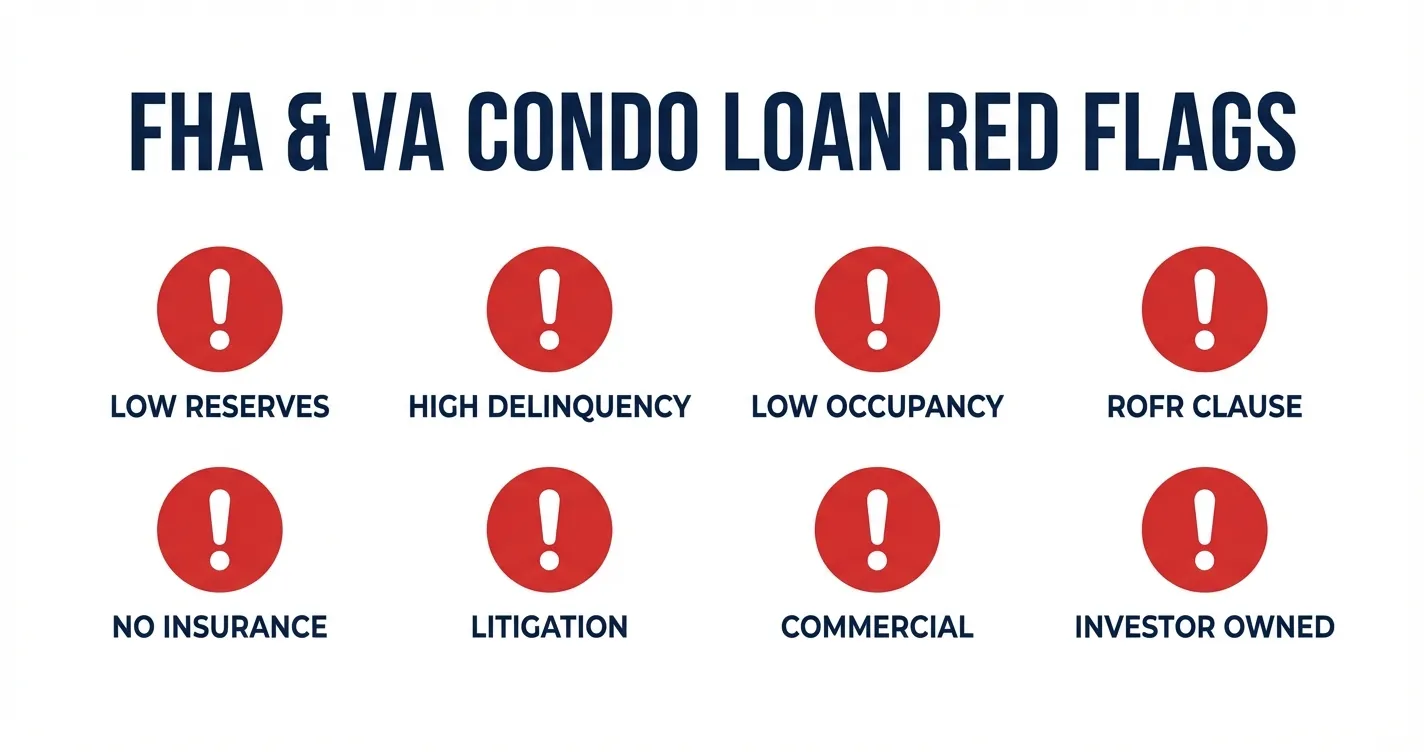
As of 2019, only 6.5% of US condos had full FHA project approval. Eight specific HOA document red flags cause most government loan denials: low reserves, high delinquency, low owner-occupancy, right of first refusal clauses, insurance gaps, active litigation, excessive commercial space, and single-entity ownership concentration.
Most of these red flags trace back to the Warrantability Checklist: the six Fannie Mae criteria that govern conventional financing. FHA and VA layer their own rules on top (notably owner occupancy, which Fannie does not check), but if a building fails the Warrantability Checklist it almost certainly fails FHA and VA too. Run the GoverningDocs 5-Number HOA Health Check on the documents before your buyer makes an offer; the result feeds the GoverningDocs HOA Health Grade and surfaces the financing-killing red flags in the first hour of review.
How do FHA and VA rules differ from the Fannie Mae Warrantability Checklist?
FHA adds owner-occupancy minimums that Fannie Mae does not enforce. Per HUD Handbook 4000.1 §II.C.2, FHA requires 50% owner occupancy, reducible to 35% for older projects with low delinquency, and 75% for 2-4 unit projects. VA does not publish a hard delinquency cap the way Fannie does (Fannie's is 15% per Selling Guide B4-2.2-01), but VA reviewers flag high delinquency, active litigation, and right-of-first-refusal clauses during project approval and routinely deny on those grounds.
What stays consistent across all three: reserve funding, master insurance adequacy, single-entity ownership concentration, and commercial-space ratios. If those four pass, you've cleared most of the conventional and government-loan eligibility bar in one check.
Your buyer found the perfect condo. They're pre-approved for an FHA or VA loan. The offer gets accepted. Then the lender pulls the HOA documents and everything falls apart.
The building isn't approved. The reserves are too low. The delinquency rate is too high. The CC&Rs have a right of first refusal clause that automatically disqualifies VA financing. Three weeks of due diligence, gone. Your buyer either walks away or scrambles for a portfolio loan at 20% down.
This happens constantly. According to HUD, only about 6.5% of the more than 150,000 condo projects nationwide had active FHA approval as of 2019. That meant roughly 93.5% of US condos lacked FHA project approval at that time (Single Unit Approval, introduced the same year, has since expanded access for individual units). The problem isn't just paperwork. It's what the documents reveal about the building's financial health, governance, and legal structure. Here are the eight red flags that kill deals before closing.
Why Most Condos Can't Get FHA or VA Loans
Most condo associations never apply for government loan approval, and those that do often fail the financial requirements.
FHA and VA loans aren't just about the borrower. The building itself must meet a separate set of requirements. FHA requires either full project approval or individual Single Unit Approval (SUA). VA requires full project approval with no single-unit alternative.
FHA condo lending dropped from 8.4% of all FHA loans in 2001 to just 2.1% by 2018, according to HUD Cityscape research. Even after HUD restored single-unit approvals in October 2019 to expand access, the vast majority of condo buildings remain outside the system.
The reasons stack up. Many HOA boards never bother applying. FHA approval lasts only three years (24 CFR 203.43b) and requires recertification. Some buildings simply can't pass the financial thresholds. And VA runs its own review with its own requirements around lease restrictions and lien priority, so a building can pass FHA and still fail VA.
For agents, this creates a recurring problem. Your buyer qualifies for the loan. The building does not. Understanding which HOA financial health indicators to check before writing an offer saves weeks of wasted effort.
FHA vs VA: What Each Program Requires
FHA and VA overlap on reserves and delinquency but diverge sharply on spot approvals, lease restrictions, and lien priority.
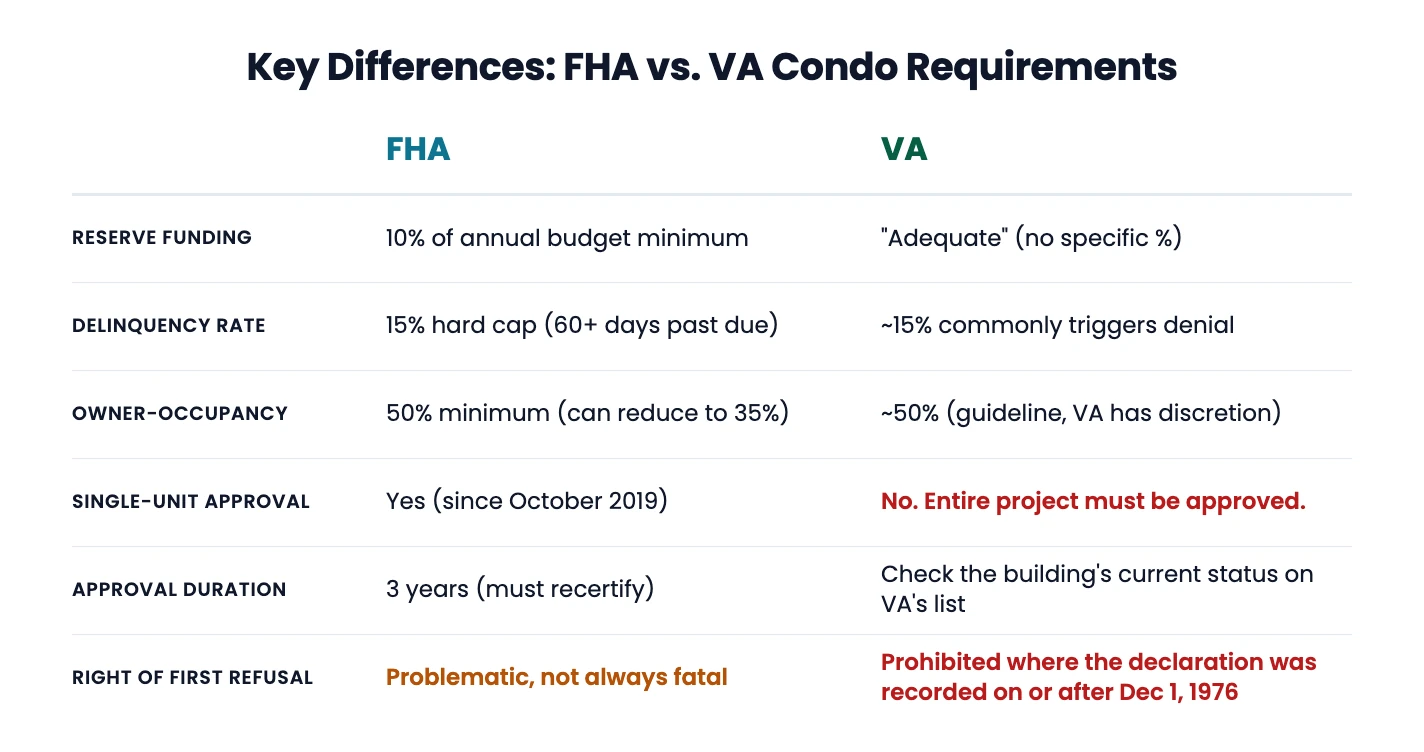
Both programs evaluate the same HOA documents, but they weigh different factors. Here's a side-by-side comparison based on HUD 4000.1 (FHA) and 38 CFR 36.4362 (VA):
| Requirement | FHA | VA |
|---|---|---|
| Owner-occupancy | 50% minimum (can reduce to 35% if project is 12+ months old and <10% delinquent) | ~50% (guideline, VA has discretion) |
| Delinquency rate | 15% hard cap (60+ days past due) | ~15% commonly triggers denial |
| Reserve funding | 10% of annual budget minimum | "Adequate" (no specific %) |
| Commercial space | 35% max of total floor area (exceptions to 49%) | Must be "primarily residential"; lenders commonly apply 25% overlay |
| Single-entity ownership | 10% max (projects with 20+ units) | 10% max |
| Right of first refusal | Problematic, not always fatal | Prohibited where the declaration was recorded on or after Dec 1, 1976 |
| Super-lien clauses | Problematic | Deal killer (lien must be subordinate) |
| Rental restrictions | Must allow leasing | Stricter: no leasing restrictions beyond a minimum lease term of up to 1 year (plus narrow age-restriction limits) |
| Approval duration | 3 years (must recertify) | Check the building's current status on VA's list |
| Spot/single-unit approval | Yes (since October 2019) | No. Entire project must be approved. |
| Insurance concentration | Max 50% of units with FHA mortgages (full approval); 10% for SUA | N/A |
The biggest difference: FHA offers a Single Unit Approval (SUA) path that lets individual units qualify even if the full project isn't approved. VA has no equivalent. If the building isn't on the VA approved condo list, the lender has to submit the whole project to VA and get it accepted before the loan can close. The unit can't be approved on its own.
The 8 HOA Document Red Flags That Kill Government Loans
Eight issues in CC&Rs, reserve studies, budgets, and insurance declarations can each independently block FHA or VA approval.
1. Reserve Funding Below 10%
The requirement: FHA mandates that at least 10% of total annual budgeted assessment income goes to the reserve fund, per HUD Handbook 4000.1. VA requires "adequate" reserves without specifying a number, but lenders interpreting VA guidelines commonly use a similar threshold.
Where to find it: The annual operating budget shows the reserve allocation as a line item. The reserve study shows the percent funded level. Both matter. A building could contribute 10% of its budget but still be critically underfunded if it deferred contributions for years.
What happens if it fails: FHA project approval and SUA both use 10% as the default. A building can budget less only if a current reserve study says the lower figure is still adequate, and most boards have never had that study done, so treat 10% as the floor. Fannie Mae and Freddie Mac are raising their threshold to 15% on January 4, 2027, which means buildings barely clearing 10% today will soon fail conventional lending standards too.
A March 2020 reserve study found Champlain Towers South in Surfside, Florida only 6.9% funded, about fifteen months before it collapsed. That building would have failed every government lending standard in place. Buildings with artificially low HOA fees are the most likely to fall short on reserves.
2. Delinquency Rate Above 15%
The requirement: HUD 4000.1 sets a hard cap: no more than 15% of units can be 60+ days delinquent on assessments. For VA, 15% is not a bright-line regulatory rule, but lenders commonly treat it as the threshold that triggers denial.
Where to find it: The HOA's financial statements or the lender questionnaire (HUD Form 9991 for FHA, Fannie Mae Form 1076 for conventional). Some associations bury this number. If the board won't provide an aging report of receivables, that's a red flag in itself.
What happens if it fails: Automatic denial for FHA project approval and SUA. Our analysis found 1,438 Florida buildings crossed the 15% delinquency threshold in 2024. High delinquency signals that the association can't collect enough revenue to maintain the building, which cascades into deferred maintenance, insurance lapses, and further decline.
3. Owner-Occupancy Below 50%
The requirement: FHA requires at least 50% of units to be owner-occupied (with a possible reduction to 35% if the project is 12+ months old and less than 10% of units are in arrears), per HUD Handbook 4000.1. VA uses a similar ~50% guideline, though it has more discretion.
Where to find it: The lender questionnaire asks directly. You can also cross-reference property records with the unit registry. Buildings in vacation markets, resort areas, and investor-heavy neighborhoods are the most likely to fail.
What happens if it fails: FHA denies project approval. SUA also requires 50% (or 35% with the same qualifying conditions). This is one of the most common failures in markets like South Florida, Las Vegas, and resort areas where rental and investment units dominate the building. A building with 60% investor-owned units is effectively locked out of government financing.
4. Right of First Refusal Clauses
The requirement: 38 CFR 36.4362 says a unit owner's right to sell "shall not be subject to any right of first refusal or similar restriction" if the declaration was recorded on or after December 1, 1976. VA applies this to the project, so one clause in the declaration blocks VA financing for every unit in the building.
Where to find it: The CC&Rs. Look for language giving the HOA board the right to match any purchase offer, approve buyers, or block sales. Declarations recorded before December 1, 1976 are held to a separate test in the same regulation.
What happens if it fails: VA won't accept the project while the clause stands. The fix is a CC&R amendment removing it, which needs an owner vote at whatever threshold the declaration sets. Read the amendment section before assuming that can happen before closing. FHA is more lenient on right of first refusal but may still flag it during review.
Get Your CC&Rs Analyzed
Upload your HOA's CC&Rs and get instant analysis of rental restrictions, pet policies, financing red flags, and more. Free. No signup required.
Your first full property report is also free. See what you'll get →
Or get your first full report free →5. Insufficient Insurance Coverage
The requirement: FHA requires a master hazard insurance policy covering 100% of replacement cost, general liability of at least $1 million per occurrence, and a fidelity bond equal to three months of aggregate assessments plus reserves for projects with more than 20 units, per HUD Handbook 4000.1. VA also requires fidelity bond coverage for projects of that size, though the VA does not specify the same formula in federal regulations.
Where to find it: Insurance declarations pages, which are separate from the CC&Rs. Request the current certificate of insurance, not last year's. Also check the budget for the insurance line item. If insurance costs dropped significantly, the board may have reduced coverage to save money.
What happens if it fails: Any insurance gap blocks approval. Flood insurance is also required if the building is in a FEMA flood zone. After the Surfside collapse, many Florida condo insurance premiums doubled or tripled. Some associations responded by cutting coverage below required thresholds rather than passing the costs to owners.
6. Active Litigation
The requirement: Both FHA and VA require disclosure of pending litigation. FHA evaluates whether the lawsuit threatens the project's financial stability, physical condition, or safety. Construction defect suits, personal injury claims, and disputes that could result in judgments exceeding insurance coverage are all red flags.
Where to find it: The lender questionnaire includes a litigation disclosure section. Board meeting minutes also reference ongoing legal matters. Check for legal expense line items in the budget that seem disproportionate to the building's size.
What happens if it fails: FHA and VA underwriters evaluate litigation on a case-by-case basis. A slip-and-fall claim within insurance limits probably won't block approval. A $10 million construction defect lawsuit on a 50-unit building will. The concern is that a large judgment could deplete reserves or trigger a massive special assessment.
7. Too Much Commercial Space
The requirement: FHA allows up to 35% of total floor area for commercial use (with exceptions to 49% in certain cases), per HUD Handbook 4000.1. VA requires the project to be "primarily residential" but does not specify an exact percentage. Most VA lenders apply a 25% maximum as an overlay.
Where to find it: The CC&Rs define the project's unit breakdown and permitted uses. The site plan or condo plat map shows floor area allocation. Mixed-use buildings with ground-floor retail, restaurants, or office space are the ones to watch.
What happens if it fails: A building with 30% commercial space passes FHA but may fail VA lender guidelines. A building at 40% is over FHA's 35% standard and can pass only through FHA's exception, which allows up to 49% when the building still reads as residential, starting with a certified appraiser's opinion on that point. This is particularly common in urban mixed-use developments where developers dedicate multiple floors to retail or office tenants. The commercial income may benefit the HOA budget, but above 35% it puts government financing in question, and above 49% FHA is off the table. If the building is over 35%, ask the lender before you go under contract whether it will pursue the exception and how its VA underwriter treats mixed-use buildings.
8. Single-Entity Ownership Above 10%
The requirement: Both FHA and VA prohibit any single entity from owning more than 10% of the total units (FHA applies this to projects with 20+ units, per HUD Handbook 4000.1). This includes the developer, an investor, a corporation, or any related entities.
Where to find it: The lender questionnaire and the HOA's unit registry. In newer buildings where the developer hasn't sold out, this is especially common. An 80-unit building where the developer still holds 12 unsold units (15%) fails both FHA and VA.
What happens if it fails: Denial until ownership concentration drops below 10%. In practice, this means waiting for the developer to sell more units. For condo financing purposes, this is a timing issue that resolves as the building sells out, but it can block deals for months or years in slow markets.
VA-Specific Deal Killers Most Agents Miss
VA has four unique deal killers most agents miss: ROFR ban, lien subordination, lease restriction limits, and no spot approval.
VA loans carry specific requirements that trip up even experienced agents. These four issues are unique to VA and cause the most denials:
Right of First Refusal (ROFR) Ban
Under 38 CFR 36.4362, a VA-financed condo "shall not be subject to any right of first refusal." This applies where the declaration was recorded on or after December 1, 1976. Most US condo associations include some form of ROFR in their governing documents. It's the most common reason condos fail VA approval, and many boards don't even realize it's a problem.
Super-Lien Prohibition
The VA mortgage must hold first lien position. Any HOA super-lien clause that gives assessment liens priority over the mortgage is a deal killer. Several states, including Florida, Colorado, and Nevada, grant HOAs a statutory super-lien that takes priority for a certain number of months of unpaid assessments. Buildings in these states face an uphill battle for VA approval even if the CC&Rs don't explicitly create a super-lien.
Lease Restriction Limits
VA expects the HOA to let owners lease their units, and the rule is stricter than most buyers expect. Like the right-of-first-refusal and lien-priority rules above, it is written into 38 CFR 36.4362: there can be no prohibition or restriction on an owner's right to lease, except a minimum initial lease term of up to one year, and certain age restrictions or limits set by state or local housing authorities. Three common clauses fall outside those exceptions: "seasoning" requirements that make the owner live in the unit for a year or two before renting, board approval of individual tenants, and board screening of lessees. Treat any of them as something that can block VA approval. This matters for military families who face PCS (Permanent Change of Station) orders and may need to rent their unit on short notice. Pull the leasing article of the CC&Rs and any rental rule the board has adopted, and ask your lender to run the exact language past its VA underwriter before you go under contract. A building that bans rentals will not get VA approval.
No Spot Approval Fallback
FHA restored Single Unit Approval (SUA) in October 2019, giving buyers a path even when the full project isn't approved. VA has no equivalent: the VA Lender's Handbook says VA "does not perform 'spot' approvals of individual condominium units." If the building is not on the VA approved condo list, the lender can submit the project to VA for review, but the whole building has to be accepted before the loan can close. That makes VA approval an all-or-nothing proposition for the building. Check the VA's lookup tool before writing an offer, and if the building isn't listed, ask the lender how long a project submission is taking.
What You Can Do If the Building Fails
FHA Single Unit Approval, portfolio loans, CC&R amendments, and VA waivers are options, but each has cost-time-success tradeoffs.
A failed building doesn't always mean a dead deal. Here are the workarounds, ranked by practicality:
| Workaround | How It Works | Tradeoff |
|---|---|---|
| FHA Single Unit Approval | Lender submits HUD Form 9991 for the individual unit | Core requirements still apply (50% occupancy, or 35% with qualifying conditions, 10% reserves, no major litigation). FHA concentration limited to 10% of units (or max 2 for <10-unit projects) per HUD 4000.1. |
| Portfolio loan | Lender keeps the loan on its books instead of selling to GSEs | 20-25% down payment required. Higher interest rates. |
| HOA applies for approval | Board proactively files for FHA (3-year) or VA approval | Requires board cooperation. Many boards don't bother. Takes weeks to months. |
| CC&R amendment | Remove the blocking clause (ROFR, rental ban, super-lien) | Needs an owner vote at the threshold the declaration sets. Politically difficult. |
| VA waiver request | Request exception for ROFR or lease restriction issues | Not guaranteed. Limited documentation on success rates. |
| Non-QM lender | Specialty lender outside qualified mortgage rules | 20-25% down. Rates 2-4% higher than conventional. Last resort. |
The most practical path for FHA buyers is Single Unit Approval. It bypasses the need for full project approval, but the core financial requirements (reserves, delinquency, occupancy) still apply. If the building fails on those fundamentals, SUA won't help.
For VA buyers, the options narrow significantly. There is no spot approval. If the building is not VA-approved and the HOA won't apply or amend its documents, the only paths forward are portfolio loans or Non-QM lenders. Both require substantially more money down and higher rates, which defeats the purpose of using a VA loan.
If FHA and VA both fall through, conventional financing is the usual next stop, and that path narrowed on August 3, 2026. Fannie Mae retired the Limited Review process under Lender Letter LL-2026-03 (as summarized by CAI), and Freddie Mac retired its Streamlined Review counterpart the same day under Guide Bulletin 2026-C. Limited Review had accounted for roughly 40% of condo project reviews, and it asked for less association documentation and less financial scrutiny than the alternative. Conventional condo purchases now require either a Full Review or a qualifying Waiver of Project Review. The trigger is the loan application date, not the closing date, so a file dated before August 3 can still close afterward under the old path. For a building that failed FHA or VA on reserves, delinquency, or litigation, this matters, because a Full Review examines those same numbers. For the full picture of what changed, see the 2026 Fannie Mae and Freddie Mac condo rules. Ask the lender which review path the file is going down before you treat conventional as the easier option.
The best approach is catching these issues before writing an offer. Check the VA condo lookup tool for VA loans. For FHA, request the HOA's financials and CC&Rs early and review them for the eight red flags above. You can upload documents to GoverningDocs' free CC&R analysis tool to flag issues automatically before your buyer gets invested.
Frequently Asked Questions
Can I get an FHA loan on a condo that isn't FHA-approved?
Yes, through Single Unit Approval (SUA). Since October 2019, lenders can submit HUD Form 9991 to approve individual units even when the full project lacks FHA approval. However, the building must still meet core requirements: 50% owner-occupancy (or 35% with qualifying conditions), 10% reserve funding, below 15% delinquency, and no disqualifying litigation. FHA concentration is limited to 10% of units (or max 2 units in projects with fewer than 10 units) under SUA, per HUD 4000.1.
How do I check if a condo is VA-approved?
Use the VA Condo Lookup Tool at lgy.va.gov. Search by state, city, or project name. If the building does not appear, it is not VA-approved and the buyer cannot use a VA loan. Unlike FHA, VA has no single-unit approval option.
What is a right of first refusal, and why does it kill VA loans?
A right of first refusal (ROFR) gives the HOA board the right to match any purchase offer or approve buyers before a sale closes. Under 38 CFR 36.4362, a unit owner's right to sell "shall not be subject to any right of first refusal or similar restriction" where the declaration was recorded on or after December 1, 1976. VA won't accept a condo project whose documents carry one, and it does not approve individual units separately, so the clause blocks VA financing for the whole building. Removing it takes a CC&R amendment at whatever vote threshold the declaration sets.
What is the FHA reserve requirement for condos?
FHA requires at least 10% of total annual budgeted assessment income to be allocated toward reserves per HUD 4000.1. This applies to both full project approval and Single Unit Approval. Note that Fannie Mae and Freddie Mac are raising their conventional loan threshold to 15% effective January 4, 2027.
Is conventional financing an easier fallback if FHA or VA won't work?
Less often than it used to be. Fannie Mae retired the Limited Review process for loan applications dated on or after August 3, 2026, and Freddie Mac retired Streamlined Review the same day. Limited Review had been roughly 40% of condo project reviews and required less association documentation. Conventional condo purchases now need either a Full Review or a qualifying Waiver of Project Review, and a Full Review examines the same reserves, delinquency, and litigation that caused the FHA or VA denial. Applications dated before August 3, 2026 can still close under the old path.
Can the HOA block a veteran from buying a condo?
Indirectly, yes. If the HOA board refuses to apply for VA approval or won't amend CC&Rs that contain disqualifying clauses like ROFR or rental bans, the building remains ineligible for VA financing. The veteran can still purchase with a conventional or portfolio loan, but loses VA benefits including the zero-down-payment advantage. Since August 3, 2026, that conventional route also requires a Full Review or a qualifying Waiver of Project Review, which applies the same financial tests to the building.
How long does FHA condo approval last?
FHA project approval is valid for three years. The HOA must recertify before the approval expires. If it lapses, new FHA buyers cannot close until the recertification is complete. For VA, check the building's current status on VA's condo list before writing an offer.
Check your building before writing an offer
Upload CC&Rs or reserve studies and get an instant analysis of FHA/VA red flags. Built on insights from 1,900+ HOA documents analyzed.
Related Articles
- HOA Financial Health Guide: The Complete Assessment
- Condo Financing and HOA Documents: What Lenders Check
- Non-Warrantable Condo: What It Means for Buyers
- HOA Delinquency Rate: The Number That Can Kill Your Condo Purchase
- Fannie Mae and Freddie Mac Condo Rules: What Changed in 2026
- Are Low HOA Fees a Red Flag?
Sources & References
- HUD 4000.1 (FHA Single Family Housing Policy Handbook) (FHA condo approval requirements, reserve minimums, delinquency thresholds)
- 24 CFR 203.43b (FHA Condominium Project Approval) (project approval valid for 3 years; recertification window)
- 38 CFR 36.4362 (VA Condo Regulations) (VA lien subordination, ROFR prohibition, leasing restrictions, condo project requirements)
- CNN: Surfside condo association was deeply underfunded (Champlain Towers South 6.9% funded, March 2020 reserve study)
- VA Pamphlet 26-7, Chapter 11, Topic 12 (Condominiums) (no spot approvals of individual units; lender submission of a project VA has not reviewed)
- Fannie Mae Selling Guide B4-2.2-01, Full Review Process (15% delinquency cap and reserve requirements)
- CAI Advocacy, Fannie Mae and Freddie Mac policy update (March 18, 2026) (Lender Letter LL-2026-03: Limited Review eliminated for applications dated on or after August 3, 2026; roughly 40% of project reviews)
- Freddie Mac Guide Bulletin 2026-C (Streamlined Review retired the same day)
- VA Condo Lookup Tool (lgy.va.gov) (search VA-approved condo projects)
- HUD Press Release PR19-121 (only 6.5% of the more than 150,000 US condo projects had FHA approval)
- National Association of Realtors analysis of FHA condo approval impact (article withdrawn by NAR; no live copy located)
- HUD Cityscape Vol. 22 No. 1 (FHA condo lending declined from 8.4% to 2.1% of FHA loans, 2001-2018)
- CAI Advocacy Blog (Fannie/Freddie reserve requirement increase to 15%, effective Jan 4, 2027)
Disclaimer: This article is for educational purposes only and does not constitute legal, financial, or real estate advice. FHA and VA condo approval requirements are subject to change. Consult a qualified mortgage lender or real estate attorney for guidance specific to your situation. GoverningDocs is not affiliated with HUD, the VA, Fannie Mae, or Freddie Mac.