
In This Guide
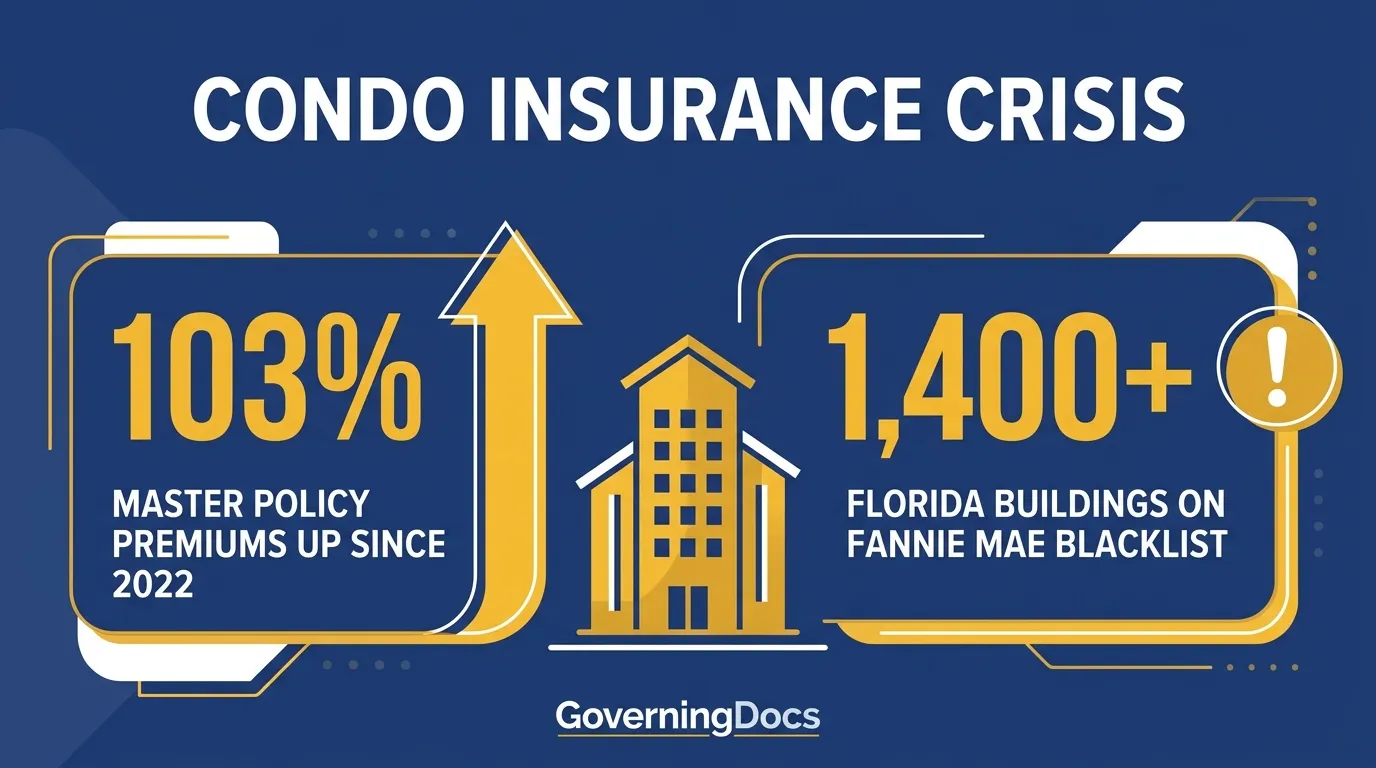
Florida condo master policy costs doubled from 2022 to 2024, and as of April 2025 more than 1,400 Florida buildings were on Fannie Mae's financing blacklist. If a building's insurance falls below Fannie/Freddie standards, buyers can't get a conventional loan, the pool of buyers shrinks, and prices tend to follow. Here's what to check before you offer.
Master insurance is metric #5 in The GoverningDocs 5-Number HOA Health Check and one of the six criteria in the Warrantability Checklist. That's why an insurance failure flips a building non-warrantable: the same policy weakness shows up in both frameworks, and Fannie Mae Lender Letter LL-2026-03 phases in changes starting Jul 1, 2026, loosening some rules and adding others. The composite verdict shows up as the GoverningDocs HOA Health Grade on every property report.
What does "insurance sufficient" actually mean for warrantability?
Three things, all set by Fannie Mae LL-2026-03 (March 2026) and Selling Guide B7-3-03. First, replacement-cost coverage on the building, meaning the policy pays what it costs to rebuild rather than the depreciated "actual cash value" (ACV). Roofs alone may be covered at ACV as of Mar 18, 2026; ACV on the building itself makes it non-warrantable. Second, if the policy has a per-unit deductible (one charged separately for each damaged unit, rather than once for the whole building), it must be at or below $50,000, effective for loan applications dated on or after July 1, 2026 (deductibles above that cap are now non-warrantable). Third, an HO-6 unit-owners policy required when the master has a per-unit deductible.
Buildings whose deductible is over 5% of coverage or over $50,000 per unit, that insure the building itself at actual cash value, or that use per-unit deductibles without requiring owners to carry an HO-6 policy fail this test. Fannie Mae's list of ineligible buildings, covered below, does not say why each building is on it, but insurance and reserves are the usual suspects, and the two are linked because rising premiums force associations to choose between insurance and reserve contributions.
Why Insurance Now Decides Your Loan
A condo's master insurance policy used to be a line item. In 2026, it's a common reason conventional financing gets denied.
You find a condo that works. Price is right. The HOA dues look reasonable. Your lender pulls the condo project questionnaire from the HOA and the file comes back with one flag: master policy deductible exceeds 5% of coverage. The loan is killed. Not because of your credit. Not because of the appraisal. Because the building's insurance doesn't meet Fannie Mae's requirements.
This is happening regularly in Florida, California, and Colorado. According to The Real Deal, citing Miami Herald reporting on data compiled by the law firm Allcock Marcus, 1,438 Florida condo buildings were on Fannie Mae's list of ineligible projects as of April 2025, with roughly half clustered in Miami-Dade, Broward, and Palm Beach. Some are likely there because of insurance. Once a building is blacklisted, buyers need cash or a non-QM loan with a larger down payment. The buyer pool collapses. Prices follow. Florida's median condo sale price fell 8.1% year-over-year in August 2025, per Realtor.com, and a South Florida realtor quoted by Domex Labs estimates the region's condo valuations are down roughly 27%.
The premium spike is the visible part of the crisis. The invisible part is what happens to financing when a building's coverage no longer meets the rules. This guide walks through both, what federal regulators changed in March 2026, and what to actually verify in the documents before you make an offer.
The Premium Spike: 2024–2026 Data
In Florida, condo master policy costs roughly doubled from 2022 to 2024. Florida is the sharpest case, but premiums are climbing wherever climate risk is concentrated.
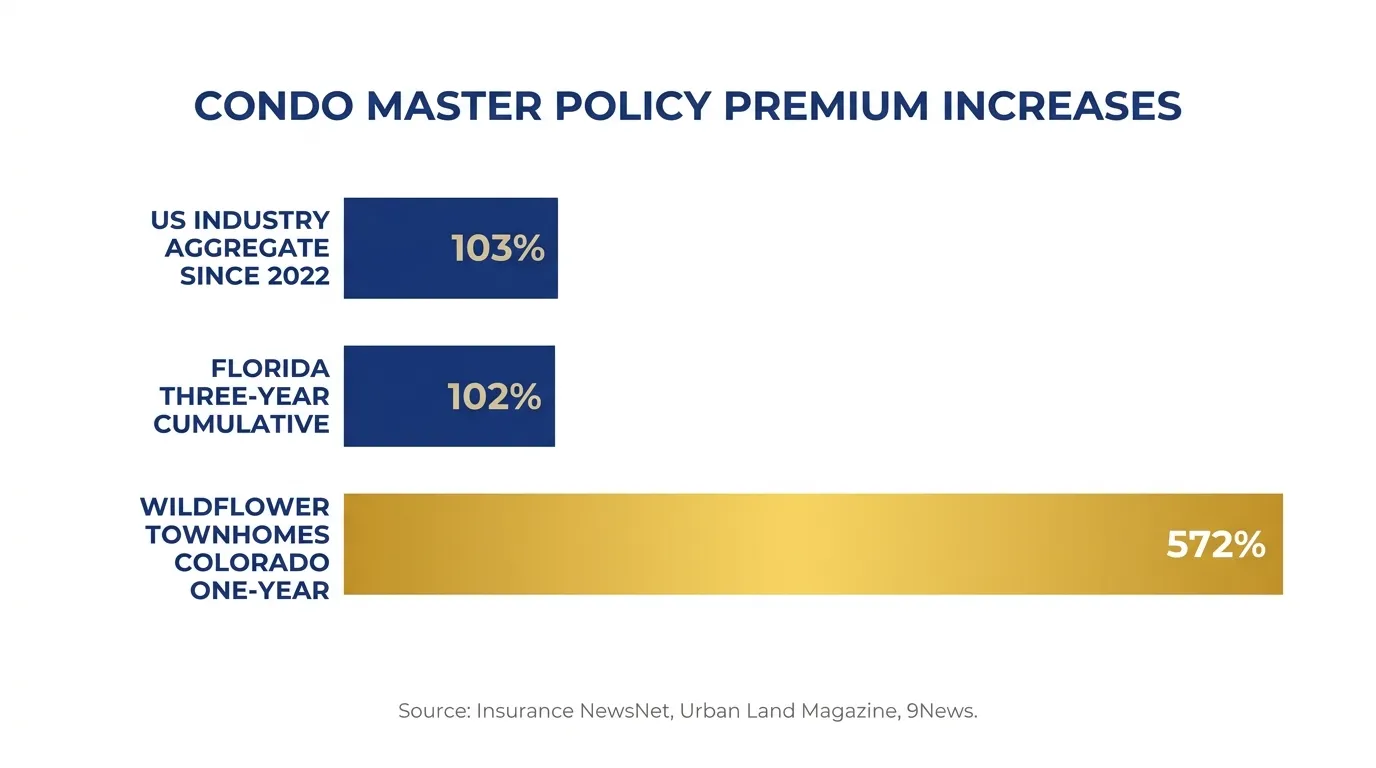
A Sun Sentinel analysis of Florida Office of Insurance Regulation data, reported by Insurance NewsNet, shows Florida condo association master policy costs doubled from mid-2022 to mid-2024, up 103% (from an average of $72,570 to $147,381). Sample 2024 renewals ran 11% to 31% higher for condo associations and up to 54% higher for HOAs, per Connie Phillips Insurance.
Florida
Florida is the extreme case. Urban Land Magazine, citing the Insurance Information Institute, reported in August 2024 that the insurance rates squeezing Florida condo owners had risen 102% over the previous three years. The unit-owner side of the ledger is just as stark: Florida HO-6 premiums rose from about $1,100 in 2020 to roughly $2,000 by the end of 2024, with Miami-Dade averaging $2,300, per WLRN, reporting data from Florida International University's Jorge M. Perez Metropolitan Center.
The good news: 2025 brought stabilization. Condo association premiums fell for three straight quarters through early 2025, by 3.0%, 2.5%, and then 5.3%, per Insurance NewsNet. Average costs for condo unit coverage rose only 1.3% from January to September 2025, and insurers filed 73 rate decreases and 94 no-change filings after hurricanes Helene and Milton, according to the Office of Insurance Regulation, per Sun Sentinel reporting republished by Florida Realtors. Florida Peninsula filed for an average 12% cut for condo unit owners, which the company called the largest rate reduction in its 20-year history; subject to state approval, it expected most policyholders to see lower premiums in late 2025 or early 2026.
Outside Florida
Colorado associations have reported sharp premium increases. The Wildflower townhome community's annual master premium jumped from $65,000 in June 2022 to $437,000 in June 2023, per a 9News report. In California, State Farm received approval in May 2025 for a 17% interim increase on its homeowners line (it had asked for 21.8%), on condition that its parent company put in $400 million, per the California Department of Insurance. The same order barred State Farm from starting new mass non-renewals, where an insurer drops whole groups of existing customers, through the end of 2025.
Ask the listing agent for the master policy's renewal date and its premium for each of the last three years. A building whose premium jumped at its last renewal is more likely to be facing a special assessment or a dues increase.
Why Carriers Are Leaving
At least 10 carriers have left or scaled back in Florida, and major national carriers have stopped writing new policies in California. The carriers that remain charge more and exclude more.
In Florida, Farmers, FedNat, Southern Fidelity, United Insurance Holdings, and others have left the market, scaled back, or gone insolvent, per Insurance.com. That concentrated coverage in state-backed Citizens Property Insurance, which peaked at 1.42 million policies in October 2023. Citizens expected to be down to about 385,000 by the end of 2025 and says it is no longer Florida's largest property insurer, per Citizens. Total exposure dropped sharply.
That's the recovery story. But the buildings those policies moved to are private carriers that price strictly, exclude wind in some coastal zones, and can drop coverage at renewal. Florida's 2022–2024 insurance reforms are drawing new carriers into the state, per Storm Smart. Some will write master policies. Some won't touch them.
California's story is different. Allstate paused new homeowner policies there in November 2022, according to the California Department of Insurance as reported by ABC10, and State Farm stopped taking new homeowner applications in May 2023, per State Farm. Governor Newsom's emergency declaration on January 7, 2025 triggered a one-year non-renewal moratorium in LA County wildfire ZIPs, per the California Department of Insurance. Commissioner Lara's Sustainable Insurance Strategy now lets carriers use catastrophe modeling and reinsurance costs in rate-setting in exchange for writing in distressed ZIPs. Those rates, when approved, will be higher.
Ask who writes the building's master policy, whether it is Citizens or a private carrier, and whether the policy has been non-renewed or moved to a new carrier in the last two years.
Check Your Building's Financial Health
Upload your HOA's reserve study and get instant analysis of percent funded, deferred maintenance, and special assessment risk. Free. No signup required.
Your first full property report is also free. See what you'll get →
Or get your first full report free →How Fannie and Freddie Use Insurance to Block Loans
Insurance requirements are in the GSE selling guides. Miss them and the building becomes non-warrantable, which means no conventional conforming loan for any buyer in that project.
Per Fannie Mae Selling Guide B7-3-03, a condo master property policy must:
- Equal 100% of the replacement cost value (RCV) of all improvements
- Settle claims on a replacement cost basis, not actual cash value (ACV); since March 2026, roofs are the one exception
- Carry a deductible no greater than 5% of the master policy coverage amount. If the policy has a separate deductible for wind or wildfire, that one has to meet the limit too
- If the policy uses a per-unit deductible, keep it at or below $50,000 per unit. Both limits apply, and each owner then needs their own unit-owner (HO-6) policy
- Document the RCV through an appraisal or comparable evidence acceptable to the lender
Miss any of those and the project fails the lender's project review. The building is flagged non-warrantable. The buyer's only options are cash, a portfolio loan from a local bank, or a non-QM loan with a higher down payment and higher rates, per BCP Mortgage. The buyer pool shrinks. The value drops.
We have not found a reliable published figure for how much less a unit in a non-warrantable Florida building sells for than one in a comparable building that still qualifies. The direction is not in doubt. Urban Land Magazine reported in August 2024 that Florida condo prices were down about 12% from their 2022 peak, and quoted a Miami Lakes town attorney saying that once a building is known as cash-only, "the prices of units have crashed." Ask the listing agent for recent sales in the same building and compare them with a similar nearby building that still qualifies for conventional loans.
The Coverage Gaps That Kill Deals
The master policy's declarations page often looks fine. The gaps are in the deductibles, the hurricane endorsement, and what the policy explicitly excludes.
Hurricane and Named-Storm Deductibles
Find the hurricane or named-storm deductible on the master policy's declarations page. For a condo association's policy, Florida law lets an insurer offer a hurricane deductible as high as 10% of the building's insured value, as long as it also offers a 3% option (Fla. Stat. §627.701(8)). The $500, 2%, 5%, and 10% choices in the same law are for an owner's own home or unit policy, not the association's. Fannie Mae's limit is tighter: each deductible on the master policy, wind included, can be no more than 5% of coverage. An $80 million building at 5% means a $4 million deductible per event before coverage pays a dollar. A $10 million building at 2–5% means $200K to $500K out of pocket first. Master policy deductibles often run past $100,000, and the association splits that bill among owners as a loss assessment, per Mitchell Joseph.
Loss Assessment Gaps on the Unit-Owner Side
Standard HO-6 unit-owner policies include only $1,000 of loss assessment coverage by default, per Stanton Insurance. That agency recommends at least $50,000, and limits up to $100,000 are commonly available. Most condo owners carry the default without realizing it, then face five or six-figure assessments with no coverage.
"Bare Walls-In" Master Policies
Many master policies now insure only the structural framing, leaving drywall, flooring, cabinets, and fixtures as the owner's responsibility. Buyers reading the declarations page see impressive-looking dwelling limits and assume they're protected. Check the CC&Rs or condominium declaration for the precise coverage boundary, then match the HO-6 walls-in coverage to it.
What the March 2026 FHFA Changes Actually Do
The Federal Housing Finance Agency eased some insurance requirements in March 2026. The easing helps at the margin. It doesn't solve the problem.
On March 18, 2026, the FHFA announced that Fannie Mae and Freddie Mac were easing some insurance rules. Fannie Mae spelled out the details in Lender Letter LL-2026-03. Three of them affect a condo building's master policy:
- Actual cash value permitted for roofs only on single-family and condo buildings, instead of replacement cost
- A $50,000 per-unit deductible cap for master policies that use a per-unit deductible. Both limits apply: the 5%-of-coverage cap and this one. Lenders must apply it to loan applications dated on or after July 1, 2026
- The requirement that the master policy carry inflation guard coverage, which raises the coverage amount automatically over time, is retired
Two additional changes matter for condo buyers in 2026. The Limited Review process, which allowed streamlined condo approval for low-LTV loans on established projects, is retired on August 3, 2026 for loan applications dated on or after that day, per Fannie Mae Lender Letter LL-2026-03. The same letter raises the minimum an association must budget for reserves from 10% to 15% of its yearly budgeted assessment income, for loan applications dated on or after January 4, 2027 (our 2026 condo rules guide walks through the rest of the letter). A building that squeaked by in 2026 can fail in 2027. Ask the listing agent for the association's current budget and check that at least 15% of its yearly assessment income goes to reserves.
What to Request Before the Offer
The declarations page alone tells you almost nothing. You need the full insurance picture plus the supporting governance documents.
Request these items from the listing agent or the HOA management company before writing an offer. If the seller pushes back, that's a signal.
- Master policy declarations page. Verify 100% RCV, replacement cost (not ACV) settlement, deductible ≤5% of coverage (and ≤$50,000 per unit if it uses a per-unit deductible), named-storm/wind deductible amount, carrier name, expiration date.
- Five-year loss runs. Prior claims show whether the building has a pattern of losses the next carrier will price punitively.
- Most recent lender questionnaire (Fannie Mae Form 1076 or Freddie Mac Form 476, one joint form) if the HOA has one on file.
- Last 12–24 months of board meeting minutes. Search the meeting minutes for: insurance, premium, deductible, non-renewal, carrier change, questionnaire, SIRS, milestone. Board discussion precedes the formal vote by months.
- Most recent reserve study. In Florida, the structural integrity reserve study (SIRS) is required for most buildings three stories and up (Fla. Stat. 718.112).
- Last two operating budgets plus the current reserve fund balance.
- Most recent audited financial statements.
- Pending litigation disclosure.
On the buyer side, your HO-6 should carry loss assessment coverage of at least $50,000, walls-in coverage matched to what the master excludes, a separate hurricane deductible where applicable, and ordinance/law coverage if the building is older. For a deeper walkthrough of the entire financial picture, see the complete guide to HOA financial health.
Frequently Asked Questions
How much have condo master insurance premiums increased?
Florida regulator data analyzed by the Sun Sentinel (reported by Insurance NewsNet) shows condo association master policy costs roughly doubled from mid-2022 to mid-2024, up 103%. Urban Land Magazine, citing the Insurance Information Institute, reported in August 2024 that the insurance rates squeezing Florida condo owners had risen 102% over the previous three years.
What are Fannie Mae's master policy insurance requirements?
Per Fannie Mae Selling Guide B7-3-03, condo master policies must provide 100% of the replacement cost value of improvements, settle claims on a replacement cost basis (not actual cash value, though roofs have been exempt since March 2026), and carry a deductible no greater than 5% of the policy coverage amount. If the policy uses a per-unit deductible, that deductible also can't exceed $50,000 per unit, a limit lenders must apply to loan applications dated on or after July 1, 2026. Both limits apply. Buildings that miss these requirements are flagged non-warrantable.
What happens if my condo building loses insurance coverage?
If a building's insurance falls below Fannie Mae or Freddie Mac standards, the project becomes non-warrantable. Buyers can no longer use a conventional conforming loan. Their options shrink to cash, portfolio loans from local banks, or non-QM loans with larger down payments and higher rates. A smaller buyer pool pushes prices down. Urban Land Magazine reported in August 2024 that Florida condo prices were down about 12% from their 2022 peak, and that some owners in affected buildings were selling to cash buyers at massive discounts.
How much loss assessment coverage should I have on my HO-6?
Standard HO-6 unit-owner policies include only $1,000 of loss assessment coverage by default. One insurance agency recommends at least $50,000, and limits up to $100,000 are commonly available. With a 5% deductible on an $80 million building coming to $4 million, the assessed share per unit can easily hit five or six figures after a storm.
Did the March 2026 FHFA changes solve the condo insurance problem?
No. The March 2026 changes permit actual cash value on roof coverage, set a $50,000 cap on per-unit deductibles, and retire the inflation guard requirement. Those help associations at the margin. But master policy premiums remain elevated, the Limited Review process is retired on August 3, 2026, and Fannie's minimum reserve contribution rises from 10% to 15% of budgeted assessment income for loan applications dated on or after January 4, 2027. Buildings that are borderline in 2026 can still fail in 2027.
How do I find out if a condo building is non-warrantable?
Ask the HOA management company for a completed Fannie Mae Form 1076 or Freddie Mac Form 476 condo project questionnaire. Your lender can also check Fannie Mae's Condo Project Manager for unavailable-project status. Review the master policy declarations, recent meeting minutes for insurance and reserve discussions, and the most recent reserve study before committing to an offer.
Find the insurance red flags hidden in the HOA documents
Upload the reserve study, CC&Rs, or meeting minutes and get an instant risk report: reserve funding, deductible exposure, discussions of non-renewal or carrier change, and warrantability signals. Built on analysis of 1,900+ HOA documents. No signup required.
Related Articles
Sources & References
- Fannie Mae Selling Guide B7-3-03 - Master Property Insurance Requirements - 100% RCV, 5% max deductible, $50,000 max per-unit deductible, replacement cost basis (roofs excepted)
- FHFA - Fannie Mae and Freddie Mac Remove Certain Homeowners Insurance Requirements (March 2026) - ACV roof coverage allowed, per-unit deductible rule simplified
- Fannie Mae Lender Letter LL-2026-03 - Updates to Project Standards & Property Insurance Requirements (March 18, 2026) - $50,000 per-unit deductible cap (July 1, 2026), inflation guard retired, Limited Review retired (Aug. 3, 2026), 15% reserve minimum (Jan. 4, 2027)
- ABA Banking Journal - Fannie Mae and Freddie Mac Ease Certain Property Insurance Requirements - ACV roof coverage, simplified per-unit deductible rule
- Insurance NewsNet - Condo Association Insurance Costs Doubled Since 2022 - 103% Florida condo association policy increase, mid-2022 to mid-2024 (Sun Sentinel analysis of Florida OIR data)
- Urban Land Magazine - After Surfside, Skyrocketing Insurance Premiums Strain Condo Owners - 102% three-year insurance rate increase (Insurance Information Institute figure), Florida condo prices down about 12% from the 2022 peak
- Domex Labs - When Insurance (Not Inventory) Moves the Market - A South Florida realtor's estimate of a 27% drop in condo valuations
- Realtor.com - Florida Condo Prices See Sharpest Drop in 15 Years - Florida median condo sale price down 8.1% year over year, August 2025
- The Real Deal - 700 Condo Buildings in South Florida on Secret Mortgage Blacklist (April 2025) - 1,438 Florida buildings ineligible for Fannie Mae financing (Miami Herald, Allcock Marcus data)
- WLRN - Condominium Unit Insurance (September 2025) - FL HO-6 premium $1,100 to $2,000 trajectory (FIU Metropolitan Center data)
- Citizens Property Insurance - Rate cuts press release, Dec 2025 - 1.42M policy peak (Oct 2023), about 385,000 expected by end of 2025, no longer FL's largest insurer
- California Department of Insurance - Commissioner Lara Adopts Judge's Ruling on State Farm Emergency Rates (May 2025) - 17% interim homeowners rate increase, $400 million parent company infusion
- Florida Statute §627.701 - Liability of Insureds; Coinsurance; Deductibles - Condo association policies: hurricane deductible up to 10% if a 3% option is also offered (subsection 8); $500, 2%, 5%, 10% options for personal policies (subsection 3)
- Florida Statute §627.4025 - Residential Coverage and Hurricane Coverage Defined - Classifies condo association policies as commercial residential coverage
- Stanton Insurance - What Is Loss Assessment Coverage - $1,000 default; recommends at least $50,000; limits up to $100,000
Disclaimer: This article is for educational purposes only and does not constitute legal, financial, insurance, or real estate advice. Insurance requirements, state statutes, and Fannie Mae/Freddie Mac guidelines change frequently. Consult a qualified insurance agent, lender, and real estate attorney before making decisions based on the coverage or financing situation of a specific condominium project.