
In This Guide
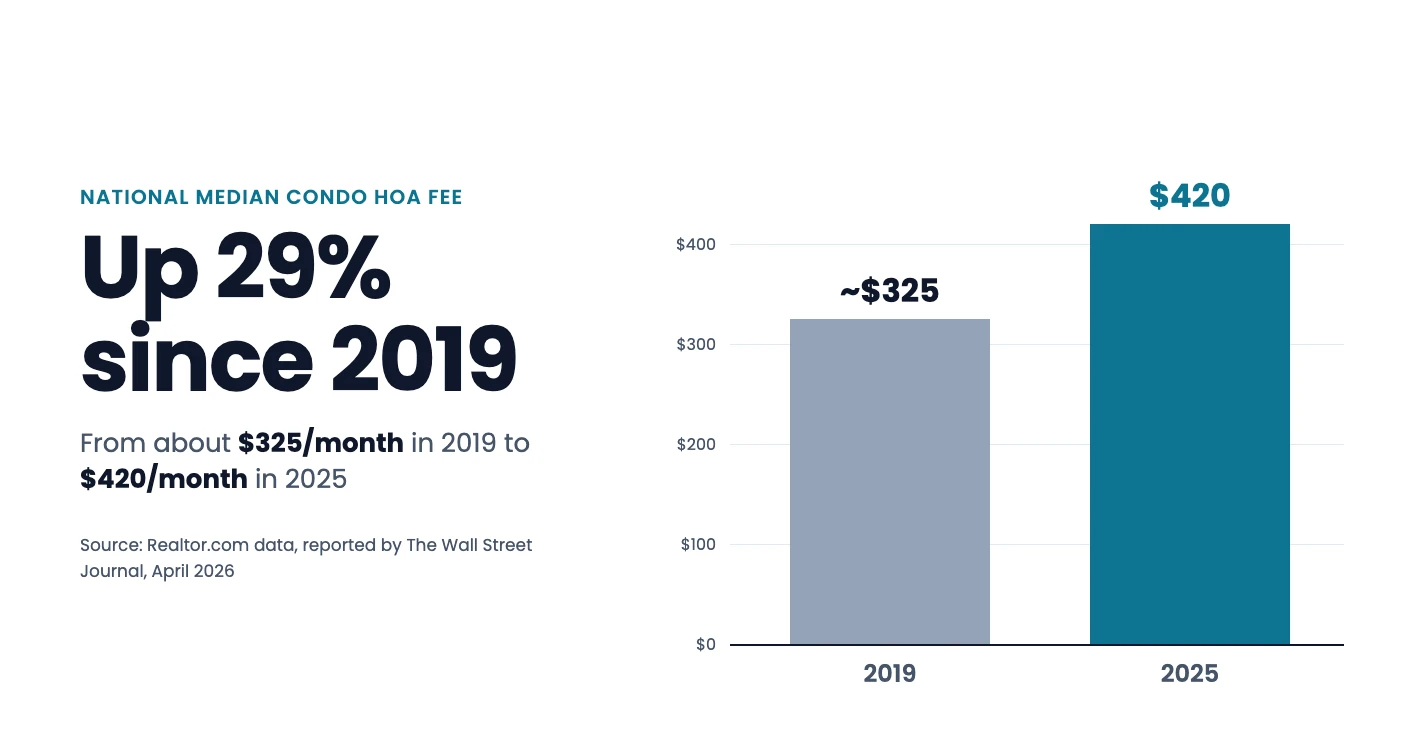
Median condo HOA fees hit $420/month in 2025, up 29% since 2019. By our estimate, every $100/month in dues cuts about $15,000 from what you can borrow. Here's what's driving the increase and what buyers must check.
HOA fee level alone isn't the signal. The structure of those fees inside the operating budget is. That structure shows up in The GoverningDocs 5-Number HOA Health Check as reserve contribution rate (#3) and connects to delinquency rate (#2) when fee jumps push owners into late status. Both are criteria in the Warrantability Checklist, so a fee structure that fails either one can flip the building non-warrantable. The composite verdict shows up as the GoverningDocs HOA Health Grade on every property report.
What does a $420/month median fee actually tell a buyer?
Almost nothing on its own. Two buildings with identical $420 fees can have opposite financial health. Building A allocates 25% to reserves and is 75% funded, so the fee is sustainable. Building B allocates 5% to reserves and is 25% funded, so the fee is too low, and a $50K+ assessment is on the horizon to catch up. The signal isn't the dollar amount. It's the contribution rate inside the budget and the resulting percent funded in the reserve study.
Per Fannie Mae Lender Letter LL-2026-03, the contribution-rate floor is rising from 10% to 15% effective January 4, 2027. Buildings that have been keeping fees artificially low by under-contributing are about to face a forced fee increase (raise contributions to 15%) or a non-warrantability flag (don't, and lose conventional financing for every unit). Either outcome shows up in the buyer's monthly cost.
The Shadow Mortgage Nobody Mentions
The national median condo HOA fee is up 29% since 2019, and in parts of Florida dues have jumped more than 16% in a single year. Most buyers still treat the fee as a footnote. Treat it as part of the mortgage.
You see the listing. The price looks right. The monthly payment looks manageable. Then you notice the HOA fee: $420 a month. That's $5,040 a year. Money you pay before the mortgage, before property taxes, before any maintenance of your own unit. It's non-negotiable, non-optional, and it can increase every year.
According to Realtor.com data reported by The Wall Street Journal in April 2026, the national median condo HOA fee reached $420 per month in 2025, up 29% since 2019. And Realtor.com's HOA report found 43.6% of 2025 listings carried HOA fees, up from 34.3% in 2019. Condo buyers in particular have no way to shop around the HOA fee the way they can shop around a mortgage rate.
That fee is a second mortgage payment with no amortization schedule and no payoff date. Over 10 years at $420/month, you will pay more than $50,000 in dues on top of your mortgage principal. And unlike a mortgage, the payment can go up without your consent.
What's Driving the Surge
The 29% increase since 2019 isn't arbitrary. Five structural forces are pushing HOA fees higher, and most of them are not going away.
1. Insurance Premiums
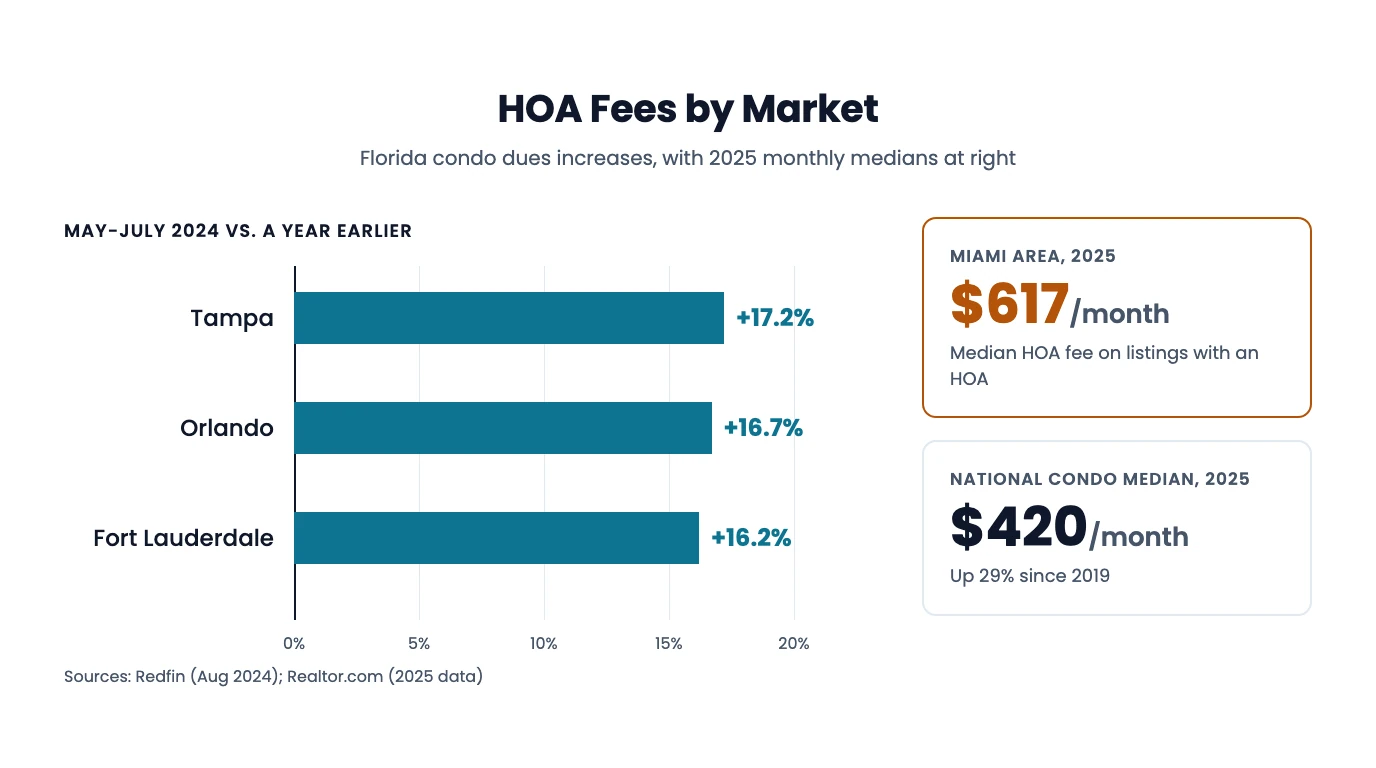
HOA master policies cover the building structure, common areas, and liability. In Florida, premiums have soared and some insurers have stopped writing policies (Redfin). When the HOA's renewal comes in 40% higher than last year, that increase gets passed directly to unit owners through higher dues. In May through July 2024, median condo HOA dues were 17.2% higher than a year earlier in Tampa, 16.7% in Orlando and 16.2% in Fort Lauderdale, and Redfin points to insurance as a major driver.
2. Deferred Maintenance Catching Up
For years, boards held fees artificially low to avoid unhappy owners. That strategy defers costs but does not eliminate them. When a roof hits 25 years, when an elevator needs a full rebuild, when a parking garage requires structural repairs, those bills arrive regardless of what the reserve fund contains. Buildings that kept fees low for a decade are now catching up all at once.
According to Association Reserves, which has analyzed more than 100,000 reserve studies since 1986, 74% of the communities in its client studies were underfunded. The correction is showing up in fee increases and special assessments.
3. Post-Surfside Structural Mandates
The 2021 Champlain Towers collapse triggered sweeping changes in Florida and increased scrutiny nationally. Florida's milestone inspection requirements and SIRS mandates require buildings to quantify deferred structural maintenance and fund it properly. For budgets adopted on or after December 31, 2024, Florida condo buildings three stories or taller can no longer vote to skip or cut reserves for the structural items their reserve study covers, such as the roof, structure, plumbing, electrical, waterproofing and windows (Fla. Stat. 718.112). Buildings that had been waiving those reserves for years can no longer do so. The result: mandatory fee increases to fund reserves that were legally avoided for decades.
4. Inflation on Labor and Materials
Concrete, steel, roofing materials, and skilled trades all cost significantly more today than they did in 2019. For example, a roof replacement budgeted at $350,000 in 2019 could cost $500,000 or more today. Reserve studies use current replacement costs, so those inflated numbers flow directly into the required reserve contribution, which flows into monthly dues.
5. Years of Below-Market Fees Now Correcting
Many HOA boards, particularly in older buildings, set dues at levels that covered operating expenses but not adequate reserve contributions. That worked while the building was young. As major systems age simultaneously, the gap between what is collected and what is needed becomes impossible to ignore. In some buildings the correction is abrupt: years of small or no increases are followed by a much larger jump in a single budget.
When High Fees Are Actually a Good Sign
A high HOA fee is not automatically a problem. The question is where the money is going.
A building charging $600/month with 30% going to reserves ($180/month per unit) is in a fundamentally different position than a building charging $400/month with 5% going to reserves ($20/month per unit). The first building is funding its future. The second is deferring it.
High fees become a good sign when they indicate:
- Reserves are adequately funded: 70% funded or higher is what Association Reserves calls strong
- No pending special assessments or history of frequent ones
- A recent reserve study showing strong percent funded and no major components at Remaining Useful Life = 0
- Low delinquency rate: below the 15% Fannie Mae limit for units 60+ days past due (well under 15% is what you want to see)
As we covered in Are Low HOA Fees a Red Flag?, a $150/month fee on a building with aging infrastructure is not a deal. It is a deferred liability arriving at your doorstep after closing. The full HOA financial health picture requires looking beyond the dues line.
Check Your Building's Financial Health
Upload your HOA's reserve study and get instant analysis of percent funded, deferred maintenance, and special assessment risk. Free. No signup required.
Your first full property report is also free. See what you'll get →
Or get your first full report free →What Buyers Should Check Before Closing
The fee itself tells you the cost. The documents tell you whether it's going up.
By our estimate, every $100/month in HOA fees cuts about $15,000 from what you can borrow at a 7% 30-year fixed rate (principal and interest only). Before closing on a condo, verify these five things about the fees you're agreeing to pay.
1. Fee History: The 3-Year Trend
Request the last three years of HOA budgets and look at the dues line. A building raising fees 3-5% annually is managing costs responsibly. A building that held fees flat for four years and is now proposing a 25% increase is signaling financial stress. The trend matters more than the current number.
2. Reserve Contribution Rate
Find the line item labeled "Reserve Contribution" or "Reserve Fund Allocation" in the current operating budget. Divide it by the budget's dues (assessment) income. Fannie Mae currently requires at least 10% of budgeted dues income to go to reserves (the Fannie Mae Selling Guide, B4-2.2-01). That threshold rises to 15% for loan applications from January 4, 2027 (Lender Letter LL-2026-03). A building at 6-8% is underfunding its reserves every year and will likely fail Fannie Mae's standard after that date.
3. Reserve Study Percent Funded
The reserve study executive summary shows a "percent funded" number. This measures how much money the building actually has versus how much it should have for future repairs. On Association Reserves' scale, 30% or below is weak (a serious red flag) and anything under 70% is only fair. See the guide to percent funded thresholds for a full breakdown.
4. Pending or Approved Special Assessments
The association's estoppel certificate lists special assessments already approved and owed on the unit, but ones the board has only discussed will not show up there. Read at least 12 months of board meeting minutes and search for mentions of upcoming projects, structural issues, or reserve shortfalls. If the board has been discussing a $2 million elevator replacement for six months but has not voted yet, that assessment could land after you close.
Always require an estoppel certificate before closing. Florida condominium associations must provide estoppel certificates within 10 business days of a written request under Florida Statute §718.116. Other states have similar but varying requirements. The estoppel certificate lists all current and pending assessments.
5. Compare to Regional Median for Building Type and Age
In the Miami area, the 2025 median HOA fee across listings with an HOA was $617 a month (Realtor.com), so a $420 fee there sits below the local median. The same fee can sit well above the median in a lower-cost market. Context matters. Compare the fee to similar buildings in the same market: same age, same unit count, similar amenities. A fee that seems high nationally may be normal for that market, or low enough to suggest underfunding.
For a deeper look at reading the reserve study specifically, see How to Read a Reserve Study in 5 Minutes. For what to do when the numbers look bad, see HOA Special Assessment Red Flags.
Frequently Asked Questions
How much have HOA fees increased in recent years?
According to Realtor.com data reported by The Wall Street Journal, the national median condo HOA fee reached $420 per month in 2025, up 29% since 2019. Florida has seen sharp increases: from May through July 2024, median condo dues were 17.2% higher than a year earlier in Tampa, 16.7% in Orlando and 16.2% in Fort Lauderdale (Redfin). The 2025 median HOA fee on Miami-area listings was $617 per month (Realtor.com).
How do HOA fees affect purchasing power?
By our estimate, every $100 per month in HOA fees cuts about $15,000 from what you can borrow. That is because $100/month is $1,200/year, and at a 7% 30-year fixed rate that payment supports about $15,000 of mortgage principal (principal and interest only). Buyers who treat HOA fees as a separate line item rather than part of their total monthly housing cost are systematically misjudging affordability.
Are high HOA fees always a bad sign?
Not at all. A high fee with strong reserve funding: 70% funded or higher, reserve contributions comfortably above Fannie Mae's 10% minimum, no pending assessments. That combination is actually reassuring. It means the building is maintaining itself properly and is unlikely to surprise owners with a large special assessment. The real concern is a high fee combined with poor reserve funding, which suggests the board is raising dues reactively rather than proactively.
Can an HOA raise fees without owner approval?
Most HOA governing documents allow the board to raise dues up to a set percentage, often 10-20% per year, without a member vote. Increases beyond that threshold typically require a member vote. The specific limit is in the CC&Rs or bylaws under the assessment or dues section. Some states also impose statutory caps. Check the governing documents for your specific building before assuming the board's authority is limited.
What percentage of home listings now have HOA fees?
According to Realtor.com's HOA report, 43.6% of homes listed for sale in 2025 carried HOA fees, up from 34.3% in 2019. The share is much higher for condominiums and townhomes: in the same Realtor.com report, 84.8% of them had an HOA. Buyers in these categories should treat the HOA fee as a core component of their monthly housing cost, not an add-on.
Check Your Building's Financial Health
Upload your HOA's reserve study and get instant analysis of percent funded, deferred maintenance, and special assessment risk. Free. No signup required.
Your first full property report is also free. See what you'll get →
Or get your first full report free →Related Articles
Sources & References
- Realtor.com - Homeowners Associations in 2025 - 43.6% of 2025 listings with HOA fees; Miami-area median $617
- The Wall Street Journal (April 2026), citing Realtor.com data - Median condo fee $420/month in 2025, up 29% since 2019
- Redfin - HOA fees surge in Florida (August 2024) - Tampa, Orlando and Fort Lauderdale condo dues increases
- Association Reserves - Three Quarters of Associations Are Underfunded - 74% underfunding rate from 100,000+ reserve studies (1986–2025)
- CondoApproval.com - Fannie Mae & Freddie Mac Condo Reserve Requirements Guide - the current 10% minimum
- Fannie Mae Lender Letter LL-2026-03 - Reserve minimum rises to 15% for loan applications from January 4, 2027
- Florida Statute §718.116 - Assessments; Liability; Estoppel Certificates - 10 business day requirement for estoppel certificate delivery
Disclaimer: This article is for educational purposes only and does not constitute legal, financial, or real estate advice. HOA fee trends, disclosure requirements, and reserve funding rules vary by state and governing documents. Consult a qualified real estate attorney or financial advisor before making decisions based on HOA financial data.