
In This Guide
Florida condos 3+ stories and 30+ years old must pass a milestone structural inspection. Most deadlines have already passed. Failures trigger mandatory repairs, special assessments that can reach six figures per unit, and potential financing loss.
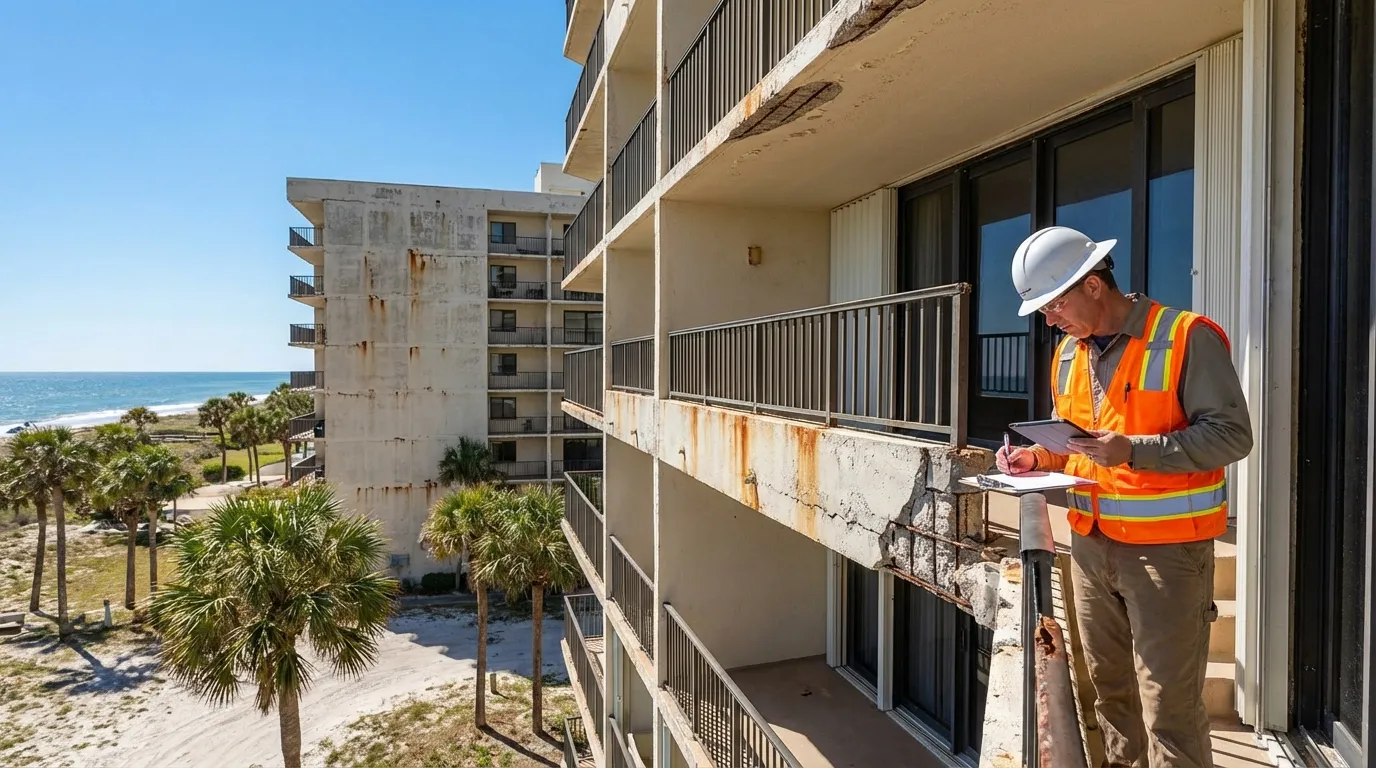
On June 24, 2021, Champlain Towers South in Surfside collapsed at approximately 1:30 a.m., killing 98 people. The 12-story beachfront condo was built in 1981. Structural problems had been identified in a 2018 report. A $15 million remediation program had been approved by the board. The work had not started.
Florida's response was SB 4-D, signed May 26, 2022, creating mandatory milestone structural inspections for aging condo and co-op buildings. The law has since been amended by SB 154 (2023) and HB 913 (2025). As of 2022 Florida was home to 912,000 condominiums aged 30 years or more, per a University of Florida analysis of Department of Revenue data, and the milestone requirement reaches those three stories or taller.
If you're buying a Florida condo, the building's milestone inspection status is now one of the most important data points in your due diligence.
The Deadlines: Most Buildings Are Already Past Due
The milestone inspection deadlines were Dec 31, 2024 and Dec 31, 2025. Most eligible buildings should have completed inspections already.
Under Florida Statute 553.899, milestone inspections apply to condo and co-op buildings that are 3 or more habitable stories tall. The deadlines are based on building age:
| Building Age | Inspection Deadline |
|---|---|
| Reached 30 years before July 1, 2022 | Dec 31, 2024 |
| Reached 30 years between July 1, 2022 and Dec 31, 2024 | Dec 31, 2025 |
| Turns 30 (or 25 near coast) in 2026+ | Dec 31 of the year the building reaches the threshold |
| After initial inspection | Every 10 years |
Local enforcement agencies may require buildings to inspect at 25 years instead of 30 based on environmental conditions such as proximity to salt water. This is not automatic statewide. It is entirely at the discretion of the local jurisdiction.
A common misconception is that Dec 31, 2026 is the milestone inspection deadline. It is not. Dec 31, 2026 is the outer limit for completing a Structural Integrity Reserve Study (SIRS) when done simultaneously with a milestone inspection. The inspection deadlines themselves have already passed for most eligible buildings.
Phase 1 vs Phase 2: What Each Inspection Covers
Phase 1 is a visual examination by a licensed engineer. Phase 2 is triggered only if substantial structural deterioration is found.
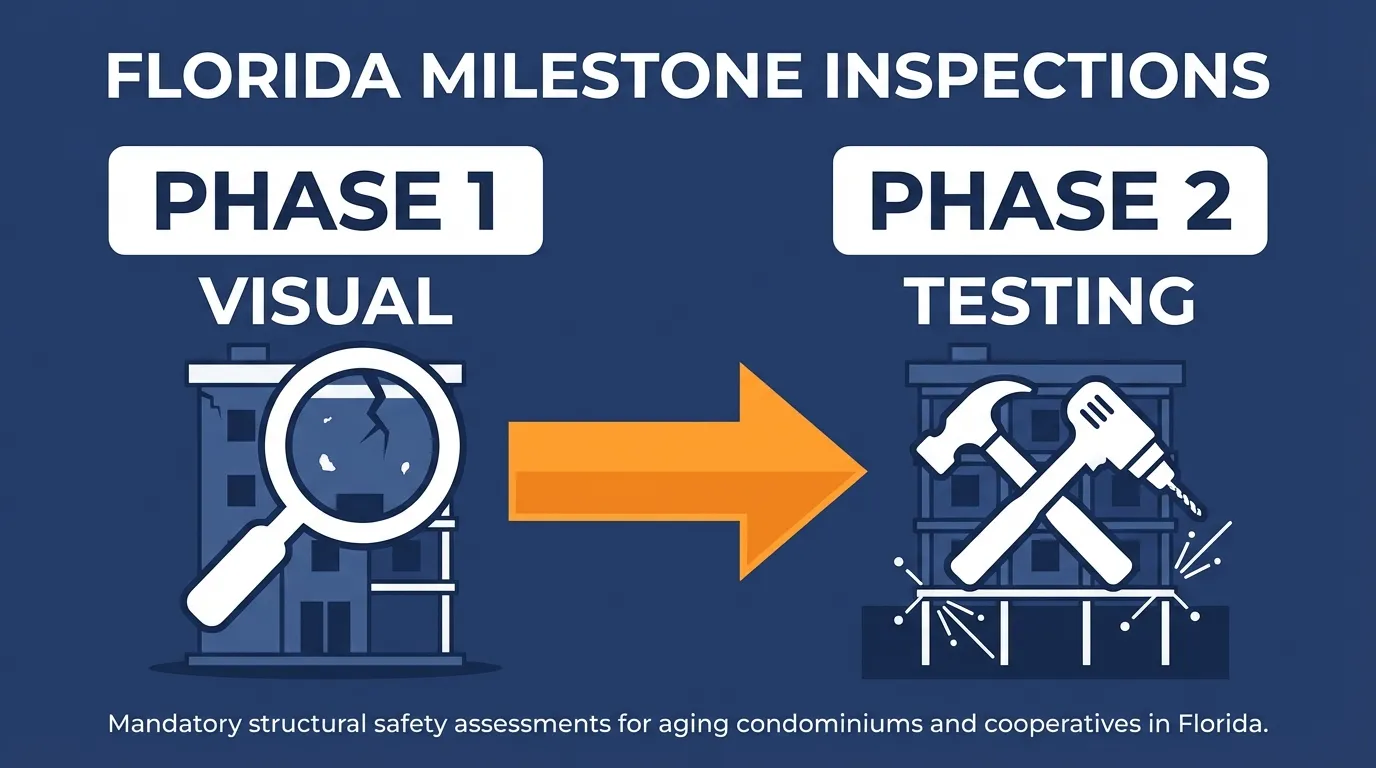
Phase 1 is a comprehensive visual examination of both habitable and nonhabitable areas, performed by a licensed architect or engineer. It focuses on major structural components: foundation, load-bearing walls, columns, floors, and roof structure. The inspector submits a report to the local building official.
If Phase 1 finds no substantial structural deterioration, Phase 2 is not required. The building passes.
Phase 2 is triggered when Phase 1 identifies "substantial structural deterioration". The statute defines this as structural distress that negatively affects the building's general structural condition and integrity. Surface imperfections like minor cracks or peeling do not qualify unless they indicate deeper problems.
Phase 2 involves destructive and non-destructive testing to confirm the extent of damage. The inspector must recommend a program for assessing and repairing the damaged portions. Under HB 913 (2025), repairs must commence within 365 days of receiving the Phase 2 report.
Phase 1 inspections cost $5,000 to $25,000 for small buildings (10-30 units), $12,000 to $60,000 for mid-size buildings (30-100 units), and $30,000 to $150,000+ for large high-rises. Phase 2, if triggered, runs $40,000 to $250,000+ depending on the scope of deterioration.
Check Your Building's Financial Health
Upload your HOA's reserve study and get instant analysis of percent funded, deferred maintenance, and special assessment risk. Free. No signup required.
Your first full property report is also free. See what you'll get →
Or get your first full report free →What Happens When a Building Fails
Phase 2 findings trigger mandatory repairs within 365 days, special assessments that can reach six figures per unit, and potential vacate orders.
When Phase 2 confirms structural deterioration, the consequences cascade. The board must fund and begin repairs within 365 days. Reserve waivers for structural components are no longer permitted under Florida law. That leaves two funding options: raise monthly assessments or levy a special assessment.
The numbers are severe. At Palm Bay Yacht Club in Miami, owners were asked for $46 million, about $175,000 each, a figure residents disputed after their own engineer put the work nearer $23 million. At Cricket Club in North Miami, a bay-front building built in 1975, the assessment was $30 million building-wide, as Axios reported from the Wall Street Journal's account. Mediterranean Village in Aventura saw assessments reported up to $400,000 per unit.
If an association fails to begin repairs, the local enforcement agency must review whether the building is unsafe for human occupancy. That can lead to a vacate order forcing residents out. Board members who willfully fail to arrange inspections may face personal liability for breach of fiduciary duty under Section 718.111.
The SIRS Connection: Reserve Waivers Are Gone
Florida banned reserve waivers for eight structural components for any budget adopted on or after December 31, 2024. Boards can no longer vote to underfund critical repairs.
For decades, Florida condo boards routinely voted to waive or reduce reserve funding, keeping monthly HOA fees artificially low. That option is gone for structural components.
Under FL Stat. 718.112(2)(g), associations can no longer waive reserves for the eight mandatory SIRS components: roof, load-bearing walls and primary structural members, fire protection, plumbing, electrical, waterproofing, windows and exterior doors, and any other item with a deferred maintenance or replacement cost exceeding $25,000. Owners in a building that needs a SIRS can no longer vote to skip or cut reserves for these components, for any budget adopted on or after December 31, 2024.
Non-structural components (landscaping, pool equipment, clubhouse furnishings) can still be waived with a majority member vote. But the big-ticket items that drive special assessments are now locked in.
One concession: associations may suspend reserve funding for up to two years after a milestone inspection to redirect funds toward urgent repairs identified in the report.
Impact on Financing and Resale
Buildings without completed inspections risk Fannie Mae's unavailable list. 1,438 Florida condos were already blocked from conventional financing by 2025.
Fannie Mae's unavailable list has grown from a few hundred condos before 2021 to 1,438 statewide by 2025. In Miami-Dade, Broward, and Palm Beach counties alone, 696 buildings are affected. The top two reasons: insufficient master insurance and critical repair or inspection failures. When a condo lands on this list, owners cannot sell using conventional mortgages.
Fannie Mae has also retired its Limited Review option for condo loans. All purchases now require Full Review, which means lenders need the HOA budget, financial statements, reserve study, delinquency data, and insurance documents. More document requests mean more opportunities for underwriters to flag problems.
The market is responding. Florida condo inventory is up 38% year-over-year with 13.2 months of supply. Pending condo sales dropped 21% statewide. Condo values in major Florida markets are down about 8% from their peak.
What Buyers Should Check Before Closing
Six due diligence questions that separate a sound Florida condo purchase from a six-figure special assessment surprise after closing.
- Has the milestone inspection been completed? Most eligible buildings should have finished by now. If not, the building is non-compliant and you have no visibility into structural condition.
- Was Phase 2 triggered? What were the findings? Request the full report. Phase 2 findings mean mandatory repairs within 365 days and likely special assessments.
- Is the SIRS current? The Structural Integrity Reserve Study must reflect the milestone inspection findings and include a baseline funding plan where reserves never fall below zero.
- Are any special assessments pending or under discussion? Check the last 12 months of board meeting minutes for hints of upcoming costs.
- Is the building on Fannie Mae's unavailable list? Check the Fannie Mae Condo Status Finder. If it's on the list, conventional financing is unavailable.
- What is the building's insurance status? Inadequate master insurance is the number one reason condos land on the unavailable list. Ask for the current policy, coverage amount, and recent premium history.
Extend your document review period beyond the typical 3 days. For out-of-area purchases, consider hiring a local engineer to interpret milestone findings and a condo attorney to review the financial documents.
Frequently Asked Questions
What is a milestone inspection in Florida?
A milestone inspection is a mandatory structural examination required by Florida Statute 553.899 for condo and co-op buildings that are 3 or more habitable stories tall and 30 years old (25 years in some coastal areas). It was created by SB 4-D in 2022 in response to the Surfside condo collapse that killed 98 people.
What is the deadline for Florida milestone inspections?
Buildings that reached 30 years before July 1, 2022 had a deadline of December 31, 2024. Buildings that reached 30 years between July 1, 2022 and December 31, 2024 had a deadline of December 31, 2025. Buildings reaching the age threshold in 2026 or later must complete inspections by December 31 of that year. After the initial inspection, re-inspection is required every 10 years.
How much do milestone inspections cost?
Phase 1 (visual) inspections cost $5,000 to $150,000+ depending on building size. Small buildings (10-30 units) typically pay $5,000 to $25,000. Large high-rises pay $30,000 to $150,000+. Phase 2 (detailed testing), if triggered, adds $40,000 to $250,000+. These costs are separate from any repairs.
Can Florida condo boards still waive reserves?
Not for structural components. Florida law now prohibits waiving or reducing reserves for the eight mandatory SIRS components (roof, load-bearing walls and primary structural members, fire protection, plumbing, electrical, waterproofing, windows, and items over $25,000). The ban applies to any budget adopted on or after December 31, 2024. Boards can still waive reserves for non-structural items like landscaping and pool equipment with a majority member vote.
What happens if my condo building hasn't completed its milestone inspection?
Non-compliant buildings face daily fines, potential liens, and referral for an unsafe building determination that could result in a vacate order. Board members who willfully fail to arrange inspections risk personal liability for breach of fiduciary duty. The building may also be added to Fannie Mae's unavailable list, blocking conventional mortgage financing for all unit sales.
Buying a Florida Condo? Check the Documents First.
Upload your reserve study or CC&Rs for instant analysis. Built on insights from 1,900+ HOA documents analyzed.
Related Articles
Sources & References
- Florida Statute 553.899 (milestone inspection requirements, deadlines, Phase 1/Phase 2 process)
- Florida Statute 718.112(2)(g) (SIRS requirements, reserve waiver ban, 8 mandatory components)
- SB 4-D (2022) Full Text (original legislation creating milestone inspection requirements)
- Building Mavens: HB 913 (2025) Changes (365-day repair deadline, habitable stories clarification, DBPR enforcement)
- NIST Champlain Towers Investigation (pool deck failure, corrosion, construction joint deficiencies)
- FL Engineering LLC (Phase 1 and Phase 2 inspection cost estimates)
- CBS Miami: Palm Bay Yacht Club ($46M assessment, about $175,000 each, disputed by residents)
- NBC News: A Reckoning Is Coming for Florida Condo Owners (Florida condo structural repair crisis overview)
- MPA Magazine: Fannie Mae Unavailable List (1,438 condos blocked from conventional financing)
- US News: Florida Condo Crisis (pending sales down 21%, market impact data)
Disclaimer: This article is for educational purposes only and does not constitute legal, financial, or real estate advice. Florida milestone inspection requirements and deadlines are subject to legislative change. Consult a qualified real estate attorney or structural engineer for guidance specific to your situation. GoverningDocs is not affiliated with the Florida Legislature, DBPR, or any state agency.