
In This Guide
Who pays an HOA special assessment at closing depends on your purchase contract and state law. Generally, assessments levied before closing are the seller's responsibility. But in Florida, Hawaii, and Washington, buyers can be jointly liable for unpaid assessments by statute.
You're two weeks from closing on a condo. Everything looks good. Then the title company sends over the estoppel certificate and there it is: a $35,000 special assessment for roof replacement, levied three months ago. The seller hasn't paid it.
Now what? Does the seller pay it off before closing? Do you inherit it? Can you negotiate a credit? The answer depends on your state, your contract, and when the assessment was approved. Get this wrong and you could be writing a five-figure check you didn't budget for. Understanding assessments is part of a broader due diligence process. See our complete guide to HOA financial health to learn all the risk factors.
Here's how special assessments actually work at closing, state by state.
The General Rule: Timing and Contract Language
The purchase contract controls who pays. If the contract is silent, the owner at the time the assessment is levied is generally responsible.
The default principle across most states is straightforward. Assessments approved and billed before closing are the seller's responsibility. Assessments imposed after closing are the buyer's.
But the purchase contract can override this default. Most standard real estate contracts address special assessments directly. If yours doesn't, you're relying on state law defaults, and those vary significantly.
There's an important wrinkle with installment assessments. If a $60,000 assessment is being paid over five years at $1,000 per month, many contracts specify that installments due before closing are the seller's obligation while installments due after closing become the buyer's. Even though the assessment was levied before the sale.
In California, many HOA boards adopt "due on sale" clauses in their governing documents. When present, these clauses make the full remaining assessment balance due upon transfer of title. The seller can't transfer remaining installments to the buyer. Check the CC&Rs for acceleration language before assuming installments will carry over.
Check Your Building's Financial Health
Upload your HOA's reserve study and get instant analysis of percent funded, deferred maintenance, and special assessment risk. Free. No signup required.
Your first full property report is also free. See what you'll get →
Or get your first full report free →State-by-State Guide: Who Pays the Special Assessment?
Three states impose joint liability on buyers by statute. Most others protect buyers through mandatory disclosure documents that cap liability.
Laws vary by state. Here's what you need to know in the states with the most condo activity.
| State | Buyer Jointly Liable? | Key Disclosure Document | Buyer Protection |
|---|---|---|---|
| Florida | Yes | Estoppel certificate | Liability capped at estoppel amount |
| Hawaii | Yes | Board statement | Liability capped at board statement amount |
| Washington | Yes | Resale certificate | Cancellation window tied to certificate delivery (length depends on which statute governs) |
| California | No | Civil Code 4525 disclosure | Many HOAs have "due on sale" clauses; lien requires recording |
| Texas | No | Resale certificate | Buyer not liable for undisclosed debts |
| Colorado | No | Status letter | Association loses lien if late providing statement |
| Illinois | No | 22.1 letter + Paid Assessment Letter | Standard attorney review period (contractual) |
| Arizona | No | Resale disclosure | Lien extinguished if association misses 10-day deadline |
| Nevada | No | Resale package | Buyer not liable beyond disclosed amounts |
| Virginia | No | Resale certificate | Buyer not liable beyond certificate amounts |
Important: This table summarizes statutory defaults. Your purchase contract can modify these rules. Always read the assessment language in your contract before relying on state defaults.
The Three Joint Liability States: What Buyers Must Know
In Florida, Hawaii, and Washington, the buyer is jointly and severally liable with the seller for unpaid assessments by statute. Estoppel certificates cap this liability.
Florida (Fla. Stat. 718.116 and 720.3085)
If you close on a Florida condo or HOA property with an unpaid assessment still on the books, you can end up owing it alongside the seller. Under Fla. Stat. 718.116(1)(a), a buyer is jointly and severally liable with the seller for all unpaid assessments that came due up to the time of transfer of title. The association can pursue either party for the debt.
This is not a condominium-only rule. The parallel provision for Florida homeowners associations, Fla. Stat. 720.3085(2)(b), uses the same language: a parcel owner is jointly and severally liable with the previous parcel owner for all unpaid assessments that came due up to the time of transfer of title.
The buyer has the right to recover those amounts from the seller after the fact. But that means hiring a lawyer and chasing the money. Not ideal.
The protection: Florida's estoppel certificate. The association must issue one within 10 business days of a written request. It must itemize all assessments, special assessments, and amounts owed. The association waives the right to collect any amount in excess of what the estoppel states from anyone who relies on it in good faith. The estoppel is valid for 30 days when it is hand delivered or sent electronically, and 35 days when it is sent by regular mail.
Do not quote a fee figure from an old listing packet. Florida caps what the association can charge for the estoppel, but the cap moves. Fla. Stat. 718.116(8)(f) sets $250 for preparation and delivery, with up to $100 more for expedited delivery within 3 business days and up to $150 more when the account is delinquent. Those figures are adjusted for inflation every 5 years, and the Department of Business and Professional Regulation publishes the current amounts on its website, so check there rather than relying on a figure quoted elsewhere. One rule does not move: if the association misses the 10-business-day deadline, it may not charge for the certificate at all.
Bottom line: In Florida, never close without a current estoppel certificate. It's your liability cap.
Hawaii (HRS 514B-144)
Hawaii follows a similar pattern. Under HRS 514B-144(f), the buyer is jointly and severally liable with the seller for all unpaid assessments up to the time of conveyance. But the buyer's liability is capped at the amount stated in a written statement from the board.
Hawaii also has a lien for assessments. Under HRS 514B-146(a), that lien outranks most other claims against the unit, but not real property taxes, and not a mortgage that was recorded before the association recorded its lien notice. There is one carve-out worth knowing if you are buying at or after a foreclosure: under HRS 514B-146(j) and (k), the board can specially assess whoever takes the unit at a foreclosure sale, the lender included, for unpaid regular monthly assessments, capped at the six months before that foreclosure was completed. So the association can still reach six months of dues even where the mortgage otherwise comes ahead of its lien.
Washington (RCW 64.34.364 / RCW 64.90.485)
Washington imposes joint and several liability on the buyer for the seller's unpaid assessments. The buyer can pursue the seller for reimbursement, but the association can come after either party. The rule appears in both of Washington's statutes, at RCW 64.34.364(12) under the older Condominium Act and RCW 64.90.485(17) under the newer common interest ownership act.
Washington also gives you a right to walk away after you receive the resale certificate, but how long you have is not the same under both of the state's condo laws, so ask which one covers the community rather than assuming. Under RCW 64.34.425(3), the older act, you can still back out (the statute says the contract is "voidable," meaning you can cancel it without being in breach) until the certificate reaches you and for five days after that, or until the deed is actually transferred to you, whichever comes first. Under RCW 64.90.640(3)(b), the newer act, you get five business days to cancel after you first receive the certificate, and there is no cancellation right at all if the certificate arrived more than five business days before you signed. Which act applies turns in part on when the community was created: RCW 64.90.365 lists the sections of the newer act that reach communities created before July 1, 2018, and the resale certificate section is not among them. So ask the title company or the association for the date the community was created, and get the answer in writing before you count days off a deadline that may not be yours.
If the association has no current reserve study, the certificate must carry a specific statutory warning. The full sentence reads: "Insufficient reserves may, under some circumstances, require you to pay on demand as a special assessment your share of common expenses for the cost of major maintenance, repair, or replacement of a common element." The resale certificate fee is capped at $275 under both chapters.
Already Levied vs. Pending: The Gray Area That Causes Disputes
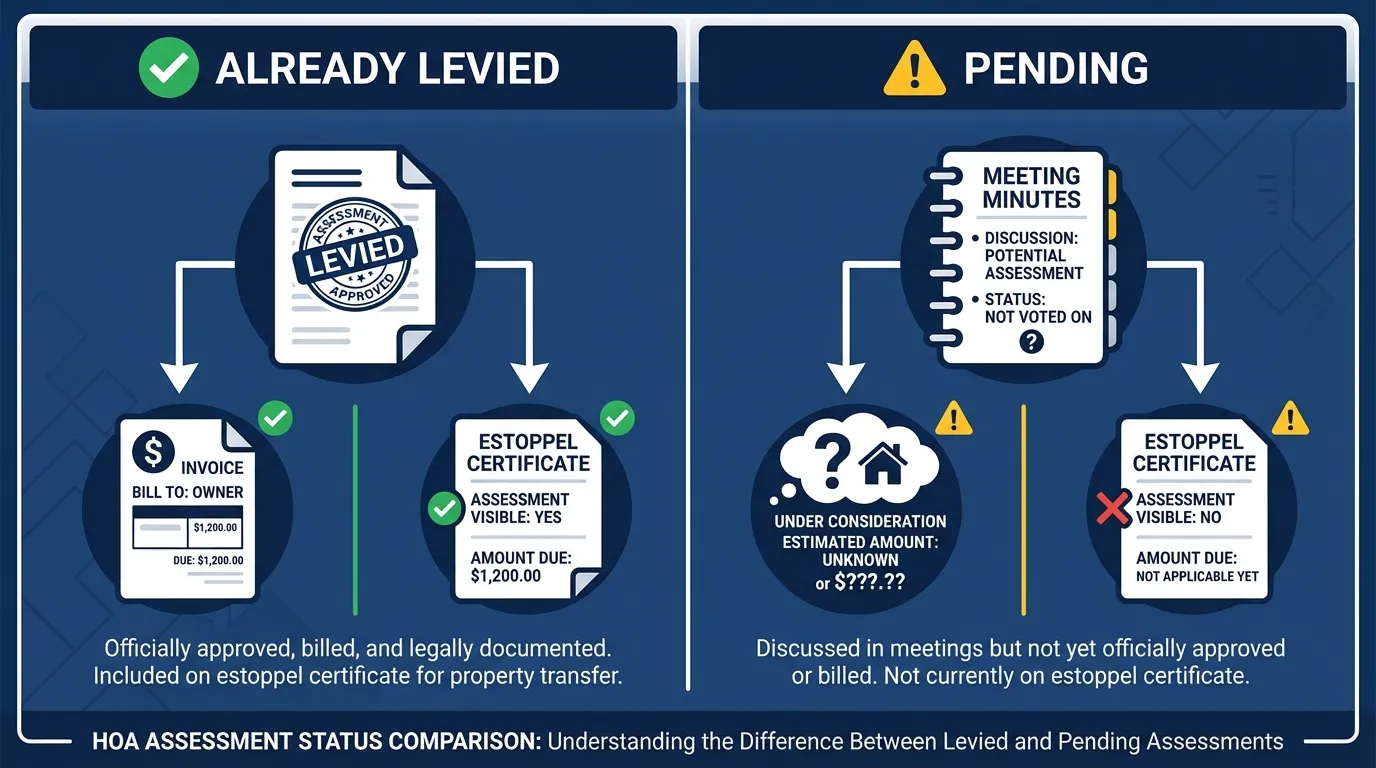
Levied assessments show up on estoppel certificates and are allocable. Pending assessments discussed in board meetings but not yet approved are the gray area buyers miss.
Already-Levied Assessments
These are formally approved by the board and billed to owners. They show up on estoppel certificates and resale disclosures. Allocation is straightforward: whoever owned the unit when the assessment was levied is responsible.
If the assessment is being paid in installments, the standard approach in most states is that the seller pays installments due before closing and the buyer pays installments due after. In California, this exception doesn't apply. The full remaining balance becomes due at sale.
Pending Assessments (Not Yet Approved)
This is where buyers get blindsided. A special assessment that the board has been discussing for six months but hasn't voted on yet won't appear on the estoppel certificate. The seller isn't legally required to pay for something that hasn't been levied.
But the warning signs are in the board meeting minutes. If the minutes mention "deferred maintenance," "engineering report," "reserve funding shortfall," or "assessment options," an assessment may be weeks away from a vote. By the time it's approved, you're the owner and you're paying it.
Always request the last 12 months of board meeting minutes before closing. This is the only way to catch pending assessments that haven't hit the estoppel yet.
How to Negotiate Special Assessments at Closing
Six negotiation strategies: seller pays in full, closing credit, price reduction, cost split, escrow holdback, or buyer assumes for a lower price.
A special assessment doesn't have to kill a deal. Here are six ways buyers and sellers typically handle it.
- Seller pays in full before closing. The cleanest option. The assessment is cleared, the buyer takes clean title, and there's no post-closing liability.
- Closing credit. The seller gives the buyer a dollar-for-dollar credit at closing. The buyer manages the payment directly with the HOA. Works well when the buyer wants control over the payment timeline.
- Price reduction. Lower the purchase price by the assessment amount. Same economic result as a credit, but affects comparable sales data for the building. Some sellers prefer this to avoid showing an assessment on the closing statement.
- Split the cost. Common when the assessment was levied shortly before listing. Both parties share the burden. Often used when the seller argues they "didn't cause the deferred maintenance" and the buyer concedes the building still needs the work done.
- Escrow holdback. When the final assessment amount isn't confirmed, funds are held in escrow until the HOA finalizes the number. Protects both parties when the board has approved the project but hasn't set the per-unit amount.
- Buyer assumes for a lower price. The buyer accepts the assessment in exchange for a significant price reduction. This works when the buyer has cash reserves and wants a deeper discount. The risk is that the final assessment could exceed the estimate.
The Estoppel Certificate: Your Most Important Closing Document
The estoppel certificate (or resale certificate) reveals all current assessments and caps buyer liability in many states. Never close without one.
Different states call it different things: estoppel certificate in Florida, resale certificate in Virginia and Nevada, 22.1 letter in Illinois, status letter in Colorado. Whatever the name, this document serves the same purpose: it tells you exactly what the seller owes the HOA.
What a good estoppel reveals:
- Current regular assessment amount and payment status
- Any unpaid or delinquent assessments from the seller
- Special assessments that have been levied (paid or not)
- Special assessments approved but not yet due
- Fines, penalties, interest, and collection costs
- Pending litigation involving the association
- Reserve fund balance
In several states, the association is legally bound by what it puts in the estoppel. Florida, Virginia, Nevada, and Texas all protect buyers from amounts not disclosed. In Arizona and Colorado, the association can actually lose its lien entirely if it fails to provide the statement within the statutory deadline.
| State | Document Name | Response Deadline | Fee Cap |
|---|---|---|---|
| Florida | Estoppel certificate | 10 business days | $250 statutory base, CPI-adjusted (see DBPR for current) |
| Arizona | Resale disclosure | 10 days | $400 |
| Washington | Resale certificate | 10 days | $275 |
| Illinois | 22.1 letter + PAL | 10 business days | ~$100 (typical) |
| Colorado | Status letter | 14 calendar days | Varies |
| Texas | Resale certificate | 10 business days | Varies |
| Nevada | Resale package | 10 calendar days | Varies |
| Virginia | Resale certificate | Per contract | Varies |
| California | Civil Code 4525 documents, requested under 4530 | 10 days | Varies |
Real Numbers: What Special Assessments Look Like in 2026
Special assessments in 2024-2026 range from $8,700 for elevator replacement to $400,000 for full building remediation. Florida leads the country.
These aren't hypothetical numbers. These are real assessments from real buildings in the past two years.
📊 GoverningDocs Research
In our review of 1,900+ HOA documents, special assessments range from $5,000 for targeted repairs to over $400,000 per unit for structural compliance in Florida. The largest assessments consistently appear in buildings with reserves under 30% funded.
| Building / Location | Assessment | Reason |
|---|---|---|
| Mediterranean Village, Aventura FL | Up to $400,000/unit | Full building remediation |
| Cricket Club, North Miami FL | $30M building-wide | Structural repairs |
| Regency Gardens, Orlando FL | Up to $22,000/unit | Deferred maintenance |
| Elevator building (multi-unit) | $8,700/unit | Elevator replacement |
Sources: Mediterranean Village as reported by the New York Post (March 1, 2025); the Cricket Club’s $30 million building-wide assessment per Axios Miami (May 15, 2024), reporting the Wall Street Journal; Regency Gardens per ResiClub Analytics. The elevator-building figure is from our own document review, not a published report.
In our analysis of 1,900+ HOA documents, special assessment language is one of the most common red flags. Florida draws the most attention, but it is not the only place this happens: California, Illinois and other coastal markets carry the same exposure wherever aging buildings have deferred maintenance. The size of an assessment tracks the building, not the state, so check the reserve study and the minutes for the specific property rather than assuming a range from where it is.
5 Steps to Protect Yourself Before Closing
Request the estoppel, read meeting minutes, check the reserve study, review your contract language, and get assessment language in writing before closing.
1. Request the Estoppel Certificate Early
Don't wait until the last week before closing. Request the estoppel (or your state's equivalent) as soon as you're under contract. Some associations take the full statutory deadline to respond. In Florida, that's 10 business days. You need time to review it and negotiate if surprises come up.
2. Read the Last 12 Months of Board Meeting Minutes
The estoppel only shows what's been levied. Meeting minutes reveal what's being discussed. If the board is getting bids for roof replacement or debating a special assessment vote, you need to know before closing. Upload the minutes to GoverningDocs to flag assessment-related language automatically.
3. Check the Reserve Study
A building with reserves below 30% funded is significantly more likely to levy a special assessment. Upload the reserve study to our free analyzer to see percent funded, deferred maintenance items, and major expenses coming in the next five years.
4. Review Your Contract's Assessment Language
Check what your purchase contract says about special assessments. Does it address who pays for assessments levied before closing? What about installment assessments? If the contract is silent, you may be relying on state defaults that may not be in your favor.
5. Get Assessment Commitments in Writing
If the seller agrees to pay a special assessment, make sure it's documented in the contract or an addendum. Verbal agreements don't survive closing. If there's a pending assessment that hasn't been levied yet, consider an escrow holdback or a contractual credit tied to a dollar cap.
How to Check Your Building's Assessment Risk
Every data point in this article comes from HOA documents: estoppel certificates, reserve studies, board meeting minutes, and CC&Rs. These documents tell you whether an assessment has been levied, whether one is being discussed, and whether the building's financial health makes one likely.
Upload your CC&Rs or reserve study to GoverningDocs. The tool extracts assessment language, reserve funding levels, and deferred maintenance items. Free. No signup.
In a market where special assessments are surging, knowing who pays at closing is only half the equation. Knowing whether one is coming is the other half.
Frequently Asked Questions
Who is responsible for a special assessment at closing, the buyer or seller?
It depends on your purchase contract and state law. In most states, the seller is responsible for assessments levied before closing and the buyer is responsible for assessments levied after. But in Florida, Hawaii, and Washington, buyers are jointly and severally liable with sellers for unpaid assessments by statute. Always check both your contract and the estoppel certificate.
What happens if a special assessment is levied after I sign the contract but before closing?
This depends on your contract language. Most standard contracts assign the assessment to whoever owns the property when the assessment is approved. If the assessment is levied after you sign but before you close, the seller typically still pays because they hold title. But some contracts shift this risk. Read the assessment clause carefully.
Can I back out of a deal because of a special assessment?
Possibly. Several states give buyers cancellation rights after receiving HOA disclosure documents. In Washington the clock starts when you get the resale certificate, but how long you have depends on which of the state's two condo laws covers the community, and under the newer one you may have no cancellation right at all if the certificate reached you more than five business days before you signed. Ask the title company which law applies. Your contract may also include a due diligence or inspection contingency that covers HOA document review.
What is an estoppel certificate and why do I need one?
An estoppel certificate is a document from the HOA that states all amounts owed by the seller, including regular assessments, special assessments, fines, and fees. In many states, the association is legally bound by the amounts listed. The certificate caps your potential liability and protects you from undisclosed debts. Never close on a condo or HOA property without one.
Check Your Building's Financial Health
Upload your HOA's reserve study and get instant analysis of percent funded, deferred maintenance, and special assessment risk. Free. No signup required.
Your first full property report is also free. See what you'll get →
Or get your first full report free →Related Articles
See how GoverningDocs detects special assessments and financial risks.
See Sample Report →Sources & References
- Florida Statute § 718.116 (Condo assessments; liability; lien and priority; estoppel certificates)
- Florida Statute § 720.3085 (Homeowners associations; payment for assessments; lien claims)
- Hawaii HRS § 514B-144 (Association fiscal matters; joint and several liability)
- Hawaii HRS § 514B-146 (Association fiscal matters; lien for assessments, and the six-month special assessment against a foreclosure purchaser)
- Washington RCW 64.34.364 (Condominium Act; lien for assessments)
- Washington RCW 64.34.425 (Condominium Act; resale certificate contents and cancellation)
- Washington RCW 64.90.640 (Common Interest Ownership Act; resale certificate)
- Washington RCW 64.90.485 (Common Interest Ownership Act; buyer jointly and severally liable with the seller, subsection (17))
- Washington RCW 64.90.365 (which sections of the newer act reach communities created before July 1, 2018)
- California Civil Code § 4525 (the documents a seller must give a buyer, "as soon as practicable" before transfer; this section sets no deadline for the association)
- California Civil Code § 4530 (the 10-day deadline: on written request the association must provide the Section 4525 documents within 10 days)
- Texas Property Code Chapter 207 (Disclosure of information by property owners' associations)
- Colorado CRS § 38-33.3-316 (CCIOA; lien for assessments)
- Illinois 765 ILCS 605/22.1 (Condominium Property Act; resale disclosure)
- Arizona ARS § 33-1256 (Condominiums; common expense liens)
- Arizona ARS § 33-1260 (Resale of units; information required; fees; the $400 aggregate fee cap and the 10-day delivery deadline)
- Nevada NRS § 116.4109 (Resales of units; resale package)
- Virginia Resale Disclosure Act (Title 55.1, Ch. 23.1) (Resale certificate requirements)
- New York Post, “Inside Florida’s brewing condo crisis” (March 1, 2025; source for the Mediterranean Village assessment figure)
- Axios Miami, “Safety regulations are pushing Miami condo owners out” (May 15, 2024, reporting the Wall Street Journal; source for the Cricket Club’s $30 million building-wide assessment)
- ResiClub Analytics (Spiking HOA fees and special assessments in Florida)
Disclaimer: This article is for educational purposes only and does not constitute legal, financial, or real estate advice. HOA assessment laws, estoppel requirements, and buyer liability rules vary by state and community. Statute citations for Florida, Hawaii and Washington were re-verified against the official statute text in August 2026; the remaining state rows in the tables above have not been re-verified since March 2026 and may be amended. Consult a qualified real estate attorney for guidance specific to your situation.