
In This Guide
You can ask for HOA documents before making an offer in any state, and you should. Whether you have a legal right to them that early depends on the state. California requires the seller to provide them before the sales contract is signed (or, at the latest, before closing), and Washington does the same for condos and for HOAs created on or after July 1, 2018. A Texas condo seller must also furnish the documents before the contract is signed. In most other states the formal request comes from the seller, or the right starts only once an offer is accepted, so asking earlier is a request the seller or association can grant or refuse. Once the request is made, most of the states covered here give the association about 10 days, with fee caps from $185 to $400 where the state sets one.
Once you have the documents, the next step is to run them through The GoverningDocs 5-Number HOA Health Check: the five numbers every condo buyer should extract before closing (percent funded, delinquency rate, reserve contribution rate, single-entity ownership, and insurance sufficiency). The lender questionnaire in the disclosure package is also where the Warrantability Checklist gets answered, so getting the docs early is what lets you flag financing risk before you ever put a number on paper.
Your client falls in love with a condo. Great unit, right neighborhood, the listing agent is responsive. You write up an offer, it gets accepted, and you go under contract. Then the HOA documents arrive five days into a seven-day review window and the reserve study shows the building is 22% funded with a $48,000 per unit special assessment scheduled for next year.
Now you have a problem. Your client either eats the bad deal, walks away from earnest money, or scrambles for a contract amendment that the seller won't sign. None of that needed to happen. Nothing stopped your client from asking for those documents before the offer was ever written, and in California, for Washington condos and newer HOAs, and for Texas condos, the law expects the seller to provide them before the contract is signed.
The misconception that HOA documents are an escrow-only artifact is the single most expensive mistake condo buyers and their agents make. Here's how to fix it.
You Don't Have to Wait Until You're Under Contract
Your agent can ask before you offer. Only a few states (and Texas condos) make the seller provide the documents that early; elsewhere the seller can simply agree to.
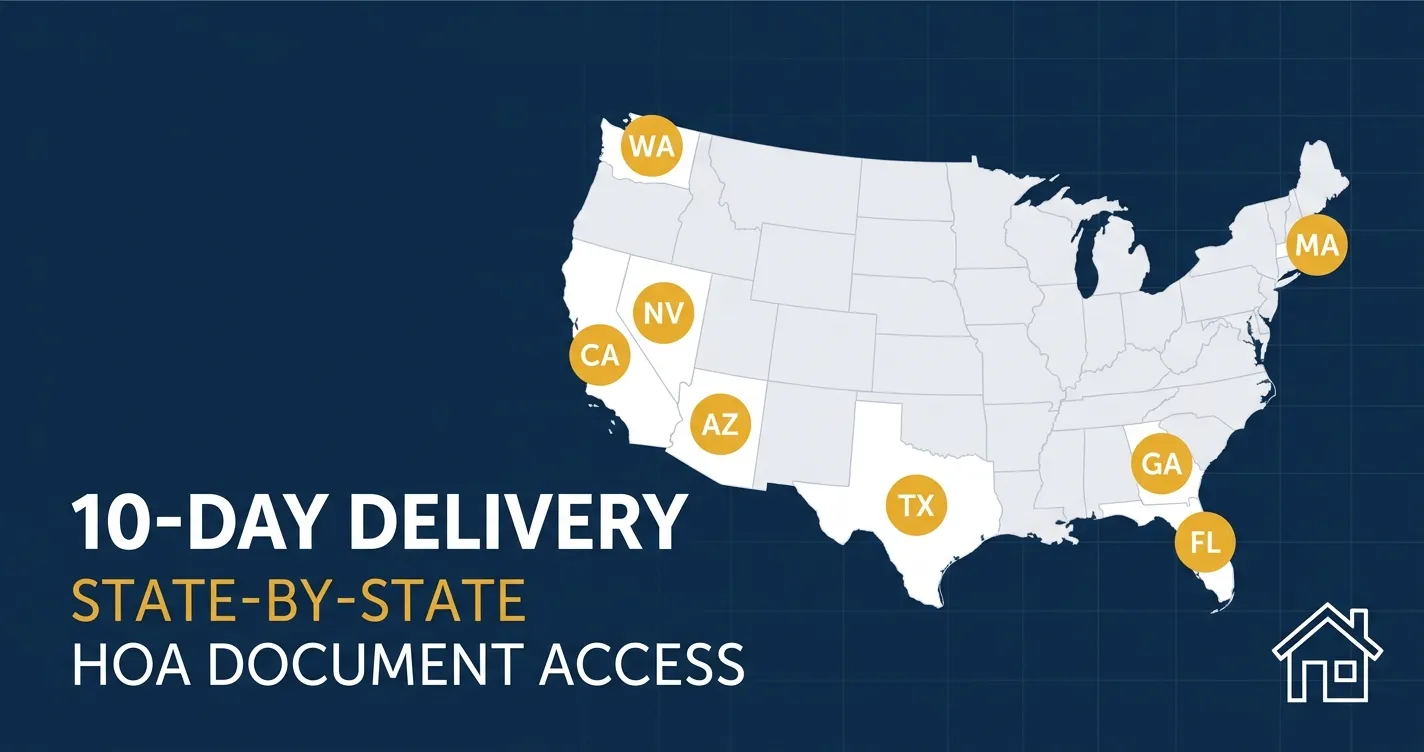
The cultural default is that buyers see HOA documents only after an offer is accepted. That default exists because document preparation has a fee, and sellers historically waited for a committed buyer before paying it. The law is more varied than the habit. Statutes in Washington, Florida, California, Texas, Arizona, Nevada and Massachusetts set a delivery deadline of about 10 days (Florida and Massachusetts count business days, as does Texas for subdivision HOAs; Nevada and Texas condos count calendar days). In most of these states the clock starts with a written request from the seller or someone acting for the seller, and in Arizona it starts only once the buyer's offer is accepted. So outside California, Washington condos and newer HOAs, and Texas condos, you usually cannot demand the documents before you make an offer, but you can still ask for them.
Two things follow from that. First, your buyer's agent can and should ask for the documents the moment you have a serious interest in a property; the seller can say yes even where the law does not require it. Second, in states like California where the statute explicitly contemplates pre-contract delivery (Civil Code § 4525 mandates delivery "as soon as practicable before the transfer of title or the execution of a real property sales contract"), the seller is legally obligated to provide them. Washington's resale certificate rule (RCW 64.90.640) works the same way for communities covered by WUCIOA, the state's newer condo and HOA law: the seller must give the buyer the certificate before the contract is signed or, failing that, before closing.
Before you write the offer, have your agent email the listing agent and ask for the reserve study, budget and recent minutes. In California, and for a Washington condo or an HOA created on or after July 1, 2018, or a Texas condo, add that the seller is expected to provide the package before the contract is signed.
The 7 Documents Every Condo Buyer Should Request
Reserve study, budget, meeting minutes, CC&Rs and bylaws, lender questionnaire, master insurance declarations, and the resale or estoppel certificate.
Each document tells you something different. Skip any one and you've left a real risk unexamined.
- Reserve study (most recent, full version, not a one-page summary): tells you whether the building has saved enough for known repairs. The headline number is percent funded.
- Operating budget (current year): shows where dues are spent and how much the board allocates to reserves. Reserve contribution rate below 10% of the budget is a warning under current Fannie Mae rules (Selling Guide B4-2.2-01); below 15% will be a warning starting January 4, 2027 per Fannie Mae Lender Letter LL-2026-03.
- Board meeting minutes (last 12–24 months): surfaces deferred maintenance, pending litigation, unfunded special assessments under discussion, and governance friction.
- CC&Rs and bylaws: these are public records (recorded against the property) but are usually easier to get from the listing agent or HOA. Look for rental restrictions, pet policies, architectural rules, and resale right-of-first-refusal clauses (which some lenders and loan programs look at closely).
- Lender (HOA) questionnaire: the form your future lender will use to confirm warrantability. Ask for a recent completed version. This is where insurance, reserves, delinquency, single-entity ownership, and commercial-space ratios all get answered.
- Master insurance declarations page: shows replacement-cost coverage, per-unit deductible, and any gaps that flip a building non-warrantable under Fannie Mae Lender Letter LL-2026-03.
- Resale certificate (Washington, Texas, Nevada, Arizona) or estoppel certificate (Florida): the statutorily required package that lists assessments, dues status, pending assessments, and rule status as of the issue date. Massachusetts, Georgia and Colorado require only a narrower statement of unpaid charges. Usually ordered closer to closing, and usually by the seller.
Who to Ask, in What Order
Listing agent first; HOA management company second (deadlines usually start when the seller asks); seller third (required before the contract in California, for Washington condos and newer HOAs, and for Texas condos).
Listing agent. Fastest path. A serious listing agent will already have the CC&Rs, recent budget, and a copy of the most recent reserve study from prior listings or the seller-supplied package. Per NAR guidance, some states require HOA documents to reach the buyer before closing, and buyers can ask for the reserve study. Asking before the offer costs nothing. Always ask first.
HOA management company. Most state statutes obligate the association to respond within about 10 days of a written request from the owner or someone the owner authorizes (business days in Florida, Massachusetts and North Carolina, and in Texas for subdivision HOAs). That means the seller or the listing agent usually makes the formal request. A buyer's agent can still ask the management company or the listing agent early as a courtesy, but the deadlines and fee rules attach to the owner's request. Fees are capped in most of these states (see the state-by-state section below), and in Florida no estoppel fee may be charged if the association misses the deadline.
Seller. In California, the seller is required to provide documents "as soon as practicable before the transfer of title or the execution of a real property sales contract." Washington's rule is similar for condos and for HOAs created on or after July 1, 2018: the seller must provide the resale certificate before the contract is signed or, failing that, before closing. Older Washington HOAs that are not condos may have no required certificate. In North Carolina the seller's HOA disclosure form is due by the time you make an offer, though the association's own documents usually come later. A Texas condo seller must furnish the declaration, bylaws, rules and resale certificate before the contract is signed. In most other states, the seller's obligation kicks in only after a contract is signed. Either way, asking early creates a record.
State-by-State Access Rules
Most of these states set a delivery deadline of about 10 days once the owner asks (in Arizona, once an offer is accepted). Georgia and Colorado only require a statement of what the seller owes (within 5 business days in Georgia, 14 calendar days in Colorado). Find your state's row, then ask the listing agent which document the seller will order, and when.
The following table summarizes the disclosure rules in 10 high-volume states. Statute citations link to primary sources.
| State | Statute | Delivery | Fee cap | Due before contract? |
|---|---|---|---|---|
| Washington | RCW 64.90.640 | 10 days | $275 base / $100 update | Yes for condos and HOAs created since July 1, 2018 (seller-driven) |
| California | Civ. Code § 4525 / § 4530 | 10 days | Reasonable fee based on actual cost | Yes, as soon as practicable before the contract or title transfer |
| Florida | § 718.116 / § 718.111(12) | 10 business days | $299 base / +$119 expedited / +$179 if delinquent (adjusted by Florida's Department of Business and Professional Regulation; statute base $250 / $100 / $150) | Through the seller (owners can inspect records) |
| Texas (subdivision HOAs) | Prop. Code § 207.003 | 10 business days | $375 base / $75 update | Post-contract typical |
| Texas (condos) | Prop. Code § 82.157 | Association: 10 days from the owner's written request | $375 for the certificate (§82.157(f)); it must also list every other transfer-related fee | Yes: the seller must furnish the documents and certificate before signing the contract |
| Arizona | A.R.S. § 33-1260 | 10 days after offer accepted (50 or more units: 10 days after the association gets the seller's notice) | $400 total (+$100 rush) | No (clock starts at acceptance) |
| Nevada | NRS § 116.4109 | 10 calendar days | $185 (+$100 rush; adjusted yearly for inflation) | Post-contract |
| Georgia | O.C.G.A. § 44-3-109 (condos) / § 44-3-232 (POAs) | 5 business days (statement of past-due amounts) | Up to $10, if the association's documents allow it | No; a buyer under contract can request the statement |
| Massachusetts | M.G.L. c. 183A § 6(d) | 10 business days | Reasonable fee (no fixed cap) | On request (statement of unpaid charges only) |
| Colorado | C.R.S. § 38-33.3-316(8) | 14 calendar days (statement of unpaid assessments) | Not set in this section | No; the owner makes the request |
| North Carolina | N.C.G.S. § 47E-5; § 47C-3-118 (condos), § 47F-3-118 (HOAs) | 10 business days (statement of unpaid assessments) | $200 (+$100 only if requested within 48 hours of closing) | Yes for the seller's HOA disclosure form, due by the time you make an offer (some sales are exempt, such as a new home's first sale, or both sides agreeing to skip the form). Not for the association's own documents |
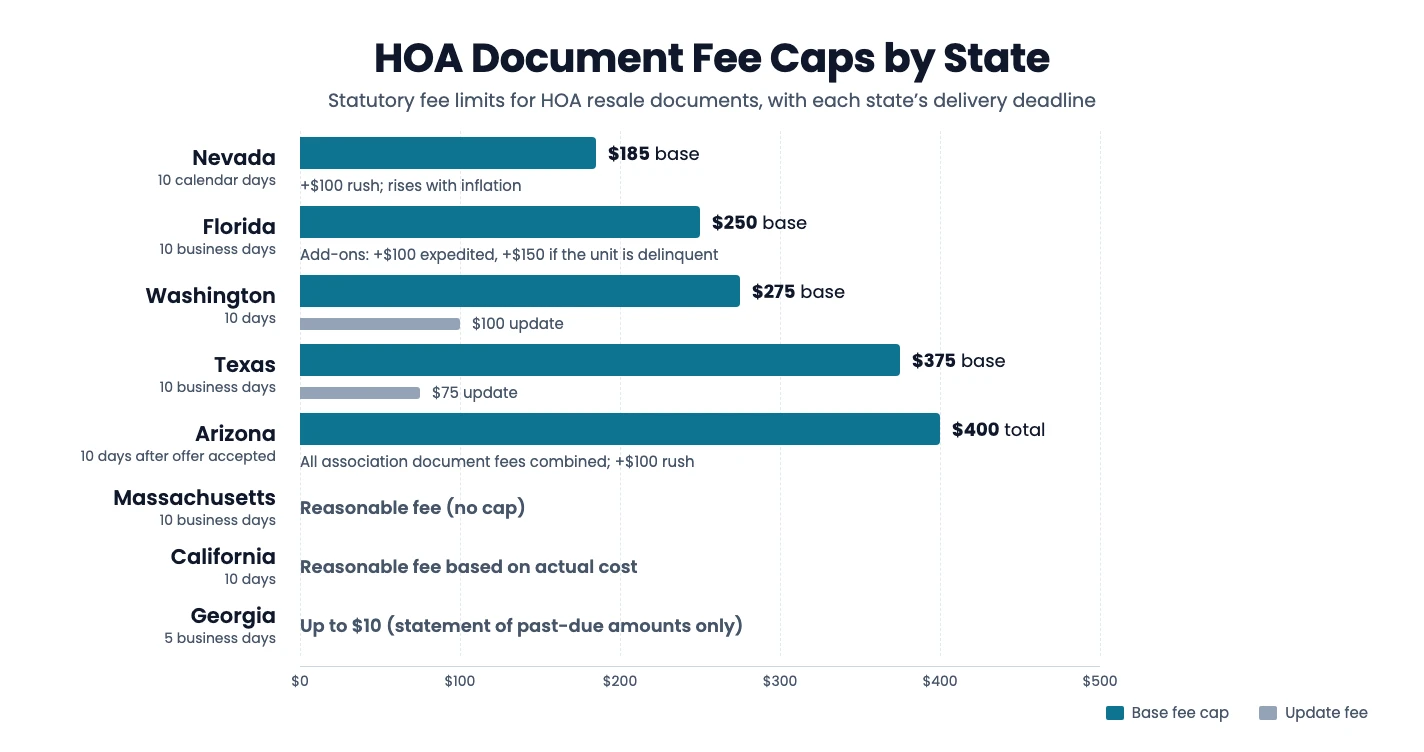
Statutory fee caps for HOA disclosure packages across major US markets (sources: state legislatures listed below). The chart shows Florida's statutory base figures; the table above shows the current amounts adjusted by Florida's Department of Business and Professional Regulation.
Three recent changes are worth knowing about:
- Washington: if the building is in an older association, ask whether the resale certificate rule applies to it yet. ESSB 5129 (Chapter 119, Laws of 2025) made a handful of WUCIOA rules apply to most Washington associations, whatever their age, from January 1, 2026: meeting requirements, emergency powers, how assessments can be paid, and EV charging stations and heat pumps, among others. It did not extend WUCIOA's resale certificate rule to older associations, although older condos already have a similar 10-day, $275-cap rule under RCW 64.34.425. Under an earlier law (SB 5796, 2024), WUCIOA applies in full to every community from January 1, 2028. ESSB 5129 also lets a buyer waive the resale certificate when it is unavailable, for example when the seller attests the association did not provide it within 10 days of being asked and paid (RCW 64.90.600(4)).
- California: if the condo has balconies, decks or elevated walkways, ask for the exterior elevated element (EEE) inspection report. SB 410 amended California's HOA law (the Davis-Stirling Act) to add these inspection reports (per Civil Code § 5551 / SB 326) to the required resale disclosure package, effective January 1, 2026. If you're buying a California condo with balconies, decks, or elevated walkways, the EEE inspection report must now be part of what you receive.
- Florida: HB 1021 (effective July 1, 2024) revised Florida's condominium rules, including those on official records. Two separate rules matter for documents. An owner can inspect the association's official records, and a request the association leaves unanswered for 10 working days lets the law presume the association is ignoring it on purpose (§ 718.111(12)). The estoppel certificate is due within 10 business days, and if it is late, no fee may be charged for it (§ 718.116(8)). Ask the listing agent the date the estoppel request went out.
What to Do if the Seller (or HOA) Drags Their Feet
Send the request in writing, log the date, and watch the statutory clock. Several states attach a consequence if the association misses the deadline.
Two practical levers. First, several states attach a consequence to a missed deadline. In Nevada, if the association doesn't deliver the resale certificate within 10 calendar days, the buyer is not liable for any delinquent assessment under NRS § 116.4109. In Florida, no fee may be charged for an estoppel certificate the association delivers late. In Washington, if the association misses its 10 days after being asked and paid, the seller can attest to that and the buyer may choose to go ahead without the certificate. That's why a written, dated request matters: it starts the clock and creates the record.
Second, treat slow document delivery as a buyer signal in itself. Associations that struggle to produce a current reserve study or recent meeting minutes often struggle for the same reason they're behind on reserves: limited management capacity, a disengaged board, or both. The friction itself is data. If you're still in due diligence and the documents take three weeks to arrive, raise the contingency window or walk.
Once You Have the Documents, Run the Numbers
Getting the documents is half the work. Reading them fast enough is the other half. Run the 5-Number Check and verify the Warrantability Checklist.
A 200-page disclosure package isn't useful in itself. What matters is how fast you can pull the five numbers that predict financial trouble (percent funded, delinquency rate, reserve contribution rate, single-entity ownership, insurance sufficiency) and confirm the building isn't about to fail any of the six criteria in the Warrantability Checklist.
That's the work the rest of the GoverningDocs blog covers in depth. For a single-page roadmap, see our complete guide to HOA financial health. If you want to short-circuit the manual reading, our free tools below will pull the highlights from your CC&Rs, reserve study, and meeting minutes in minutes instead of hours.
Get Your HOA Documents Analyzed
GoverningDocs analyzes CC&Rs, reserve studies, and meeting minutes, identifying red flags, restrictions, and financial risks so you can buy with confidence. Free. No signup required.
Your first full property report is also free. See what you'll get →
Or get your first full report free →Frequently Asked Questions
Can I get HOA documents before making an offer?
You can always ask, and you should. Whether you have a legal right to them that early depends on the state. California, and Washington for condos and HOAs created on or after July 1, 2018, require the seller to provide them before the sales contract is signed (or, at the latest, before closing). In Arizona the delivery clock starts only once your offer is accepted, and in Nevada, Georgia and Texas subdivision HOAs the documents usually come after the contract is signed. A Texas condo seller, by contrast, must furnish the declaration, bylaws, rules and resale certificate before the contract is signed (Prop. Code § 82.157). In North Carolina the association's documents usually come later too, but the seller's HOA disclosure form (dues, approved special assessments, lawsuits involving the association, transfer fees) is due by the time you make an offer, though the seller may answer "no representation" to any item. Elsewhere the formal request usually comes from the seller, so asking before an offer is a request the seller or association can grant or refuse. Once the seller asks, most of the states covered here give the association about 10 days.
Who pays for the HOA documents?
Typically the seller, though practice varies; California makes the seller responsible for paying the association. Where a state caps the fee, caps run from $185 (Nevada, adjusted yearly for inflation) to $400 (Arizona) for the resale or estoppel package, before any rush or update fees. In Florida, the association cannot charge for an estoppel certificate it delivers late. California allows a reasonable fee based on the association's actual cost, with no fixed cap, and the association must give a written estimate of the fees before processing the request. Massachusetts also allows a reasonable fee with no fixed cap.
What if the listing agent says I can't see the documents until I'm under contract?
Ask anyway, and be specific about what you need. In California, for Washington condos and newer HOAs, and for Texas condos, the law expects the seller to provide the documents before the contract is signed (or, at the latest, before closing), so you can point to that. In most other states the formal request comes from the seller and the right starts later, so an early look is something the seller agrees to rather than something you can demand. Your buyer's agent can also ask the HOA management company as a courtesy, and the seller can authorize it to release documents early.
Are the CC&Rs really public records?
Yes. CC&Rs (covenants, conditions, and restrictions) are recorded against the property in the county recorder's office and are public information. Anyone can pull them without HOA permission. Reserve studies, budgets, and meeting minutes are governed by the disclosure statutes covered above and are not public records, but the association is generally required to provide them when the owner (the seller) asks.
What changed in 2026 for HOA document access?
Washington's ESSB 5129 made a handful of WUCIOA rules (meetings, emergency powers, how assessments can be paid, EV charging and heat pumps, among others) apply to most Washington associations from January 1, 2026. WUCIOA as a whole, including its resale certificate rule, applies to every community regardless of age only from January 1, 2028. California's SB 410 added exterior elevated element (EEE) inspection reports to the required resale disclosure package, effective January 1, 2026. Florida's broader HB 1021 reforms (July 1, 2024) revised condominium rules, including those on official records. Check which of these apply to the building you are looking at.
Got the documents? Don't spend the weekend reading them.
Upload your reserve study, CC&Rs, or meeting minutes for a free analysis. Our tools surface the financial and warrantability red flags in minutes, grounded in 1,900+ HOA documents.
Related Articles
Sources & References
- RCW 64.90.640: Washington WUCIOA resale certificate (10-day delivery, $275 cap)
- RCW 64.90.600: Washington buyer waiver when a resale certificate is unavailable
- RCW 64.34.425: Washington Condominium Act resale certificate (older condos until January 1, 2028)
- Washington ESSB 5129 (Chapter 119, Laws of 2025): select WUCIOA rules apply to all associations from Jan 1, 2026; full coverage of older communities from Jan 1, 2028 (SB 5796)
- California Civil Code § 4525: Davis-Stirling pre-contract disclosure
- California Civil Code § 4530: association delivery within 10 days, reasonable fee based on actual cost, written fee estimate
- California SB 410: EEE inspection report disclosure (effective Jan 1, 2026)
- FL Stat. § 718.116: Florida condo estoppel certificates
- FL Stat. § 718.111(12): Florida condo records inspection
- Florida HB 1021 (2024): comprehensive condominium reform
- Texas Property Code § 207.003: resale certificates (subdivision HOAs)
- Texas Property Code § 82.157: resale certificates (condominiums)
- Florida DBPR estoppel certificate fees: current adjusted amounts
- A.R.S. § 33-1260: Arizona condo resale disclosure (after offer acceptance)
- NRS § 116.4109: Nevada resale certificate ($185 cap, 10 calendar days)
- C.R.S. § 38-33.3-316(8): Colorado statement of unpaid assessments
- O.C.G.A. § 44-3-109 and § 44-3-232: Georgia statement of past-due assessments (condos and POAs)
- N.C.G.S. § 47E-5: seller's disclosure forms due by the time of the offer (contents in § 47E-4, exemptions in § 47E-2); § 47C-3-118 and § 47F-3-118: statement of unpaid assessments within 10 business days (fees in § 47C-3-102 and § 47F-3-102); § 47C-4-109: condo seller's resale statement before closing
- M.G.L. c. 183A § 6(d): Massachusetts statement of unpaid condo charges
- NAR: Navigating HOA rules for agents and buyers
Disclaimer: This article is for educational purposes only and does not constitute legal, financial, or real estate advice. State HOA laws change frequently, and the rights of buyers, sellers, and agents differ materially across jurisdictions. Consult a qualified real estate attorney licensed in your state before relying on any specific statutory rights or remedies described above.