

In This Guide
WUCIOA covers every Washington community on January 1, 2028. Until then, older communities follow a short list of its rules. Under WUCIOA, buyers get a $275-capped resale certificate and five business days to cancel.
Updated September 29, 2026: corrected which communities WUCIOA covers before 2028, changed the cancellation window to five business days, and added the resale certificate changes that took effect June 11, 2026.
If you are buying a condo or a home in a Washington HOA, the first question is which law the community falls under. The answer decides what the resale certificate must contain and how long you have to back out after it arrives.
Washington is moving every community association onto one statute, the Washington Uniform Common Interest Ownership Act (WUCIOA). That move finishes on January 1, 2028. Until then a community created before July 1, 2018 still runs mostly under the older condo or HOA law, and picked up only a list of WUCIOA rules on January 1, 2026. Buyers in older communities get a different set of protections, and many summaries of the 2026 changes leave that out.
This guide sorts out which rules reach your purchase, what changed in 2026, and what to ask for before you sign.
What Is WUCIOA?
WUCIOA (RCW 64.90) is Washington's single law for condos and HOAs. It governs communities created since July 2018 now and all communities from January 1, 2028.
WUCIOA stands for the Washington Uniform Common Interest Ownership Act, codified as RCW 64.90. It replaces four older laws:
- RCW 64.32: Horizontal Property Regimes Act (the oldest condos)
- RCW 64.34: Condominium Act
- RCW 64.38: Homeowners Association Act
- RCW 58.19: Land Development Act
All four stop applying on January 1, 2028, when they are repealed (2024 c 321, SSB 5796). Until that date, WUCIOA applies in full only to a community created on or after July 1, 2018, or an older community that amended its declaration (the recorded document that sets up the community and its rules) to opt in (RCW 64.90.360).
SB 5129 (2025) extended a list of WUCIOA sections to older communities starting January 1, 2026 (RCW 64.90.365). The ones a buyer will notice are open board meetings with an owner comment period, a fee-free way to pay assessments, the EV charger and heat pump rules, and the reserve study requirement. The WUCIOA resale certificate is not on that list. The list also skips two kinds of communities: small non-condo communities (50 homes or fewer, where the developer can no longer build more or add units) whose declaration caps average dues at $1,000 a year, adjusted for inflation, and nonresidential or mixed-use communities. For a plain-English primer, see What Is WUCIOA?
Ask the listing agent or the association when the community was created and whether it has amended its declaration to opt into WUCIOA. That answer decides which of the rules below reach your purchase.
Key Deadlines: What's Already Live and What's Coming
Washington changed its condo and HOA rules on January 1, 2026 and again on June 11, 2026. The older laws are repealed on January 1, 2028.
| Date | What Happens | Source |
|---|---|---|
| Jan 1, 2026 | A list of WUCIOA sections starts applying to communities created before July 1, 2018: open meetings and the 15-minute owner comment period, fee-free payment, EV charger and heat pump rules, reserve studies | SB 5129 (2025 c 119) |
| Jan 1, 2026 | Foreclosure mediation opens to owners behind on association assessments, under WUCIOA and the older condo and HOA acts | SB 5686 (2025 c 393) |
| Jun 11, 2026 | WUCIOA resale certificate changes: five business days to cancel, no extra charge for documents already on an owner portal, a "NONE" or "RECORDS UNAVAILABLE" line for anything missing | ESHB 1500 (2026 c 194) |
| Jun 11, 2026 | Owners who ask the association a question by certified mail get a written answer within 30 days, with limited extensions | EHB 1501 (2026 c 128) |
| Jan 1, 2028 | WUCIOA applies to every community. RCW 64.32, 64.34, 64.38 and 58.19 repealed | RCW 64.90.360 |
The Washington State Bar News notes there is no grace period: older associations must follow the new rules from the day they apply, even where their governing documents say something different, and actions taken under the old procedures may be open to challenge.
If the seller or the association tells you a rule does not apply to them yet, ask which law they are relying on and when the community was created.
Resale Certificates: What You Get Depends on the Community
A WUCIOA community owes a 26-item certificate and five business days to cancel. An older condo still uses the Condominium Act version, which also caps the fee at $275.
Communities under WUCIOA
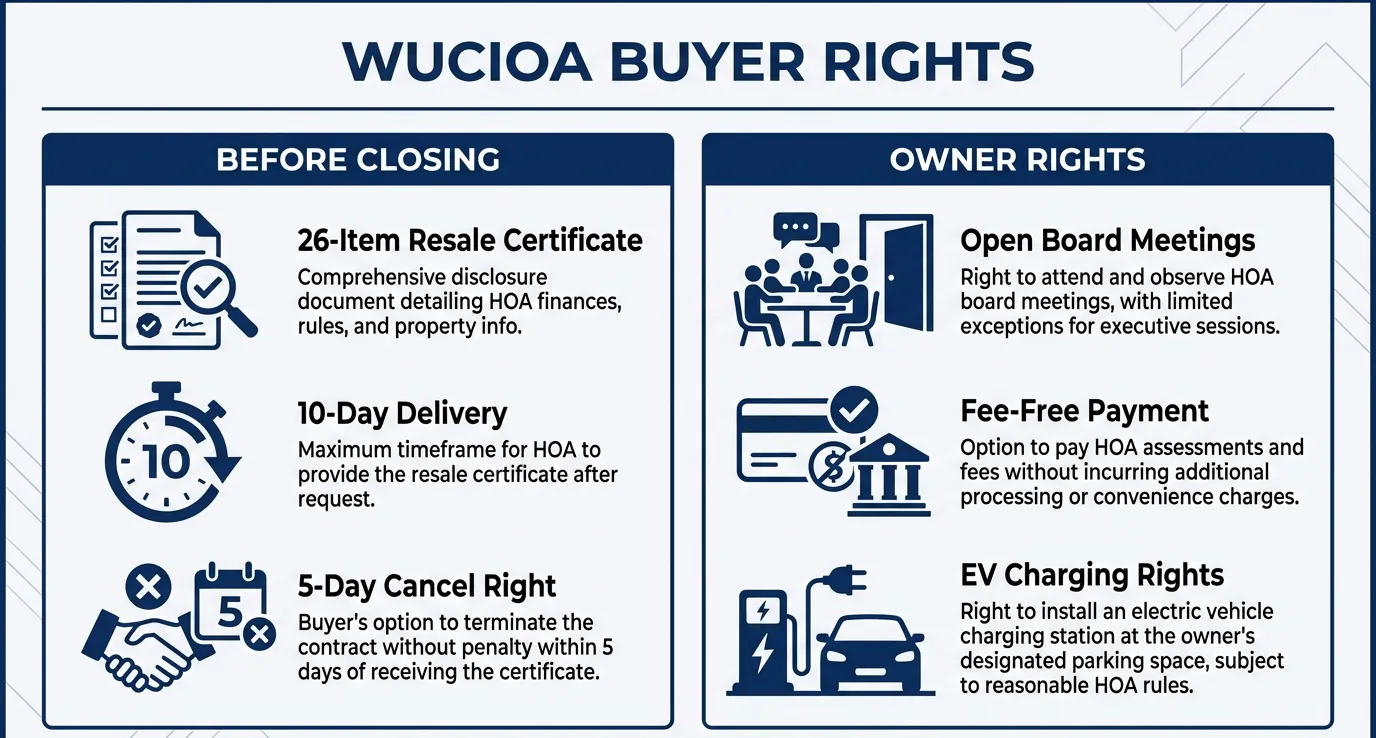
The seller must give you a resale certificate before you sign, or otherwise before closing (RCW 64.90.640). It lists 26 categories, including:
- The current operating budget and latest financial statements
- Whether a reserve study exists, and a copy of the most recent one
- 12 months of board and association meeting minutes
- Insurance coverage and the insurance agent's contact
- Special assessments already levied, and any expense expected to exceed 5% of the annual budget
- Unpaid judgments and lawsuits involving the association
- Rental and occupancy restrictions
- The declaration, bylaws, rules, and, since June 2026, every board policy and resolution in effect
The association must furnish it within 10 days of the owner's request. The charge is capped at $275, plus up to $100 to update a certificate within six months. Since June 11, 2026 the association cannot charge extra for documents already on an owner portal, cannot make the owner open an account with a third party to pay for or receive the certificate, and must write "NONE" or "RECORDS UNAVAILABLE" for any category it leaves out (ESHB 1500).
Your right to cancel: you can cancel within five business days after you first receive the certificate. If it reaches you more than five business days before you sign, the right does not apply. If it arrives fewer than five business days before closing, you can push closing back to the fifth business day after you received it.
The certificate also limits what you can inherit. You are not liable for unpaid assessments above the amount it states, or for an alteration to the unit that breaks the rules if the association should have known about it and left it off the certificate.
Older condos (created before July 1, 2018)
A condo that has not opted into WUCIOA still uses the Condominium Act version, RCW 64.34.425, until 2028. It has the same $275 cap and 10-day delivery. The buyer's remedy is worded differently: you can back out of the contract until the certificate is provided and for five days after, or until closing, whichever comes first.
Older HOAs outside a condo
If you are buying a house in an older HOA that has not come under WUCIOA, there may be no required resale certificate at all. We found no resale certificate section in the Homeowners Association Act (RCW 64.38). Ask your agent which association documents your contract requires the seller to deliver, and when.
Which certificate form your deal uses
Washington has two statewide resale certificate forms, and the right one depends on whether the community is under WUCIOA. According to the Washington Realtors Legal Hotline, a condo still under the Condominium Act uses Form 27, and a house or condo in a WUCIOA community uses Form 27CIC. If the wrong form is delivered, your clock to cancel does not start. Ask your broker which form applies before you count on a cancellation deadline.
Get Your HOA Documents Analyzed
GoverningDocs analyzes CC&Rs, reserve studies, and meeting minutes, identifying red flags, restrictions, and financial risks so you can buy with confidence. Free. No signup required.
Your first full property report is also free. See what you'll get →
Or get your first full report free →New Rights for Existing Owners
Since January 1, 2026, owners in most Washington communities get open board meetings, 15 minutes of comment before votes, a fee-free way to pay, and EV charger rights.
Board meetings are open to owners except for limited executive sessions, and no final vote can happen in one (RCW 64.90.445). Owners get 14 days' notice of a board meeting, or 7 days for an event that could not have been foreseen. The board must set aside at least 15 minutes at the start of each meeting for owners to comment on agenda items before it votes, with at least 90 seconds per owner unless more than 10 owners want to speak. When meetings are held remotely, anyone entitled to take part must have a telephone option.
Associations must offer at least one way to pay assessments at no charge to the owner (RCW 64.90.480(10)).
An association cannot prohibit or unreasonably restrict an EV charging station for an owner's personal use in the unit or in a designated parking space (RCW 64.90.513). An application not denied in writing within 60 days is treated as approved, unless the delay comes from a reasonable request for more information. The owner, and each later owner, pays for upkeep, electricity and damage, so a unit you buy may come with a charger and its costs. Heat pumps get similar protection (RCW 64.90.580).
Three 2026 laws, effective June 11, 2026, add to this. An owner who sends a question by certified mail gets a written answer within 30 days (the association can extend that in limited cases), and the cost of a legal opinion on it is spread across all owners through dues rather than billed to the owner who asked (EHB 1501). Governing documents cannot ban fire-hardened building materials, though reasonable design rules are allowed (SSB 6054). And the rule making the owner pay for a charger or heat pump can no longer be changed by the governing documents (SHB 2354).
If the unit you are buying has a charger or heat pump, ask the seller what it costs each year to run and maintain, because those costs pass to you.
Assessment Collection Protections
An association must mail a delinquency notice within 30 days, wait 15 days before collecting, and meet a minimum balance before it can foreclose.
If many owners in the community are behind on dues, this is the process the association must follow before it can foreclose. The same steps appear in all three Washington laws, WUCIOA (RCW 64.90.485), the Condominium Act (RCW 64.34.364) and the Homeowners Association Act (RCW 64.38.100). Under WUCIOA:
- A notice of delinquency must go out by mail within 30 days after an assessment becomes past due.
- For 15 days after that notice, the association cannot take other collection action. The only charges allowed in that window are printing and mailing, a fee of up to $10, and a single late fee of $50 or 5% of the unpaid assessment, whichever is less.
- Foreclosure cannot start until the owner owes at least three months of assessments or $2,000, whichever is greater, not counting fines, late charges, interest or legal fees, and at least 90 days have passed since that amount built up.
- A second notice has to follow, and foreclosure mediation is available. SB 5686 opened it to association liens as of January 1, 2026.
For a buyer, these rules matter when you read the certificate's line on delinquent accounts across the community. A building where many owners are behind collects slowly, and special assessments are how shortfalls usually get covered.
The Seller's Unpaid Assessments Can Follow You
In a WUCIOA community, the association can collect the seller's unpaid assessments from you. The certificate caps how much.
When a unit is sold (other than by foreclosure), the buyer and seller both owe the seller's unpaid assessments up to closing, and the association can collect the full amount from either one (RCW 64.90.485(17)). You keep the right to recover what you pay from the seller.
Your protection is the certificate. You are not liable for more than the unpaid amount it states. The association must also give an owner or lender a signed statement of unpaid assessments within 15 days of a request, and that statement binds the association.
Before closing, ask your agent to have the seller or your lender request that signed statement, and check that the unpaid balance on it matches the figure the title company is using.
For a deeper look at how assessment debt is handled at closing, see our state-by-state guide to who pays the HOA special assessment at closing.
What Buyers Should Check Before Closing
Find out which law the community is under, then check the certificate, reserve study, minutes and delinquencies before you sign.
- Which law applies: Ask when the community was created and whether it has amended its declaration to opt into WUCIOA. That decides which certificate and which cancellation window you get.
- The certificate itself: In a WUCIOA community, check that every category is answered, including any marked "NONE" or "RECORDS UNAVAILABLE", and that the charge is at or below $275.
- The date you received it: Write it down. Your cancellation window counts from that day.
- Reserve study: Updated this year? Site-inspected by a professional within the last three years? What percent funded is it?
- 12 months of meeting minutes: Look for red flags like deferred maintenance, board conflict, or pending litigation
- Delinquencies: The certificate states assessments more than 30 days past due across the community. Compare that with the operating budget.
- Expected big expenses: Any cost over 5% of the budget must be listed. Ask how it will be paid.
- The right certificate form: Ask your broker whether the community is under WUCIOA (Form 27CIC) or is an older condo under the Condominium Act (Form 27), and check that the certificate you got matches.
If the association takes longer than 10 days to produce the certificate, ask the listing agent why before you set a closing date. A late certificate can move your cancellation window and your closing.
How Washington Compares to Florida and California
Washington is folding condos and HOAs into one law by 2028. It requires annual reserve study updates but sets no minimum reserve balance.
| Feature | Washington | Florida | California |
|---|---|---|---|
| Statute structure | Moving to one law (RCW 64.90) for all communities by Jan 1, 2028 | Separate chapters for condos (718) and HOAs (720) | One act for condos and HOAs (Davis-Stirling, Civil Code 4000-6150) |
| Reserve study | Updated annually, professional site inspection at least every third year (some communities are exempt), no minimum balance | Condo buildings three stories or higher need a structural integrity reserve study (SIRS) and must fund reserves for the items it covers, with limited exceptions such as a pause of up to two budget years after a milestone inspection (Fla. Stat. 718.112) | Visual inspection at least every three years, reviewed annually (Civil Code 5550) |
| Owner comment at board meetings | At least 15 minutes before votes, 90 seconds per owner | Open board meetings required (Fla. Stat. 718.112 for condos, 720.303 for HOAs) | Open board meetings required (Civil Code 4925) |
The reserve rules are where a Washington buyer has to do the most reading. Unlike Florida, which since the Surfside-era reforms makes condo buildings three stories or higher fund reserves for their structural components, with limited exceptions (Fla. Stat. 718.112), Washington leaves the funding level to the board. Unless the community is exempt, for example because its reserve costs are tiny or its units are all nonresidential, the reserve study must be updated annually, with a professional site inspection at least every third year (RCW 64.90.545), and must show the percent funded and a 30-year plan (RCW 64.90.550). Reserve money must be kept separate from the association's other funds (RCW 64.90.535). We found no minimum balance anywhere in these sections.
Because Washington sets no minimum, pull the reserve study from the certificate, read the percent funded and the recommended yearly contribution, and ask the association how it plans to close any gap.
A note on enforcement: these rules are enforced mostly by owners. Under WUCIOA, an owner can sue the association or its management company over resale certificate fees, late delivery or a carelessly prepared certificate, and the court may award attorney fees to the winner (RCW 64.90.640(4)). If you think a rule was broken in your purchase, talk to a Washington real estate attorney.
Frequently Asked Questions
Does my Washington condo or HOA fall under WUCIOA?
WUCIOA (Washington Uniform Common Interest Ownership Act, RCW 64.90) is Washington's single law for condos, HOAs and other common interest communities. It already governs communities created on or after July 1, 2018. Since January 1, 2026, a list of its rules also applies to older communities. It covers every community on January 1, 2028, when the older laws are repealed.
What is a Washington resale certificate and how much does it cost?
In a WUCIOA community it is a 26-category disclosure covering the association's finances, reserve study, minutes, insurance, lawsuits and governing documents. The charge is capped at $275, plus up to $100 for an update within six months, and the association must produce it within 10 days of the owner's request. Older condos use the Condominium Act version, which has the same $275 cap.
How long do I have to cancel after I get the resale certificate?
In a WUCIOA community, five business days after you first receive it, unless it reached you more than five business days before you signed. In an older condo under the Condominium Act, you can back out until the certificate is provided and for five days after, or until closing, whichever comes first.
Is a buyer liable for the seller's unpaid HOA assessments in Washington?
In a WUCIOA community, yes: the buyer and seller both owe the seller's unpaid assessments up to closing, and the association can collect from either. The buyer is not liable for more than the amount stated in the resale certificate, and can recover what they pay from the seller.
Can an HOA in Washington foreclose for unpaid assessments?
Yes, after several steps. The association must mail a delinquency notice within 30 days, wait 15 days before other collection, send a second notice, and wait until the owner owes at least three months of assessments or $2,000, whichever is greater. Since January 1, 2026, owners can use the state's foreclosure mediation program for association liens.
Does Washington require the HOA to keep a minimum in reserves?
We found no minimum. Unless the community is exempt, for example because its reserve costs are tiny, the reserve study must be updated annually, with a professional site inspection at least every third year, and must show the percent funded and a 30-year plan, but the board sets the funding level. Read the percent funded and the recommended contribution before you buy.
Buying a Condo in Washington?
Upload your resale certificate documents for instant analysis. Our tools check CC&Rs, reserve studies, and meeting minutes against insights from 1,900+ HOA documents.
Related Articles
Sources & References
- RCW 64.90: Washington Uniform Common Interest Ownership Act (full chapter text)
- RCW 64.90.640: Resale Certificates (26 categories, $275 cap, five business days to cancel)
- RCW 64.90.485: Assessment Liens (buyer liability for unpaid assessments, delinquency notices, foreclosure limits)
- RCW 64.90.445: Board Meetings (open meeting, 15-minute comment period, notice requirements)
- RCW 64.90.365: Sections Applying to Pre-2018 Communities (the January 1, 2026 list)
- RCW 64.34.425: Condominium Act Resale Certificate (older condos until 2028)
- ESHB 1500, 2026 c 194 (resale certificate changes effective June 11, 2026)
- EHB 1501, 2026 c 128 (30-day answers to owner inquiries)
- SHB 2354, 2026 c 96 (EV charger and heat pump cost rules, reserve study exemption)
- SSB 6054, 2026 c 180 (fire-hardened building materials)
- ESSB 5129, 2025 c 119 (WUCIOA sections extended to older communities)
- E2SSB 5686, 2025 c 393 (foreclosure mediation for association liens)
- HCMP Law: SB 5129 Client Alert (SB 5129 overview)
- VF Law: WUCIOA Phase One Is Live (compliance overview)
- Washington State Bar News: Impacts of WUCIOA (comprehensive overview of standardization impacts)
- CommunityPay: SB 5686 Analysis (foreclosure mediation, late fee caps, collection timeline)
- Summit Law: SB 5129 Overview (what SB 5129 means for HOAs and homeowners)
- Washington Realtors Legal Hotline: WUCIOA Explained (Form 27 vs. Form 27CIC, practical guidance for agents)
- Helsell Fetterman: SB 5796 Legacy Statute Repeal (2028 repeal of RCW 64.32, 64.34, 64.38, 58.19)
- RCW 64.90.580: Heat Pumps (heat pump installation rights)
- Fla. Stat. 718.112: Condominium Bylaws (structural integrity reserve study and reserve funding)
- California Civil Code 5550: Reserve Study (three-year visual inspection, annual review)
Disclaimer: This article is for educational purposes only and does not constitute legal, financial, or real estate advice. WUCIOA requirements and enforcement may vary by community type and formation date. Consult a qualified real estate attorney for guidance specific to your situation. GoverningDocs is not affiliated with the Washington State Legislature or any state agency.