
In This Guide
When HOA reserves hit 0%, every repair is a special assessment. Real cases show per-unit bills reaching six figures (one Boston owner's share was about $360,000), and condo prices in some Florida metros fell 12% to 18% in a year, per Reventure figures reported by Newsweek in November 2025.
In March 2020, a reserve study landed on the board's desk at Champlain Towers South in Surfside, Florida. It showed the building was 6.9% funded, projecting about $706,000 in reserves by January 2021 against roughly $10.3 million needed for planned repairs. Fifteen months later the tower collapsed. Ninety-eight people died.
The collapse had many causes. But the document that should have funded the fix, the reserve study, was a warning no owner got to act on. In our own analysis of 38 Florida SIRS reports (1,993 units, 2023 to 2025), 7 of the 26 buildings with extractable funding data, or 26.9%, were below 30% funded, the funding tier that industry analysts call Weak.
This piece walks through four documented cases where owners were handed huge repair bills, starting with Champlain, where the reserves had all but run out, and what happened next, the financial cascade that follows, and the five board behaviors you can spot in the documents before the assessment notice arrives.
What 0% Funded Actually Means
0% funded means the HOA has no money saved for planned repairs. Every unplanned repair becomes an emergency special assessment levied on current owners.
Percent funded measures what an HOA has in reserves against what it should have based on the age and useful life of building components. Association Reserves groups outcomes into three tiers:
- Weak (0% to 30%): High risk of special assessments and deferred maintenance.
- Fair (30% to 70%): Medium risk. A funding improvement plan is appropriate.
- Strong (70%+): Sufficient reserves. Special assessments unlikely.
A 0% building is past Weak. There is no savings account. When the roof fails or the elevator cable snaps or the insurance carrier demands a coverage upgrade, the board has two options: borrow or assess. Most boards assess, because HOA-backed loans require the same thing the reserves were supposed to prevent, a cash call on current owners.
A building with empty reserves can also fail Fannie Mae's project rules, for example if the association's dues do not put at least 10% of its budget into reserves (unless a qualifying reserve study supports less), or if more than 15% of units are 60 or more days behind on their dues. A building that fails is called non-warrantable, meaning it fails the building-level checks lenders run before making a standard conventional loan. That matters because when a building is non-warrantable, the low-down-payment conventional loans most buyers use are often off the table. Buyers commonly turn to non-QM loans (mortgages made outside the standard Fannie Mae and Freddie Mac rules), which usually need a bigger down payment and carry a higher rate, or they pay cash. The buyer pool shrinks. Prices follow. If you are financing, ask your lender early whether the building is warrantable and what a non-QM loan would cost you.
Four Real Cases of Six-Figure Repair Bills
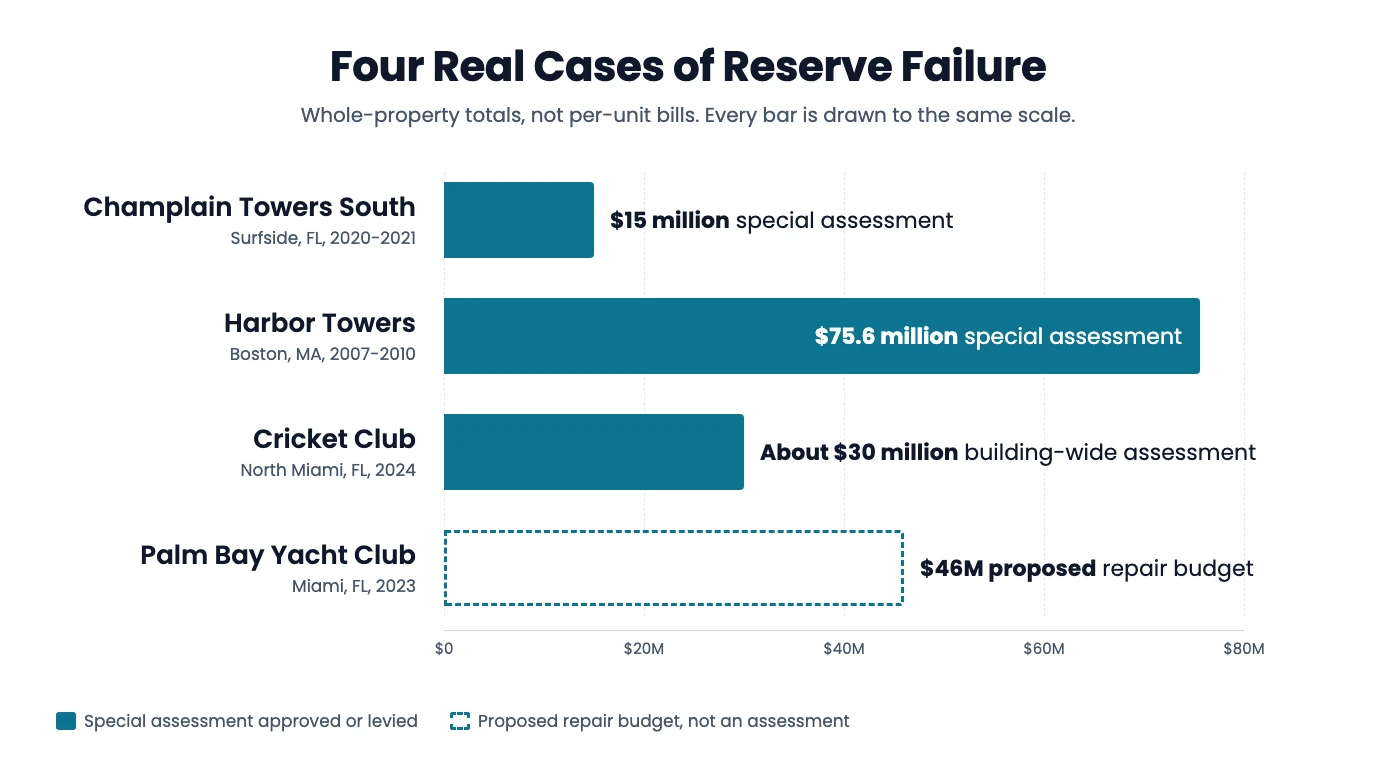
Champlain Towers, Harbor Towers, Cricket Club, and Palm Bay Yacht Club show how fast a major repair becomes a six-figure bill per unit when the money is not already saved. Before you buy, ask whether any assessment has been approved or proposed.
Champlain Towers South (Surfside, FL, 2020-2021)
The March 2020 Association Reserves report was the first reserve study the Champlain Towers South board had ever received. It projected about $706,000 in reserves by January 2021 versus $10.3 million recommended for planned repairs, or 6.9% funded. The study followed a 2018 structural inspection that flagged major structural damage. In April 2021 the board moved to levy a $15 million special assessment. Two months later, on June 24, 2021, the tower collapsed.
Harbor Towers (Boston, MA, 2007-2010)
Harbor Towers is a pair of 40-story towers on the Boston waterfront, completed in 1971. In August 2007 the boards levied a $75.6 million special assessment to pay for critical repairs, mostly the buildings' heating and cooling systems. Bills were allocated at roughly 20% of each unit's value, which for one owner came to about $360,000. The bill went straight to the owners.
Cricket Club (North Miami, FL, 2024)
The Cricket Club in North Miami faced a roughly $30 million building-wide special assessment (Axios Miami, reporting the Wall Street Journal), to pay for roof and facade work, part of the wave of repairs after Florida's post-Surfside inspection rules. One owner, Ivan Rodriguez, had liquidated his 401(k) to buy a unit for $190,000 in 2019 and listed it for $350,000 after the assessment landed. It sold for $110,000, a 42% loss from his purchase price. One sale does not make a market, but it shows how an assessment can follow a unit into its sale price.
Palm Bay Yacht Club (Miami, FL, 2023)
Palm Bay Yacht Club is a bay-front tower on Biscayne Bay. The management company's engineering firm proposed a $46 million repair budget, about $175,000 per unit, tied to 40-year recertification. Owners hired a different engineer who put the figure closer to $23 million and sued. In December 2025 a Miami jury awarded owners $6.3 million in damages against the management company and a contractor for mismanagement and fraud. The case shows how a recertification repair bill can land on owners all at once, and that the first estimate is not always the last word. If the minutes mention recertification, ask for the engineer's report and the proposed repair budget.
Check Your Building's Financial Health
Upload your HOA's reserve study and get instant analysis of percent funded, deferred maintenance, and special assessment risk. Free. No signup required.
Your first full property report is also free. See what you'll get →
Or get your first full report free →The Cascade: How Empty Reserves Destroy Property Value
Emergency assessment leads to delinquency, non-warrantable status, a shrunken buyer pool, and falling prices. Ask the association for its delinquency rate before you make an offer.
The cascade is well documented. When an emergency assessment lands, a share of owners cannot pay. Delinquency climbs. Once a project has more than 15% of units 60 or more days behind on their dues, it fails Fannie Mae's project rules, and Fannie Mae-backed conventional loans in the building stop. Other loan programs set their own rules, so ask your lender which ones apply to the building.
At least one lender that works with these buildings expects their number to grow. In a February 2024 blog post, Universal Capital Mortgage, a California mortgage company that makes loans in non-warrantable condos, warned of a "tidal wave" of them and predicted that insurance problems would keep adding California projects to Fannie Mae's ineligible list. When conventional financing vanishes, buyers turn to non-QM loans (usually a bigger down payment and a higher rate) or cash, and the pool of qualified buyers contracts.
Prices follow. In 2025, Florida condo medians fell YoY in specific metros by amounts far beyond the state average: Punta Gorda, Cape Coral, Tampa and parts of Sarasota down between 12% and 18% year over year (Reventure CEO Nick Gerli's figures, as reported by Newsweek). Gerli tied the drop to rising HOA fees and insurance costs, and Newsweek noted the steep repair costs that followed the post-Surfside safety rules. Miami-Dade relaunched a condo special assessment loan program to help owners pay for repairs required under building recertification laws: loans of up to $50,000, at zero percent interest over 40 years for eligible households, for owners earning up to 140% of the area median income. If you are buying into a Miami-Dade building with an assessment pending, read the county's eligibility rules before you count on this help. For a deeper breakdown of the cascade and how to measure financial health, see the HOA Financial Health pillar guide.
How to Spot a Building Heading Toward 0%
Five board behaviors reliably precede reserve depletion. Each one leaves a paper trail in the reserve study, budget, or meeting minutes.
- Declining percent funded trend. Pull the last two or three reserve studies and compare percent funded. A trajectory from 45% to 32% to 22% is a warning that the contribution rate is not keeping up with the component-replacement schedule. Industry guidance treats the Weak tier (below 30%) as high risk.
- Reserve contribution below 10% of the operating budget. Fannie Mae currently requires at least 10%. Under Fannie Mae LL-2026-03, the minimum rises to 15% for loan applications dated on or after January 4, 2027, when the lender uses Fannie Mae's Full Review process (its standard, lender-run review of the building). A building allocating 6% or 7% is actively underfunding every year.
- Board votes to waive or reduce reserve contributions. Minutes often record these decisions verbatim. A repeated pattern of reserve waivers is a board prioritizing current dues over future solvency.
- No reserve study, or an out-of-date one. Under Fannie Mae Selling Guide B4-2.2-01, a lender that relies on a reserve study wants one completed within three years of the date it approves the project. Check the date on the study you are given. A missing or stale study is both a lender flag and a sign the board has stopped tracking component useful life.
- Same maintenance items tabled across multiple meetings. When the minutes show the same roof, elevator, or plumbing issue deferred across consecutive meetings, the problem is real and the funding is absent. Deferred work compounds into emergency assessments. See the meeting minutes red flags guide for the exact patterns.
You do not need to audit a decade of documents. Two years of meeting minutes, the most recent reserve study, and the current operating budget are enough to see all five signals.
Frequently Asked Questions
What does 0% funded mean for an HOA?
0% funded means the HOA has no money saved against its planned repair obligations. Every unplanned repair becomes an emergency special assessment levied on current owners. The building can also fail Fannie Mae's project rules, which shrinks the buyer pool and pushes values down.
Can an HOA go bankrupt if its reserves hit zero?
HOAs can enter receivership or, in condo settings, be deconverted (sold in bulk to a single buyer). Individual owners can also face foreclosure if they cannot pay an emergency special assessment. Chicago saw a deconversion wave by 2018. Owners there were drawn mainly by the price premium of selling the whole building, and partly to avoid large repair assessments in older buildings.
Is 50% funded safe?
50% sits in the Fair tier (30% to 70%) under Association Reserves' framework. Medium risk. Whether it is safe depends on component ages. A 50%-funded building with a new roof and a young HVAC system is healthier than a 50%-funded building with a roof at RUL = 0.
How do I find out the percent funded for a building I'm considering?
Request the most recent reserve study from the listing agent or HOA management company. Percent funded is usually on the cover page or the executive summary. California associations must hand over the annual budget report, which includes a reserve summary, within 10 days of a written request (Civil Code §4530). Florida condo resale buyers are entitled to the structural integrity reserve study, or a statement that none exists (Fla. Stat. §718.503). Ask before making an offer, not after.
Does 0% funded affect my mortgage?
It can. A building with empty reserves can fail Fannie Mae's project rules, for example if dues do not put at least 10% of the budget into reserves or if many owners are behind on their dues. If it fails, Fannie Mae-backed conventional loans in the building are off the table, so ask your lender early. Buyers commonly turn to non-QM loans, which usually need a bigger down payment and carry a higher rate, or pay cash. This is a financing problem before it is a home-value problem.
Check the reserve study before the assessment finds you
Upload any HOA reserve study and get an instant risk report with percent funded, RUL=0 components, and special assessment risk scoring. Built on analysis of 1,900+ HOA documents. No signup required.
Related Articles
Sources & References
- CNN: Report found Surfside condo association was deeply underfunded, Champlain Towers South 6.9% funded per Association Reserves March 2020 study
- Boston Magazine: The Harbor Towers' Towering Contradictions, $75.6M assessment, allocated at about 20% of each unit's value
- Yahoo Finance: South Florida condo owners are dumping their homes after six-figure special assessments, Cricket Club $30M building-wide and Rodriguez $190K/$350K/$110K resale
- CBS Miami: Palm Bay Yacht Club condo owners say $46 million repair bill doesn't add up, $46M proposed assessment, $175K per unit
- Biscayne Bay Tribune: Palm Bay Yacht Club owners awarded $6.3M, December 2025 jury verdict
- Association Reserves: What Exactly Is Percent Funded?, Weak/Fair/Strong tier definitions
- Association Reserves: Three Quarters of Associations Are Underfunded, national underfunding baseline
- Universal Capital Mortgage: Non-warrantable condominium trends, non-warrantable condominium trends
- Newsweek: Florida condo prices suffer biggest decline since housing market crash, 2025 metro-level declines
- Fannie Mae Lender Letter LL-2026-03, reserve-funding threshold change to 15% on January 4, 2027
- Fannie Mae Selling Guide B4-2.2-01, 36-month reserve-study age requirement
- Bisnow Chicago: Condo deconversion wave hits Chicago, August 2018, on the bulk-sale trend
Disclaimer: This article is for educational purposes only and does not constitute legal, financial, or real estate advice. Case-study facts are drawn from cited news reports and reserve-study summaries at the time of publication. Reserve funding rules, special assessment authority, and lender project-review standards vary by state and by governing document. Consult a qualified real estate attorney before making decisions specific to your situation.