
In This Guide
First-time condo buyers must review CC&Rs for rental restrictions, reserve study funding levels, and special assessments before closing. Don't skip HOA docs.
You found the perfect condo. Great location, within budget, and the monthly HOA fee looks manageable. You sign the contract, close in 30 days, and move in. Four months later, a $12,000 special assessment notice shows up in your mailbox.
This happens more than you'd think. First-time buyers focus on price, location, and layout. The HOA documents are an afterthought. Most people flip through 300+ pages of legalese, understand maybe 10% of it, and sign anyway. The warning signs were there. They just didn't know what to look for.
If you're buying your first condo, understanding HOA documents isn't optional. It's the difference between a smart purchase and an expensive lesson. This guide covers the five things you need to check, the questions to ask your agent, and how to get help when you're short on time.
Why First-Time Buyers Often Choose Condos
Condos are the most affordable entry point into homeownership for many buyers, especially in urban markets.
The math makes sense on paper. Condos often cost less than single-family homes in the same area. You get a lower down payment, a smaller mortgage, and someone else handles the roof, the landscaping, and the exterior maintenance.
For buyers in cities like Miami, Seattle, or San Diego, a condo might be the only way to buy in the neighborhood where they work. Less maintenance responsibility. Urban location. Lower purchase price. It checks every box.
But condos come with something single-family homes don't: a homeowners association. And that HOA comes with documents. Lots of them.
Get Your HOA Documents Analyzed
GoverningDocs analyzes CC&Rs, reserve studies, and meeting minutes, identifying red flags, restrictions, and financial risks so you can buy with confidence. Free. No signup required.
Your first full property report is also free. See what you'll get →
Or get your first full report free →The HOA Document Blindspot
Most first-time buyers don't realize HOA documents can reveal deal-breaking problems that don't show up in the listing or the inspection.
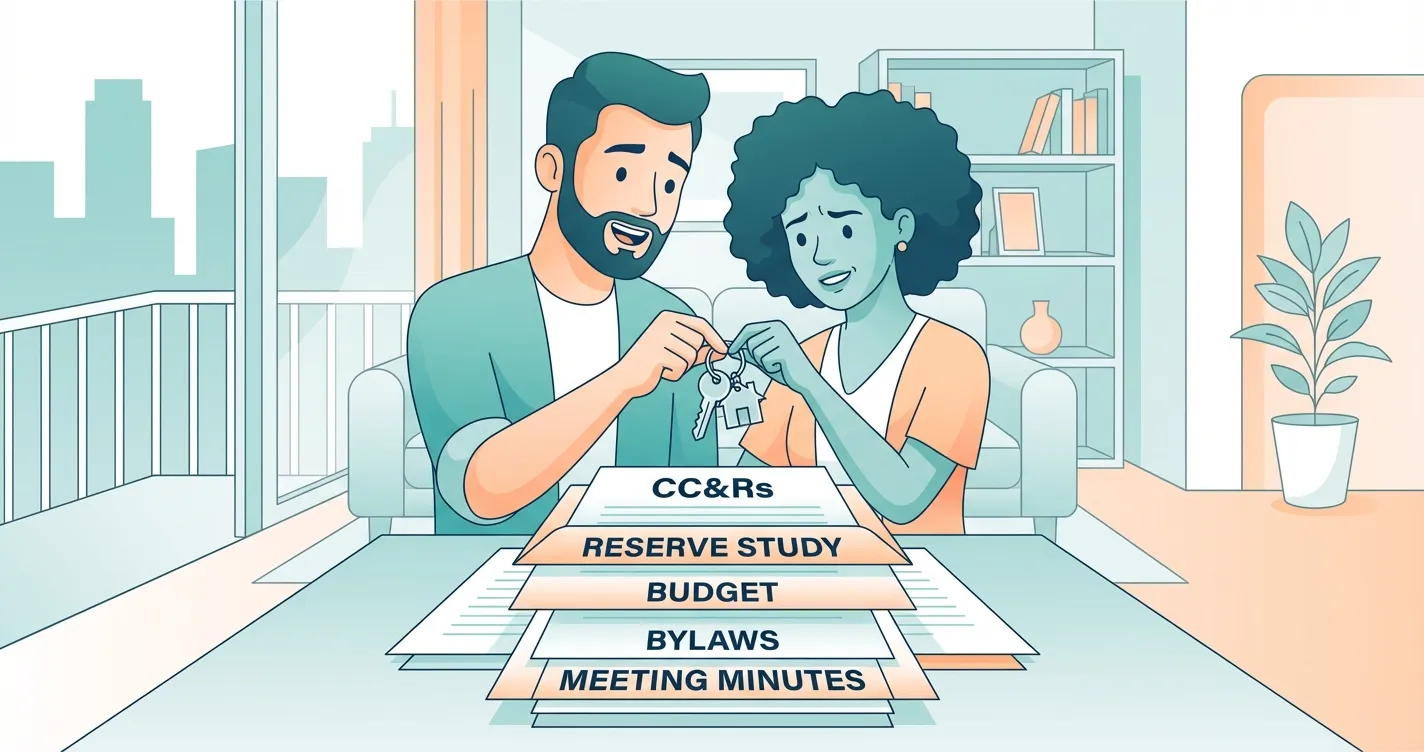
Here's how it usually goes. You make an offer. It gets accepted. During escrow, you receive a stack of HOA documents. CC&Rs, bylaws, budgets, meeting minutes, maybe a reserve study. It's 200-400 pages.
Your agent says something like "let me know if you have any questions." You skim the first few pages, see a lot of legal language, and move on. You're busy picking paint colors and scheduling the move.
The problem is that these documents contain information that can completely change the economics of your purchase. A special assessment the board voted on last month. A rental restriction that kills your backup plan to rent it out if you relocate. A reserve fund so low that a major repair could cost every owner $10,000 or more.
None of this shows up in the listing. Your inspector won't catch it. And your lender might not flag it until it's too late.
5 Things Every First-Time Buyer Must Check
These five items in your HOA documents can reveal thousands of dollars in hidden costs before you close.
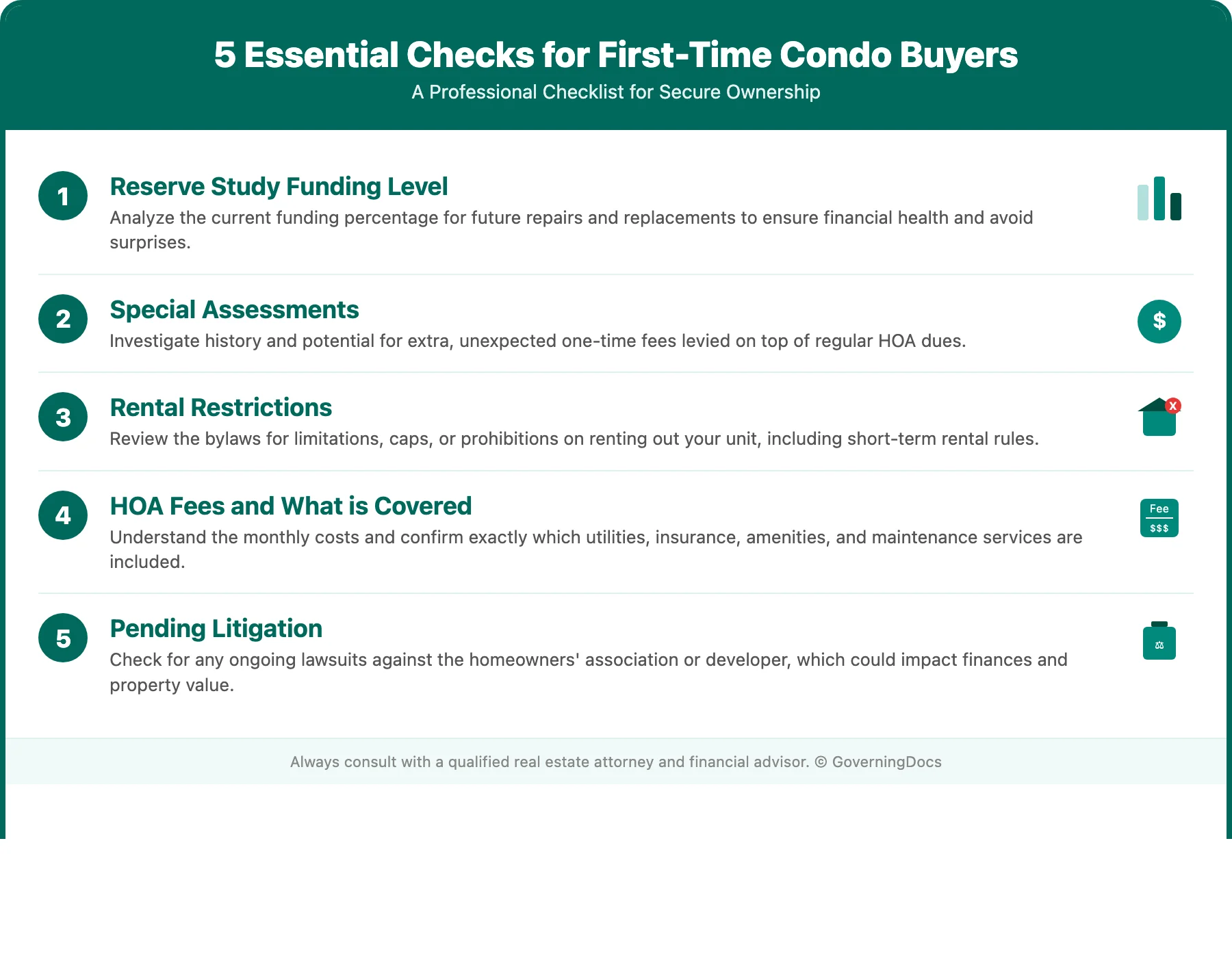
Five critical items to review in your HOA documents before closing
1. Reserve Study Funding Level
The reserve study tells you how much money the HOA has saved for major repairs like roofs, elevators, parking structures, and plumbing. The key number is percent funded.
According to Association Reserves, a reserve study firm, a reserve fund at 70% funded or higher is strong, and special assessments are rare at that level. Under 30% is weak, with a high risk of special assessments and put-off repairs. In between is fair: worth watching, but not an emergency on its own.
In Florida, condo buildings three or more stories tall must have a structural integrity reserve study, and owners can no longer vote to skip or cut the reserves it calls for on structural and safety items like the roof and main structural walls. The law allows a few exceptions, such as a temporary pause, with owner approval, to pay for repairs found by a milestone inspection (a state-required structural inspection of an older building).
Low reserves are not rare. In an April 2026 report on its own clients, Association Reserves found 34% were under 30% funded, and the firm notes its clients may be better funded than average. If your building is in that group, you need to know before you close.
2. Current or Planned Special Assessments
A special assessment is a one-time charge to every unit owner, usually for a major repair the reserve fund can't cover. They can run to thousands of dollars per unit, and far more when a building needs major structural repairs.
Check the board meeting minutes from the last 12 months. If the board has been discussing roof repairs, elevator replacements, or structural issues, an assessment could be coming. Also check the current year's budget for any line items labeled "special assessment" or "capital contribution."
Ask the seller directly: are there any pending or planned special assessments? Get the answer in writing.
3. Rental Restrictions
Even if you plan to live in your condo forever, rental restrictions matter. Life changes. Job relocations, marriage, family growth. If you can't rent your unit, your only option is to sell.
Check the CC&Rs for rental caps (e.g., only 20% of units can be rented at any time), lease minimums (e.g., 12-month minimum, no short-term rentals), and outright bans on leasing. Some associations require board approval before you can rent.
Rental restrictions also affect resale value. A rental ban, or a cap that is already full, rules out any buyer who wants the option to rent, which can shrink your pool of buyers when you sell.
4. HOA Fees and What They Cover
The monthly HOA fee on the listing is just a number. What matters is what it includes. Some associations cover water, sewer, trash, insurance, and reserves in the monthly fee. Others cover almost nothing.
Look at the annual budget. Check whether reserves are being funded from monthly dues or if the board is keeping fees artificially low by skipping reserve contributions. Low fees today can mean a massive special assessment tomorrow.
Also check the history of fee increases. If fees have jumped 10-15% per year for the last three years, that trend is likely to continue.
5. Pending Litigation
Lawsuits against the HOA can signal deeper problems. Construction defect suits, personal injury claims, disputes with contractors. These cost money to defend, and the legal fees come out of the association's budget.
Check the meeting minutes and the financial statements for any references to legal actions, attorney fees, or settlement discussions. Ongoing litigation can also make it harder to get a mortgage. Fannie Mae, for example, generally won't buy loans in a building whose association is a party to a pending lawsuit, though it makes exceptions for some minor cases.
The Short Review Window
Depending on your state and your contract, you may get only a few days to review hundreds of pages of HOA documents and decide whether to move forward.
How long you get depends on your state and your contract. If you are buying a resale condo in Florida and get the association documents after you sign, you have 7 days, not counting weekends and legal holidays, to cancel. In Virginia, unless the contract sets its own period, buyers get three days, counted from when the contract is fully signed or the association's resale certificate (the package of documents and financial details the association gives the buyer) arrives, whichever is later. For a Florida HOA that isn't a condo, a buyer who didn't get the required disclosure summary before signing can cancel within 3 days of receiving it, or before closing if that comes first. Either way, it isn't much time to find a real estate attorney or CPA.
Most first-time buyers don't know what they're looking at. The documents are written by lawyers, for lawyers. Reserve studies are full of spreadsheets and component inventories. Meeting minutes reference motions, quorums, and board resolutions. None of it is written for someone buying their first home.
The temptation is to let the review period run out: trust your agent, hope for the best, and sign. For a deeper look at why this system fails, see our guide on Why the 3-Day HOA Review Period Fails Buyers. Before you sign, ask your agent or the title company exactly when your window to cancel ends, and whether it starts when you sign or when the documents arrive.
Questions to Ask Your Agent
Your agent should be able to answer these questions. If they can't, that's a red flag on its own.
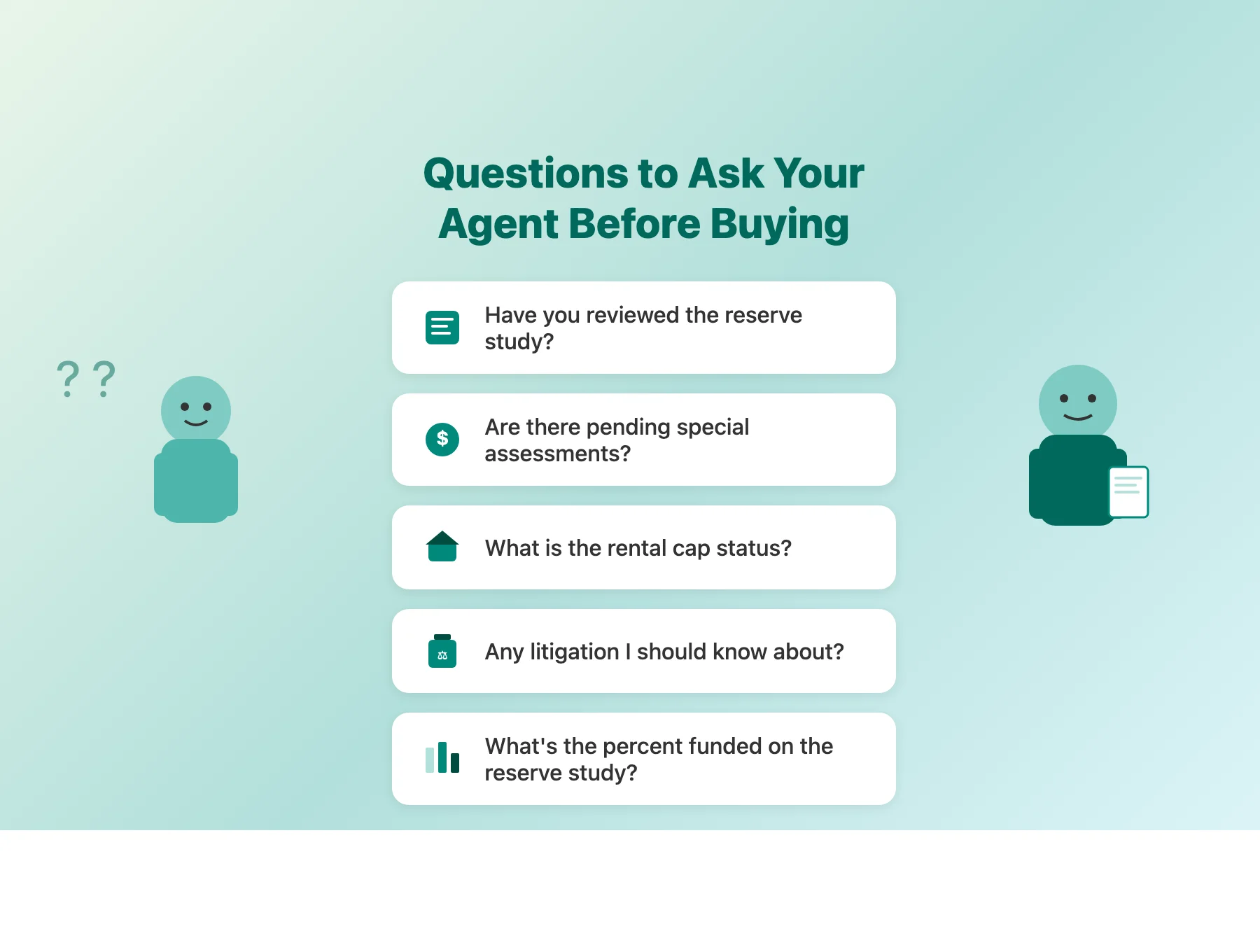
Key questions every first-time condo buyer should ask their agent
A good buyer's agent should be able to walk you through the HOA documents and point out potential issues. If your agent treats the HOA review as a formality, you may want a second opinion.
What $12K in Surprise Assessments Looks Like
A special assessment four months after closing can wipe out your emergency fund and leave you financially trapped.
Here's how it can play out. A first-time buyer closes on a condo for $350,000. They put 5% down. They've got $8,000 left in savings after closing costs and moving expenses. Four months later, the board votes on a $12,000 per-unit special assessment for elevator modernization.
The warning signs were in the documents. The reserve study showed the building was 22% funded. Meeting minutes from six months before the sale mentioned "deteriorating elevator equipment" and "contractor bids." The annual budget showed zero being contributed to elevator reserves.
The buyer didn't read the documents. Their agent didn't flag it. Now they're $4,000 short on an assessment they can't avoid, in a home they just bought.
The cost of not reading HOA documents
A $12,000 special assessment on a $350,000 condo is a 3.4% hit on top of your purchase price. That's money that could have been negotiated off the sale price, or a reason to walk away entirely. Fifteen minutes reviewing the reserve study could have saved $12,000.
How to Get Help Fast
You have options for reviewing HOA documents, ranging from free to a few hundred dollars. The right choice depends on your timeline and comfort level.
DIY With a Checklist
Free
- ✓No cost
- ✓Covers the basics
- ⚠Easy to miss things
- ⚠Requires HOA knowledge
AI Document Analysis
$39 per property
- ✓Fast (results in minutes)
- ✓Covers all document types
- ✓Flags specific red flags
- ✓Links claims to source pages
Real Estate Attorney
- ✓Legal expertise
- ✓Can advise on contract
- ⚠Hard to book on short notice
- ⚠Higher cost
For most first-time buyers, the sweet spot is a combination. Use an AI analysis tool to quickly identify red flags, then consult an attorney if something serious comes up. That way you're not paying attorney rates to read 300 pages of boilerplate, but you have professional backup when it matters.
Bottom Line: Read the Documents Before You Sign
Buying your first condo is one of the biggest financial decisions you'll make. The HOA documents aren't just paperwork. They tell you what you're actually buying into: the financial health of the building, the rules you'll live under, and the costs that aren't in the listing price.
Key takeaways:
Get Your HOA Documents Analyzed
GoverningDocs analyzes CC&Rs, reserve studies, and meeting minutes, identifying red flags, restrictions, and financial risks so you can buy with confidence. Free. No signup required.
Your first full property report is also free. See what you'll get →
Or get your first full report free →Frequently Asked Questions
What HOA documents should I ask for before buying a condo?
Request the CC&Rs (Covenants, Conditions & Restrictions), bylaws, current year's budget, most recent reserve study, last 12 months of board meeting minutes, and financial statements. Together, these give you a complete picture of the association's rules, finances, and any upcoming issues.
What is a good percent funded for an HOA reserve study?
Association Reserves, a reserve study firm, rates 70% funded or higher as strong, where special assessments are rare, and under 30% as weak, with a high risk of special assessments. In between is fair: worth watching, but not an emergency on its own. For more detail, see our guide on How to Read a Reserve Study in 5 Minutes.
Can I negotiate the price based on what I find in HOA documents?
Yes. If you find a pending special assessment, low reserves, or other financial issues, these are legitimate reasons to renegotiate. A $10,000 expected assessment is a valid basis for a price reduction. Your agent can help structure the negotiation.
What happens if I find a problem during the review period?
It depends on your state and your contract. Some states give you a set window to cancel after you get the documents. In Virginia, for example, canceling within that window is without penalty, and your deposit comes back. Elsewhere, your right to back out comes from the contingencies in your contract. If you find a serious issue before your deadline, you can usually walk away, try to renegotiate the price, or ask the seller to fix the problem. Confirm your exact deadline with your agent or attorney before it passes.
Do HOA fees ever go down?
Rarely. HOA fees typically increase over time as maintenance costs, insurance premiums, and labor costs rise. Associations that keep fees artificially low are often underfunding their reserves, which leads to special assessments later. Steady, moderate fee increases are actually a sign of responsible management.
Sources & References
- Association Reserves, "What Exactly is Percent Funded?", the 30% and 70% funding bands
- Association Reserves, HOA Reserves: Industry Insights Report (April 2026), share of its clients under 30% funded
- Florida Statutes, section 718.112, structural integrity reserve studies and condo reserve rules
- Florida Statutes, section 718.503, cancellation window for Florida condo resale buyers
- Florida Statutes, section 720.401, disclosure summary and cancellation for Florida HOA (non-condo) buyers
- Code of Virginia, section 55.1-2312, Virginia buyer's right to cancel after receiving the resale certificate
- Fannie Mae Selling Guide B4-2.1-03, Ineligible Projects, pending litigation and condo loan eligibility
This article is for informational purposes only and does not constitute legal, financial, or professional advice. HOA rules vary by state and association. Consult a licensed real estate attorney or qualified professional for guidance specific to your situation.