

In This Guide
An HOA transfer fee is a one-time administrative charge (commonly $100 to $500) for moving ownership records from seller to buyer, usually billed by the association's management company. It is separate from a capital contribution, a non-refundable buy-in (often two to three months of dues) that goes to the association's reserves. Add move-in deposits and per-document portal fees and a typical condo buyer can face roughly $1,000 to $2,000 in HOA charges at closing that never appeared in the listing. A few states cap these fees; most do not.
The monthly HOA fee was in the listing. You budgeted for it, you budgeted for your down payment and the usual closing costs, and you thought you knew the number. Then the settlement statement arrives and there's a transfer fee, a capital contribution, a move-in deposit, and three separate document charges you've never heard of.
None of these are large enough to break a deal on their own. Stacked together, they routinely add four figures to what you owe at the table, and they tend to surface late, after your inspection contingency is gone and walking away costs you your earnest money. Most of them are legal, most are negotiable, and almost all of them are disclosed somewhere in the resale package you were handed and probably didn't read line by line.
This guide breaks down every closing-time HOA charge, who actually keeps the money, where state law caps it, and the one type of fee that can quietly make a property harder to finance. Read it before you remove your contingencies, not after.
What an HOA Transfer Fee Actually Is
A transfer fee covers the administrative work of updating ownership records at closing. It typically runs $100 to $500 and is usually billed by the management company.
An HOA transfer fee (sometimes called a transfer disclosure fee, account setup fee, or processing fee) pays for the paperwork of moving you onto the association's books. Someone has to update the owner database, change the billing account, reissue amenity passes and gate codes, and transfer the account history from the seller to you. The transfer fee is the charge for that labor.
In practice this fee is usually performed and billed by the management company, not the association itself. As Elina Gilbert of Altitude Community Law puts it, transfer fees "are typically charged by the management company for all the things they have to do for a closing." Some associations frame it as a fee paid to the HOA. Who ultimately keeps it depends on the management contract and the governing documents, so the honest answer is: typically the management company does the work and bills for it, but the split varies by community.
Typical range is $100 to $500, with $200 to $250 the most commonly cited figure. Few states cap it, and several require only that it be "reasonable" and disclosed. The key thing to understand is that a transfer fee is a one-time service charge. It is not money that builds the association's savings, which is exactly what makes the next fee different.
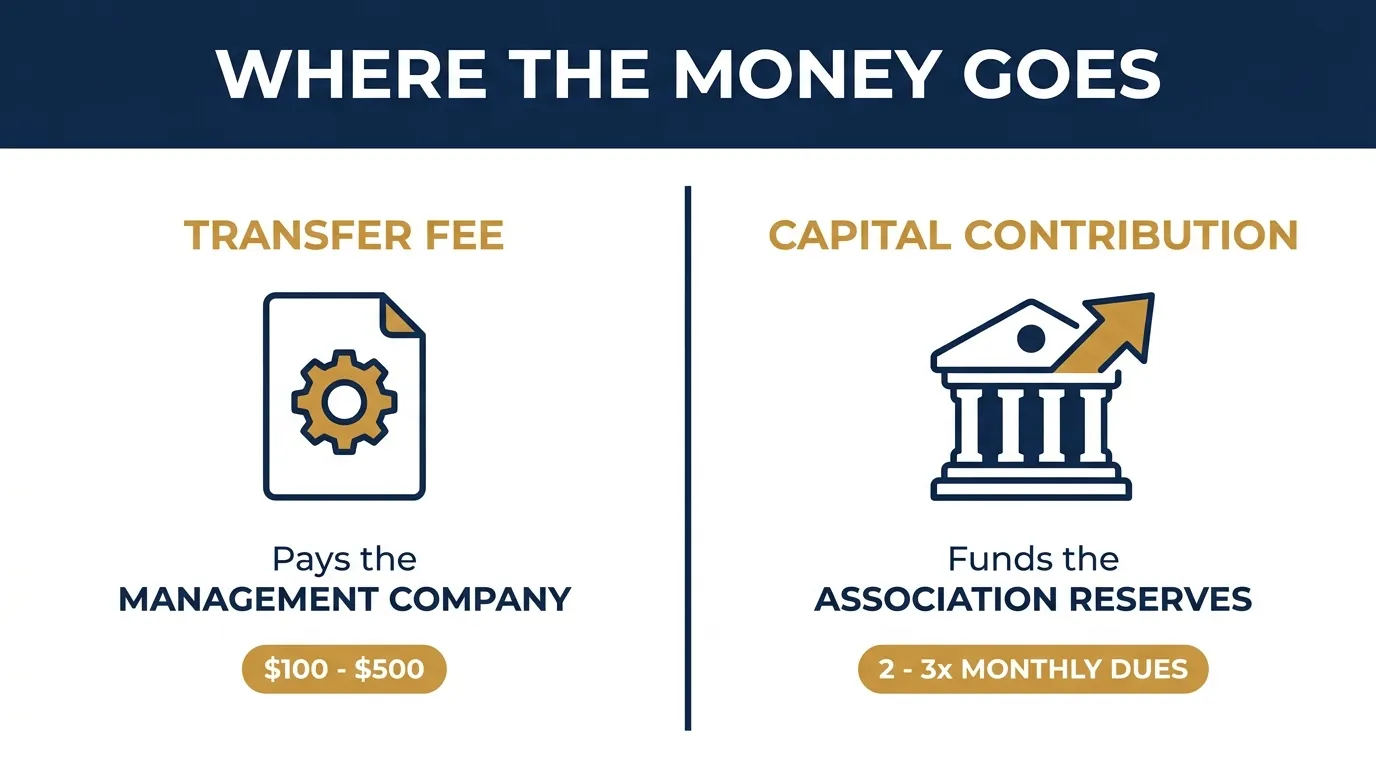
Transfer Fee vs Capital Contribution: Where the Money Goes
A capital contribution is a non-refundable buy-in the buyer pays at closing, often two to three months of dues, that goes into the association's reserves rather than to the manager.
The single most useful distinction in this whole topic is where the money lands. A transfer fee pays the management company for closing work. A capital contribution (also called a working-capital contribution, initiation fee, or buy-in) is a one-time, non-refundable charge the buyer pays at closing, and the proceeds go into the association's reserve or operating fund. It is meant to give the community a cushion and to make every new owner help seed the reserves, rather than leaving that burden on existing owners.
Amounts are bigger than transfer fees. FirstService Residential describes capital contributions ranging from "a few hundred dollars to over $1,000," commonly calculated as two to three times the monthly dues. Associa notes the same two-to-three-month rule of thumb and adds that some communities charge as much as a full year of assessments. In gated and golf communities the buy-in can run into the thousands. One HOAleader account described a buyer hit with a $2,000 "reinvestment fee" (a capital contribution by another name) stacked on top of a separate $100 transfer fee.
Two traps catch buyers here:
- It recurs on every sale. The fact that the seller paid a capital contribution when they bought does not exempt you. Many associations re-charge it on each transfer.
- It is usually fixed, not negotiable on amount. Because the figure is set in the governing documents, the negotiation is over who pays it, not how much it is.
One important state exception: in Florida, condominium associations are not permitted to collect capital contributions from new owners at all under the Condominium Act, and a condo transfer-approval fee is capped at $150 per applicant. Florida HOAs governed by Chapter 720 are not restricted the same way and commonly do charge them. This condo-versus-HOA split trips up buyers and even agents.
The Other Charges Hiding in the Resale Package
Move-in deposits, document and portal fees, estoppel or resale certificate charges, and rush fees all appear separately and are easy to miss until closing.
Beyond the transfer fee and capital contribution, several smaller line items pile up:
- Move-in and move-out fees and deposits. Common in elevator buildings and high-rises. Refundable move-in deposits (returned if there's no damage to common areas) commonly run $100 to $500. Non-refundable move fees, which cover elevator padding, hallway wear, and cleanup, typically run around $100 to $350.
- Document and portal fees. Management companies route resale documents through third-party portals like HomeWiseDocs and CondoCerts on a pay-per-document basis, often $25 to $400 per document, billed separately for each item (the resale certificate, the estoppel, the lender questionnaire). Optional "rush" processing costs extra.
- Estoppel or resale certificate fees. This is the charge for the association's statement of the seller's account standing, the unpaid balance, violations, and pending assessments. It protects you from inheriting the seller's debt, and it is a distinct cost from the transfer fee. We cover it in depth in our guide to the condo resale certificate.
These charges hide for a simple structural reason: each arrives as its own line item near the end of the process, generated by the HOA or its portal rather than by your lender, and labeled in ways a first-time buyer doesn't recognize. By the time they show up on the settlement statement, you're days from closing.
What It All Adds Up To at Closing
For a typical mid-range condo, closing-time HOA charges often total roughly $1,000 to $2,000 beyond your down payment and standard closing costs.
Individually these numbers look small. Here is how they stack for a single, fairly ordinary purchase: a condo with about $250 a month in dues.
| Charge | Typical amount | Who keeps it |
|---|---|---|
| Transfer / processing fee | ~$225 | Management company |
| Capital contribution (2-3x dues) | $500 - $750 | Association (reserves) |
| Refundable move-in deposit | ~$200 | Association (returned if no damage) |
| Non-refundable move fee | ~$150 | Association |
| Document / portal / estoppel fees | $200 - $600 | Management company / portal |
| Illustrative total | ~$1,275 - $1,925 |
That total is a worked example, not a published average, and it sits on top of your down payment and the standard closing costs (title, recording, lender fees). Add a rush fee or buy into a luxury community where the capital contribution alone runs into the thousands, and the figure climbs from there. The point is the order of magnitude: closing-time HOA charges are a four-figure category that most buyers treat as zero.
Where State Law Caps These Fees
A handful of states cap document and resale fees by statute. Most simply require fees be "reasonable." Knowing your state's rule tells you whether a charge is inflated.
There is no federal limit on HOA transfer or document fees, and the large majority of states leave the amount to a "reasonable" or "actual cost" standard. A few states set hard dollar caps, mostly on the resale or estoppel document fee rather than the transfer fee itself. The states with the clearest rules:
| State | Statute | What it caps |
|---|---|---|
| Florida | §718.116(8) / §718.112(2)(i) / §720.30851 | Estoppel certificate capped (base $250, CPI-adjusted to roughly $299), plus statutory add-ons for rush and delinquency. Condo transfer-approval fee capped at $150 per applicant (§718.112(2)(i)); condos may not charge capital contributions. |
| Texas | Prop. Code §207.003 | Resale certificate fee capped at $375, update at $75. Certificate must itemize every transfer-related fee, to whom paid, and the amount. |
| Washington | RCW 64.90.640 | Resale certificate fee capped at $275, update at $100. Buyer not liable beyond amounts stated; 5-day cancellation right. |
| California | Civ. Code §4530 / §4575 | No flat transfer fee allowed. Charges limited to actual record-change cost plus the actual cost of the documents. Seller can buy only the documents they need. |
| Arizona | A.R.S. §33-442 / §33-1806 | Transfer fee covenants executed after July 29, 2010 are unenforceable. Disclosure-fee aggregate commonly capped around $400, plus a rush add-on. |
| Colorado | CCIOA + HB 22-1137 | No fixed dollar cap, but the association must maintain and disclose a list of every transfer-related fee it charges. Fees must be reasonable. |
| Illinois | 765 ILCS 605/22.1 | No dollar cap; the board "may charge a reasonable fee." Reasonableness of vendor document fees has been litigated repeatedly. |
The practical takeaway: in a capped state, you can check a charge against the statutory ceiling and push back on anything above it. Florida buyers, for instance, should question an estoppel charge well above the roughly $299 figure. In an "actual cost" state like California, a flat $300 transfer fee with no cost breakdown is worth challenging. Even where there's no cap, states like Texas and Colorado require the fees be itemized and disclosed, which gives you a list to scrutinize.
The Dangerous One: Private Transfer Fee Covenants
A private transfer fee covenant pays a developer or third party on every future sale. It can make a property ineligible for Fannie or Freddie financing and is void in many states.
Most closing-time HOA fees are an annoyance. A private transfer fee covenant (PTFC) is a genuine risk. This is a recorded covenant, usually imposed by a developer and sometimes labeled a "capital recovery," "reconveyance," or "reinvestment" fee, that requires a payment to a private third party every time the property sells, often for as long as 99 years. The money does not benefit the community. It flows to the developer or an investor who bought the right to collect it.
The reason this matters at the financing stage: under a Federal Housing Finance Agency rule (12 C.F.R. Part 1228), Fannie Mae, Freddie Mac, and the Federal Home Loan Banks generally may not buy or invest in mortgages on properties encumbered by certain private transfer fee covenants created on or after February 8, 2011. A loan they can't buy is a loan most lenders won't make on ordinary terms, so a PTFC can effectively render a property hard to finance.
There is a clear line between a banned PTFC and a legitimate HOA transfer fee. The federal rule carves out an exception for a covenant that pays a "covered association" (your mandatory-membership HOA or condo association) and uses the money exclusively for the direct benefit of the property. A fee that funds your community's operations is allowed. A fee that funnels money to an outside developer on every resale is the problem. On top of the federal rule, roughly 43 states have passed laws restricting or voiding PTFCs. Texas voids them if created on or after June 17, 2007 and requires sellers to disclose any that remain; Arizona makes post-2010 transfer fee covenants unenforceable.
You find these the same way you find any encumbrance: in the recorded declaration and the title commitment. If a "transfer fee" in the documents is payable to anyone other than the association or its agent, treat it as a financing red flag and ask your lender and title company about it before you remove contingencies. The CC&R analyzer surfaces transfer-fee and capital-contribution language buried in a long declaration so you can see who the money is actually payable to.
Who Pays, and How to Negotiate It
Custom varies by market. The transfer fee often falls to the seller, the capital contribution to the buyer, but the purchase agreement controls and everything is negotiable.
There is no universal rule for who pays. The most common defaults: the transfer fee often falls to the seller, since they are the one transferring responsibilities, while the capital contribution is usually paid by the buyer at closing. But custom "varies by state or association," and the document that actually decides it is your purchase agreement, not local habit.
That makes allocation a negotiating lever. A few practical moves:
- Spell out responsibility for the transfer fee, capital contribution, and document fees explicitly in the contract, so nothing is a surprise at the table.
- In a buyer's market, ask the seller to cover or split the transfer fee and the document charges.
- Treat the capital contribution as a fixed cost to budget for rather than negotiate down, since the amount is set by the governing documents. Negotiate who pays it, not what it is.
- If a fee exceeds your state's statutory cap or has no cost basis in a "reasonable cost" state, flag it and ask for documentation before you agree to pay it.
How to Find These Fees Before You Close
Request the full fee schedule in writing during your contingency period, read the resale package, and compare the Loan Estimate to the Closing Disclosure.
These fees are findable. They simply require asking before, not after, your contingencies expire. The work:
- Ask for the complete HOA fee schedule in writing, up front. Before you remove contingencies, request an itemized list: transfer fee, capital contribution, move-in deposit, estoppel or resale certificate fee, document and portal fees, and any rush charges.
- Read the resale disclosure package and the governing documents. The resale package and the declaration are where the capital contribution formula and any transfer fees live. Check whether any "transfer fee" is payable to a party other than the association.
- Watch your Closing Disclosure, Section H. HOA transfer fees and capital contributions appear in Section H ("Other") of the Closing Disclosure, the part for costs not required by your lender. Because these fall in the "no tolerance" category, they can legally rise between your Loan Estimate and the final Closing Disclosure. Ask your loan officer to update the estimate as soon as the HOA figures arrive, and compare the two documents.
- Check the charges against your state's cap. If you're in a capped state, hold each fee up to the statutory ceiling. If you're in an "actual cost" state, ask for the cost basis of any flat fee.
The deeper financial picture matters too. A community charging a healthy capital contribution to seed its reserves is often in better shape than one charging nothing and running its savings down. To see whether the reserves those contributions feed are actually adequate, our reserve study analyzer pulls the percent-funded figure and special-assessment risk out of the reserve study, and the broader framework is in our guide to HOA financial health.
Frequently Asked Questions
What is an HOA transfer fee?
An HOA transfer fee is a one-time administrative charge for moving ownership records from the seller to the buyer at closing: updating the owner database, changing the billing account, and reissuing amenity access. It commonly runs $100 to $500 and is usually billed by the association's management company. It is separate from recurring dues and from a capital contribution.
What is the difference between a transfer fee and a capital contribution?
A transfer fee pays the management company for the administrative work of a closing and is typically $100 to $500. A capital contribution is a one-time, non-refundable buy-in the buyer pays at closing, often two to three months of dues, and the money goes into the association's reserves rather than to the manager. The capital contribution is usually the larger of the two.
Who pays the HOA transfer fee, the buyer or the seller?
It varies by market and association, and the purchase agreement controls. As a common default, the transfer fee often falls to the seller while the capital contribution is paid by the buyer, but all of it is negotiable. Spell out responsibility for each charge in the contract so nothing is a surprise at closing.
How much are hidden HOA costs at closing?
For a typical mid-range condo, closing-time HOA charges (transfer fee, capital contribution, move-in deposit, and document or portal fees) often total roughly $1,000 to $2,000 on top of your down payment and standard closing costs. Luxury and golf communities with large capital contributions can run well above that. The exact figure depends on your dues level, your state, and the building.
Are HOA transfer fees capped by law?
It depends on your state. Florida, Texas, and Washington cap the resale or estoppel document fee by statute. California limits charges to actual cost rather than allowing a flat fee. Arizona caps disclosure fees and voids certain transfer fee covenants. Many states only require that fees be "reasonable." There is no federal cap on HOA transfer fees.
Can an HOA transfer fee affect my financing?
An ordinary HOA transfer fee does not. A private transfer fee covenant can. If a recorded covenant requires a fee payable to a developer or third party on every future sale, Fannie Mae and Freddie Mac generally cannot buy a mortgage on the property under the FHFA rule at 12 C.F.R. Part 1228, which can make it hard to finance. Check the declaration and title commitment for any transfer fee not payable to the association.
Get Your CC&Rs Analyzed
Upload your HOA's CC&Rs and get instant analysis of rental restrictions, pet policies, financing red flags, and more. Free. No signup required.
Your first full property report is also free. See what you'll get →
Or get your first full report free →Related Articles
- The Condo Resale Certificate, Explained: What It Is and Why It Matters
- Can an HOA Raise Fees With No Limit? What Your CC&Rs Actually Allow
- Who Pays the HOA Special Assessment at Closing?
- Fannie and Freddie Condo Rules 2026: The Warrantability Framework
- How to Read HOA Financial Health: The Complete Buyer Guide
Sources & References
- FirstService Residential (capital contribution ranges and 2-3x dues formula)
- Associa (initiation/capital contribution structure and amounts)
- HOAleader (transfer fee vs reinvestment fee; Altitude Community Law commentary)
- Siegfried Rivera (Florida condo capital contribution prohibition; $150 transfer-approval cap)
- Fla. Stat. §718.116(8) (estoppel certificate fee caps and CPI adjustment)
- Tex. Prop. Code §207.003 ($375 resale certificate cap; fee-itemization requirement)
- RCW 64.90.640 (Washington WUCIOA $275 resale certificate cap)
- Cal. Civ. Code §4530 and §4575 (actual-cost document fees; transfer fee restriction)
- A.R.S. §33-442 (Arizona transfer fee covenant prohibition)
- FHFA Final Rule, 12 C.F.R. Part 1228 (private transfer fee covenant restrictions; covered-association exception)
- Tex. Prop. Code §5.202 (Texas private transfer fee obligations void)
- U.S. Census Bureau, 2024 ACS (share of homeowners paying HOA/condo fees)
- Green Ocean Property Management (third-party document portal per-document fees)
Disclaimer: This article is for educational purposes only and does not constitute legal, financial, or real estate advice. HOA fee caps, statutory amounts, and disclosure rules change frequently, condominium and planned-community statutes differ within the same state, and the dollar figures shown are illustrative ranges, not quoted averages. Statutes referenced are current as of June 2026 and may be superseded. Consult a qualified real estate attorney in your state before acting on any specific fee or financing issue.