

In This Guide
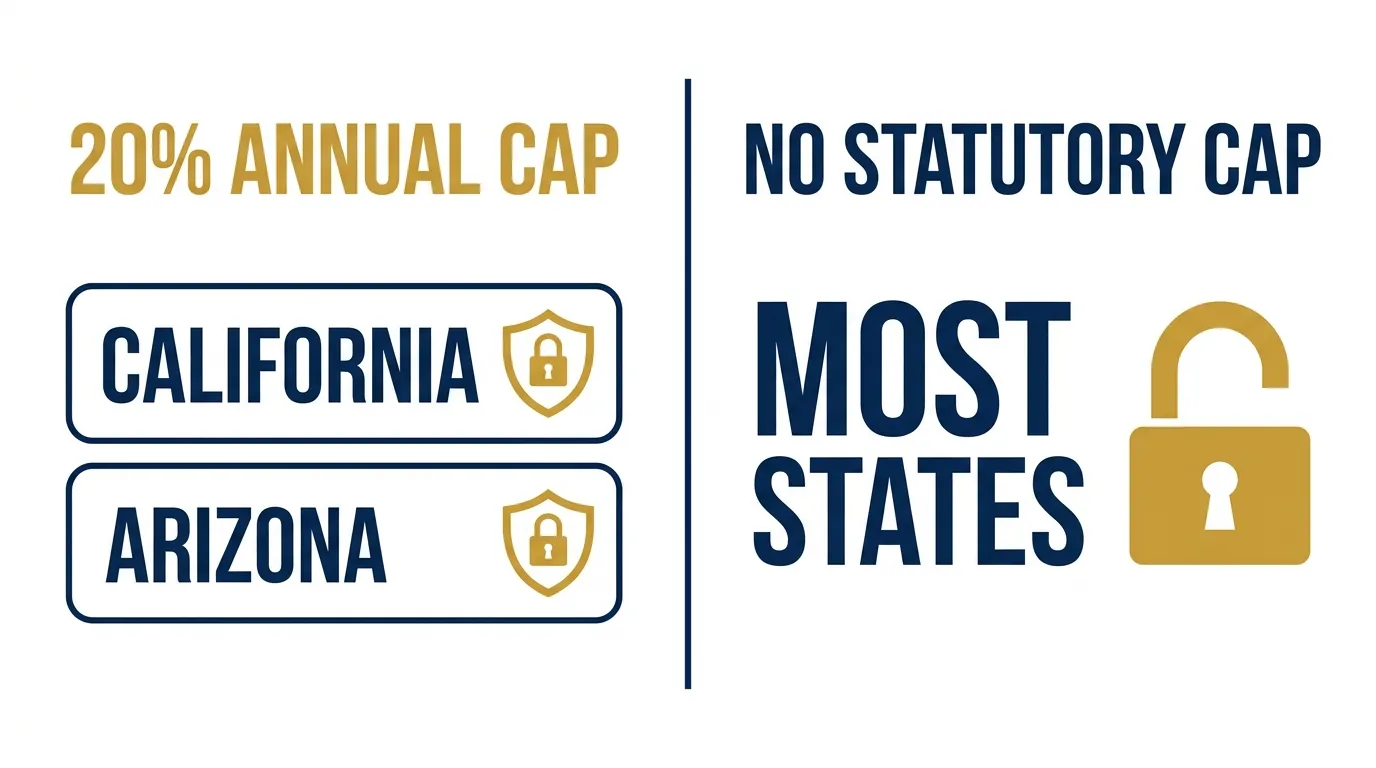
In most U.S. states an HOA can raise your regular dues with no statutory percentage cap. Only California and Arizona impose a hard 20% limit a board cannot exceed without a member vote. A few states (Florida and Illinois condominiums at 115%, plus Colorado, Nevada, Washington, and North Carolina) give owners a way to push back on a large increase (a substitute budget, a petition for a meeting, or a vote to reject the budget) rather than a fixed ceiling. Everywhere else, the only real limit is whatever your CC&Rs spell out. If your declaration has no cap, your board can raise dues by as much as its budget requires.
You read the listing, the monthly HOA fee looks reasonable, and you assume some law keeps it from spiking. Most buyers believe that. Almost none check whether it's true.
Then dues climb 15% one year and 22% the next, and the board never puts it to a vote. You go looking for the legal ceiling that's supposed to protect you. In most of the country, that ceiling does not exist. In 2024 one Florida condo association nearly doubled its dues to roughly $713 a month, with some units paying over $1,000, after insurance costs caught up with it.
The limit on your dues is rarely set by your state legislature. It's set, or left blank, in your association's governing documents. This guide shows you where to find your actual limit before you buy, and what your options are when there isn't one.
The Short Answer: In Most States, Yes
Most states set no percentage limit on regular HOA dues increases. Only California and Arizona cap them, at 20% per year without a member vote.
People assume HOA dues work like rent control. They don't. No federal law limits how much an association can raise fees, and the large majority of states leave the question entirely to each association's governing documents. The board sets a budget, the budget sets your dues, and in most states it takes effect without an owner vote.
The clearest proof of how rare statutory caps are: when Colorado floated a cap in 2022 ( SB22-060, which targeted certain recurring common-element fees rather than general dues), the bill was postponed indefinitely on a 5-0 committee vote and never became law. Caps are the exception, and even narrow attempts to create them tend to fail.
How an HOA Actually Raises Your Dues
The board adopts a budget, and that budget sets your dues. In most states no owner vote is needed, though 30 to 60 days written notice usually is.
A dues increase is not a separate decision an HOA makes. It's a byproduct of the annual budget. The board projects next year's operating costs (insurance, utilities, management, landscaping, repairs) and the reserve contribution, divides the total among the units, and that becomes your monthly assessment. If costs rise, dues rise.
In most states the board can adopt that budget on its own authority. An owner vote is required only when the CC&Rs or state law specifically demand one. What is nearly universal, even where no vote is required, is a notice period: typically 30 to 60 days of advance written notice before the new amount is due. In California, for example, Civil Code §5615 requires individual written notice 30 to 60 days before an increased assessment takes effect, and §5300 requires an annual budget report 30 to 90 days before the fiscal year ends.
So the answer to "can they do this without asking me?" is usually yes. The board has a fiduciary duty to set assessments reasonably, tied to the association's actual needs, but in most states that duty is the only real constraint unless your governing documents add one.
The States That Actually Limit Fee Increases
California and Arizona cap regular increases at 20%. Florida and Illinois condos use a 115% challenge trigger. Other states let owners veto the budget.
Statutory limits fall into four categories. Only the first is a true ceiling. The rest give owners a way to push back, not a hard cap.
| State | Statute | Limit on regular dues increase |
|---|---|---|
| California | Civ. Code §5605(b) | Hard cap. No more than 20% over the prior year without a member vote. Special assessments totaling more than 5% of the year's budgeted expenses need that vote too. |
| Arizona | A.R.S. §33-1803 | Hard cap. Increase above 20% in one year requires majority member approval. CC&Rs can set a lower cap. |
| Florida (condos) | §718.112(2)(e) | Challenge trigger. Over 115% of prior year, the board must also put a stripped-down substitute budget to owners at the budget meeting; a majority of all owners can adopt it. A true cap only while a developer controls the board. |
| Illinois (condos) | 765 ILCS 605/18(a)(8) | Challenge trigger. Over 115%, owners holding 20% of votes can petition within 21 days to force a rejection vote. No hard ceiling. |
| Colorado | C.R.S. §38-33.3-303(4) | Budget veto. No percentage cap. Budget is deemed approved unless a majority of all owners vote it down. |
| Nevada | NRS 116.31151 | Budget veto. No cap. Budget is ratified unless a majority of owners reject it at a meeting. |
| Washington | RCW 64.90.525 | Budget veto. No cap. Budget and its assessments stand unless a majority of owners reject them. |
| North Carolina | Ch. 47F-3-103(c) | Budget veto. No cap (post-1999 communities). Budget is ratified unless a majority of owners reject it. |
| Texas | Prop. Code Ch. 209 | No statutory cap. Any limit lives in the declaration. (§209.0051 only requires open, noticed board meetings.) |
| Georgia | O.C.G.A. §44-3-225 | No statutory cap. No percentage limit and no veto mechanism. The declaration is the only constraint. |
Three points worth flagging. First, the Florida and Illinois 115% figures are condominium statutes; single-family HOAs in those states (Florida Chapter 720, the Illinois Common Interest Community Association Act) work differently. Second, Arizona's 20% cap runs the other way: A.R.S. §33-1803 is a planned-community (HOA) rule, and Arizona condominiums under A.R.S. §33-1242 have no equivalent statutory cap. Third, Florida's 115% is widely misread as a cap. For an owner-controlled board it only means the board must also propose a substitute budget without discretionary spending, which a majority of all owners can adopt instead, and reserve contributions, insurance premiums, and non-recurring items are excluded from the calculation. It is a hard cap only while the developer still controls the board.
Where the Real Limit Lives: Your CC&Rs
The assessment article of your declaration is where any real cap sits. Many cap increases at 5% to 20%; older declarations often have no cap at all.
If your state does not set a limit, your CC&Rs are the only place one can exist. Look in the assessment article of the declaration (sometimes called "Assessments," "Covenant for Maintenance Assessments," or similar). That is where a cap, if there is one, will be written.
Common patterns you'll see:
- A percentage cap on how much the board can raise the annual assessment over the prior year without a vote, frequently in the 5% to 20% range, sometimes stated as a flat dollar amount.
- A supermajority requirement (often two-thirds of all members) to exceed that cap.
- Separate, usually lower, caps for special assessments.
The catch: older declarations frequently have no cap language at all. Many communities recorded in earlier decades simply gave the board authority to set assessments based on the budget, full stop. When there is no CC&R cap and no state cap, the only thing standing between you and an unlimited increase is the board's fiduciary duty to act reasonably. That is real, but it is far weaker and harder to enforce than a number on a page. Raising the cap later is not a quick fix either: it usually requires amending the declaration, which means a supermajority of the entire membership and a recorded amendment.
This is exactly the kind of provision buyers skim past. The CC&R analyzer pulls the assessment article and any increase cap out of a long declaration in one pass, so you can see your actual ceiling before you remove the inspection contingency. For a plain-English primer on the document itself, see what CC&Rs are and why they matter.
Why HOA Fees Keep Climbing
The median condo fee hit about $420 a month in 2025, up 29% since 2019. Insurance spikes and underfunded reserves are the main drivers.
The absence of a cap matters more now because the costs behind dues are rising fast. The median monthly condo fee reached roughly $420 in 2025, up about 29% since 2019, according to Realtor.com data. The U.S. Census Bureau, which broke out HOA fees specifically in its American Community Survey for the first time in 2024, counted 21.6 million households paying a condo or HOA fee, with a median of $135 a month across all homes that carry one. Realtor.com data shows about 43.6% of for-sale listings now include an HOA fee, up from 34.3% in 2019.
Those are medians. Individual buildings move much faster:
- Lakewood Park Condos (Altamonte Springs, FL): dues roughly doubled in 2024, to about $713 a month for the smallest units and over $1,000 for the largest (Florida Daily).
- Miami-Dade County: the metro median condo fee rose from $567 a month in 2019 to $900 in 2024, a 59% jump (Moneywise).
- A California condo owner told The Wall Street Journal his dues more than doubled since 2015, reaching $1,500 a month.
Insurance is the most common accelerant. Wekiva Country Club Villas, a Seminole County, Florida association, saw its insurance premium rise from $91,000 in 2023 to $233,000 in 2024, the kind of single-line cost increase that forces a double-digit dues hike on its own. As Redfin sales manager Eric Auciello put it, condo fees climbing on the back of insurance costs have hurt unit values significantly. Redfin agent Rafael Corrales noted that many Miami buildings, even those without amenities, now carry dues north of $1,000 a month, and that retired owners on fixed incomes are being forced to sell.
When a Dues Increase Is a Warning Sign
A dues increase that funds reserves is healthy. Lenders test reserves and delinquency, not the fee, so artificially low dues are the real risk.
A rising fee is not automatically bad. Counterintuitively, dues that go up to properly fund reserves can protect your ability to finance and resell the unit. Lenders do not penalize a building for charging enough. They penalize buildings that don't.
Fannie Mae's warrantability rules test two financial thresholds, and neither is the fee amount. A project generally fails Full Review if it contributes less than 10% of its budgeted dues income to reserves (rising to 15% for loan applications dated on or after January 4, 2027 under Lender Letter LL-2026-03), or if more than 15% of units are 60+ days delinquent on assessments (Fannie Mae Selling Guide B4-2.2-01). A building with low dues and a starved reserve fund is far closer to non-warrantable than one that raised dues to keep reserves healthy.
So the figure to fear is not a 20% increase that's closing a reserve gap. It's the suspiciously cheap fee that hasn't budged in years while the roof ages. We covered that trap in depth in Are Low HOA Fees a Red Flag? and the warrantability mechanics in Fannie and Freddie Condo Rules 2026.
What You Can Do as a Buyer or Owner
Read three documents: the CC&R assessment article, the budget and reserve study, and 12-24 months of minutes. Then use any state challenge option.
Whether you're buying or already own, the work is the same. Three documents tell you almost everything about your dues risk:
- The CC&R assessment article. Find the increase cap, if any, and the vote threshold to exceed it. No cap is itself a finding.
- The current budget and the full reserve study. A flat or declining reserve contribution against an aging building is a near-certain future increase or special assessment. Percent funded under 30% is what Association Reserves calls weak. The reserve study analyzer flags this quickly.
- The last 12 to 24 months of board meeting minutes. This is where the next increase is discussed before it's billed. Look for "deferred," insurance renewal, and phased repair language.
If a board does raise dues beyond what you think is justified, your remedy depends on your state. In California and Arizona, an increase above 20% requires a member vote you can organize against. In Florida condos, a budget over 115% of the prior year must come with a substitute budget that a majority of all owners can adopt instead; in Illinois condos, it opens a 21-day window for owners holding 20% of votes to petition for a meeting. In Colorado, Nevada, Washington, and North Carolina, you and your neighbors can reject the budget outright if you reach a majority. In Texas, Georgia, and most other states, your leverage is the declaration's own cap (if it has one), the board's fiduciary duty, and electing different directors. For buyers, the cleanest protection is simpler: read the documents during the inspection period and walk if the picture is bad.
Frequently Asked Questions
Can an HOA raise fees with no limit?
In most states, yes. There is no federal cap on HOA fees, and the majority of states set no statutory percentage limit on regular dues increases. Only California and Arizona impose a true cap (20% per year without a member vote). Everywhere else, the only limit is whatever your CC&Rs contain, and many declarations contain none.
Can an HOA board raise dues without a vote?
Usually yes. In most states the board adopts the annual budget, and the budget sets your dues, without an owner vote. A vote is required only where state law or the CC&Rs demand one, such as California and Arizona above 20%, or in budget-veto states like Colorado, Nevada, Washington, and North Carolina, where owners can reject the budget but it otherwise stands.
How much can an HOA raise dues per year?
It depends entirely on your state and your CC&Rs. California and Arizona cap regular increases at 20% per year without a member vote. Most other states have no statutory ceiling, so the answer is whatever your declaration allows. If your declaration has no cap, there is no fixed annual limit beyond the board's duty to budget reasonably.
Can an HOA raise dues without notice?
Almost never. Even where no owner vote is required, nearly every state and most governing documents require advance written notice, commonly 30 to 60 days before the increase takes effect. California, for example, requires individual notice 30 to 60 days before an increased assessment is due under Civil Code §5615. Check your CC&Rs and bylaws for the exact notice period.
How do I challenge an HOA fee increase?
Your options depend on the state. In California and Arizona, an increase above 20% needs a member vote you can oppose. In Florida condos, a budget over 115% of the prior year must come with a substitute budget that a majority of all owners can adopt instead; in Illinois condos, owners holding 20% of votes can petition for a meeting within 21 days. In Colorado, Nevada, Washington, and North Carolina, a majority of owners can reject the budget. In states with no statutory mechanism, your tools are the declaration's own cap, a claim that the board breached its fiduciary duty, and electing new directors.
Does a big dues increase hurt my ability to get a mortgage?
Not directly. Lenders do not test the fee amount. They test whether the building puts at least 10% of its budgeted dues income into reserves and whether no more than 15% of units are 60+ days delinquent (Fannie Mae Selling Guide B4-2.2-01). The reserve minimum rises to 15% for loan applications dated on or after January 4, 2027, under Lender Letter LL-2026-03. A dues increase that funds reserves can actually improve warrantability. Artificially low dues that leave reserves underfunded are the real financing risk.
Get Your CC&Rs Analyzed
Upload your HOA's CC&Rs and get instant analysis of rental restrictions, pet policies, financing red flags, and more. Free. No signup required.
Your first full property report is also free. See what you'll get →
Or get your first full report free →Related Articles
- Special Assessment vs HOA Fee Increase: What's the Difference and Which Is Worse?
- Are Low HOA Fees a Red Flag? When Cheap Monthly Dues Cost You More
- HOA Fees: The Shadow Mortgage Most Buyers Underestimate
- Fannie and Freddie Condo Rules 2026: The Warrantability Framework
- How to Read HOA Financial Statements
Sources & References
- Cal. Civ. Code §5605(b) (member vote needed for regular increases over 20% and special assessments over 5% of budgeted expenses)
- A.R.S. §33-1803 (Arizona 20% regular assessment cap)
- Fla. Stat. §718.112(2)(e) (Florida condo 115% substitute-budget trigger)
- 765 ILCS 605/18(a)(8) (Illinois condo 115% owner petition window)
- C.R.S. §38-33.3-303(4) (Colorado budget-veto model)
- NRS 116.31151 (Nevada budget ratification)
- RCW 64.90.525 (Washington WUCIOA budget ratification)
- N.C. Gen. Stat. Ch. 47F (North Carolina Planned Community Act budget ratification)
- Tex. Prop. Code §209.0051 (Texas open board meetings; no statutory cap in Ch. 209)
- O.C.G.A. §44-3-225 (Georgia POA Act assessments)
- Colorado SB22-060 (failed 10% HOA fee cap, postponed indefinitely 2022)
- Realtor.com / The MortgagePoint (2025 HOA and condo fee medians and growth)
- U.S. Census Bureau, 2024 ACS (21.6M households paying HOA/condo fees, $135 median)
- Florida Daily (Lakewood Park dues doubling; Wekiva insurance premium jump)
- Redfin (Florida HOA fee surge; agent commentary)
- Moneywise (Miami-Dade median fee 2019 to 2024; California owner example)
- Fannie Mae Selling Guide B4-2.2-01 (10% reserve and 15% delinquency thresholds)
- Fannie Mae Lender Letter LL-2026-03 (reserve minimum rises to 15% for loan applications dated on or after January 4, 2027)
Disclaimer: This article is for educational purposes only and does not constitute legal, financial, or real estate advice. State assessment statutes, fee caps, notice periods, and budget-ratification rules change frequently, and condominium and planned-community statutes differ within the same state. Statute subsections referenced are current as of May 2026 and may be superseded. Consult a qualified real estate attorney in your state before acting on any specific assessment-increase issue.