In This Guide
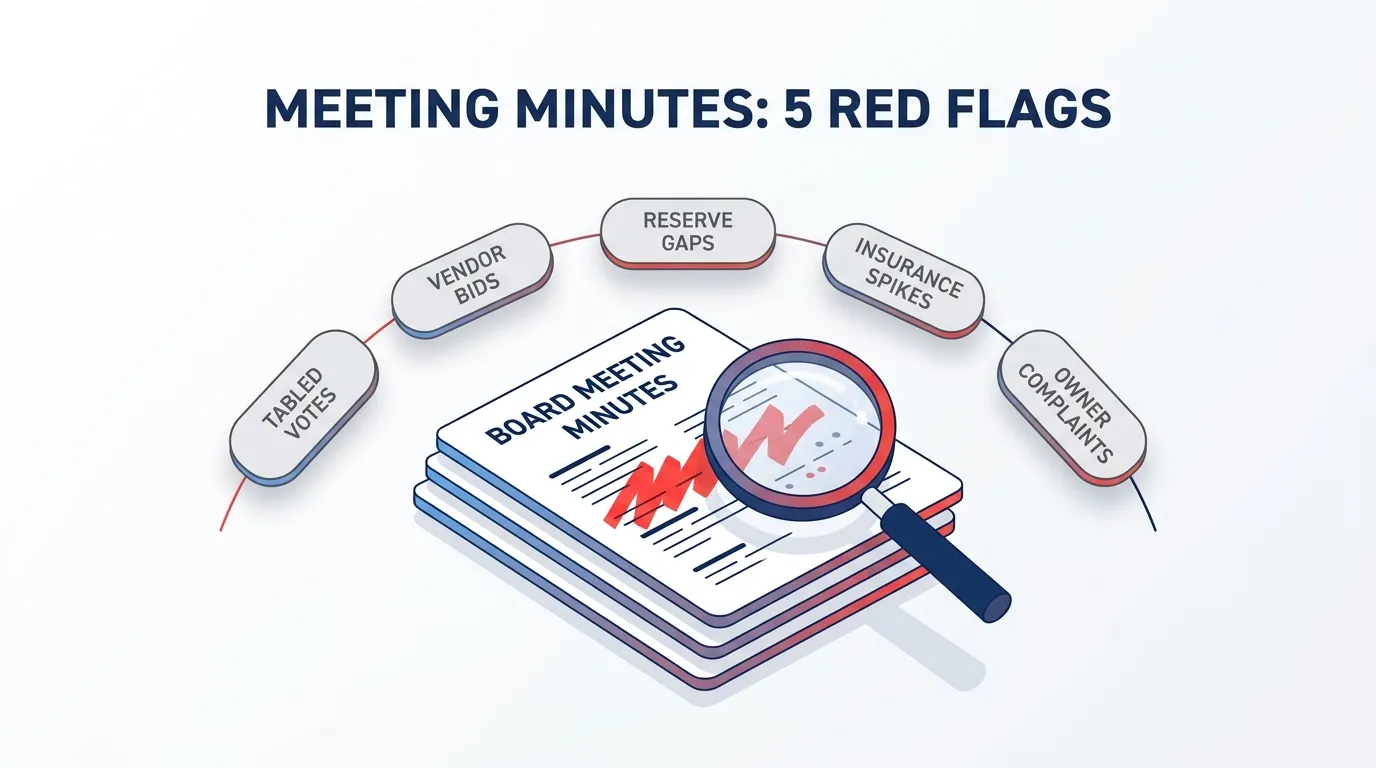
Meeting minutes contain the clearest warnings of upcoming special assessments. Five patterns in the last 12 months of minutes predict what is coming.
Reserve studies show the money. Meeting minutes show the decisions. By the time a six-figure special assessment lands in an owner's mailbox, the board has usually been talking about it, in the open, for a year or more. The minutes are the record.
The scale of the problem is documented. Association Reserves' analysis of more than 100,000 reserve studies found that 74% of associations are below 70% funded, the threshold above which special assessments are unlikely. The figure has run higher in recent years as construction-cost inflation outpaced reserve contributions. Below 30% funded is the tier industry analysts call Weak, where deferred maintenance and surprise assessments become the norm.
Most buyers skim the most recent two or three sets of minutes. That is rarely enough. The patterns below show up across multiple meetings and become visible only when you read 12 months at a time. Each pattern is something a board does, not something it says, and each one leaves a paper trail.
Why Meeting Minutes Are the Most Underrated HOA Document
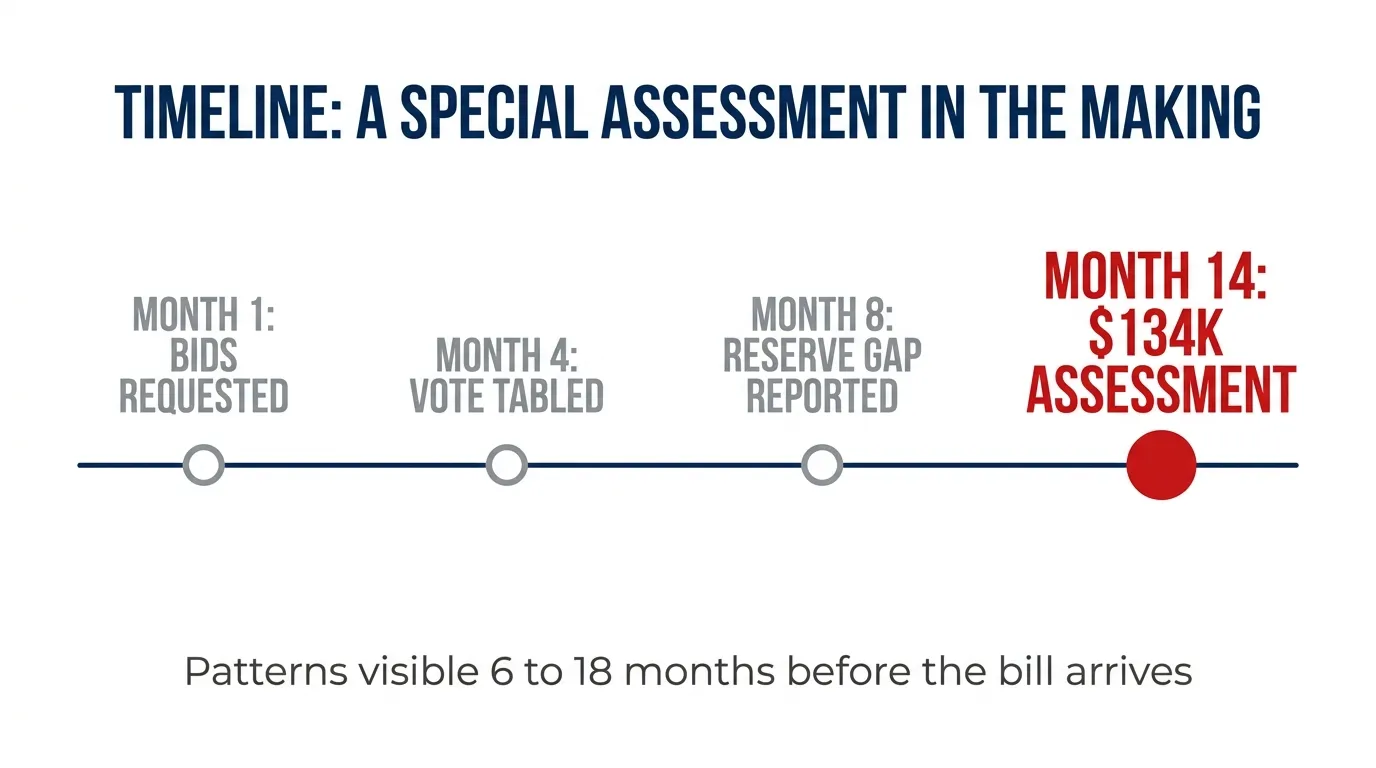
Boards discuss assessments for months before voting. Patterns visible in minutes appear 6 to 18 months before the bill arrives.
Reserve studies tell you the building's funded percentage on a single date. Minutes tell you what the board did about it. A reserve study saying the elevator needs replacement in three years is information. Minutes showing the board has tabled the elevator vote across the last four meetings is a forecast.
State law is unusually generous about access. Florida Stat. §718.111(12) requires condo associations to keep minutes for 7 years and produce them within 10 business days of a written request, with a $50/day penalty (capped at $500) plus attorney fees for denial. California Civ. Code §4950 requires non-executive board minutes available to members within 30 days. Texas Prop. Code §209.005 sets a 7-year retention rule with a 10-business-day response window. Washington's WUCIOA, which covers all common-interest communities starting January 1, 2026 under RCW 64.90.495, gives owners a 21-day records-production window. Most listing agents will produce minutes if the buyer asks early. See our state-by-state guide for the exact request mechanics.
Pattern 1: Maintenance Votes Tabled or Deferred
Search for "tabled," "deferred," "postponed," "revisit next quarter." Three or more deferred capital items in 12 months is a board kicking the can.
The Champlain Towers South timeline is the cleanest illustration. Morabito Consultants delivered a structural inspection in October 2018 flagging "major structural damage" with a roughly $9 million repair estimate. The board did not approve the assessment until April 2021. Roughly 30 months passed between the engineering report and the vote. In September 2019, five of seven board members resigned. Board president Anette Goldstein wrote in her resignation letter: "We work for months to go in one direction and at the very last minute objections are raised that should have been discussed and resolved right in the beginning." The repeated postponement is what attorneys at Hellmuth & Johnson identified as the throughline lesson: deferred maintenance is the precondition for emergency assessments.
What to do with the minutes you have: open a fresh document and list every capital item that comes up across 12 months of meetings. Mark each as approved, tabled, or deferred. If three or more line items are sitting in the tabled column at the end of the year, the board is not maintaining the building. It is delaying the bill.
Pattern 2: Vendor Bids Discussed But Not Approved
Bids requested, discussed, then not approved across multiple meetings means the board knows the work is needed but cannot fund it.
A vendor-bid trail in the minutes usually goes: a board member raises an issue, the manager is directed to solicit bids, two or three bids appear in a later meeting, and then the line item disappears or moves to the next agenda. When the same scope of work cycles through bids twice without a vote, the board is signaling the cash is not there.
Palm Bay Yacht Club shows what happens when that signal gets ignored. The 235-unit Miami tower's management firm proposed a $48.6 million assessment for 40-year recertification work. Owners hired their own engineer who put the figure closer to $23 million and sued. In December 2025 a Miami jury awarded owners $6.3 million for mismanagement and fraud. The competing bids were the warning. Two scopes that differ by $25 million are a sign the board has not done the diligence, not a sign the project is small.
Pattern 3: Reserve Study Recommendations Ignored
Minutes reference the reserve study, then the board adopts a contribution lower than recommended. The gap is the future shortfall.
Champlain Towers South again sets the floor. The first reserve study the board ever received arrived in March 2020 and showed about $706,000 on hand against roughly $10.3 million recommended for planned repairs, or 6.9% funded. By April 2021 the cost had escalated past $16 million and the board approved a $15 million special assessment averaging roughly $110,000 per owner.
The board behavior to look for in your own building's minutes:
- Reserve study is referenced, summarized, then the recommended contribution is reduced or waived for the year
- Operating budget is adopted with a reserve line item below 10% of total assessments
- Minutes mention "funding plan" or "catch-up plan" without a vote attaching numbers
Fannie Mae and Freddie Mac currently require reserve contributions of at least 10% of the operating budget, rising to 15% on January 4, 2027. As MBK Chapman, a California HOA law firm, observes, underfunded reserves are among the most common avoidable causes of special assessments.
Run 12 months of minutes through the meeting-minutes analyzer
Upload any HOA meeting minutes and get an instant report on tabled votes, deferred maintenance, vendor-bid patterns, and special-assessment risk. Built on analysis of 1,900+ HOA documents.
Your first full property report is also free. See what you'll get →
Or get your first full report free →Pattern 4: Insurance Premium Discussions
Premium spikes, coverage gaps, and a board shopping for cheaper policies are an early warning of both special assessments and warrantability problems.
The Florida and Colorado insurance markets are the noisiest signal in current minutes. Florida's Citizens Property Insurance approved an average 14.2% rate increase for 2025 condos, with the broader market reporting premium increases of around 34% since Q4 2022. In Colorado, KRDO's March 2026 investigation documented an owner with a $50,000 HO-6 loss-assessment endorsement receiving only a $1,000 payout on a $17,000+ hail assessment because of a buried per-unit cap.
What this looks like in minutes: line items where the board approves a renewal at a higher premium, or directs the manager to obtain quotes from alternate carriers, or accepts higher deductibles to keep premiums flat. Higher deductibles shift the loss to owners through future assessments. A board shopping for cheaper policies after a major weather event is a flag, not a savings story. For the financing implications, see the condo insurance crisis breakdown.
Pattern 5: Repeated Owner Complaints About Deferred Repairs
Owner comments about the same roof leak, plumbing issue, or facade crack across consecutive meetings means the deferred maintenance is real and growing.
Open meeting laws in most states require that owner comments be summarized in the minutes. When the same complaint shows up across two, three, or four consecutive meetings without a vote authorizing repair, two things are happening: the issue is real enough that owners keep raising it, and the board is choosing not to fund a fix. South Florida Law's 2024 owner-side guidance walks through the rights owners have when assessments land without warning. A board that resists producing bank statements, vendor contracts, or meeting minutes when owners ask is one of the most reliable warning signs of an upcoming special assessment.
Cricket Club in North Miami illustrates the endpoint. The 217-unit, 1975-vintage building had no reserves on the books until 2024. After Florida's post-Surfside SIRS law forced a reckoning, the board levied a $30 million assessment, about $134,000 per unit. The owner complaints had been there for years. The funding had not.
How to Get the Minutes Before You Make an Offer
Ask for 12 months of board meeting minutes during the document-review window. State law gives buyers and owners explicit rights to access them.
Request 12 months of board meeting minutes (not annual meeting minutes alone) from the listing agent or HOA management company. In Florida and Texas the legal retention requirement is 7 years, so the association will have them. Read all 12 months looking for the five patterns above. If a pattern appears, ask for the underlying document, the bid, the engineer's report, the reserve study, before the offer goes hard.
For a deeper read on document review, see the longer red-flag guide and the HOA financial health pillar.
Frequently Asked Questions
How many months of HOA meeting minutes should I review before buying a condo?
Twelve months at minimum. Boards discuss capital projects, vendor bids, and reserve funding across multiple meetings before voting. Patterns like repeatedly tabled votes or recurring owner complaints only appear when you read a full year. State retention rules in Florida, Texas, and Washington keep at least 7 years on file, so 12 months is always available on request.
What does it mean when an HOA tables a vote?
Tabling a vote moves the item to a future meeting without a decision. One tabled vote is normal procedure. Three or more tabled capital items across 12 months of minutes is a sign the board cannot reach consensus on funding, which is the precondition for an emergency special assessment later.
Can the HOA refuse to share meeting minutes with a prospective buyer?
The legal owner of record can compel access; a prospective buyer typically has to ask through the listing agent. Sellers and listing agents will almost always produce minutes when requested early. Florida Stat. §718.111(12) requires owner-requested production within 10 business days with a $50/day penalty for denial. California, Texas, and Washington have similar rules.
Are executive session minutes available to owners?
Most states require a summary of executive session topics to appear in the regular minutes, even when the underlying discussion is confidential (litigation, personnel, contracts). The summary itself often signals risk: repeated executive sessions about "legal matters" or "contractor disputes" indicate active conflict that may produce future assessments.
How early can a special assessment be predicted from meeting minutes?
Six to eighteen months in most cases. Champlain Towers South had a structural report in October 2018 and approved a $15 million assessment in April 2021, roughly 30 months later. Insurance-driven assessments tend to materialize faster, often within a renewal cycle once premium hikes appear in the minutes.
Read 12 months of minutes in seconds
Upload any HOA meeting minutes and get an instant analysis of tabled votes, deferred maintenance, vendor-bid patterns, recurring owner complaints, and overall special-assessment risk. Built on analysis of 1,900+ HOA documents. No signup required.
Related Articles
Sources & References
- Florida Statute §718.111(12), condo records access, 7-year retention, 10-business-day production
- California Civil Code §4950 (Davis-Stirling), 30-day minutes availability for non-executive board meetings
- Texas Property Code §209.005, 7-year retention, 10-business-day response
- Washington WUCIOA / RCW 64.90.495, 21-day records production, effective for all WA CICs January 1, 2026
- Association Reserves: 74% of associations are below 70% funded, 100,000+ reserve studies analyzed
- CNN: Champlain Towers South 6.9% funded, $706K vs $10.3M recommended
- CNN: Five of seven Champlain Towers board members resigned September 2019
- Hellmuth & Johnson: Deferred maintenance lessons from Champlain Towers
- Cricket Club: $30M / ~$134K per owner assessment
- Palm Bay Yacht Club: $6.3M jury verdict, December 2025
- WPTV: Citizens Insurance 14.2% condo rate hike approved
- KRDO: Colorado HO-6 loss-assessment loophole, $1K payout on $50K policy
- South Florida Law: Special assessment warning signs for condo owners
- MBK Chapman: Underfunded reserves and special assessments
Disclaimer: This article is for educational purposes only and does not constitute legal, financial, or real estate advice. State records-access rules, board procedural requirements, and association governing documents vary widely. Patterns described here are diagnostic indicators, not guarantees, and a board following best practice can still face an emergency assessment. Consult a qualified real estate attorney for guidance specific to your situation.