

In This Guide
A condo is a home you own inside a building run by an association, so on top of the mortgage you take on monthly dues, a share of the building's repair costs, the association's rules, and a lender who often checks the building as well as you.
Suppose you rent an apartment today and just found a condo listing that looks like a fair step up. The listing shows a price and a monthly HOA fee. It does not show what that fee pays for, whether the building has money set aside for a new roof, what the rules say about renting the unit out later, or which parts of the building your own insurance policy has to cover. Those answers are in documents that a renter usually never has to read.
This guide goes through what changes when you move from a lease to ownership, and for each change it names the document that answers the question. It is written for a first-time buyer or a renter thinking about buying, and for the agent helping them. It does not compare prices, because the numbers that decide that comparison are in the building's own paperwork.
What You Own When You Own a Condo
A condo buyer owns a unit plus a shared stake in the common areas, and a recorded document called the declaration says where the unit ends.
In Florida, the condominium statute defines a condominium as "that form of ownership of real property created pursuant to this chapter, which is comprised entirely of units that may be owned by one or more persons, and in which there is, appurtenant to each unit, an undivided share in common elements" (Fla. Stat. 718.103). In plain terms, you own your unit, and you share ownership of everything that is not a unit. The same section defines common elements as "the portions of the condominium property not included in the units." Other states word their condominium laws differently, but the shape is the same: a unit you own, and shared property you and your neighbors own together.
Where your unit ends is not guesswork. Florida's statute says a unit is "a part of the condominium property which is subject to exclusive ownership" and that it may be in improvements, land, or both, "as specified in the declaration" (Fla. Stat. 718.103). The declaration is "the instrument or instruments by which a condominium is created" (Fla. Stat. 718.103). It is the first document to read, because it decides which parts of the building are yours and which belong to everyone.
What the Monthly Assessment Pays For
Condo dues usually go straight to the association instead of your mortgage servicer, and the CFPB puts them at a few hundred to over $1,000 a month.
The Consumer Financial Protection Bureau (CFPB) describes how dues are paid: "Condo/co-op fees or homeowners' association dues are usually paid directly to the homeowners' association (HOA) and are not included in the payment you make to your mortgage servicer" (CFPB). The same page says "Homeowners' association dues can range from a few hundred dollars a month to more than one thousand dollars a month," and that a servicer "may be willing" to include the dues in the escrow part of your payment on request, though that is not common. A budget built only on the mortgage payment leaves the dues out.
What the dues buy depends on the building. The CFPB says that "Condominium HOAs take on more responsibilities including, for example, the maintenance of driveways, shared structures, and roofs" than a neighborhood HOA (CFPB key terms). Florida's statute defines an assessment as "a share of the funds which are required for the payment of common expenses," and common expenses as "all expenses properly incurred by the association in the performance of its duties" (Fla. Stat. 718.103). So the monthly assessment is your share of what the association spends to run the building, which is why the association's budget is the document to read. Our comparison of a special assessment and a fee increase explains how the two differ, and the average HOA fees by state post shows typical fees by state.
Reserves and Special Assessments: The Part Most Renters Never See
A reserve study shows how much the association has set aside for big repairs, and a low reserve raises the odds of an extra charge to owners.
When the roof, the elevator or the pipes need replacing, someone pays. In a condo, the owners do, either through reserves the association saved ahead of time or through an extra charge to owners, called a special assessment, when the savings fall short. A reserve study is the report that lists the building's big parts, their age and their replacement cost.
One measure from that report is percent funded. The reserve-study firm Association Reserves explains that "Percent Funded is a reserve study measurement that shows how the current Reserve Fund Balance compares to the association's Fully Funded Balance," computed as of a particular date, and gives a rule of thumb: "Associations under 30% Funded have a high risk of special assessments and deferred maintenance," while special assessments are "rare" at associations that are 70% funded or above (Association Reserves, 2011). That is one firm's general rule from 2011 and carries no legal force, and the figure is a snapshot that changes every year. Our guide to what a good percent funded looks like goes further, and real cases of reserves that hit zero show what happens to owners when the money runs out.
The Rules You Agree To
Buying a condo usually means joining the association, and its governing documents set rules a lease would otherwise set.
The CFPB notes that "Condominiums, co-ops, and some neighborhoods may require you to join the local homeowners' association and pay dues" (CFPB). Membership brings the association's governing documents with it: the declaration, the bylaws, which are the association's operating rules, and any rules and regulations the board adopts. Together they cover questions a lease answers for a renter, such as whether you can rent the unit out, what pets and parking are allowed, and what you can change on the outside. Which rule applies in your building is a question for those documents.
If you might move out and keep the unit, rental limits matter. Our post on whether an HOA can ban rentals after you buy shows how much these rules vary, and the free CC&R analysis tool pulls the rental, pet and parking sections out of a declaration so you can read them first.
Who Insures What
Condo owners usually carry two policies: the association's master policy on the building and their own policy for what the master policy leaves out.
The Insurance Information Institute (Triple-I) explains that two policies are needed to fully insure a condo: "a master policy for the building, and an individual policy to cover you for liability, to protect your belongings and to insure any apartment structural elements that are not covered by the master policy." It adds that the master policy's "premiums come out of your maintenance fee or association dues" (Triple-I). Where the master policy stops varies. In some buildings the association insures the units "as they were originally built"; in others it insures "only the bare walls, floor and ceiling," leaving cabinets, built-in appliances and fixtures to the owner (Triple-I). That information "should be in your association's bylaws and/or proprietary lease."
Lenders care about the gap. Fannie Mae's Selling Guide says the borrower must have a unit owners property insurance policy when "any portion of the interior of the unit or improvements to the unit are not covered by the master property insurance policy, or the master property insurance policy includes a per unit deductible" (Fannie Mae B7-3-04), and Triple-I notes that a lender will require insurance and your condo agreement will likely require it too, on top of the master policy. Our posts on the condo insurance gap and the condo insurance crisis cover what happens when the two policies do not line up.
What a Lender Checks About the Building
For many condo loans, the lender reviews the association's budget and finances, and small buildings can be exempt from that review.
A condo loan depends partly on the building. Fannie Mae's Selling Guide, for the loans it buys, tells lenders that "Lenders must review the HOA projected budget to determine that it is adequate (that is, it includes allocations for line items pertinent to the type of condo project), and provides for the funding of replacement reserves for capital expenditures and deferred maintenance" (Fannie Mae B4-2.2-01). The numeric tests that follow that sentence are in our guide to the Fannie Mae reserve rule, and they change for some applications in January 2027 (Lender Letter LL-2026-03), so this guide does not repeat them.
Not every building gets that review. Fannie Mae waives project review for a unit in a two- to four-unit condo project, and for a unit in a five- to ten-unit condo project "that is not part of a larger development or master association" (Fannie Mae B4-2.1-02). Other lenders and loan programs have their own rules, so your lender is the one who tells you which review your building gets.
When Renting Still Fits
Renting buys flexibility and avoids homeownership's maintenance duties, while owning asks you to plan to stay for years.
An archived CFPB post on the rent-or-buy decision says that "some people rent for the flexibility of knowing they could move if they needed to, or because they're not ready to take on the financial and maintenance responsibilities that come with homeownership," and warns that "you shouldn't depend on being able to sell your home to get out of a mortgage, especially in the early years" (CFPB, archived). The CFPB marks that post as archived and possibly out of date, so read it as a general reminder that may be out of date. For a condo owner, those responsibilities include paying the dues and any special assessments.
Apartment Lease and Condo Purchase, Line by Line
Each line shows what changes between a lease and a condo purchase, with the document that answers it, so you can build your request list.
| Question | Apartment lease | Condo purchase | Where to check |
|---|---|---|---|
| What you hold | The right to live there on the lease's terms | Your unit plus a shared stake in the common elements | Declaration |
| Monthly cost | Set by the lease | Mortgage plus HOA dues, usually paid separately | Budget |
| Big building repairs | Set by the lease | Paid by the association from reserves or a special assessment | Reserve study, board minutes |
| Insurance | Set by the lease and your insurance agent | A master policy for the building plus your own policy | Master policy certificate, bylaws |
| Rules | Set by the lease | Set by the association's governing documents | Declaration, bylaws, rules |
| Who checks the building | Not applicable | Often your lender | Budget, reserve study, insurance |
The Documents to Ask For Before You Make an Offer
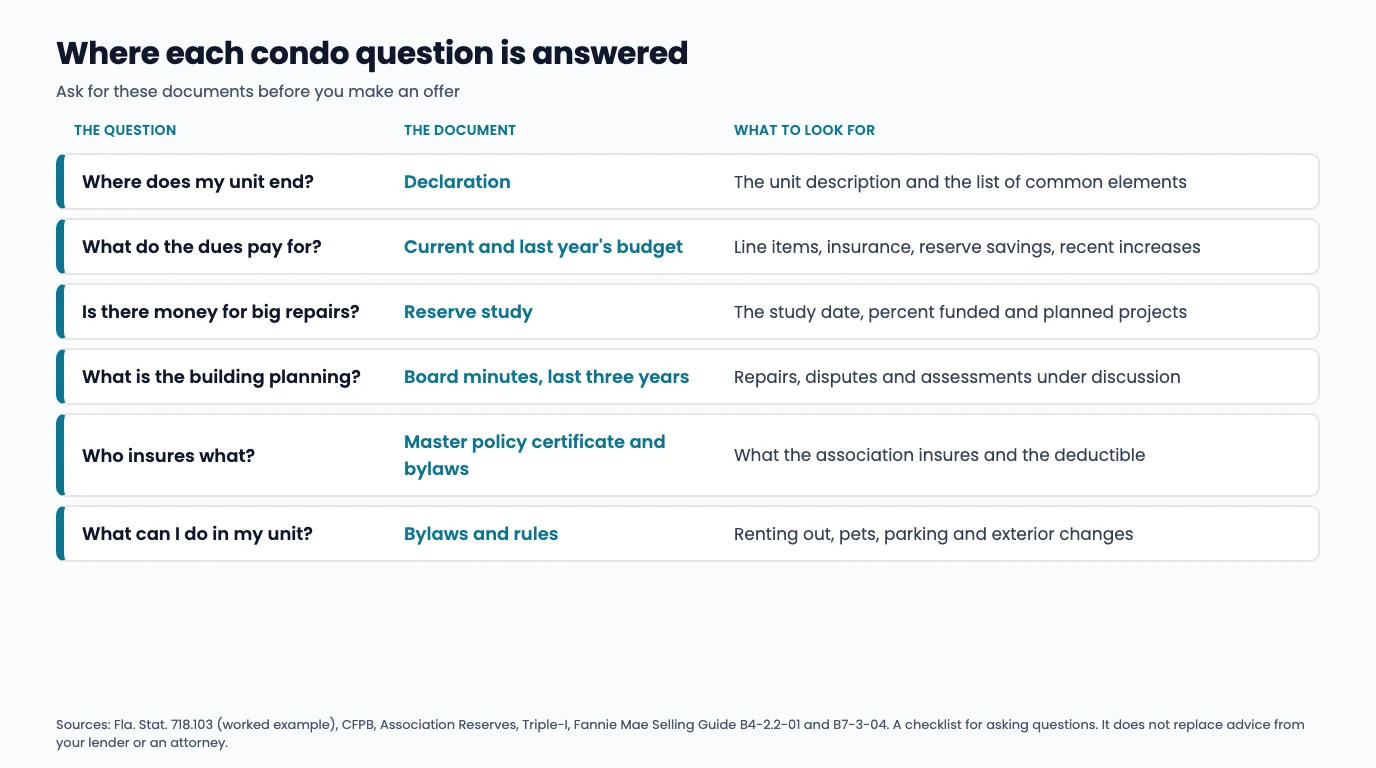
Seven documents answer nearly every question above, and a buyer can ask for all of them before making an offer at no cost.
Send this list to the listing agent. Our guide to getting HOA documents before an offer covers who to ask and how long it can take, and the 2026 condo buying checklist turns the list into a walk-through.
- The declaration, to see where your unit ends
- The bylaws and current rules, to see what you can and cannot do
- The current budget and last year's budget, to see what the dues pay for
- The latest reserve study, to see how much is set aside
- The last three years of board minutes, to see what repairs and disputes are coming
- A certificate of the master insurance policy, to see where it stops
- The resale certificate or estoppel certificate, to see what the association says you owe
A GoverningDocs report reads that packet and lists each finding with the page it came from. It costs $39 per property, your first full report is free when you sign up, and it works as a first step before an attorney and does not replace one. A typical attorney review of the same documents costs between $300 and $1,500 (what an attorney review costs). For a question about your own contract or your state's law, ask a real estate attorney.
Frequently Asked Questions
Is owning a condo the same as owning a house?
A condo owner holds title to a unit and shares ownership of the common areas, while the association runs those shared parts. Florida's statute, for example, defines a condominium as ownership of units with "an undivided share in common elements." The declaration says where your unit ends, and the association's rules apply to you as a member.
Are HOA dues included in my mortgage payment?
Usually not. The CFPB says condo and HOA dues are usually paid directly to the association and are not included in the payment you make to your mortgage servicer, though a servicer may add them to escrow on request. The CFPB also says dues can range from a few hundred dollars a month to more than a thousand.
What is a special assessment?
A special assessment is an extra charge to owners, on top of regular dues, usually when the association needs money it has not saved. Association Reserves says associations under 30% funded have a high risk of special assessments and deferred maintenance, and that they are rare at 70% funded or above. That is one firm's rule of thumb, so read the building's own reserve study.
Do I need my own insurance policy for a condo?
Usually yes. Triple-I says condos need a master policy for the building and an individual policy for your belongings, liability and any structural parts the master policy does not cover, and that a lender will require insurance and your condo agreement will likely require it too. Fannie Mae requires one when part of the unit's interior is not covered by the master policy or the master policy has a per-unit deductible.
Will a lender look at the building as well as me?
Often. For loans it buys, Fannie Mae tells lenders to review the association's projected budget and its funding of replacement reserves, and it waives project review for some small buildings, such as a unit in a two- to four-unit project. Other lenders have their own rules, so ask your lender which review applies.
Is a condo cheaper than renting an apartment?
This guide does not say, because the answer depends on the building's dues, reserves, insurance and rules, and those are in its documents. The items to price are the mortgage, the dues, your own insurance policy and a cushion for a special assessment. The CFPB notes that renting offers flexibility and that owning brings maintenance responsibilities, so compare your plan for staying with the full monthly cost.
Get Your CC&Rs Analyzed
Upload your HOA's CC&Rs and get instant analysis of rental restrictions, pet policies, financing red flags, and more. Free. No signup required.
Your first full property report is also free. See what you'll get →
Or get your first full report free →Related Articles
Sources & References
- Florida Statutes, section 718.103 (definitions, condominium act) (used as a worked example; other states word their laws differently)
- CFPB: Are condo/co-op fees or homeowners' association dues included in my monthly mortgage payment? (last reviewed September 2024)
- CFPB: Mortgages key terms (homeowners' association)
- CFPB: Making the decision to rent or buy (archived content)
- Association Reserves: What Exactly is Percent Funded? (R. Nordlund, 2011)
- Triple-I: Insuring a co-op or condo
- Fannie Mae Selling Guide B7-3-04 (property insurance for individual units in a project development, 08/05/2026)
- Fannie Mae Selling Guide B4-2.2-01 (Full Review process, 08/05/2026)
- Fannie Mae Selling Guide B4-2.1-02 (waiver of project review, 08/05/2026)
Disclaimer: This article is for educational purposes only and does not constitute legal, financial, or real estate advice. Condominium laws differ by state and lender rules differ by loan program; the Florida statute is a worked example, and the Selling Guide sections cited apply to Fannie Mae loans and are as published on October 21, 2026. Insurance and financing depend on the building and your lender. Consult a qualified real estate attorney and your lender for guidance specific to your situation.