

In This Guide
Fannie Mae and Freddie Mac loans applied for from January 4, 2027 face a 15% reserve test. Six states change association rules on January 1.
If you are writing an offer on a condo or an HOA home this winter, two dates you have never heard of may decide how the deal goes: the day your loan application is dated, and the day a new state rule takes effect in the building's state. On a Fannie Mae or Freddie Mac loan, an application dated January 3 and one dated January 4 can face different reserve tests on the same condo.
These dates are scattered across lender letters, flood notices and state session laws, and none of them appear in a listing. An agent who learns in January that the budget fails the new reserve test learns it after the offer is signed.
This calendar covers the Fannie Mae, Freddie Mac and federal flood program dates that reach condo purchases nationwide, plus these states: Georgia, Minnesota, Illinois, Tennessee, North Carolina, California, New Jersey, Florida, Maryland and Washington. It does not cover every state, and several legislatures meet in early 2027, so new rules may arrive mid-year.
The 2027 Calendar at a Glance
Thirteen entries from December 2026 to January 2028, each with the question a buyer or agent can ask before the contract is signed.
| Date | Where | What changes | What to ask |
|---|---|---|---|
| Dec 6, 2026 | Freddie Mac loans | Flood-zone condo buildings with more than 25% commercial space need private flood coverage | Does the master flood policy include private coverage? |
| Dec 11, 2026 | Federal flood program | Authority to sell and renew flood policies lapses unless Congress extends it | Can the seller's flood policy be assigned to me? |
| Dec 31, 2026 | Florida | Outer limit for a narrow group of older condos to finish the structural integrity reserve study | When was the study completed for each building? |
| Jan 1, 2027 | Georgia | Associations register with the state ($100 a year) or file an opt-out | Is the association registered, or did it opt out? |
| Jan 1, 2027 | Minnesota | Seller hands over any reserve study from the last three years; caps on late fees, interest and most fines | Is there a reserve study from the last three years? |
| Jan 1, 2027 | Illinois | No collection lawsuit without a written collection policy | May I see the collection policy? |
| Jan 1, 2027 | Tennessee | Fidelity bond of at least reserves plus a quarter of annual assessments, minimum $10,000 | What is the bond limit, and how does it compare to the reserve balance? |
| Jan 1, 2027 | North Carolina | Annual reports for nonprofit-incorporated associations; first due Nov 15, 2027 | Is the association incorporated? |
| Jan 1, 2027 | California | Replacement window protection; managing agent fee statements become owner records | May I see the architectural rules as revised for 2027? |
| Jan 4, 2027 | Fannie Mae and Freddie Mac loans | Reserve minimum rises from 10% to 15% for loan applications dated on or after this day | What share of assessment income goes to reserves? |
| During 2027 | California, New Jersey, Florida | Inspection deadlines for buildings that reach a certain age | When is this building's inspection due? |
| Oct 1, 2027 | Maryland | Owners in all-residential condos must carry a unit policy; all-detached condos excepted | What is the master policy deductible? |
| Jan 1, 2028 | Washington, Illinois | Washington's newer condo and HOA law reaches older communities; Illinois owner websites due | When was the community created? |
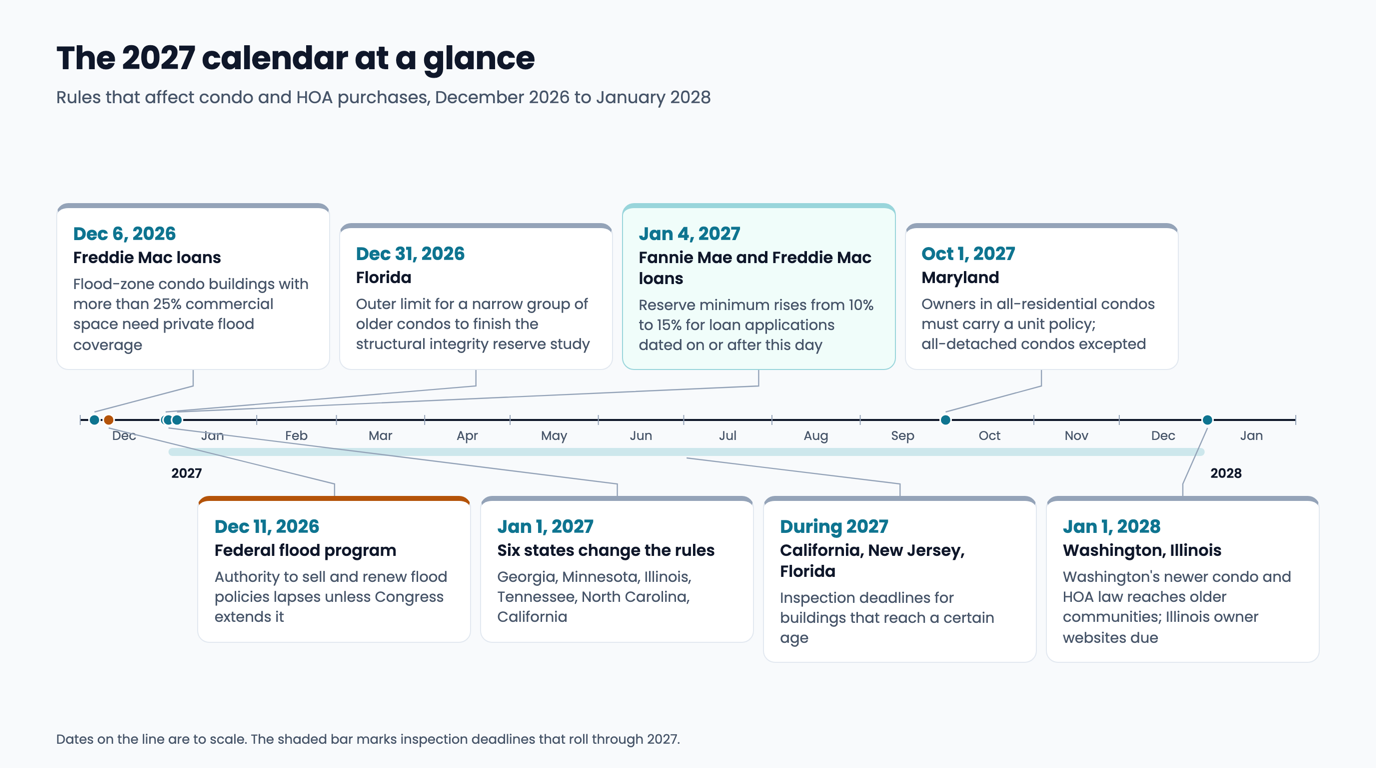
Some dates are worked out from a rule rather than printed in it. Those are flagged below with the condition that triggers them, so check that your building meets it.
Before January: Three Late-2026 Dates That Reach 2027 Closings
Two flood insurance dates and one Florida deadline fall in December 2026. Depending on the loan and the state, a January closing can hit any of them.
December 6: Freddie Mac flood rule for mixed-use buildings
For Freddie Mac loans, starting December 6, 2026, an attached condo building in a flood zone with more than 25% commercial space needs more than the federal program's General Property flood policy (the federal form a building gets when it has too much commercial space for the federal condo building policy). Freddie's Bulletin 2026-13 says that policy, which currently tops out at $500,000 per building, is "insufficient," and the association must carry a private flood policy, alone or on top of the federal one. If the building has ground-floor retail in a flood zone, ask whether the association's flood coverage for the building includes a private policy.
December 11: the federal flood program deadline
FEMA says Congress must reauthorize the National Flood Insurance Program by 11:59 p.m. on December 11, 2026. If authority lapses, FEMA could still pay valid claims but "would stop selling and renewing policies," which can hold up a purchase where the lender requires flood insurance and the buyer needs a new federal policy.
Freddie Mac says its flood requirements stay the same during a lapse, private flood insurance is not affected, and one interim option it accepts is the seller's existing policy assigned to the buyer. If you close in a flood zone around then, ask early whether the seller's policy can be assigned.
December 31: Florida's last date for some reserve studies
If you are buying in a Florida condo building three stories or taller, check whether the association has finished its required reserve study, because a small group still has until the end of 2026. Most associations' deadline has passed: those that existed by July 1, 2022 and are run by owners rather than the developer had to finish a structural integrity reserve study (SIRS) for each building three stories or taller by December 31, 2025. The smaller group got more time: associations that existed on or before July 1, 2022 and whose milestone inspection (Florida's required structural safety inspection for condo buildings three stories or taller) was due by December 31, 2026 could do both at once. For them, the statute says that "in no event may the structural integrity reserve study be completed after December 31, 2026."
Another paragraph of the same law lets a board delay a required study for up to two budget years after a milestone inspection, and how the two fit together is a question for a Florida attorney. Ask the association for the SIRS completion date for each building, and whether the board used that delay. Our explainer on what a SIRS report is covers what the study should contain.
January 1, 2027: Six States Change the Rules
Georgia, Minnesota, Illinois, Tennessee, North Carolina and California change association rules on January 1, from registration to collection limits.
Georgia: registration with the Secretary of State
Under SB 406, Georgia HOAs and condo associations register with the Secretary of State starting January 1, 2027, for $100 a year. An association that neither registers nor files an opt-out cannot collect fines or fees, record liens or start foreclosure. One that files a written opt-out cannot assess or collect fines, fees or accelerated assessments (a demand for the rest of the year's dues all at once when an owner falls behind), so ask which status the association has.
The same law raises the bar for foreclosure, but only in communities under Georgia's Property Owners' Association Act, which reaches only communities whose documents submit to it. There, an association cannot foreclose until the unpaid amount reaches the lesser of $4,000 or 12 months of regular dues, never below $2,000, with fines left out. The association must now wait 60 days after sending notice before it can foreclose, up from 30, and the lien lasts six years instead of four. Georgia's condo law was not changed by that section. Our full Georgia SB 406 guide has the rest.
Minnesota: reserve study disclosure and fee caps
Minnesota's 2026 Laws chapter 82 reaches most communities regardless of when they were created. From January 1, 2027:
- A reselling owner hands the buyer any reserve study, if any, the association obtained in the past three years. This law does not make the association get one.
- Interest on late assessments is capped at 8%, and late fees at the greater of $20 or 5% of the amount owed.
- Most fines are capped at $100 per violation, with exceptions that include repeat violations, safety problems and renting.
- No foreclosure until an owner is more than three months behind, and a written collection policy is required.
Ask the seller for the reserve study by name before you sign, since the law calls for the resale documents before you sign the purchase agreement, or at the latest before closing. More in our Minnesota HOA laws guide.
Illinois: no collection lawsuit without a written policy
If you are buying in an Illinois condo or HOA, ask the manager for the association's written collection policy: from January 1, 2027, without one the association cannot sue owners for unpaid dues. Under Public Act 104-0734, a condo association, or a common interest community association (Illinois's term for an HOA or townhome association that is not a condo) other than a small one, "shall not take legal action to collect" unless it has adopted, and follows, that policy, which must state when dues are payable and when, if ever, an owner can get a payment plan. Under the Common Interest Community Association Act, a small common interest community organized as a nonprofit corporation (10 or fewer units, or $100,000 or less in yearly assessments) is exempt unless it opted in. That exemption does not cover condo associations.
Tennessee: a required fidelity bond
Under Public Chapter 731, a Tennessee HOA or condo association that collects assessments must carry a fidelity bond (theft insurance) equal to the reserve balance plus one quarter of annual assessment income, with a $10,000 minimum. Ask for the bond declarations page and compare its limit to the reserve balance.
North Carolina: annual reports for incorporated associations
North Carolina's S.L. 2026-52 requires nonprofit corporations to file an annual report with the Secretary of State by November 15 each year. The rule starts January 1, 2027, so by our reading the first reports fall due November 15, 2027. An unincorporated HOA is not caught. Ask whether the association is incorporated and, after November 2027, whether it is current. More in our North Carolina HOA laws guide.
California: windows and management fees
California's SB 908 voids association rules that prohibit or restrict an owner from replacing windows with ones that meet the California Energy Code, though reasonable installation rules survive, as do reasonable appearance rules in multifamily buildings of more than 20 units with no townhomes. Separately, AB 739 has boards review the managing agent's fee statement yearly and makes it an association record. A buyer planning upgrades can ask for the architectural rules as revised for 2027.
January 4, 2027: The Fannie Mae and Freddie Mac 15% Reserve Rule
For loan applications dated January 4, 2027 or later, Fannie Mae and Freddie Mac want 15% of a condo budget's assessment income going to reserves.
Fannie Mae's Lender Letter LL-2026-03 raises the minimum reserve contribution in a condo budget from 10% to 15% of annual budgeted assessment income. Lenders must apply it in Fannie's Full Review process (the lender's review of the condo project and its budget) "for all loan applications dated on or after Jan. 4, 2027." Freddie Mac's Bulletin 2026-C makes the same change for mortgages with application received dates on or after January 4, 2027. The 15% rule comes from Fannie Mae and Freddie Mac. FHA and VA condo loans follow their own standards, so ask an FHA or VA lender separately.
The loan application date is what counts. Apply on January 3 and the building is tested at 10%; apply on January 4 and it is tested at 15%, even if both loans close the same week.
Small buildings often skip this test. Fannie Mae and Freddie Mac both skip the project review (the lender's check of the building and association), where the reserve test sits, for detached condo units and for buildings of 2 to 4 units, or 5 to 10 units that are not part of a larger master association, as long as a few other conditions are met. Ask the lender which review your building gets.
As of October 2026, Fannie's online Selling Guide still says 10%. Its August 2026 announcement says the new standard will not appear in the Guide until after January 4, 2027, so the lender letter is the source for 15% until then.
How to check a building. Ask for the current budget. Fannie's method, set out in its Full Review guide page, divides the annual budgeted reserve contribution by the annual budgeted assessment income, which can leave out special assessments and some other income. With $300,000 in assessment income and a $36,000 reserve line, a budget sits at 12%, which passes today and falls short for applications dated January 4 or later, when the line would need to be $45,000. Our Fannie Mae reserve calculator runs the division, and the 15% rule, explained with the actual math walks through harder budgets.
When a lender relies on a reserve study instead, Fannie requires the budget to include the study's highest recommended reserve contribution, and the study must be no more than three years old when the lender approves the project. If the budget comes in under 15%, ask the lender whether the building still qualifies, and which path it will use. The wider set of 2026 changes is in our 2026 Fannie Mae condo rules guide.
Check Your Building's Financial Health
Upload your HOA's reserve study and get instant analysis of percent funded, deferred maintenance, and special assessment risk. Free. No signup required.
Your first full property report is also free. See what you'll get →
Or get your first full report free →Inspection Deadlines That Roll Through 2027
California, New Jersey and Florida tie inspection deadlines to a building's age, so its certificate of occupancy decides whether 2027 is its year.
None of these is a single statewide date. Each runs from the building's certificate of occupancy (the document that cleared it for move-in), so ask for that date first.
California balconies and walkways. Condo buildings with three or more attached units and wood-supported balconies, decks, stairs or walkways more than six feet off the ground had their first inspection due January 1, 2025. Buildings whose permit application was submitted on or after January 1, 2020 have six years from the certificate of occupancy. If the permit was applied for in 2020 or later and the certificate issued in 2021, its deadline falls in 2027. Ask for the report and any repair items. Our California balcony law guide explains what the inspection covers.
New Jersey 15-year structural inspections. New Jersey requires a structural inspection around the 15-year mark for condo and co-op buildings with a concrete, masonry or steel frame. If your building's certificate issued in 2012, that window comes up around 2027. Wood-frame buildings are excluded, but a concrete podium deck under a wood building is still covered. Ask for the report and the reserve study, which the same law requires every five years.
Florida milestone inspections. Florida condo and co-op buildings three habitable stories or taller need a milestone inspection by December 31 of the year they turn 30, or 25 where the local building official requires it because of conditions such as nearness to salt water. If your building's certificate of occupancy issued in 1997, or in 2002 in a 25-year area, its deadline is December 31, 2027. The local agency can extend the first inspection for good cause, so ask whether phase one is done or extended. See our Florida milestone inspection guide.
October 1, 2027: Maryland's Unit-Owner Insurance Rule
Oct. 1, 2027: Maryland requires owners in all-residential condos to carry their own unit policy (an HO-6), and an owner where damage starts owes up to $25,000 of the master deductible (the deductible on the association's building policy).
Maryland's SB 747 requires each owner to keep a unit owner policy (an HO-6 or similar), with proof each year, that includes:
- Coverage for the owner's share of the association's master policy deductible
- Loss assessment coverage of at least $25,000 (it pays the owner's share when the association bills all owners for a loss)
- Dwelling coverage of at least $25,000 or the cost to repair and replace the unit's improvements, whichever is greater
The owner of the unit where damage starts pays the least of the repair cost, the master deductible, or $25,000, up from a $10,000 cap. The unit-policy requirement applies only to condos made up entirely of residential units, and it excludes the units of a condo made up entirely of similar detached units. The $25,000 deductible share reaches more condos, including mixed-use ones.
Ask for the master policy deductible and whether your HO-6 quote covers it. Our post on the HO-6 loss assessment gap explains why the default coverage is often too low.
Already on the Horizon: 2028 and Beyond
A 2027 buyer in Washington, Illinois or Florida faces rules that start or run out in 2028, so ask about them during this year's due diligence.
Washington, January 1, 2028. The Washington Uniform Common Interest Ownership Act (WUCIOA) reaches communities created before July 1, 2018, and the older condo and HOA laws (along with the Land Development Act) are repealed. On that day, provisions in an older community's governing documents that conflict with WUCIOA become invalid, with exceptions for some small plat and "miscellaneous" communities and nonresidential or mixed-use ones. Ask when the community was created and whether the declaration was reviewed for conflicts. See what WUCIOA is and our Washington WUCIOA guide.
Illinois, January 1, 2028. Under Public Act 104-0797, condo boards, and common interest community boards above the same small-association exemption, must provide an owner website with meeting information and approved board minutes. Until then, request the minutes directly; our meeting minutes analysis tool flags recurring issues and disputes.
Florida, budgets through 2028. If a Florida condo finished a milestone inspection within the previous two calendar years, the board can, with approval from a majority of all owners' votes, pause or reduce reserve contributions for up to two annual budgets to pay for the repairs that inspection recommended. It is not available to developer-controlled associations, associations whose owners took over from the developer less than a year ago, or associations controlled by a bulk buyer. It covers only budgets adopted on or before December 31, 2028, and a SIRS is required before contributions resume. Ask whether the association paused reserves, and for which years.
California, 2032. AB 2050 adds a minimum reserve funding rule starting January 1, 2032, which changes nothing at a 2027 closing. An owner still in the unit in 2032 could face a required yearly transfer of at least 15% of the budget to reserves, or a special assessment, if the reserve study shows the fund running dry within 30 years. Ask whether the latest reserve study projects the fund going below zero.
For the questions on the November 3 ballot, see our 2026 election and HOA laws guide.
What to Ask Before You Close in 2027
Most 2027 dates come down to a handful of requests: the budget, the loan application date, the insurance policies and the inspection reports.
- The lender: What date will my application carry, and does this building pass the 15% reserve test on that date?
- The association: The budget, the latest reserve study, the collection policy and the master flood and property policies.
- The insurance agent: Does my HO-6 cover my share of the master deductible?
- The seller: The certificate of occupancy date, any inspection reports, and whether the seller's flood policy can be assigned.
- State-specific: Georgia registration status, Tennessee bond limit, Washington creation date.
If an answer is unclear, or the building falls short on a rule that affects your loan, ask a real estate attorney in the property's state to review the documents before your due diligence period ends.
Frequently Asked Questions
When does the Fannie Mae 15% reserve rule start?
For loan applications dated on or after January 4, 2027. Freddie Mac uses the same date. A loan applied for on January 3 is tested at 10% even if it closes later.
If my condo building was already approved, does the 15% rule still apply?
On a Freddie Mac loan, yes. Freddie says an unexpired project review done before January 4, 2027 does not excuse the lender from confirming the new requirements. Fannie Mae's letter does not address this, so ask your lender how it will handle an existing approval.
What new HOA laws take effect January 1, 2027?
Among the states covered here: Georgia registration, Minnesota reserve study disclosure and fee caps, Illinois collection policies, a Tennessee fidelity bond, North Carolina annual reports, and California window and management fee rules. Other states may have changes too.
What happens to flood insurance if the federal flood program lapses in December?
FEMA says it could still pay valid claims but would stop selling and renewing policies after 11:59 p.m. on December 11, 2026, unless Congress extends the program. Freddie Mac's flood requirements stay the same during a lapse, and it accepts an assignment of the seller's existing policy as interim proof.
Do Maryland condo owners have to carry HO-6 insurance?
Starting October 1, 2027, owners in all-residential Maryland condos must carry a unit owner policy with coverage for their share of the master deductible, at least $25,000 in loss assessment coverage, and dwelling coverage of at least $25,000 or the cost to repair the owner's improvements and upgrades, whichever is greater. Condos made up entirely of similar detached units are excluded.
Check the Budget and Reserves Before Your Application Date
Upload the reserve study or CC&Rs and see percent funded, special assessment risk, lending flags, fees and rental rules in minutes. Free, no signup.
Related Articles
Sources & References
- Fannie Mae Lender Letter LL-2026-03 (March 18, 2026; 15% reserve rule for applications dated on or after Jan. 4, 2027; reserve study and Limited Review changes)
- Fannie Mae Selling Guide Announcement SEL-2026-07 (August 5, 2026; reserve standard added to the Guide after Jan. 4, 2027)
- Fannie Mae Selling Guide B4-2.2-01, Full Review Process (reserve calculation method and three-year reserve study limit)
- Fannie Mae Selling Guide B4-2.1-02, Waiver of Project Review (detached units and 2- to 10-unit projects)
- Freddie Mac Bulletin 2026-C (15% reserve rule; unexpired project reviews) and Guide Section 5701.7 (Exempt From Review for detached units and 2- to 10-unit projects)
- Freddie Mac Bulletin 2026-13 (flood coverage for condo buildings over 25% commercial, effective Dec. 6, 2026)
- Freddie Mac Guide Section 4703.3 (flood requirements during an NFIP lapse)
- FEMA, NFIP Congressional Reauthorization (authorization through Dec. 11, 2026)
- Fla. Stat. 718.112 (SIRS deadlines; post-milestone reserve pause) and Fla. Stat. 553.899 (milestone inspections)
- Georgia SB 406 (2026 Act 715) (bill status)
- Minnesota Laws 2026, chapter 82
- Illinois Public Act 104-0734 and Public Act 104-0797; 765 ILCS 160/1-75 (small-association exemption)
- Tennessee Public Chapter 731 (SB 2326) (enacted text; Senate Amendment 1 sets Jan. 1, 2027)
- North Carolina H.B. 517 (S.L. 2026-52)
- California SB 908, AB 739, AB 2050 and Civil Code 5551 (balcony inspections)
- New Jersey P.L. 2023, c. 214 (structural inspections and reserve studies)
- Maryland Real Property 11-114.3, 11-114, 2026 chapter 717 (SB 747)
- Washington RCW 64.90.360 and RCW 64.90.375
Disclaimer: This article is for educational purposes only and does not constitute legal, financial, or real estate advice. Lender rules, federal flood program authority and state laws can change, and whether a date applies to a building depends on its state, its age, how its association is organized and the loan program. It covers Fannie Mae, Freddie Mac and federal flood program rules and the states named; other states and loan programs are outside its scope. Consult a qualified real estate attorney in the property's state for guidance specific to your situation.