

In This Guide
North Carolina buyers get a seller's HOA disclosure by the time they offer. Which other rules apply depends on when the community was created.
If you are buying a condo or a home in a North Carolina HOA, the seller owes you a short form about the association before you make your offer. What that form leaves out, and which state rules stand behind it, depends on a date most buyers never think to ask about: the year the community was created.
North Carolina has about 15,200 community associations with roughly 2.9 million residents, the fifth-highest association count of any state. No agency polices them. The state Attorney General's office says that "no state or federal agency oversees homeowners' associations", so the documents are your main protection.
Very little changed in 2026. This guide covers which law applies to your community, the disclosure you get before you offer, fees at closing, foreclosure and fines, how the rules can change after you buy, and the questions to ask before you sign.
Which Law Covers Your Community?
HOAs created since 1999 and condos created after October 1986 get the full state law. Older communities get only part of it.
North Carolina has two main laws for community associations, and a community's creation date decides how much of each applies.
- HOAs created on or after January 1, 1999 are fully covered by the Planned Community Act (Chapter 47F). Communities with 20 or fewer lots are left out unless their declaration opts in.
- HOAs created before 1999 get only a listed set of sections, covering amendments, fines and hearings, meetings, liens and records. Even those apply unless the community's own documents expressly say otherwise. An older HOA can adopt the whole Act with a vote of owners holding 67% of the votes, or a smaller share if its declaration allows.
- Condos created after October 1, 1986 are fully covered by the Condominium Act (Chapter 47C).
- Older condos started under an earlier law, but the Condominium Act's rules on liens, fines, budgets, records and meetings reach them anyway, even where their own documents say something different.
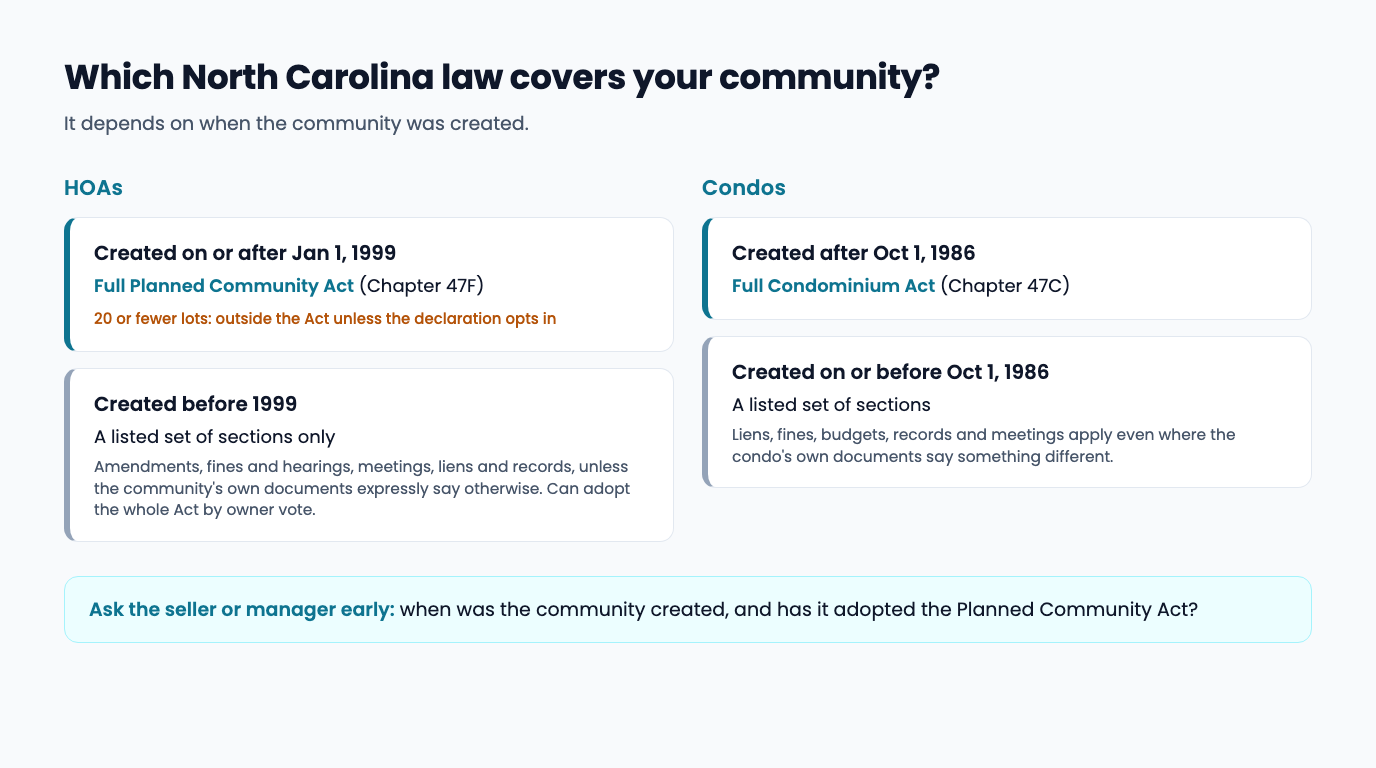
Ask the seller or the manager two things early: when the community was created, and whether it ever amended its declaration to adopt the Planned Community Act. Several rules below turn on the answer.
The HOA Disclosure Due by Your Offer
The seller must give you an HOA disclosure form by the time you offer. If it comes late, you get a short window to cancel.
On most resales of a home with one to four units, the seller must hand you an owners' association and mandatory covenants disclosure statement, and it is due "no later than the time the purchaser makes an offer". The form must cover:
- who runs the association and how to reach them
- the regular dues, and what the dues pay for
- any assessments or fees that have been "duly approved" as of the date the seller signs
- unpaid judgments or pending lawsuits involving the lot, the community or the association (the association's own suits to collect dues from other owners are left out)
- fees charged when the home transfers to a new owner
Three limits keep this form from being the whole story.
The seller can decline to answer. For each item the seller may mark "no representation", and a seller who does that has no duty to disclose those conditions.
Assessments still being discussed do not have to appear. Only charges already "duly approved" when the seller signs are covered. Recent board minutes are where a planned special assessment shows up first.
The cancel right exists only if the form was late. If you did not get it by your offer, you may cancel, but the right ends at the earliest of the third calendar day after you receive the form, the third calendar day after the contract, or closing or move-in. This is not a general cooling-off period.
The form is a seller's summary. Use it to decide what to request, then ask for the declaration, the budget, the latest financial statements and the last year of minutes. Our guide on getting HOA documents before you offer covers how to ask.
Fees and Balances at Closing
The HOA payoff statement is due in 10 business days and capped at $200. No statewide cap applies to other transfer fees.
Before closing, the seller or the closing attorney asks the association for a statement of unpaid assessments, the balance that has to be paid off. The association must provide it within 10 business days of a written request, and the statement binds the association. The same rule applies to condos.
| Charge | Limit in state law |
|---|---|
| Statement of unpaid assessments | $200 per statement or request |
| Expedite fee | Up to $100, only if the request is made within 48 hours of closing |
| Transfer, move-in or capital contribution fees | No dollar cap; must be listed on the HOA disclosure form. A separate state law means later buyers do not have to pay a resale fee that a deed or declaration sets up for the developer or another outside party |
| Late fees | The greater of $20 a month or 10% of the unpaid installment |
| Interest on past-due assessments | Up to 18% a year, unless an HOA created before 1999 has a declaration that sets its own rate |
The fee and late-charge limits come from the association powers section and the interest cap from the assessments section; an HOA created before 1999 may charge interest only if its declaration provides for it, and the 18% cap applies only when the declaration does not set a rate. Sellers in condos created after October 1986 also owe the buyer, before closing, a statement of the monthly assessment and any other owner fees. That law sets no deadline for it and no fee cap.
Only the statement fee has a dollar cap. A fee owed to the association has no set limit beyond reasonableness, while North Carolina's ban on private transfer fees means a deed or declaration cannot make later buyers pay a resale fee to the developer or another third party. Ask the listing agent for the full list of charges at closing and who receives each one, and see how HOA transfer fees add up.
Can an HOA Foreclose in North Carolina?
Yes. After 90 days unpaid and a board vote it can foreclose, with no minimum dollar amount. Fine-only debts need a court case.
North Carolina's foreclosure triggers are based on time, not on how much is owed. Under the HOA lien statute and its condo twin:
- An assessment unpaid for 30 days becomes a lien once the association files it with the clerk of superior court, after mailing the owner a statement of the amount at least 15 days earlier.
- Once an assessment is unpaid for 90 days, and the board votes to proceed against that specific home, the association can use the faster foreclosure route that runs through the court clerk instead of a judge. Neither statute sets a minimum dollar amount.
- A debt made up only of fines (or interest and legal fees tied only to fines) can be foreclosed only through a lawsuit before a judge.
- The owner must get written notice and 15 days to pay before being charged attorney fees, and can stop a foreclosure by paying everything owed before the bidding period ends. If the owner does not contest it, attorney fees plus the trustee's commission in the faster route are capped at $1,200, plus costs.
In Charlotte, The Settlements HOA withdrew a foreclosure petition in January 2026 in a dispute that began with a $100 fine. The homeowner, Jeffrey Baldwin, said it had grown into a $1,337 lien made up entirely of fines, which is the kind of debt that has to go before a judge. He said the HOA later dropped the fines and claimed unpaid dues instead, and its lawyers did not say in court why they withdrew.
For a buyer, the HOA's lien ranks behind a mortgage recorded before the lien was filed, and behind property taxes. The seller's balance should be paid off at closing from the statement of unpaid assessments. Ask the closing attorney to confirm whether any lien has been filed against the unit, and whether the association is pursuing the seller for anything not yet on the statement.
Fines, Budgets and Reserves
Default fines top out at $100 a violation or a day. Rejecting a budget takes a majority of all owners or more. No reserves are required.
Fines. Before a fine, the owner is entitled to notice, a hearing before the board or a panel, a chance to present evidence, and notice of the decision, unless the declaration sets its own procedure. Under that state procedure, a fine may not exceed $100 for the violation. If it continues more than five days after the decision, the association can fine up to $100 for each additional day without another hearing, and the total keeps growing for as long as the violation lasts. If the declaration sets its own fine procedure, check whether it sets a different amount.
Budgets. The board sends owners a budget summary, and the budget "is ratified unless at that meeting a majority of all the lot owners" reject it. Owners who skip the meeting count toward the total, so rejecting a budget takes more than half of every owner in the community (or a larger share if the declaration requires one), which is hard to reach. For HOAs, this rule covers communities created since 1999 and older ones that adopted the Act; the condo version covers condos of any age. Our post on whether an HOA can raise fees without limit compares North Carolina with other states.
Reserves. No North Carolina statute requires an HOA or condo association to keep reserves, commission a reserve study or contribute a minimum amount. The laws only allow reserve budgeting. Associations must make an annual income and expense statement and balance sheet available to owners free within 75 days after the fiscal year ends (the condo rule is the same), so ask the seller to get it for you. See how reserve study rules vary by state.
Check Your Building's Financial Health
Upload your HOA's reserve study and get instant analysis of percent funded, deferred maintenance, and special assessment risk. Free. No signup required.
Your first full property report is also free. See what you'll get →
Or get your first full report free →Can the Rules Change After You Buy?
Yes, usually with 67% of the votes. North Carolina's Supreme Court has struck down an amendment that imposed obligations owners never bargained for.
Both laws let owners amend the declaration with 67% of the votes, or a higher number if the declaration requires it, and a residential HOA cannot set a lower one. In an HOA, an amendment takes effect when it is recorded, is presumed valid, and can be challenged only within one year of recording.
There is a limit. In Armstrong v. Ledges Homeowners Association (2006), the North Carolina Supreme Court held that "amendments to a declaration of restrictive covenants must be reasonable," judged by the original documents and the character of the community, and refused to let an association use its amendment clause to impose "a new and different set of covenants." That case involved a subdivision outside the Planned Community Act, so how it applies to a given community is a question for an attorney.
Condos have one more protection: an amendment cannot change "the uses to which any unit is restricted" without every owner agreeing. How far that reaches, for example to a rental cap, is not settled in any case we found, so treat it as a question for an attorney rather than a guarantee. If you plan to rent, read the declaration's leasing and amendment sections and ask whether any amendment is being circulated. Our guide to the HOA amendment process explains what to look for.
Obligations That Outlive the Developer
A 2026 appeals ruling enforced a 1999 promise to pay clubhouse dues, after a judgment led to a $48,120 assessment on each of 163 lots.
The clearest recent example of a document risk in North Carolina is Myers v. Smoky Mountain Country Club Property Owners' Association, decided by the Court of Appeals on May 6, 2026.
- The community's 1999 declaration bound every owner to pay "Clubhouse Dues" for a clubhouse the developer built. The Myers bought a condo unit there in 2006.
- In 2014 the association's board stopped collecting the dues. The company that held the developer's rights sued, and in 2019 a jury verdict produced a judgment of about $7.07 million against the association, plus about $772,000 in attorney fees.
- The association split the total across its 163 lots, an assessment of $48,120 per lot, filed for Chapter 11 bankruptcy, and in 2023 began foreclosure on the Myers' unit to collect it.
- The Court of Appeals held that the promise to pay clubhouse dues is attached to the property and binds the Myers and other owners, and sent the case back to set the amount owed.
A buyer in 2006 had no way to see the lawsuit coming, but the obligation itself was in the recorded declaration. Read the declaration for any promise to pay a third party, such as a club, an amenity owner or the developer, and ask whether the association is in litigation or bankruptcy. Pending lawsuits are one of the items on the seller's disclosure form. Our guide to what happens when a condo association goes bankrupt covers the next step.
Get Your CC&Rs Analyzed
Upload your HOA's CC&Rs and get instant analysis of rental restrictions, pet policies, financing red flags, and more. Free. No signup required.
Your first full property report is also free. See what you'll get →
Or get your first full report free →What Changed in 2026, and Who to Call
Two 2026 laws made narrow changes for associations: flag display, and annual reports for nonprofits. The broader HOA reform bills did not pass.
Flags. Session Law 2026-59, in effect since August 11, 2026, stops HOA and condo restrictions from barring an owner from displaying a U.S. or North Carolina flag up to 4 by 6 feet on property that only that owner owns. Common areas are not covered.
Annual reports. Session Law 2026-52 changes the state's nonprofit corporation law. It does not mention HOAs, but many associations are nonprofit corporations, and starting with reports due on or after January 1, 2027, those associations must file an annual report with the Secretary of State by November 15. Missing it can lead to the corporation being dissolved. Once that starts, it is worth asking whether the association is current on its filings.
What did not pass. House Bill 444, the "Homeowners Association Reform Bill", has sat in committee since May 2025. Three 2026 bills, including the HOA Oversight Act, were sent to committee in May 2026 and have not advanced. Nothing in these bills, including H.B. 444's proposed owner vote on midyear increases of more than 5% over the approved budget, applies to a purchase today.
Who to call. No state agency regulates HOAs. The Secretary of State says "there's not a government agency that's responsible for regulating HOAs," and the Attorney General's office directs owners with board disputes to private counsel. Before you buy, that means your questions go to the seller, the manager and your closing attorney.
What to Ask Before You Sign
Ask when the community was created, what is approved or pending, what you will pay at closing, and whether any lawsuit or lien exists.
- To the seller or manager: When was the community created, and has it adopted the Planned Community Act? Can I see the declaration, the current budget, the latest annual financial statements and the last 12 months of minutes?
- On the disclosure form: Did the seller answer each item, or mark "no representation"? Are any assessments being discussed that are not yet approved?
- About money: What transfer, move-in or capital contribution fees apply at closing? Has the statement of unpaid assessments been requested, and is any lien filed against the unit?
- About risk: Is the association a party to any lawsuit, judgment or bankruptcy? Does the declaration require owners to pay a third party, such as a club or the developer?
- If you plan to rent or change the property: What do the leasing and architectural sections say, and is any amendment being circulated?
If an answer points to a lawsuit, a large judgment or an unusual obligation, have a North Carolina real estate attorney review the documents before your due diligence period ends.
Frequently Asked Questions
Can an HOA foreclose on my house in North Carolina?
Yes. Once an assessment has been unpaid for 90 days and the board votes to proceed against that home, the association can foreclose through the court clerk. There is no minimum dollar amount. A debt made up only of fines requires a lawsuit before a judge.
Is there a limit on HOA fines in North Carolina?
Yes. Under the state's default hearing procedure, a fine may not exceed $100 for a violation, and after a hearing the association can fine up to $100 a day for each day a violation continues more than five days after the decision. The owner gets notice and a hearing first unless the declaration sets its own procedure.
Can I cancel if I didn't get the HOA disclosure in North Carolina?
Only if the seller did not deliver it by the time you made your offer. The right ends at the earliest of the third calendar day after you receive the form, the third calendar day after the contract, or closing or move-in.
How much can a North Carolina HOA charge for a payoff statement?
Up to $200 for a statement of unpaid assessments, due within 10 business days of a written request, plus up to $100 only if the request is made within 48 hours of closing. Other transfer fees have no dollar cap, and state law means later buyers do not have to pay a resale fee that a deed or declaration sets up for the developer or another outside party.
Do North Carolina HOAs have to have a reserve study?
No. No North Carolina statute requires reserves, a reserve study or a minimum contribution for HOAs or condos. Ask for the budget and the annual financial statements to see what the association actually saves.
Who regulates HOAs in North Carolina?
No state agency. The Attorney General's office and the Secretary of State both say no government agency oversees HOAs, and the Attorney General directs owners with board disputes to private counsel.
Read the Declaration Before Your Due Diligence Ends
Upload the declaration or reserve study and see fines, amendment rules, third-party dues and funding red flags in minutes, from tools built on 1,900+ HOA documents.
Related Articles
Sources & References
- N.C.G.S. Chapter 47F, Planned Community Act (scope 47F-1-102; powers and fees 47F-3-102; budget 47F-3-103; fines 47F-3-107.1; interest 47F-3-115; lien and foreclosure 47F-3-116; records and statements 47F-3-118; amendments 47F-2-117)
- N.C.G.S. Chapter 47C, Condominium Act (scope 47C-1-102; powers and fees 47C-3-102; budget 47C-3-103; lien 47C-3-116; statements 47C-3-118; amendments 47C-2-117; resale statement 47C-4-109)
- N.C.G.S. Chapter 47E, Residential Property Disclosure Act (exemptions 47E-2; owners' association disclosure 47E-4; delivery and cancellation 47E-5)
- N.C.G.S. 39A-3 (private transfer fee covenants prohibited; association fee exemption in 39A-2)
- Session Law 2026-59 (flag display) and Session Law 2026-52 (nonprofit annual reports)
- Myers v. Smoky Mountain Country Club Prop. Owners' Ass'n (N.C. Ct. App. No. COA25-701, May 6, 2026)
- Armstrong v. Ledges Homeowners Ass'n (360 N.C. 547, 2006)
- Charlotte Observer via Yahoo News (The Settlements HOA foreclosure withdrawn, January 2026)
- N.C. Department of Justice: Homeowners' Associations and N.C. Secretary of State: HOA FAQ
- Foundation for Community Association Research: 2025 Statistical Review (North Carolina association counts, rounded estimates)
- Bills not enacted: H.B. 444, H.B. 1212, S.B. 1051, H.B. 1174
Disclaimer: This article is for educational purposes only and does not constitute legal, financial, or real estate advice. Which rules apply depends on when your community was created, its size, whether it adopted the Planned Community Act, and what its own declaration says. Consult a qualified North Carolina real estate attorney for guidance specific to your situation.