

In This Guide
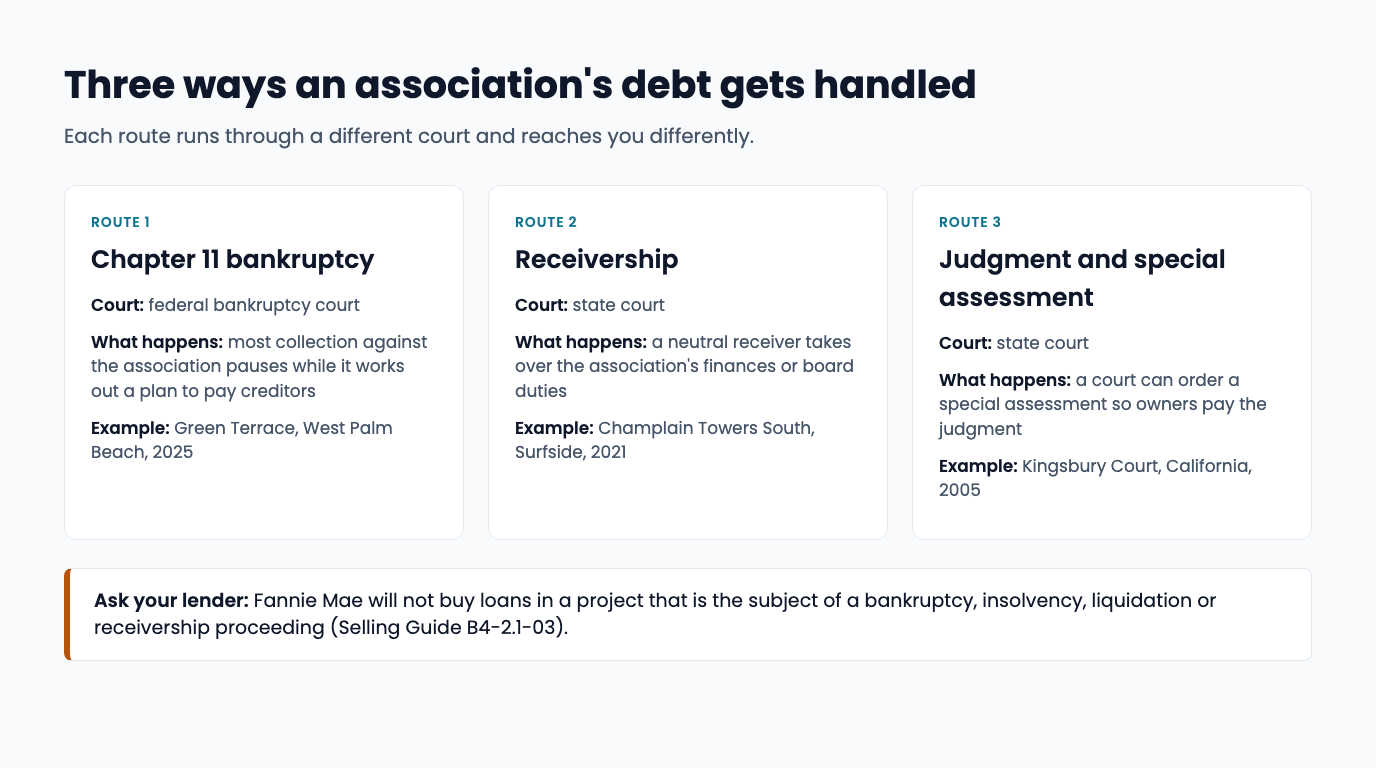
A condo association can file for Chapter 11 or Chapter 7 but not Chapter 9, and filings are rare. A court-appointed receiver or a judgment paid by special assessment can reach owners with no filing at all.
You are under contract on a condo, and the document packet shows a court judgment against the association, or a note in the minutes that the board has hired a bankruptcy lawyer. Your agent says it is probably fine. Your lender has not said anything yet.
Bankruptcy at an association is unusual enough that most buyers and agents have never seen one, which is why the first reaction is usually a guess. The real picture has three parts: what a filing does, what a court can do without one, and whether your own money is on the line. The answer to the last question depends heavily on your state.
This guide covers who can file, two Florida associations that did, what changes for owners, the receivership route, the limits on what you can personally owe, how lenders treat the building, and the questions to ask before you sign.
Can a Condo Association Actually File for Bankruptcy?
Yes, under Chapter 11 or Chapter 7. Chapter 9 is for government bodies, so it is closed to a private association. Filings are rare.
A condo association is usually a private nonprofit corporation, and federal law lets corporations file. The usual route is Chapter 11, which lets the debtor keep operating while it works out a plan to pay creditors. One Florida law firm describes Chapter 11 as the most common type used by associations and Chapter 7, which sells assets to pay debts, as generally unrealistic because the members jointly own the property.
Chapter 9 is the chapter you may have heard about from cities that went bankrupt. It is available only to a "municipality", which federal law defines as a political subdivision, public agency or instrumentality of a State, and 11 U.S.C. 109(c) limits Chapter 9 to those entities. A private association is not one.
There is no national count of association filings. A 2025 practitioner column on the subject said that bankruptcies have traditionally been rare for community associations. Treat it as an unusual event, which is part of why the warning signs in the documents matter so much. Ask the association for any judgments and pending lawsuits before you rely on the packet alone.
Two Florida Associations That Did
Two Florida associations filed Chapter 11: Bayou Pointe Villas by 2021 over hurricane repair bills, Green Terrace in 2025 with city water bills.
Bayou Pointe Villas (Panama City, 28 units). Hurricane Michael tore up the buildings in 2018, and the association hired a contractor to clean up and repair them. The work stopped after the association reportedly ordered it halted, and the association later filed Chapter 11 facing claims of more than $1 million from contractors who say they were not paid, with $408,000 in listed assets, according to a November 2021 report.
Green Terrace (West Palm Beach, 84 units). The city said the association owed more than $1.4 million in unpaid water bills. In April 2025, with a water shutoff scheduled, the association filed Chapter 11, and a city official said the filing temporarily prevented the city from shutting off the water. CBS12 reported in October 2026 that the complex had sold for $13.5 million in a court-approved bankruptcy sale completed on behalf of a Chapter 11 trustee.
Both cases involved unpaid bills, and in both the reporting describes problems that had been building for years. The kinds of signals a buyer can ask about are unpaid vendors, utility balances and judgments. Our guide to lawsuit red flags in HOA documents covers where to look.
What a Filing Changes for Owners
A filing pauses most collection against the association. It does not tell you what the case will do to dues, assessments or your unit.
The moment an association files, federal law puts a pause on most actions against it. Under 11 U.S.C. 362(a), creditors generally cannot start or continue lawsuits against the debtor, enforce earlier judgments, or collect earlier debts. That is why Green Terrace's filing paused the water shutoff.
The pause covers the association's creditors. What happens to owners is a separate question, and a few points are open enough that you should put them to a lawyer rather than assume:
- Dues and special assessments during the case. Whether an association in Chapter 11 can keep levying special assessments is a question for an attorney; the sources we reviewed do not answer it.
- The building's future. In Green Terrace the case led to a court-approved sale of the whole complex, completed on behalf of a Chapter 11 trustee.
- Your closing timeline. A filing can stall a lender's approval of the building, covered below.
Receivership: The Route That Skips Bankruptcy
A state court can hand the association to an independent receiver. A California court has also ordered a special assessment to pay a judgment.
A receiver is a neutral person a state court appoints to take over an association's finances or board duties. It does not need a federal filing.
In Florida, an owner can ask a court for a receiver when board vacancies leave the association without a quorum, after 30 days of notice, and the receiver has all of the board's powers under Fla. Stat. 718.1124, paid from association funds. The Florida Supreme Court has also held that those statutes do not limit a trial court's built-in power to appoint a receiver over a condo association (Granada Lakes Villas Condominium Association v. Metro-Dade Investments, 2013).
The largest recent example is Champlain Towers South in Surfside. After the June 2021 collapse, a Miami-Dade judge put the association into receivership, and the board had voted unanimously to accept it. The receiver took charge of the association's financial matters while the lawsuits proceeded.
A receiver can also be the way a judgment gets paid. In a 2005 California case, a 46-unit association owed a judgment of about $140,000 plus interest, the court appointed a receiver, and the Court of Appeal upheld the order requiring a special assessment on the owners to pay it (James F. O'Toole Co. v. Los Angeles Kingsbury Court Owners Association). That is one way an association's debt reaches an owner's wallet. If the documents mention a judgment, ask whether a receiver has been requested and whether a special assessment is planned to pay it.
Are You Personally on the Hook?
In the three states we checked, an owner's exposure is limited to a share of the association's debt. That does not make the share small.
The rule differs by state, and we verified three. Check your own state's condominium act before relying on any of them.
- Florida. An owner's liability for common expenses is limited to the amounts assessed under the condo law and the association's documents. For the association's acts relating to the common elements (the shared parts of the building), an owner may be personally liable only to the extent of the owner's proportionate share, never more than the value of the unit (Fla. Stat. 718.119(2)).
- Illinois. An owner's liability for a judgment against the association is limited to the owner's proportionate share (your unit's slice of the total) of the debt, whether it is collected by assessment or otherwise (765 ILCS 605/9.1).
- Washington. A court judgment for money against the association becomes a claim recorded against every unit (a lien), but an owner's other property is not subject to the association's creditors, and an owner can pay the unit's share to have that unit released (RCW 64.90.490). This rule is in Washington's newer condo law, which applies to communities created on or after July 1, 2018, to older ones that opted in, and to every community from January 1, 2028. It is not among the few sections that already reach older communities. Our Washington guide explains which community it reaches.
A share of a large debt can still be large, which is the point of the special assessment in the California case. Ask what judgments exist and how big your share would be before you are bound to the purchase. Our guide to special assessment red flags lays out the other warning signs.
What It Does to Your Mortgage
Fannie Mae will not buy loans in a project involved in bankruptcy or receivership, and some pending lawsuits make a project ineligible.
Fannie Mae's selling guide (B4-2.1-03) says a project must not be the subject of a voluntary or involuntary bankruptcy, insolvency, liquidation, or receivership proceeding. That includes a project that has voted or is in the process of voting to start one.
The same section makes a project ineligible when the association is a party to pending litigation that relates to safety, structural soundness, habitability or functional use. It excepts some minor matters, among them cases that are insured and defended, cases where the association is the plaintiff on a minor matter, cases where damages and fees are not expected to exceed 10% of funded reserves, and cases where the association is suing to collect past-due assessments or foreclose.
For a buyer, the consequence is practical. If the building is ineligible, a conventional lender selling to Fannie Mae cannot use it, and your options narrow to lenders that follow other investors' project rules, a portfolio lender, or cash. Loans can be sold to different investors, so ask your lender whose project rules it follows. Our explainer on the non-warrantable condo and the lender questionnaire shows how the review works.
Get Your Meeting Minutes Analyzed
Upload your HOA's meeting minutes and get instant analysis of key decisions, recurring issues, litigation flags, and governance patterns. Free. No signup required.
Your first full property report is also free. See what you'll get →
Or get your first full report free →What to Ask Before You Sign
Ask for every judgment, lawsuit and unpaid vendor balance before you sign, and ask your lender whether the building is eligible today.
- The litigation disclosure. Ask the association for every pending or threatened lawsuit, who brought it, and whether the insurer is defending it.
- Judgments against the association. Ask for the amount, whether it is under appeal, and how the board plans to pay it. A special assessment is one way boards pay.
- Utility and vendor balances. Ask whether the water, sewer, insurance and contractor accounts are current. Green Terrace's trouble included a utility balance.
- The last 12 to 24 months of minutes. Read for mentions of counsel, settlement talks, unpaid invoices, or a vote to consider filing. Our meeting minutes red flags guide lists the phrases to look for.
- Federal court records. Ask your attorney or the title company to run the association's name through the federal court records system (PACER) for any bankruptcy filing.
- Lender eligibility. Ask your lender to confirm, in writing, that the project is approved for the loan program you are using.
If any answer is unclear, a real estate attorney in your state can read the judgment or the court filing and tell you what it means for your share before the inspection period ends.
Frequently Asked Questions
Can a condo association file for bankruptcy?
Yes. A condo association can file under Chapter 11 or Chapter 7. It cannot file under Chapter 9, which is limited to government bodies. Filings are rare, and the two Florida associations described here filed over contractor and utility debt.
Do I have to pay my condo association's debts personally?
In the states we checked, an owner's liability is limited to the owner's proportionate share of the debt. Florida and Illinois set limits like this in their condo laws, and Washington protects an owner's other property from the association's creditors. Check your state's act, because your share can still arrive as a special assessment.
Can I get a mortgage on a condo if the association has filed for bankruptcy?
A conventional loan sold to Fannie Mae is unavailable while the project is the subject of a bankruptcy, insolvency or receivership proceeding. Portfolio lenders and cash buyers set their own terms. Ask your lender before you commit.
How do I find out if a condo association has filed for bankruptcy?
Ask the association directly, read the minutes for mentions of counsel or a vote to file, and ask your attorney or title company to search the association's name in the federal court records system.
Check the association's documents before you sign
Upload the minutes, CC&Rs or reserve study and get a read on litigation flags, deferred maintenance and special assessment risk, with every finding linked to its source page. Trained on 1,900+ HOA documents. Free. No signup required.
Related Articles
Sources & References
- 11 U.S.C. 109, 101 and 362 (who may file, the definition of a municipality, and the pause on collection)
- Siegfried Rivera on how condo owners are affected when an association files (2025) and a 2025 practitioner column on association bankruptcies
- Fannie Mae Selling Guide B4-2.1-03 (ineligible projects: insolvency proceedings and litigation)
- Fla. Stat. 718.119 and 718.1124 (owner liability and receivers)
- Granada Lakes Villas Condominium Association v. Metro-Dade Investments (Fla. 2013)
- 765 ILCS 605/9.1 (Illinois owner liability for association judgments)
- RCW 64.90.490 (Washington judgments against the association)
- James F. O'Toole Co. v. Los Angeles Kingsbury Court Owners Association (Cal. Ct. App. 2005)
- Levelset on Bayou Pointe Villas (2021), WFLX on Green Terrace (2025), CBS12 on the Green Terrace sale (2026) and NPR (via KSUT) on Champlain Towers South (2021)
Disclaimer: This article is for educational purposes only and does not constitute legal, financial, or real estate advice. Owner liability and receivership rules vary by state, and only the states named above were checked. Lender rules change. Consult a qualified real estate attorney in your state for guidance specific to your situation.