
In This Guide
When a condo project fails the lender questionnaire, the loan is denied and the whole building becomes non-warrantable, so conventional financing disappears for every unit, not just the one being sold. Buyers are pushed to cash or high-rate portfolio loans, sellers cannot refinance, and values slide. Most projects can recover, but only after the board fixes the failing item, delinquency, reserves, litigation, insurance, or repairs, and documents it back to Fannie Mae.
The deal is halfway to closing. The buyer is approved, the appraisal is ordered, then the lender sends the HOA a questionnaire and the answers come back wrong. Delinquencies are over the line, or the reserves are too thin, or there is a lawsuit nobody flagged. The loan is denied, and not because of anything the buyer did. The building failed.
This is happening at scale. In early 2025, roughly 5,175 condo projects nationwide sat on Fannie Mae's confidential ineligible list, up from a few hundred before the 2021 Surfside collapse, and the count is still climbing (National Mortgage News, reporting Wall Street Journal data). More than 1,400 of those projects are in Florida, the most of any state. Behind almost every one is a questionnaire that failed.
This guide explains what the questionnaire is, which answers make a building ineligible, what happens the moment it does, and, for boards and buyers alike, how to see the failure coming before it kills a sale. For the underlying definition, see our explainer on what a non-warrantable condo means.
What the Lender Questionnaire Actually Is
The questionnaire is the HOA's signed statement about the project's finances, insurance, and legal status, tested against Fannie and Freddie rules.
When a buyer applies for a conventional mortgage on a condo, the lender does not just underwrite the borrower. It also has to confirm the project is eligible, because Fannie Mae and Freddie Mac will only buy the loan if the building meets their standards. The instrument they use is the condo project questionnaire.
The standard long form is Fannie Mae Form 1076 / Freddie Mac Form 476, the Condominium Project Questionnaire (the joint form; Selling Guide B4-2.1-01), with a shorter Form 1077 / 477 (short form) for streamlined reviews. After Surfside, the agencies added the Form 1076A addendum (Form 1076A / 476A), which asks specifically about the date of the last structural inspection and whether it found anything affecting safety, soundness, structural integrity, or habitability. The HOA or its management company fills out and signs the questionnaire, and lenders rely on those answers, so an inaccurate or incomplete response can sink a loan and expose the signer.
The lender feeds the answers into Fannie Mae's Condo Project Manager (CPM) and evaluates them under the Selling Guide review rules (Full Review, B4-2.2-01). One important shift has already taken effect: under Lender Letter LL-2026-03, the streamlined Limited Review is retired for every project, of any size, for loan applications dated on or after August 3, 2026, pushing most condos onto Full Review and the full questionnaire. Separately, and effective right away, very small projects of ten or fewer units may instead qualify for a Waiver of Project Review, a lighter path that still carries insurance and other conditions. A project of five to ten units only qualifies if it is not part of a master association or larger development. The 2026 Fannie and Freddie condo rules cover that timeline in detail.
The Answers That Make a Building Fail
A single disqualifying answer, high delinquency, thin reserves, active litigation, or an insurance gap, flips the entire project to ineligible.
The questionnaire is pass or fail at the project level. One answer over the line makes the whole building ineligible, and it applies to every unit at once. These are the items that most often do it, each tied to a Fannie Mae Selling Guide rule.
| Questionnaire item | What fails the project | Rule |
|---|---|---|
| Dues delinquency | More than 15% of units 60+ days past due on assessments | B4-2.2-01 |
| Reserves | Budget funds reserves below 10% of income (rising to 15% for applications dated on or after Jan 4, 2027) | B4-2.2-01; LL-2026-03 |
| Reserve study age | Study older than 3 years | B4-2.2-01 |
| Single-entity ownership | One owner holds more than 2 units in an 11–20 unit project (or a 5–10 unit project that is part of a master association), or more than 20% in a 21+ unit project | B4-2.1-03 |
| Commercial space | Non-residential space exceeds 35% of total floor area | B4-2.1-03 |
| Litigation | Pending suit involving safety, structural soundness, or habitability | B4-2.1-03 |
| Master insurance | Less than 100% replacement-cost coverage, or a deductible over 5% of coverage | B7-3-03 |
| Deferred maintenance | Significant deferred maintenance or unsafe conditions not yet repaired | B4-2.1-03 |
| Condo-hotel | Hotel-like or primarily transient operation, mandatory rental pooling | B4-2.1-03 |
Two of these tests deserve a close look in any packet. Insufficient master property insurance and critical repair issues can each put a project on the ineligible list, and both are a legacy of the post-Surfside rules that are now permanent in the Selling Guide (B4-2.1-03). Larger projects must also carry fidelity or crime coverage sized to the funds the association holds, and flood insurance is required where any part of the project sits in a Special Flood Hazard Area. The 15% delinquency rule and the reserve funding minimum are the other two to check early, because a building can look healthy and still miss either one.
What Happens the Moment It Fails
The loan is denied mid-underwriting. The project is flagged ineligible, and every unit in it loses conventional financing at once.
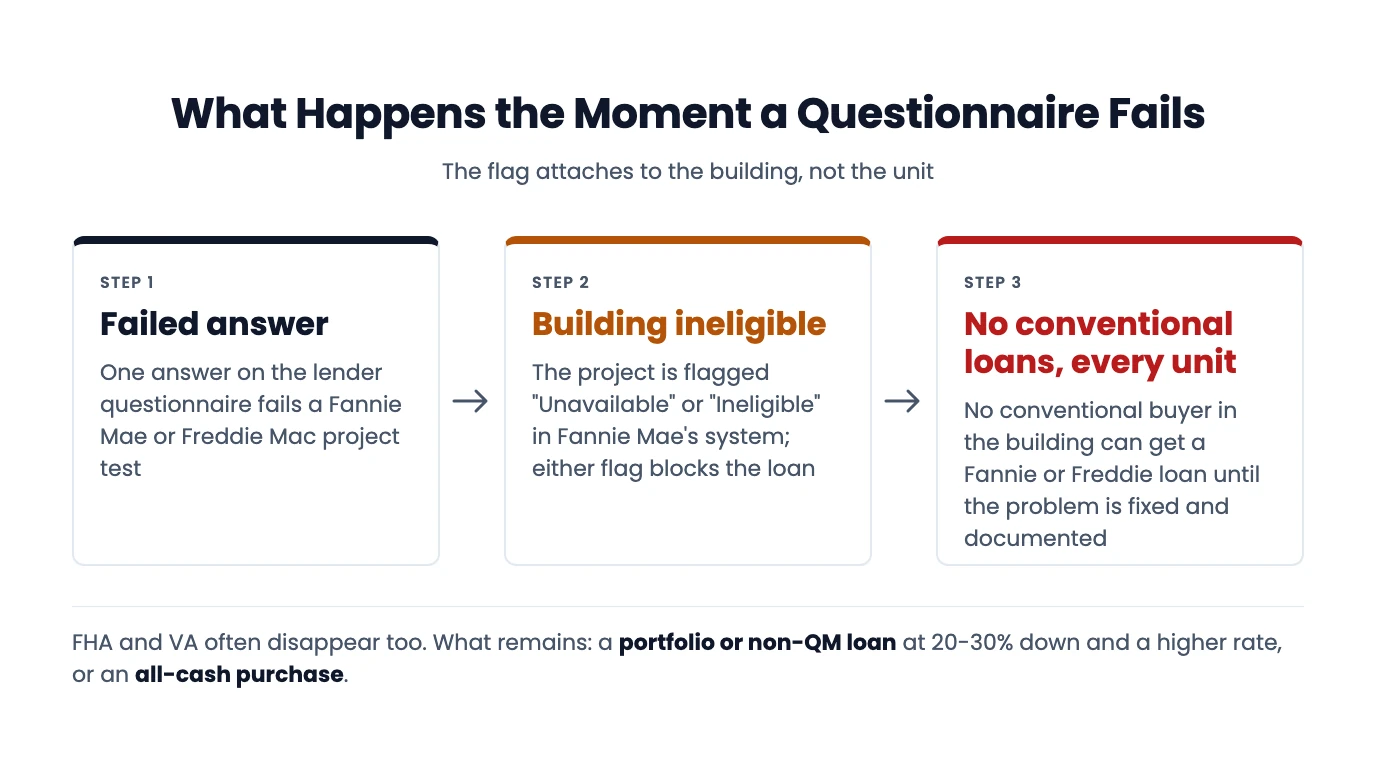
A questionnaire usually comes back late in the process, after inspection and appraisal money has already been spent, because the lender orders it during underwriting. When an answer fails, the project is marked ineligible. In Fannie Mae's system that can show as "Unavailable" (Fannie has affirmatively placed the project on its ineligible list) or "Ineligible" (the data entered in Condo Project Manager shows the project fails a requirement). Either flag blocks the loan.
The important thing to understand is that the flag is attached to the building, not the unit. It is not that this one buyer was turned down. Once the project is ineligible, no conventional buyer in the building can get a Fannie or Freddie loan until the underlying problem is fixed and documented. The sale that triggered the questionnaire is usually the first casualty, and it collapses through no fault of the buyer or seller.
What a Failed Questionnaire Does to the Buyer
Conventional and often FHA and VA loans vanish. The fallback is a portfolio loan at 20–30% down and a higher rate, or an all-cash purchase.
For the buyer, a failed questionnaire usually means the conventional loan is dead. Fannie Mae and Freddie Mac will not buy it, so the mainstream lender will not make it. The remaining paths are narrower and more expensive: a portfolio or non-QM lender that keeps the loan on its own books, usually at 20% or more down (Homebuyer.com), or an all-cash purchase. Ask any lender you are considering what the rate will be, because it varies a lot: one lender reports that non-QM lenders typically charge 2% to 4% higher than standard conventional rates, while local and regional banks price closer to conventional but often offer only adjustable-rate loans (JVM Lending). The appraisal can also come in low, because comparable sales in a non-warrantable building close at a discount.
Government-backed loans are not a reliable backstop. FHA uses a project-approval system of its own (HRAP or DELRAP review, Form HUD-9992), and a building that fails the conventional standards on insurance, delinquency, or repairs will usually fail FHA too. VA maintains an approved-condo ID list and approves the whole project, not individual units. One nuance worth flagging: VA does not publish a hard dues-delinquency cap the way Fannie, Freddie, and FHA do (VA Lender's Handbook), so a VA-eligible building is possible even where a conventional loan is not. VA reviewers can still flag high delinquency during project approval, so confirm with the lender for the specific project.
What It Does to the Seller and the Whole Building
Owners cannot sell to financed buyers or refinance. The market narrows to cash, prices slide, and one lender estimates non-warrantable units often sell 5–15% lower.
The failure does not stop at one deal. Because the flag freezes the entire building, every owner is affected simultaneously. A seller can no longer reach financed buyers and is left with the smaller pool of cash and portfolio buyers, who know the constraint and price for it. One mortgage lender estimates that non-warrantable units often sell for 5 to 15% below identical warrantable units in the same building (X2 Mortgage). The discount in your market may be larger or smaller, so pull recent sales in the building before pricing an offer.
Owners also lose the ability to refinance, including a cash-out refinance that might have helped them pay a looming special assessment. That is the trap: the building often needs money to fix the very condition that caused the failure, but the failure has cut off the owners' access to financing. Sales stall, prices drift down, and it becomes harder to pass and fund the assessment needed to climb back out. Florida, which holds more of these ineligible projects than any other state, shows the effect at the community level. In Seminole County alone, one real estate agent reported losing 10 deals in a single year to the issue (News 6 Orlando).
How Boards Find Out Too Late
Fannie's Condo Project Manager is lender-facing, so boards that never check Fannie's free Condo Status Finder often learn their building is non-warrantable only when a member's buyer is denied a loan.
Most boards do not see this coming, because the information sits on the lender's side of the wall. Fannie Mae's project status lives in Condo Project Manager, which owners and boards cannot query directly. The problem usually surfaces the hard way: a member goes to sell or refinance, the lender runs the questionnaire, the answer fails, and only then does the board learn the building has been non-warrantable, sometimes for months.
The asymmetry is structural. Boards answer questionnaires transactionally, one deal at a time, and rarely monitor warrantability as an ongoing metric. Fannie Mae does run a free board-side tool, the Condo Status Finder, which shows in real time whether Fannie is aware of any condition that makes the project ineligible. Only a board member, the property manager, or an advisor serving the association with its written permission can register, so a buyer cannot look the building up directly. Under the tool's license terms, those users may share the result with a prospective buyer, so a buyer can ask the board or manager to run the check. When nobody runs it, the same distress signals, rising delinquencies, an aging reserve study, a new lawsuit, sit in the association's own documents for a year or more before anyone connects them to a financing cliff.
How a Board Documents Its Way Back
Most projects recover. Fix the failing item, then prove it to Fannie Mae with dated reports, updated coverage, or engineer-verified repairs.
Ineligible is not permanent. Most projects can regain eligibility once the underlying issue is fixed and the fix is documented back to Fannie Mae. There is no automatic re-review, so the board or management company has to be the one to resolve the item and resubmit. The path depends on which answer failed.
| Failing item | What a board can do |
|---|---|
| Delinquencies over 15% | Enforce a collection policy, use payment plans and liens, then prove the rate is under 15% with dated delinquency reports |
| Reserves too low | Raise the reserve contribution to the required level, or commission a current reserve study and fund it at the highest recommended level (the LL-2026-03 exception path). Usually requires an assessment increase. |
| Disqualifying litigation | Resolve or settle the matter. Note the minor-litigation exceptions: routine collection suits, insured claims, or anticipated costs under 10% of funded reserves generally do not disqualify. |
| Insurance gaps | Upgrade the master hazard and liability policy to replacement cost, add fidelity or crime and flood coverage where required, and provide an updated certificate |
| Deferred maintenance / repairs | Complete the repairs and document remediation with engineer verification. An unfinished safety or structural special assessment keeps the project ineligible until completion is proven. |
| Investor / commercial concentration | The hardest category. Ownership mix and commercial square footage are largely outside short-term board control; boards can track occupancy and tighten future rental policy within state law |
The recurring theme is documentation. Fixing the problem is only half the job. The board also has to prove the fix, with dated reports, updated policies, or an engineer's sign-off, and submit it so the flag can be lifted. For the reserve path specifically, our guide to the 15% reserve rule for boards walks through the study exception in depth.
How to Screen a Building Before You Buy
Every failing signal already lives in the documents. Read the budget, reserve study, minutes, insurance, and delinquency report before you offer.
The best defense is to run the questionnaire's logic yourself, from the documents, before you write an offer, instead of discovering the problem during underwriting. Every disqualifying condition leaves a trace in paperwork the association already produces:
- Budget. Check the reserve contribution as a share of assessment income against the 10% floor (15% from 2027), and watch for a looming assessment. Our HOA budget red flags guide shows what to look for.
- Reserve study. Confirm it is current (within 3 years) and note the highest recommended funding level, the figure that unlocks the reserve exception. The reserve fund calculator helps you sanity-check the numbers.
- Meeting minutes. The earliest narrative signals of litigation, special assessments, failed inspections, and deferred maintenance show up here first.
- Insurance certificate. Look for 100% replacement-cost hazard coverage, adequate liability and fidelity, and flood coverage where required.
- Delinquency report. Ask for the percentage of units 60-plus days past due, and confirm it is under 15%. See our delinquency-rate guide.
- Project status. Have your lender confirm the building's standing in Condo Project Manager early, before you spend on inspection and appraisal.
This turns a reactive, deal-killing surprise into a pre-offer screen. For a document-by-document walkthrough that applies to any condo purchase, see the complete condo buying checklist.
Frequently Asked Questions
What is a condo lender questionnaire?
It is a form (Fannie Mae Form 1076 or Freddie Mac Form 476, with a short-form 1077/477) that the HOA or its management company completes about the project's finances, insurance, ownership, and legal status. Lenders use the answers to confirm the building meets Fannie Mae and Freddie Mac eligibility rules before making a conventional loan. A post-Surfside addendum (Form 1076A) also asks about recent structural inspections.
What makes a condo fail the lender questionnaire?
Common triggers include more than 15% of units 60+ days delinquent on dues, reserves funded below 10% of the budget (rising to 15% in January 2027), an active lawsuit involving safety or structural soundness, insufficient master insurance, significant unrepaired deferred maintenance, one owner holding too many units, or hotel-like operation. Any single disqualifying answer can make the whole project ineligible.
Does one unit failing affect the whole building?
Yes. The questionnaire evaluates the project, not the individual unit, so an ineligible flag applies to every unit at once. Until the association fixes and documents the underlying problem, no conventional buyer in the building can get a Fannie Mae or Freddie Mac loan.
Can I still buy a condo that failed the questionnaire?
Sometimes, but not with a standard conventional loan. The options are a portfolio or non-QM lender, which typically requires 20% or more down at a higher interest rate, or an all-cash purchase. FHA and VA have their own project-approval systems and may or may not be available. Confirm financing before you commit, because a non-warrantable building can kill an otherwise-approved loan.
How does an HOA get its building off the ineligible list?
By fixing the failing item and documenting it back to Fannie Mae. That means bringing delinquencies under 15% and proving it with dated reports, funding reserves to the required level or via a current reserve study, resolving disqualifying litigation, closing insurance gaps, or completing and verifying repairs. There is no automatic re-review, so the board or manager must resubmit. Most projects can recover.
How can a buyer check a building's warrantability before making an offer?
Read the documents the association already produces: the budget and reserve study for funding levels, the meeting minutes for litigation and deferred maintenance, the insurance certificate for coverage gaps, and the delinquency report for the 15% test. Then ask your lender to confirm the project's status in Condo Project Manager early, before spending on inspection and appraisal.
Get Your HOA Documents Analyzed
GoverningDocs analyzes CC&Rs, reserve studies, and meeting minutes, identifying red flags, restrictions, and financial risks so you can buy with confidence. Free. No signup required.
Your first full property report is also free. See what you'll get →
Or get your first full report free →Related Articles
Sources & References
- Fannie Mae Selling Guide B4-2.1-03 (ineligible projects: single-entity ownership, commercial space, litigation and its minor-litigation exceptions, including costs under 10% of funded reserves, condo-hotel)
- Fannie Mae Selling Guide B4-2.2-01 (Full Review: 15% delinquency ceiling, 10% reserve requirement, reserve-study age)
- Fannie Mae Selling Guide B4-2.1-01 (Condominium Project Questionnaire, Form 1076)
- Fannie Mae Form 1076 / Freddie Mac Form 476 (the full condo project questionnaire)
- Fannie Mae Form 1076A / Freddie Mac Form 476A (post-Surfside addendum on structural inspections)
- Fannie Mae Selling Guide B7-3-03 (master property insurance: 100% replacement cost, 5% deductible cap)
- Fannie Mae Lender Letter LL-2026-03 (Limited Review retired Aug 3, 2026; Waiver of Project Review expanded to projects of ten or fewer units, with 5 to 10 unit projects excluded if part of a master association, effective immediately; reserves 10% to 15% Jan 4, 2027; reserve-study exception)
- Fannie Mae Selling Guide Announcement SEL-2023-06 (made the post-Surfside significant-deferred-maintenance and unsafe-conditions rules permanent, effective Sept 18, 2023; the temporary LL-2021-14 was retired)
- Fannie Mae Condo Status Finder (free board-side tool showing whether Fannie is aware of any condition that makes the project ineligible)
- Fannie Mae Condo Status Finder license terms (who may register, and permission to share results with a prospective buyer)
- National Mortgage News (5,175 projects on the ineligible list in early 2025; over 1,400 in Florida; WSJ data)
- News 6 Orlando (Aug 2025; Seminole County agent reported losing 10 deals in a year to ineligible-list issues)
- Homebuyer.com (non-warrantable financing usually requires 20% or more down)
- JVM Lending (non-QM rates typically 2% to 4% above conventional; local and regional banks closer to conventional, often adjustable-rate only)
- X2 Mortgage (lender estimate: non-warrantable units often sell 5 to 15% below identical warrantable units)
- VA Lender's Handbook (VA Pamphlet 26-7) (Chapter 16, condominiums: no published dues-delinquency cap)
- HUD Form 9992 (FHA condominium project approval questionnaire, HRAP/DELRAP)
Disclaimer: This article is for educational purposes only and does not constitute legal, financial, or mortgage advice. Fannie Mae, Freddie Mac, FHA, and VA project-eligibility rules change frequently and are applied case by case by each lender. Figures are current as of July 2026 and may be superseded. Confirm a specific project's status with your lender, and consult a qualified attorney or your association's counsel for guidance specific to your situation.