
In This Guide
A reserve study usually costs an association $1,000 to $7,500 or more. How often one is required, and who may prepare it, depends on the state.
If you are reading a condo or HOA resale package, the reserve study is the document that says whether the association has saved enough to replace the roof, the elevators and the parking deck when they wear out. The association pays for it, and you inherit whatever it found, or missed.
The price of that study shapes what you are reading. A full study with an inspector walking the property costs several times more than a desk update, and some states let a board skip the inspection for years or prepare the study itself. Other states require a credentialed professional on a fixed schedule.
This guide covers what reserve studies cost, what drives the price, what 17 states require, and the questions that tell you how much weight the study in your package can carry.
How Much Does a Reserve Study Cost?
Firms quote about $1,000 to $7,500 or more. Association Reserves puts a full study at under 1% of the budget and updates at a fraction.
We found no industry price survey, so the best figures come from the firms that do the work. Reserve Advisors says a study can cost "as little as $1,000 or as much as $7,500 or more." Association Reserves gives a rule of thumb instead of a dollar figure: a full study "is typically less than 1% of the Association's annual budget."
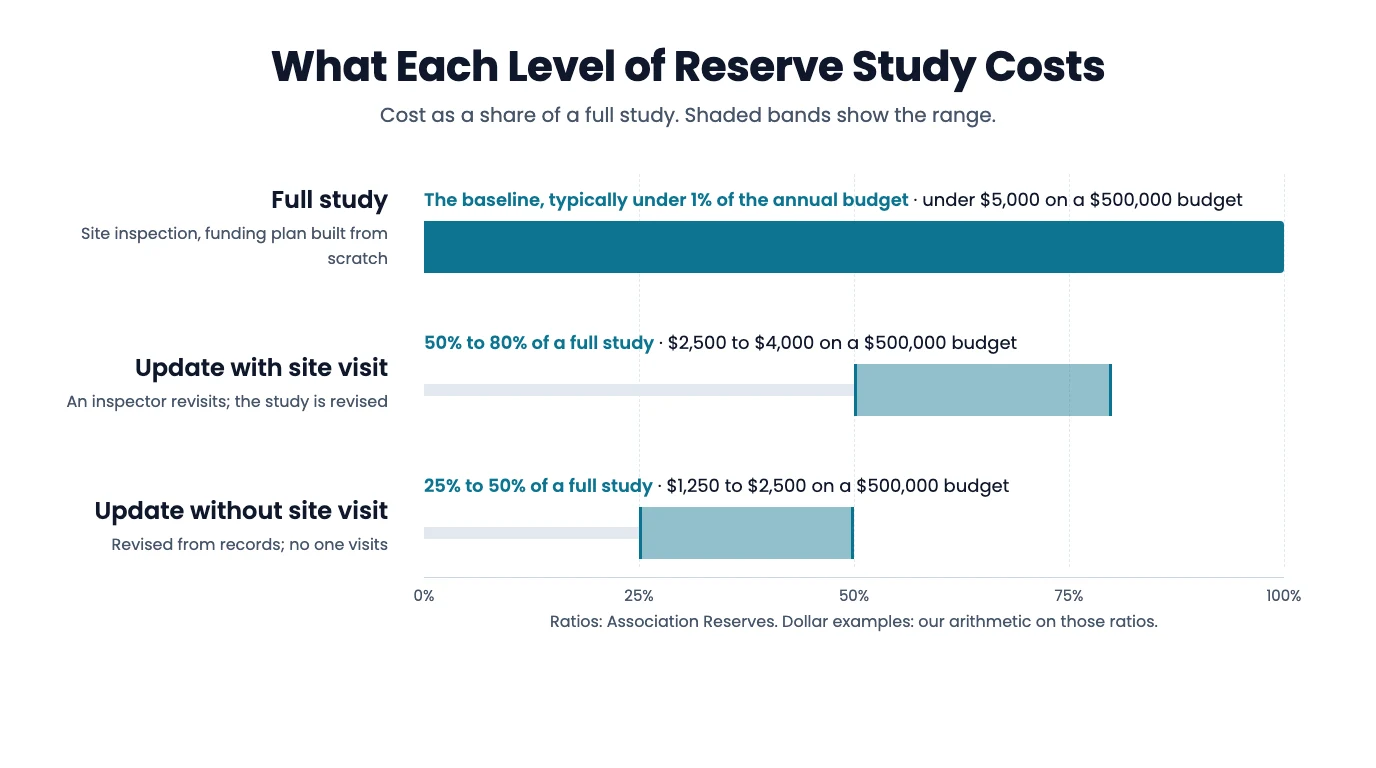
There are three levels of study, and the price follows the level. Association Reserves prices the two kinds of update as a share of a full study:
| Study level | What happens | Typical cost |
|---|---|---|
| Full study | Site inspection, a complete list of components, and a funding plan built from scratch | Under 1% of the annual budget |
| Update with site visit | An inspector revisits and the existing study is revised | 50% to 80% of a full study |
| Update without site visit | Numbers are revised from records, with no one visiting the property | 25% to 50% of a full study |
To put that in dollars, take an association with a $500,000 annual budget. By Association Reserves' ratios, a full study would come in under $5,000, an update with a site visit at roughly $2,500 to $4,000, and a desk update at roughly $1,250 to $2,500. That is our arithmetic on their percentages, not a quote.
Association Reserves' April 2026 Industry Insights Report says industry best practice, as set by the Community Associations Institute's reserve study standards, is an update with a site visit at least every three years, with updates without one in the years between.
Ask the association when the last site visit happened. If it was more than three years ago, the study in your package is behind that best practice.
What Makes One Study Cost More Than Another
More building systems to inspect, an in-person site visit, and a state rule requiring a credentialed preparer all push the price up.
The building itself
A townhome community with a pool has a short list of components. A high-rise has elevators, boilers, chillers, a roof membrane, a facade and a garage. Association Reserves says: "The more complex the property, the more building components that need to be included for study, such as air conditioners, boilers, elevators and other equipment that operates on a daily basis."
Whether anyone visits
The site visit is where much of the cost sits: by Association Reserves' ratios, an update with one runs 50% to 80% of a full study, against 25% to 50% without. It is also the part that finds what the records do not show. A desk update can only rework numbers someone already wrote down.
Who is allowed to prepare it
Some states require a licensed engineer or architect, or one of two industry credentials. The Reserve Specialist (RS) designation from the Community Associations Institute requires at least three years of experience and 30 studies based on site visits in the last three years. The Professional Reserve Analyst (PRA) designation from the Association of Professional Reserve Analysts requires 50 studies based on site visits. Other states let the board prepare the study itself.
When you read a study, check the cover page for its level (full study, update with a site visit, or update without one) and for the preparer's credential.
Reserve Study Requirements by State
Of 17 states we checked, 12 require a reserve study in some form, on schedules running from every year to every 10 years.
State law decides how often a study has to be done and by whom, which is most of what drives the cost over time. We checked each rule below against the state's official statute text in September 2026. Many rules apply only to condos, or yield to what the community's own documents say, so read the "Applies to" column before relying on a row.
| State | Applies to | How often | Who prepares it |
|---|---|---|---|
| California | Condos and HOAs, where components are worth at least half the budget | Site inspection every 3 years; reviewed every year | No credential named |
| Florida | Condo buildings three or more stories (structural integrity reserve study, SIRS); not HOAs | Every 10 years | Licensed engineer or architect, or RS or PRA |
| Washington | Condos and HOAs, with exemptions | Updated every year; professional site visit every third year | A "reserve study professional" |
| Oregon | HOAs and condos (some older communities excepted) | Conducted or updated every year | No credential named |
| Nevada | Condos, co-ops and HOAs (Nevada's term is common-interest communities) | At least every 5 years; reviewed every year | Holder of a state reserve study permit (communities of 20 or fewer units in counties under 55,000 people excepted) |
| Maryland | Condos; HOAs with at least $10,000 in components (Md. Real Prop. 11B-112.3) | Every 5 years | Experienced preparer, licensed architect or engineer, or RS or PRA |
| New Jersey | Associations that own at least $25,000 in shared property and equipment (the law's "total common area capital assets") | Every 5 years | CAI-credentialed reserve specialist, or licensed engineer or architect |
| Virginia | HOAs; condos unless their documents provide otherwise (Va. Code 55.1-1965 for condos) | At least every 5 years; reviewed every year | No credential named |
| Delaware | Condos and co-ops | A study done within the last 5 years, or fixed minimum reserves apply instead. Communities that adopted a budget after Sept. 30, 2009 are covered even if they are older (25 Del. C. 81-103(40) and 81-119) | Independent engineering, architectural or construction firm, or other qualified person |
| Utah | HOAs and condos, unless their documents provide otherwise | Every 6 years; reviewed or updated every 3 years | No credential named; the board may do it |
| Hawaii | Condos | Budget must rest on a study; reviewed by an independent preparer at least every 3 years if not prepared by one | Independent preparer holds an industry certification |
| Colorado | Condos and HOAs | Once, paid by the developer before owners take control (from Aug 12, 2026); after that, a reserve policy only | Independent professional for the handover study |
| Florida HOAs, Minnesota, Illinois condos, Ohio, Connecticut, North Carolina | No statutory reserve study requirement found (Minnesota does require associations to budget reserves and reevaluate them at least every third year, under Minn. Stat. 515B.3-1141). Starting January 1, 2027, the association's resale disclosure certificate in Minnesota must include any study from the past three years (Minn. Laws 2026, ch. 82). | ||
We could not confirm the rule from official statute text for Texas, Arizona, Georgia, New York, Massachusetts, Pennsylvania or Tennessee, or for Illinois HOAs, so they are left out rather than guessed. If you are buying in one of those states, ask the association directly whether it has a study and when it was done.
Some of these states also require the association to save at the level the study recommends. Maryland condo budgets have to carry the amount the study recommends, with up to five years to build up to it after a building's first study, unless two-thirds of the board vote that owners face a financial hardship (Md. Real Prop. 11-109.2), New Jersey requires a 30-year funding plan, and Delaware requires the budget to fund reserves at the level in the study. California, Virginia and Washington require the study but set no minimum balance in the sections we read. For how the Washington rule works in practice, see our Washington WUCIOA guide.
In any state, compare the reserve contribution in the budget with the amount the study recommends, and ask the association to show you that line if you cannot find it.
Florida: Why a Structural Integrity Reserve Study (SIRS) Costs More, and Which Buildings Need One
Florida condo buildings with three or more habitable stories need a structural integrity reserve study every 10 years, by an engineer, architect, RS or PRA.
Florida's structural integrity reserve study (SIRS) covers a defined list of structural and safety items, and under Fla. Stat. 718.112(2)(g) it must be performed or verified by a licensed engineer or architect, or a certified Reserve Specialist or Professional Reserve Analyst. It applies to residential condo buildings three or more habitable stories tall. Florida HOAs under chapter 720 have no reserve study requirement (Fla. Stat. 720.303 lets them include reserves in the budget but does not require a study).
For budgets adopted on or after December 31, 2024, owners can no longer vote to waive or reduce reserves for the items the SIRS covers, with narrow exceptions such as a vote to terminate the condominium.
We found no news outlet or industry body that publishes SIRS prices. One provider that compares reserve study proposals, PropFusion, citing engineering firms, estimates a SIRS for a qualifying building "typically runs $5,000–$15,000." Florida law requires a separate SIRS for each qualifying building in a multi-building community, and PropFusion notes that the milestone inspection (a structural safety inspection Florida requires of older condo and co-op buildings with three or more habitable stories, under Fla. Stat. 553.899) is "typically a separate engagement." For how the two documents differ, see HOA reserve study vs SIRS.
If you are buying in a Florida condo building with three or more habitable stories, ask the association for the SIRS and the date it was completed before you sign.
What the Price Tells You as a Buyer
Spread across the units, a study costs owners little. An old, board-prepared or desk-only study is the one worth questioning.
Spread across a building, the cost is small. At Reserve Advisors' upper figure of $7,500, a 100-unit association pays $75 per unit for a study, once, and the study guides decisions for years.
Where the price does matter is in the version you get. Three things lower the cost of a study and lower how much you can rely on it:
- No site visit. A desk update rolls forward the last inspector's observations. If the last visit was years ago, so are the observations.
- Prepared by the board. Utah lets the board prepare its own analysis, and Colorado accepts an internal study for its ongoing reserve policy. A board-prepared study can be careful, but no outside professional has checked it.
- Age. Construction costs move. A study from several years ago can understate what the next roof will cost, which understates what the association should be saving.
The number to read in any study is percent funded: reserves on hand compared with what the study says should be there by now. Association Reserves treats under 30% as weak, with a high risk of special assessments, 30% to 70% as fair, and 70% or above as strong. Our guide to reading a reserve study walks through where to find it.
Check Your Building's Financial Health
Upload your HOA's reserve study and get instant analysis of percent funded, deferred maintenance, and special assessment risk. Free. No signup required.
Your first full property report is also free. See what you'll get →
Or get your first full report free →What to Ask Before You Buy
Ask for the latest study, its date and level, who prepared it, the percent funded, and when the next site visit is scheduled.
- Is there a current reserve study? If the state requires one and the association does not have it, that is a governance problem as well as a financial one.
- What date and what level? Look for the words full, update with site visit, or update without site visit on the cover page.
- Who prepared it? Look for an engineer's or architect's license, or an RS or PRA designation, next to the preparer's name.
- What is the percent funded? Then compare the recommended annual contribution with what the budget actually puts into reserves.
- When is the next site visit? If the board cannot say, ask how it plans to keep the numbers current until then.
- In Florida, is there a SIRS? For a condo building with three or more habitable stories, ask for the SIRS and whether the budget funds the items it covers.
Once you have the study, our free reserve study analysis tool pulls out the percent funded, deferred maintenance, contribution trends and special assessment risk. It reads a study the association already has; it does not prepare one. If the study raises a question about your rights under your state's law, ask a local real estate attorney.
Frequently Asked Questions
How much does a reserve study cost?
Reserve Advisors says as little as $1,000 or as much as $7,500 or more. Association Reserves puts a full study at typically under 1% of the association's annual budget, an update with a site visit at 50% to 80% of that, and an update without one at 25% to 50%.
Who pays for the reserve study?
The association orders it and pays from its budget, which owners fund through assessments. Colorado is one exception: from August 12, 2026, the developer must pay for a study before handing control of the association to owners.
How often does an HOA need a reserve study?
It depends on the state. Oregon and Washington require a yearly update, California a site inspection every three years, Nevada, Virginia, Maryland and New Jersey a study at least every five years, Utah every six, and Florida a SIRS every ten for condo buildings with three or more habitable stories. Several states have no requirement.
Can the board do its own reserve study?
In some states. Utah lets the board prepare its own analysis, and Colorado accepts an internal study for its ongoing reserve policy. Florida's SIRS and New Jersey require a licensed engineer or architect or a credentialed reserve professional, and Maryland also accepts a preparer with 30 studies in the past three years.
Is there free reserve study software?
GoverningDocs offers a free tool that analyzes a reserve study the association already has, pulling out percent funded, deferred maintenance and special assessment risk. It does not prepare a new study, which still takes an inspection and a preparer.
Have the Reserve Study Already?
Upload it and see the percent funded, deferred maintenance and special assessment risk in minutes, from a tool built on 1,900+ HOA documents.
Related Articles
Sources & References
- Reserve Advisors: How Much Does a Reserve Study Cost? (national range)
- Association Reserves: How Much Does It Cost to Do a Reserve Study? (cost as a share of budget, update levels)
- Association Reserves: What Exactly Is Percent Funded? (weak, fair and strong tiers)
- Association Reserves: HOA Reserves Industry Insights Report (April 2026)
- CAI: Reserve Specialist (RS) credential
- APRA: Professional Reserve Analyst (PRA) credential
- PropFusion: How Much Do HOA Reserve Studies Cost? (provider estimate, Florida SIRS)
- PropFusion: Florida SIRS Requirements (milestone inspection as a separate engagement)
- C.R.S. 38-33.3-209.5 (Colorado reserve policy; an internally conducted study is sufficient)
- State statutes (the table links the primary section for each state; the others are listed here): Cal. Civ. Code 5550 and 5560; Fla. Stat. 718.112, 720.303 and 553.899; RCW 64.90.545 and 64.90.550; ORS 94.595 and 100.175; NRS 116.31152; Md. Real Prop. 11-109.4, 11B-112.3 and 11-109.2; N.J. P.L.2023, c.214; Va. Code 55.1-1826 and 55.1-1965; 25 Del. C. 81-103(40), 81-315 and 81-119; Utah Code 57-8a-211 and 57-8-7.5; HRS 514B-148; Colorado HB26-1099; Minn. Stat. 515B.3-1141; Minn. Laws 2026, ch. 82
Disclaimer: This article is for educational purposes only and does not constitute legal, financial, or real estate advice. Reserve study rules vary by state, by community type, and by what a community's own governing documents say, and prices vary by provider and property. Consult a qualified real estate attorney for guidance specific to your situation.