In This Guide
A reserve study is a nationwide financial-planning document that estimates the cost of repairing and replacing every common-area component an association maintains, then recommends how much to save. A SIRS (Structural Integrity Reserve Study) is a narrower, Florida-only requirement that covers a fixed list of structural and life-safety components for buildings three or more habitable stories tall, and whose reserves can no longer be waived. Every building that needs a SIRS still needs ordinary reserve planning for everything else.
You are looking at a Florida condo. The disclosure packet includes a 60-page "reserve study" and a separate document labeled "SIRS." They both talk about roofs, money, and percent funded, so it is natural to assume one is just a newer name for the other. They are not. Confusing them can cost you, because they answer different questions, cover different components, and follow very different funding rules.
The stakes are real. After the 2021 Champlain Towers South collapse in Surfside, Florida rewrote how condos must plan for structural repairs. A building can have a healthy-looking general reserve study and still be out of compliance, underfunded, or facing a mandatory assessment because of what a SIRS requires. For buyers and owners, knowing which document you are holding, and which one is missing, is part of reading the building's real financial health.
This guide breaks down what each document is, where they overlap, the one rule that separates them most, and how SIRS fits alongside the milestone inspection that buyers often confuse with it.
What Is a Reserve Study?
A reserve study is a long-range capital budget that inventories every major common-area component, estimates repair and replacement costs, and recommends a multi-year funding plan.
A reserve study is the association's long-range capital-planning tool, used across the country. It has two parts. The physical analysis inventories the major components the association maintains, assesses their condition, and estimates each one's remaining useful life and replacement cost. The financial analysis looks at the current reserve balance, calculates how well funded the association is, and recommends a multi-year funding plan so the money is there when a roof or elevator reaches the end of its life.
The defining feature is its breadth. A reserve study covers everything the association is responsible for maintaining: roofs, paving and asphalt, pools and pool equipment, exterior painting, fencing, elevators, HVAC, the clubhouse, and more, usually over a roughly 30-year horizon. The Community Associations Institute established National Reserve Study Standards in 1998 and created the Reserve Specialist (RS) credential to standardize how these studies are prepared.
The headline number is percent funded: the reserve balance divided by the amount the association should ideally have saved. By the tiers Association Reserves uses, above 70% is strong, 30% to 70% is fair, and below 30% is weak and at real risk of a special assessment. Roughly 74% of associations are funded below 70%. We cover the mechanics in how to read a reserve study in 5 minutes and what percent funded means.
One thing a reserve study is not: a structural safety inspection. The physical analysis is a visual condition assessment for budgeting purposes, not an engineering-grade evaluation of whether the building is structurally sound. That distinction is the heart of the SIRS comparison.
What Is a SIRS Report?
A SIRS is a Florida reserve study limited to a fixed list of structural and life-safety components, required for condo and co-op buildings three or more habitable stories tall.
A Structural Integrity Reserve Study (SIRS) is Florida's answer to a specific failure: associations that deferred structural maintenance because owners kept voting to waive reserves. Created by Senate Bill 4-D in 2022 after the Surfside collapse, and later amended by SB 154 (2023) and HB 913 (2025), the SIRS requirement lives in Fla. Stat. §718.112(2)(g). It applies to residential condominium and cooperative buildings that are three or more habitable stories, and it must be completed at least every 10 years.
Unlike a general reserve study, a SIRS does not try to cover everything. It studies a fixed, statutory list of structural and life-safety components:
- Roof
- Structure, including load-bearing walls and other primary structural members and systems
- Fireproofing and fire-protection systems
- Plumbing
- Electrical systems
- Waterproofing and exterior painting
- Windows and exterior doors
- Any other item with a deferred-maintenance or replacement cost over $25,000 that affects one of the components above
That $25,000 threshold was raised from the original $10,000 by HB 913, effective July 1, 2025. The original SIRS completion deadline of December 31, 2024 was also extended to December 31, 2025 for most existing owner-controlled associations. Some buildings can align their SIRS with a milestone inspection due by the end of 2026. For the full requirements, see the Florida SIRS report explained and our SIRS knowledge-base page.
Reserve Study vs SIRS: Side by Side
A reserve study is national, broad, and can be underfunded by a vote. A SIRS is Florida-only, narrow, structural, and mandatory to fund.
The two documents share DNA, both estimate component lives, costs, and funding needs, but they differ on scope, geography, and how binding the funding is. Here is the comparison that matters most:
| Feature | Reserve Study | SIRS |
|---|---|---|
| Where it applies | Nationwide (rules vary by state) | Florida only |
| What it covers | All major common-area components | A fixed list of structural and life-safety components |
| Main purpose | Long-range financial planning | Funding structural repair and life safety |
| Who it covers | Any association with reserve components | Condo/co-op buildings 3+ habitable stories |
| Can reserves be waived? | Often yes, by member vote (varies by state) | No, mandatory for SIRS components |
| Update interval | Varies (often every 3 to 5 years) | At least every 10 years |
| Governing rule | CAI standards plus state statute | Fla. Stat. §718.112(2)(g) |
The simplest way to hold the difference in your head: a reserve study answers "are we saving enough for everything we maintain?" A SIRS answers "are we funding the specific structural items that keep this building standing, whether owners like it or not?"
The Biggest Difference: You Can't Waive SIRS Reserves
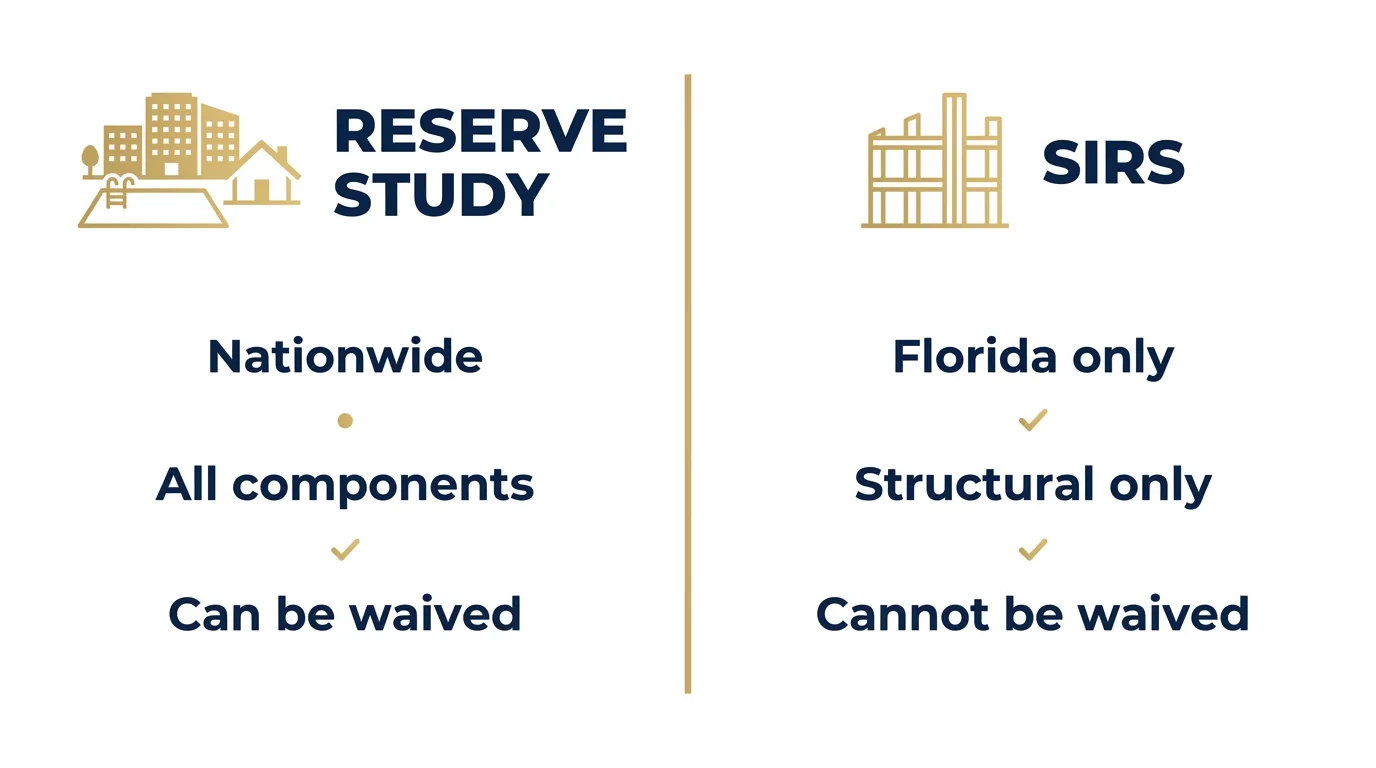
Florida associations can still vote to underfund ordinary reserves, but as of December 31, 2024 they can no longer waive or reduce reserves for SIRS structural components.
For decades, Florida condo owners could vote at an annual meeting to fund no reserves, or less than fully funded reserves, under Fla. Stat. §718.112(2)(f). That kept dues low and was popular, and it is a big reason so many buildings entered the 2020s with badly deferred maintenance. That waiver ability still exists, but only for ordinary, non-structural reserve items.
For SIRS components, the waiver is gone. For budgets adopted on or after December 31, 2024, members of an owner-controlled association that must obtain a SIRS may no longer vote to provide no reserves, or less than the SIRS recommends, for those structural components. The funds must also be kept separate and used only for their designated components. HB 913 added flexibility in how associations fund the work, through loans, lines of credit, or special assessments with the required approvals, but that is a how-to-pay tool, not permission to underfund.
For a buyer, this changes what a clean-looking budget means. A Florida building that historically waived reserves now faces mandatory structural funding it cannot vote away, which often shows up as rising dues or a near-term special assessment. We walk through owner options in what owners can do about a SIRS assessment and the larger picture in the 2026 Florida condo crisis.
SIRS vs Milestone Inspection (the Third Term People Confuse)
A milestone inspection is a structural safety check by an engineer or architect. A SIRS is the financial reserve study that funds those structural components.
Buyers often see three terms and assume two of them are the same. The milestone inspection and the SIRS were created by the same 2022 law, but they do different jobs.
| Milestone Inspection | SIRS | |
|---|---|---|
| Nature | Structural safety inspection | Financial reserve study |
| Who performs it | Licensed engineer or architect | Reserve specialist, engineer, or architect |
| Question it answers | Is the building structurally safe? | Are we saving enough to repair it? |
| Trigger | Building turns 30 (then every 10 years) | Every 10 years |
| Statute | Fla. Stat. §553.899 | Fla. Stat. §718.112(2)(g) |
The milestone inspection (§553.899) is a physical safety check. A licensed engineer or architect performs a visual Phase 1 examination of the structure when a building reaches 30 years of age, then every 10 years after that. Buildings near salt water may face an earlier timeline if the local enforcement agency determines local conditions warrant it. If Phase 1 finds substantial structural deterioration, a more invasive Phase 2 follows. The SIRS, by contrast, never touches the question of safety; it exists to make sure the money is there to fix what the inspection might find. See milestone inspections in 2026 for the full breakdown.
Does a SIRS Replace a Reserve Study?
No. A SIRS covers only structural components. A Florida building still needs reserve planning for the pool, paving, clubhouse, and everything else it maintains.
This is the single most common misconception, and it matters for both compliance and due diligence. A SIRS covers a fixed list of structural and life-safety items. It does not cover the swimming pool, the asphalt, the landscaping hardscape, the clubhouse, the amenity buildings, or any of the other common elements an association still has to repair and replace. A building can be fully SIRS-compliant and still be dangerously underfunded for everything outside that structural list.
In practice, many Florida associations now maintain a combined reserve study that includes the SIRS structural components plus the ordinary, non-structural components in one document, with the structural items flagged as the no-waiver portion. When you review a Florida building, do not stop once you confirm a SIRS exists. Check that the rest of the building's components, the ones the association can still choose to underfund, are also being funded responsibly.
What Buyers and Owners Should Check
In Florida, confirm both a SIRS and a milestone inspection exist; everywhere, check percent funded and whether reserves are being responsibly funded.
Whether you are buying or already own, here is the practical checklist:
- Confirm the documents exist. In Florida, a 3+ story building should have both a completed SIRS and, if it is 30 or more years old, a milestone inspection. A missing or overdue SIRS is itself a red flag.
- Read the SIRS funding plan, not just its existence. Because SIRS reserves cannot be waived, an underfunded SIRS signals that dues are about to rise or an assessment is coming.
- Check percent funded on the broader reserve study. Below 30% is weak. This applies to the non-structural components a SIRS does not cover.
- Cross-check against the meeting minutes and the budget. Anticipated structural work discussed in the minutes but not yet funded tells you what is coming. See 7 meeting-minutes red flags.
- Confirm you actually received the reports. Under Fla. Stat. §718.503, a Florida resale seller must give a buyer the milestone summary and the most recent SIRS, or a statement that none exists. If they are not provided, the contract is voidable at the buyer's option before closing.
Reserve Study Rules Outside Florida
Most large condo states require reserve studies on a set schedule, but only Florida adds a separate mandatory structural study like the SIRS.
SIRS is unique to Florida, but reserve studies themselves are required in many states, just under ordinary reserve-study law rather than a structural-safety statute. A sampling of the major condo states:
| State | Reserve study interval | Key statute |
|---|---|---|
| California | Every 3 years (visual), reviewed annually | Civ. §5550 |
| Nevada | Every 5 years, reviewed annually | NRS 116.31152 |
| Washington | Every 3 years, with site inspection | RCW 64.90.545 |
| Virginia | Every 5 years, reviewed annually | §55.1-1965 (condo) |
| Utah | Full study every 6 years; review every 3 | Utah Code §57-8a-211 |
| Hawaii | Update every 3 years, reviewed annually | HRS §514B-148 |
| Maryland | Study plus update every 5 years | HB 107 (2022) |
Confirm the exact current interval for your state with a local attorney, since these statutes are amended often. Reserve adequacy also drives mortgage eligibility everywhere: Fannie Mae is raising its minimum reserve allocation from 10% to 15% of budgeted assessment income for loan applications dated on or after January 4, 2027, which makes a current, well-funded reserve study (or SIRS) more important to your financing. See the 2026 Fannie and Freddie condo rules.
Frequently Asked Questions
What is the difference between a reserve study and a SIRS?
A reserve study is a nationwide financial-planning document covering every major common-area component an association maintains, and its reserves can often be waived by a member vote. A SIRS (Structural Integrity Reserve Study) is a Florida-only requirement covering a fixed list of structural and life-safety components for buildings three or more habitable stories tall, and those reserves cannot be waived. A reserve study is broad and financial; a SIRS is narrow, structural, and mandatory to fund.
Does a SIRS replace a regular reserve study?
No. A SIRS only covers structural and life-safety components such as the roof, load-bearing structure, plumbing, electrical, and waterproofing. A building still needs reserve planning for everything else it maintains, like the pool, paving, and clubhouse. Many Florida associations now combine both into one document, with the SIRS structural items flagged as the portion that cannot be underfunded.
Which Florida buildings need a SIRS?
Residential condominium and cooperative buildings that are three or more habitable stories tall must have a SIRS, completed at least every 10 years. The deferred-maintenance threshold for additional components is $25,000, raised from $10,000 by HB 913 in 2025. Buildings of three or fewer habitable stories are generally exempt.
Is a SIRS the same as a milestone inspection?
No. A milestone inspection (Fla. Stat. §553.899) is a structural safety inspection performed by a licensed engineer or architect when a building reaches 30 years of age, then every 10 years. A SIRS (§718.112(2)(g)) is the financial reserve study that funds those structural components. The inspection asks whether the building is safe; the SIRS asks whether the association is saving enough to fix it.
Can a Florida HOA still waive reserves?
Only partially. Owners can still vote to underfund or waive reserves for ordinary, non-structural components. But for budgets adopted on or after December 31, 2024, they can no longer waive or reduce reserves for the structural components covered by a required SIRS. Those reserves are mandatory and must be kept separate.
What should I check if I'm buying a Florida condo?
Confirm the building has a completed SIRS and, if it is 30 or more years old, a milestone inspection. Read the SIRS funding plan, since underfunding signals a coming dues increase or assessment. Check percent funded on the broader reserve study for non-structural components. Under Fla. Stat. §718.503, the seller must provide the milestone summary and the most recent SIRS, or state that none exists; if they are not provided, the contract is voidable before closing.
Get Your HOA Documents Analyzed
GoverningDocs analyzes CC&Rs, reserve studies, and meeting minutes, identifying red flags, restrictions, and financial risks so you can buy with confidence. Free. No signup required.
Your first full property report is also free. See what you'll get →
Or get your first full report free →Related Articles
Sources & References
- Fla. Stat. §718.112 (SIRS requirement, component list, $25,000 threshold, no-waiver rule)
- Fla. Stat. §553.899 (milestone inspection: 30-year trigger, Phase 1 and Phase 2)
- Fla. Stat. §718.503 (resale disclosure of SIRS and milestone reports; contract voidable)
- Adams and Reese (HB 913, 2025: deadline extension, $25,000 threshold, funding flexibility)
- Association Reserves (percent-funded tiers: weak, fair, strong)
- Association Reserves (about 74% of communities funded below 70%)
- Community Associations Institute (National Reserve Study Standards, Reserve Specialist credential)
- Fannie Mae Lender Letter LL-2026-03 (reserve minimum rising from 10% to 15%, effective January 4, 2027)
Disclaimer: This article is for educational purposes only and does not constitute legal, financial, or real estate advice. Reserve-study and SIRS requirements, deadlines, and disclosure rules vary by state and by the specific building and transaction, and Florida's statutes have been amended repeatedly since 2022. Statutes referenced are current as of June 2026 and may be superseded. Consult a qualified real estate attorney for guidance specific to your situation.