

In This Guide
For loan applications dated on or after January 4, 2027, Fannie Mae wants a condo association's budget to put at least 15% of its assessment income into replacement reserves, up from 10% today. The number is not 15% of the whole budget. Four kinds of income come out of the bottom of the fraction first, and a building that fails the quick version of the calculation often passes the one a lender actually runs.
You are two weeks into a condo purchase and the lender asks for the association's budget. You open it, find the reserve contribution, divide it by the total at the bottom of the income column, and get something like 13%. The rule you read about says 15%. Now you are wondering whether the deal is dead.
That fear is worth taking seriously, because a building that misses this test can become ineligible for conventional financing, and the problem belongs to the whole project rather than to you. No amount of down payment or credit score fixes it. Every owner in the building feels it on resale and refinance, which is why the arithmetic is worth getting right rather than guessing at.
It is also worth getting right because the quick version of the calculation is usually wrong. The denominator most people reach for is larger than the one Fannie Mae specifies, which drags the percentage down and turns passing buildings into failing ones on a buyer's kitchen table. Here is the formula as written, the four income lines that come out of it, and the same building worked both ways.
1. What the 15% Is Actually 15% Of
Fannie Mae divides the reserve line by budgeted assessment income rather than the whole budget. That denominator is smaller than most people assume.
Fannie Mae's Selling Guide B4-2.2-01 tells the lender to "divide the annual budgeted replacement reserve allocation by the association's annual budgeted assessment income (which includes regular common expense fees)." That phrase, assessment income, is doing the work. It is not the same as total budgeted revenue, and it is not the same as total expenses.
Lender Letter LL-2026-03, which Fannie Mae issued on March 18, 2026, raises the threshold that fraction has to clear from 10% to 15%. Freddie Mac issued Guide Bulletin 2026-C the same day, carrying the same increase and the same date. The method of calculating it does not change. Only the number it has to beat does.
One boundary worth keeping in view: these are Fannie Mae's project standards, matched by Freddie Mac. FHA and VA run their own condo approval processes with their own requirements, so a building that clears this test has not automatically cleared those.
Two dates matter, and they are both about the loan application date rather than the closing date. The 15% attaches to applications dated on or after January 4, 2027. Separately, for applications dated on or after August 3, 2026, Fannie Mae retired the streamlined Limited Review for established condo projects, which pushes many more loans into the Full Review where this reserve test gets applied at all. The Community Associations Institute puts Limited Review at roughly 40% of all project reviews historically, so that is a large share of condo sales moving onto the more document-heavy path. If your closing lands near the new year, ask the loan officer which date the application will carry.
2. The Four Income Lines That Come Out First
Four income types may be excluded from the denominator: incidental income, owner-billed utilities, reserve-account income, and special assessments.
The Selling Guide lists exactly four categories of income that may be excluded from the reserve calculation. In plain terms:
- Incidental income the building does not run on. Laundry machines, clubhouse rentals, guest parking, vending. The test in the Guide is income "on which the project does not rely for ongoing operations, maintenance, or capital improvements."
- Utilities that owners would normally pay themselves. The Guide names cable TV and internet access. Many associations buy these in bulk and bill them through the monthly fee, which inflates the income line without funding the building.
- Income allocated to reserve accounts. This applies where the budget shows a separate reserve assessment as its own income line rather than funding reserves out of general assessments.
- Special assessment income. A one-time levy for a roof or a garage repair does not count toward the ongoing income the reserve percentage is measured against.
Note the word may. These are permitted exclusions rather than automatic ones, and the lender makes the call off the association's actual budget documents. Whether a particular line counts as incidental is a judgment the lender applies, not one a buyer can settle from the outside. That is a reason to ask which lines were excluded rather than to assume an answer.
Check Your Building's Financial Health
Upload your HOA's reserve study and get instant analysis of percent funded, deferred maintenance, and special assessment risk. Free. No signup required.
Your first full property report is also free. See what you'll get →
Or get your first full report free →3. The Same Building, Calculated Both Ways
The same budget reads 13.6% or 15.3% depending on the denominator. One of those numbers misses the 2027 threshold and the other clears it.
Take a 120-unit building whose 2027 budget shows $1,100,000 of total income and a $150,000 replacement reserve line. The quick calculation is $150,000 divided by $1,100,000, which is 13.6%, short of the 15% threshold.
Now look at what makes up that $1,100,000:
| Budget income line | Amount | Excludable? |
|---|---|---|
| Regular common expense assessments | $980,000 | No, this is the core of assessment income |
| Bulk cable TV and internet billed through the association | $60,000 | Yes, a utility owners would typically pay themselves |
| Laundry and clubhouse rental income | $15,000 | Yes, incidental income the building does not rely on |
| Special assessment income | $45,000 | Yes, special assessment income is named in the Guide |
| Total budgeted income | $1,100,000 |
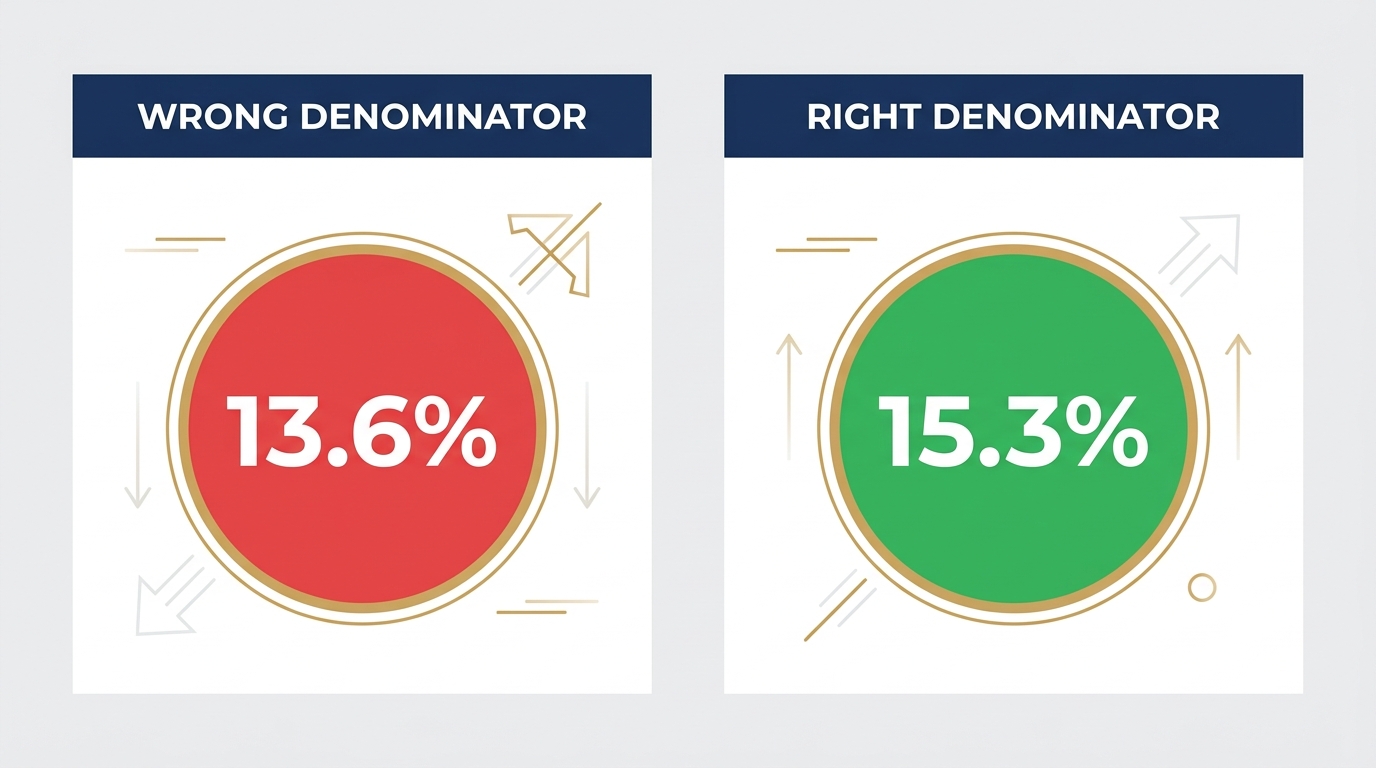
Strip the three excludable lines and the denominator is $980,000. Nothing about the building has changed and the reserve line is the same $150,000, but dividing it by $980,000 gives 15.3%, which clears the 2027 threshold.
This is why a buyer and a lender can look at the same budget and reach opposite conclusions. It is also why it is worth asking the loan officer which income lines they excluded from the denominator and what number they landed on. If the answer is that they used the $1,100,000 figure, that is worth a second conversation, because the Guide permits a smaller one.
4. The Other 15% That Has Nothing to Do With Reserves
A separate rule caps units 60 or more days past due at 15% of the building. It is unrelated to reserve funding and it applies today, not in 2027.
A Full Review applies more than one 15% threshold, and they get confused for each other constantly. Under the same Selling Guide section, no more than 15% of the total units in a project may be 60 or more days past due on common expense assessments. Fannie Mae's own example: a 100-unit project may not have more than 15 units that far behind. There is a matching 15% cap on units 60 or more days past due on each special assessment.
These are counted by units, not by dollars, and they are in force now rather than waiting for January. A building can fund reserves beautifully and still fail on delinquency, or run a tight collections operation and still miss the reserve line. Both outcomes stop the same loan, so ask the association how many units are 60 or more days past due, on the regular assessment and on any special assessment separately, before you assume the reserve number is the only thing between you and a mortgage. For the mechanics of the delinquency side, we covered it in HOA Delinquency Rate: The Number That Can Kill Your Condo Purchase.
5. The Reserve Study Route Around the Percentage
A current reserve study can stand in for the percentage test, but only if the budget funds the highest amount that study recommends.
The Selling Guide lets a lender "use a reserve study in lieu of calculating the replacement reserve" percentage, which is how plenty of well-run buildings with a lower headline number still qualify. The conditions are specific. The lender has to obtain and retain an acceptable study. The study has to show funded reserves that give the project protection equivalent to Fannie Mae's standard requirement. And the budget has to include the highest recommended reserve allocation amount in the study, not a lower figure the board found more comfortable.
One method is ruled out by name. Some studies set a funding goal that lets the reserve balance approach zero without going negative, often called baseline funding. The Guide states that this method "may not be used to waive" the reserve requirement. Both of these reserve study conditions are already part of Fannie Mae's standard, so do not assume they start when the 15% number does. A study can also only be used if it was completed within three years of the date the lender approves the project, and it has to come from an independent third party such as a credentialed reserve specialist, a construction engineer, or a CPA who specializes in reserve studies.
So there are three documents worth asking the seller or the listing agent for, in this order: the line-item budget rather than a one-page summary, the most recent reserve study with its date on it, and the association's own statement of how many units are more than 60 days behind. Those three answer every question on this page for a specific building. If you want a second read on the reserve study before you send it to a lender, our free reserve study tool pulls out the percent funded, the contribution trend, and the components the study flags.
Frequently Asked Questions
Is the 15% reserve requirement based on the association's total budget?
No. Fannie Mae's Selling Guide directs the lender to divide the annual budgeted replacement reserve allocation by the association's annual budgeted assessment income, which includes regular common expense fees. Four categories of income may then be excluded from that denominator: incidental income the project does not rely on, utility income such as cable and internet that owners would typically pay themselves, income allocated to reserve accounts, and special assessment income. Using total budgeted revenue instead will understate the percentage.
When does the 15% start applying to my loan?
It attaches to loan applications dated on or after January 4, 2027, under Fannie Mae Lender Letter LL-2026-03, with an aligned Freddie Mac bulletin. The trigger is the application date rather than the closing date, so a purchase that closes in 2027 on an application dated in 2026 is measured against the older 10% figure. If your timeline sits near the new year, that is a question for your loan officer.
My building's reserve line works out to 13%. Is the loan dead?
Not necessarily, and a 13% result off the total income line is often the wrong calculation rather than a real shortfall. Ask which income lines the lender excluded from the denominator, and ask whether the association has a reserve study the lender can use in place of the percentage test. A qualified lender or attorney should evaluate a specific building, since the exclusions are permissive and depend on the association's actual budget documents.
Can a reserve study get a building out of the 15% requirement?
It can substitute for the percentage calculation if several conditions are met. The lender must obtain and retain an acceptable study, the study must show funded reserves equivalent to Fannie Mae's standard protection, and the budget must include the highest recommended reserve allocation amount in the study. The Guide also states that a baseline funding method, one that lets the reserve balance approach zero without going negative, may not be used to waive the requirement. The study must have been completed within three years of the date the lender approves the project. These reserve study conditions are already part of Fannie Mae's standard, so do not assume they start when the 15% number does.
Is the 15% delinquency limit the same rule as the 15% reserve requirement?
They are separate tests that happen to share a number. The reserve rule is about how much of assessment income goes into replacement reserves and rises to 15% for applications dated on or after January 4, 2027. The delinquency rule caps the share of units that are 60 or more days past due on common expense assessments at 15% of total units, with a matching cap on each special assessment, and it applies today. A building can pass one and fail the other.
Get Your HOA Documents Analyzed
GoverningDocs analyzes CC&Rs, reserve studies, and meeting minutes, identifying red flags, restrictions, and financial risks so you can buy with confidence. Free. No signup required.
Your first full property report is also free. See what you'll get →
Or get your first full report free →Related Articles
Sources & References
- Fannie Mae Selling Guide B4-2.2-01, Full Review Process (the division method, the four permitted income exclusions, the reserve study in lieu conditions, the baseline funding restriction, and the 15% delinquency limits)
- Fannie Mae Lender Letter LL-2026-03 (issued March 18, 2026; raises the reserve minimum from 10% to 15% for applications dated on or after January 4, 2027, and retires Limited Review for applications dated on or after August 3, 2026)
- Freddie Mac Guide Bulletin 2026-C (issued March 18, 2026; the matching increase from 10% to 15% of annual budgeted assessment income, effective for mortgages with application received dates on or after January 4, 2027)
- Community Associations Institute Advocacy (context on the scale of the Limited Review retirement, which CAI puts at roughly 40% of all project reviews historically)
Disclaimer: This article is for educational purposes only and does not constitute legal, financial, or real estate advice. It describes Fannie Mae project standards, matched by Freddie Mac, and does not describe FHA or VA condo approval, which follow separate processes. The income exclusions described here are permitted rather than automatic, and the lender applies them to a specific association's budget documents, so the worked example is an illustration rather than a determination about any building. Citations are current as of September 2026 and may be superseded. Consult a qualified lender for a specific transaction and a qualified real estate attorney for guidance specific to your situation.