
In This Guide
An HOA board can change day-to-day rules and regulations on its own, but it generally cannot rewrite the recorded CC&Rs without a supermajority owner vote, commonly two-thirds, plus recording and sometimes lender consent. A validly adopted amendment can bind you even if you bought before it passed, because you took title subject to a declaration that says it can be amended. The main exception is rental restrictions: Florida and California grandfather existing owners, while many other states do not.
It is the fear that shadows almost every HOA purchase. You read the documents, the rules work for you, you buy. Then a year later the board circulates a proposed amendment: no more rentals under a year, or no dogs over 30 pounds, or a cap on how many units can be leased at once. Can they actually do that to you, after you already own?
The honest answer has two parts, and they are frequently confused. Part one is which document the change lives in, because that decides whether a single board vote or a building-wide owner vote is required. Part two is whether a new restriction can reach back and bind an owner who bought before it passed. Both parts turn on the governing documents and on your state's statutes, and both are readable before you ever write an offer.
This guide walks through the document hierarchy, how amendments actually pass, the retroactivity question, the rental carve-outs that protect existing owners in some states, and the red flags a buyer can catch in advance. For the deep dive on the single most-feared amendment, see our companion piece on whether an HOA can ban rentals after you buy.
CC&Rs, Bylaws, and Rules: Who Can Change What
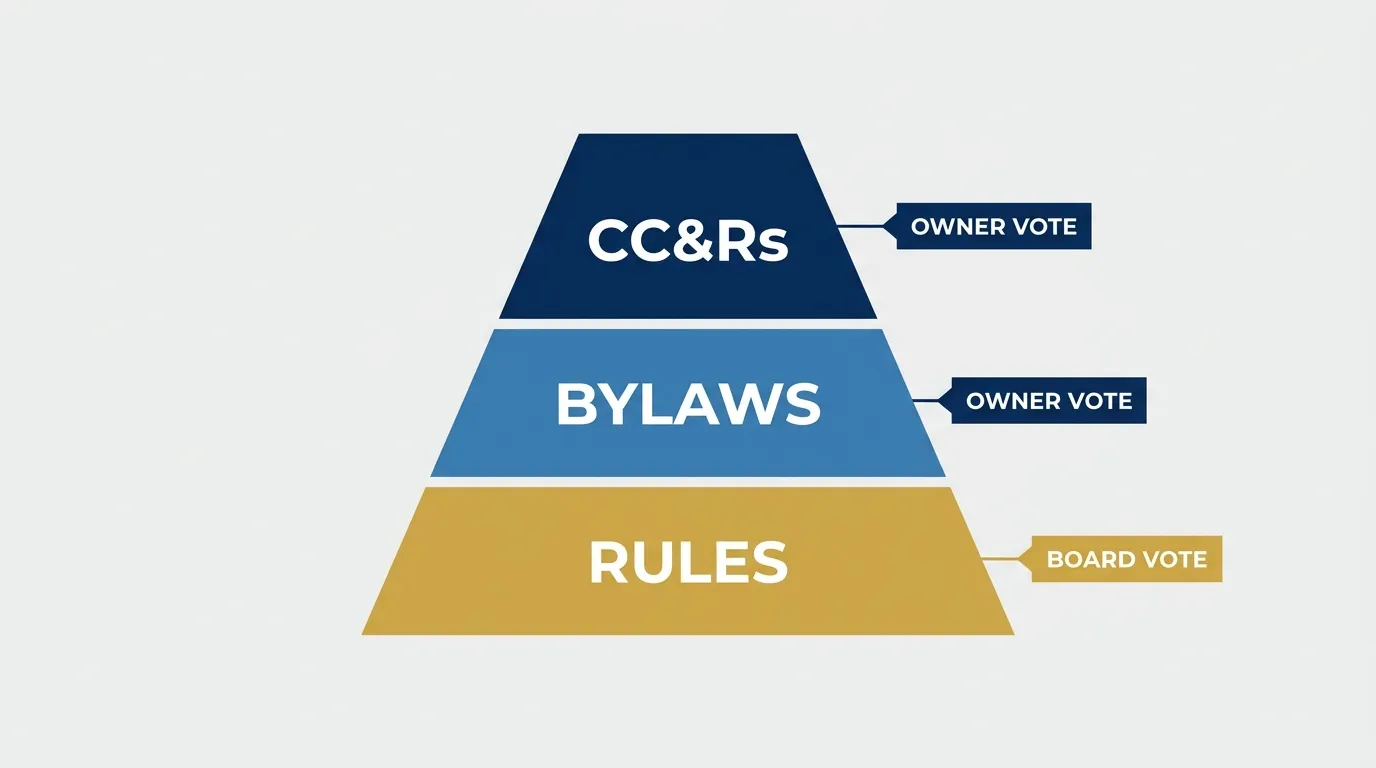
The board can change rules and regulations alone. Changing the recorded CC&Rs or bylaws takes an owner vote, and the CC&Rs sit at the top.
An HOA runs on a stack of documents, and they are not equal. Understanding the order is the single most useful thing a buyer can learn here, because it tells you which changes need your neighbors' votes and which the board can make on a Tuesday night.
- CC&Rs (the declaration). The recorded contract that runs with the land. It covers the big, durable restrictions: use, architecture, leasing, pets, assessments. Changing it requires an owner supermajority vote and recording in the county land records.
- Bylaws. The association's internal operating manual: how the board is elected, meeting and quorum rules, officer duties. Amending the bylaws also takes a membership vote, though the threshold is often lower than for the CC&Rs.
- Rules and regulations. The day-to-day policies that flesh out the CC&Rs: pool hours, guest parking, signage, amenity use. The board can usually adopt or change these on its own, after notice, with no owner vote.
When two documents conflict, the higher one controls, so a rule cannot contradict the CC&Rs, and the CC&Rs cannot override state law (sources: AlphaHOA; KPPM). This distinction is also why courts treat the two layers differently. A restriction written into the recorded declaration gets strong deference, while a rule the board adopts later is judged by a more flexible reasonableness standard, a line the California Supreme Court drew in Nahrstedt v. Lakeside Village Condominium Assn., 8 Cal.4th 361 (1994), when it upheld a recorded pet restriction (Justia).
How a CC&R Amendment Actually Passes
Amending the declaration usually needs a supermajority of owners, often two-thirds, plus recording in the county land records.
CC&Rs are deliberately hard to change. The whole point of a recorded declaration is that buyers can rely on it, so the drafters build in friction. Three steps usually stand between a proposal and an enforceable amendment.
First, the owner vote. The declaration states its own amendment threshold, and it is almost always a supermajority. In general practice this runs from two-thirds (67%) to 75% of owners, and many state statutes use two-thirds as the default when the declaration is silent (e.g., Tex. Prop. Code §209.0041(h-2) and Fla. Stat. §718.110(1)(a); see also RunHOA). Second, recording. An amendment is not effective until it is recorded in the land records of every county where the property sits, the same act that gives future buyers constructive notice. Third, in condominiums, lender consent may be required for changes that materially and adversely affect mortgage-holders; Fannie Mae has generally looked for the consent of mortgagees holding at least 51% of the mortgaged units before it will treat such an amendment as valid (Kass Shuler).
Statutes derived from the Uniform Common Interest Ownership Act add two more protections that matter to buyers. There is usually a short window, one year in UCIOA-based acts, to challenge a recorded amendment in court, and the most drastic amendments, such as changing the fundamental use to which a unit may be put, can require a much higher vote or even unanimity. Texas is a clean example: a condominium declaration amendment normally needs 67% of votes, but changing the use restrictions on a unit, moving boundaries, or altering ownership interests requires 100% approval (Tex. Prop. Code §82.067).
Can an Amendment Bind You If You Bought First?
Often yes. Courts hold that owners take title subject to an amendable declaration, so a valid amendment can bind them unless a statute says otherwise.
This is the heart of the buyer's fear, and the case law is not entirely comfortable. The leading rule is that a validly adopted amendment can bind owners who bought before it passed. In Woodside Village Condominium Assn. v. Jahren, 806 So.2d 452 (Fla. 2002), the Florida Supreme Court upheld a declaration amendment that sharply restricted leasing and enforced it against existing owners, reasoning that anyone who buys into a condominium takes title knowing the recorded declaration expressly says it can be amended (FindLaw). A Wisconsin appeals court reached a similar result in Apple Valley Gardens Assn. v. MacHutta, 2007 WI App 270, aff'd, 2009 WI 28, 763 N.W.2d 126 (Wis. 2009), enforcing a rental prohibition adopted by bylaw amendment against a pre-existing owner (CourtListener).
The logic is constructive notice. Because the declaration is recorded and states that it may be amended by a supermajority, every buyer is charged with knowing the rules can change, so a later amendment is treated as part of the bargain they accepted at closing. Recorded declaration restrictions also carry a presumption of validity under Nahrstedt, meaning a challenger has to show the amendment is arbitrary, violates public policy, or imposes burdens that clearly outweigh its benefits to the community as a whole.
There is a minority line the other way. Some courts have declined to bind a pre-existing owner to a later leasing restriction, holding that it can apply only prospectively. Those cases often turn on a single distinction: whether the change was made to an unrecorded bylaw rather than to the recorded declaration, which is exactly the fault line that decides many of these disputes. The practical takeaway is not that you are always protected or always exposed. It is that the answer depends on your state, the document that was changed, and whether it was properly recorded, so the general principle should never be a substitute for reading the specific documents and, for anything consequential, asking a licensed attorney.
The Rental Exception Most Buyers Care About
For rental bans, some states shield existing owners: Florida and California grandfather anyone who bought before the restriction took effect.
The most litigated and most financially painful amendment is the one that restricts leasing, because it can turn an investment condo into a unit you can only sell or live in. Responding to cases like Woodside, several legislatures carved out a specific protection: a new rental restriction applies only to owners who consent to it or who buy after it takes effect, and everyone who already owned is grandfathered.
- Florida condominiums. An amendment that prohibits rentals, changes the allowed rental term, or limits rental frequency applies only to owners who consent and those who take title after the effective date (Fla. Stat. §718.110(13)).
- Florida HOAs. The same grandfather rule applies to rental amendments passed after July 1, 2021, with one carve-out that binds everyone: an HOA may still restrict rentals shorter than six months and may bar renting a home more than three times a year (Fla. Stat. §720.306(1)(h)).
- California. An owner is not subject to a governing-document provision prohibiting rentals unless it was effective before that owner acquired title (Cal. Civ. Code §4740).
Here is the trap for buyers who assume this protection is universal. It is not. Among the states below, only Florida and California grandfather existing owners at the statute level. In Texas, Colorado, Arizona, and Washington, there is no statutory grandfather that exempts an owner who bought before a rental amendment passed, which is precisely why the Woodside line of cases still matters there. That does not always mean zero protection: a high amendment-vote threshold can make a rental ban hard to pass, and in Washington a leasing restriction is treated as a “use” change that needs 90% owner approval in older condos (Wash. Rev. Code 64.34.264(4)). If leasing flexibility is part of why you are buying, confirm your state's rule and the current declaration language before you close, and treat any owner-specific question as one for an attorney. Our HOA rental restrictions guide covers the leasing angle in more depth.
State by State: How High the Bar Is
The vote to amend is around two-thirds in most states, but the mechanics differ sharply, and only two of these six grandfather owners on rentals.
A 67% figure shows up again and again, but do not read it as one uniform national rule. States get there in opposite ways: some cap how high a declaration's threshold can go, one overrides a higher number down to 67%, another voids anything above 67%, and one treats 67% as a floor the declaration can exceed. The table below summarizes the amendment rule for the recorded declaration in six large HOA states.
| State | Vote to amend the declaration | Rental grandfather for existing owners? |
|---|---|---|
| Florida (condo) | 2/3 default; statute caps the threshold at 4/5 (declarations recorded after April 1, 1992) | Yes – §718.110(13) |
| Florida (HOA) | 2/3 of voting interests (default) | Yes – §720.306(1)(h) (except under-6-month / 3x-a-year rules) |
| California | Whatever the declaration says; a court can reduce a >50% threshold (§4275) | Yes – §4740 |
| Texas | 67% (HOA); condo 67%, but 100% to change use restrictions | No |
| Colorado | >50% up to 67%; anything above 67% is void and deemed 67% | No |
| Arizona (condo) | At least 67% (a floor; the declaration may require more) | No |
| Washington | 67% default; declaration may raise it, but not above 90% (WUCIOA, communities created on/after July 1, 2018; older condos follow ch. 64.34) | No |
Sources for the table: Fla. Stat. §718.110 and §720.306; Cal. Civ. Code §4270, §4275, §4740; Tex. Prop. Code §209.0041 and §82.067; Colo. Rev. Stat. §38-33.3-217; Ariz. Rev. Stat. §33-1227; Wash. Rev. Code 64.90.285.
Red Flags to Spot Before You Close
The warning signs of a coming rule change sit in the documents: a low amendment threshold, pending amendments in the minutes, declarant control.
You cannot stop an HOA from ever amending its documents, but you can read the odds before you buy. Several signals show up in paperwork the association already produces:
- A low amendment threshold. Check the declaration's own amendment clause. A declaration that can be amended by a bare majority is far easier to change than one requiring 75%, so the lower the bar, the more exposed you are to a future rule shift.
- Pending or recent amendments in the minutes. Board and annual-meeting minutes are where a leasing cap, pet limit, or architectural change first appears, often months before it goes to a vote. This is the earliest warning you will get.
- Declarant control. In a newer community still run by the developer, the declarant often reserves broad power to amend the declaration unilaterally during the build-out period, without the usual owner vote. Read the declarant-rights section carefully.
- A rental-dependent purchase in a no-grandfather state. If you are counting on leasing income and buying in a state without a statutory grandfather, understand that a future amendment could reach you. Weigh that risk before you commit.
Reading a declaration's amendment clause and scanning years of minutes by hand is exactly the kind of slow, easy-to-skip work that gets skipped. Our free CC&R analysis tool pulls the rental, pet, and architectural provisions and flags the amendment mechanics, and the meeting minutes analyzer surfaces proposed and passed amendments buried in the record. For the full pre-offer routine, see the complete condo buying checklist.
Frequently Asked Questions
Can an HOA change its rules without an owner vote?
It depends on the document. A board can usually adopt or change ordinary rules and regulations (pool hours, parking, amenity use) on its own after giving notice. But changing the recorded CC&Rs or the bylaws requires an owner vote, typically a supermajority for the CC&Rs. A rule can never contradict the CC&Rs, and the CC&Rs cannot override state law.
How many owners have to approve a CC&R amendment?
The declaration sets its own threshold, and it is almost always a supermajority. In general practice it runs from two-thirds (67%) to 75% of owners, and many state statutes use 67% as the default when the declaration is silent. Some states also cap or override that number, and the most drastic amendments, like changing a unit's permitted use in Texas condos, can require unanimous approval.
Can an HOA ban rentals after I already own my unit?
In some states, yes; in others, you are protected. Courts have enforced rental amendments against existing owners on the theory that they took title subject to an amendable declaration. But Florida (§718.110(13) and §720.306(1)(h)) and California (§4740) grandfather owners who owned before the restriction took effect. Texas, Colorado, Arizona, and Washington have no such statutory grandfather. Confirm your state's rule and consult an attorney for your situation.
Is a CC&R amendment retroactive?
A validly adopted amendment can apply to current owners, not just future buyers, because the recorded declaration puts everyone on notice that it can be amended. That was the holding in Woodside Village Condominium Assn. v. Jahren (Fla. 2002). A minority of courts have limited amendments to prospective effect, often where the change was to an unrecorded bylaw rather than the recorded declaration. State statutes can also override the general rule for specific restriction types, such as rentals.
What is the difference between CC&Rs, bylaws, and rules?
CC&Rs (the declaration) are the recorded restrictions that run with the land and sit at the top of the hierarchy. Bylaws are the association's internal operating manual for elections, meetings, and board duties. Rules and regulations are the day-to-day policies that flesh out the CC&Rs. Changing the CC&Rs or bylaws takes an owner vote; changing rules usually only takes a board vote.
How can I tell before buying whether the rules are likely to change?
Read the declaration's amendment clause to see how easy it is to amend, then scan recent board and annual-meeting minutes for proposed or pending amendments, which is where changes surface first. In newer communities, check whether the developer still holds declarant rights to amend the declaration unilaterally. A free CC&R analysis tool and a meeting-minutes analyzer can surface these signals quickly.
Get Your HOA Documents Analyzed
GoverningDocs analyzes CC&Rs, reserve studies, and meeting minutes, identifying red flags, restrictions, and financial risks so you can buy with confidence. Free. No signup required.
Your first full property report is also free. See what you'll get →
Or get your first full report free →Related Articles
Sources & References
- Fla. Stat. §718.110 (condominium declaration amendment: 2/3 default, 4/5 cap, rental grandfather in subsection 13)
- Fla. Stat. §720.306 (HOA amendment 2/3; rental grandfather §720.306(1)(h), under-6-month and 3x-a-year carve-outs)
- Cal. Civ. Code §4270 and §4275 (Davis-Stirling amendment procedure and court-reduction petition)
- Cal. Civ. Code §4740 (rental prohibition applies only if effective before the owner took title)
- Tex. Prop. Code §209.0041 (HOA declaration amendment: 67% default; a declaration may set a lower percentage, which then controls) and §82.067 (condo: 67%, 100% for use-restriction changes)
- Colo. Rev. Stat. §38-33.3-217 (CCIOA: >50% up to a 67% cap; higher thresholds void)
- Ariz. Rev. Stat. §33-1227 (condominium amendment: at least 67%) and §33-1260.01 (rentals permitted unless prohibited in the declaration)
- Wash. Rev. Code 64.90.285 (WUCIOA: 67% default, 90% ceiling; applies to communities created on/after July 1, 2018) and 64.34.264(4) (older condos: a leasing restriction is a “use” change requiring 90% approval, per Filmore LLLP v. Unit Owners Ass'n of Centre Pointe Condominium, 183 Wash. App. 328 (2014), aff'd, 184 Wash.2d 170 (2015))
- Nahrstedt v. Lakeside Village Condominium Assn., 8 Cal.4th 361 (1994) (recorded restrictions presumptively reasonable; board rules get less deference)
- Woodside Village Condominium Assn. v. Jahren, 806 So.2d 452 (Fla. 2002) (leasing amendment enforceable against existing owners)
- Apple Valley Gardens Assn. v. MacHutta, 2007 WI App 270, aff'd, 2009 WI 28, 763 N.W.2d 126 (Wis. 2009) (bylaw rental prohibition enforceable against a pre-existing owner)
Disclaimer: This article is for educational purposes only and does not constitute legal, financial, or real estate advice. HOA statutes, amendment procedures, and grandfather protections vary by state and change over time, and courts apply them to the specific facts of each case. Figures and citations are current as of July 2026 and may be superseded. Read your community's actual governing documents and consult a qualified real estate attorney for guidance specific to your situation.