

In This Guide
State law sits above an association's recorded documents, so a CC&R provision can be correctly recorded and still unenforceable. Seven states changed rules that reach existing communities.
You have a few days left in a due diligence window and a stack of association documents in front of you. The declaration is recorded, it is the current version, the management company confirmed it, and nothing in it looks unusual. You read it carefully because it is the document that will govern the property you are buying.
Some of what you read may not bind anyone. A restriction can sit in a recorded declaration for years after a state law made it unenforceable, because nothing forces an association to go back and delete it. The reverse also happens. A rule can bind you without appearing in the document at all, because the statute reached past the declaration and set a floor the association has to meet.
That gap between what the paper says and what actually governs is where buyers get surprised, usually by a budget rather than by a rule. Below are the changes in Florida, California, Colorado, Maryland, Washington, Arizona and Georgia that reach communities whose documents were written long before the law arrived, along with the questions worth asking about each one.
1. The Document Can Be Recorded, Current, and Partly Unenforceable
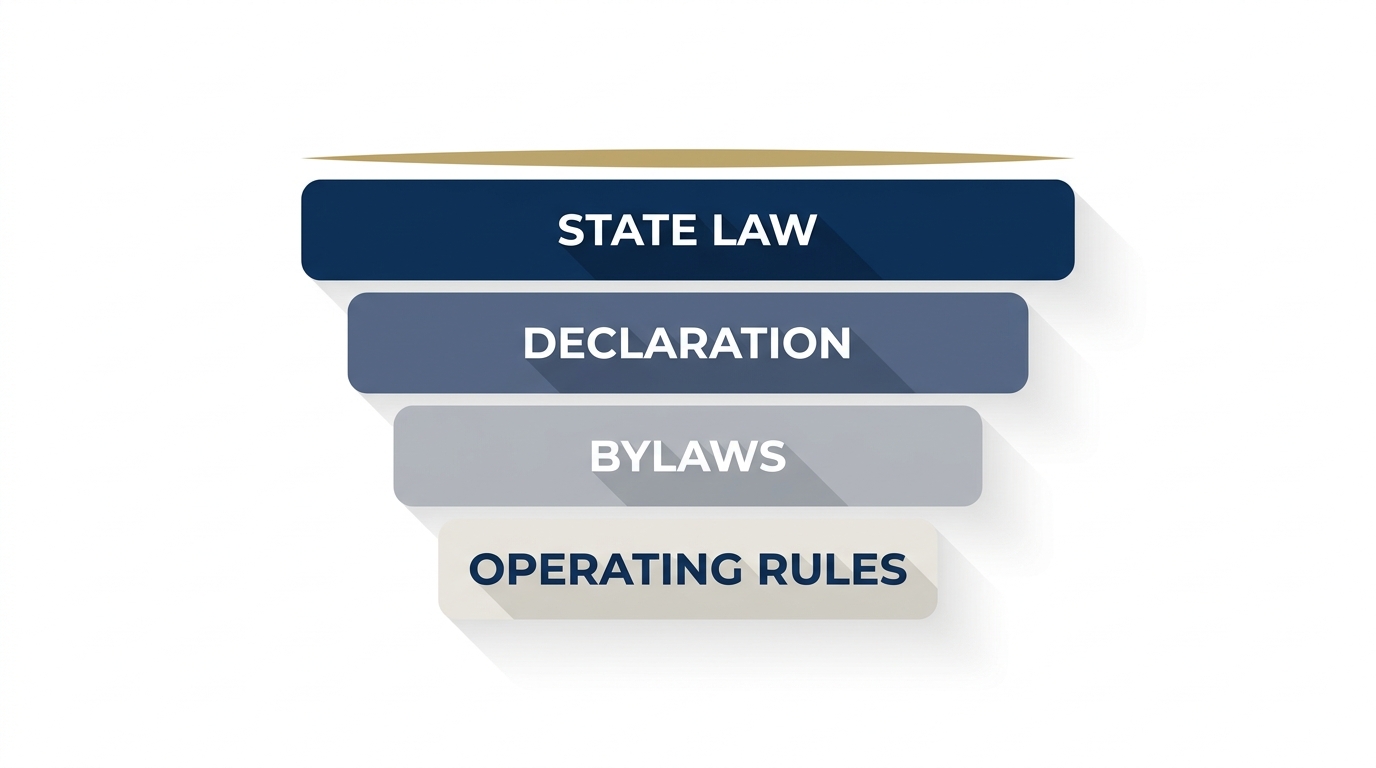
When a governing document conflicts with state law, the law controls. California states the ranking directly in Cal. Civ. Code §4205.
California puts the order of authority in a single sentence. Cal. Civ. Code §4205(a) reads: "To the extent of any conflict between the governing documents and the law, the law shall prevail." The same section then ranks the association's own documents against each other, with the declaration above the bylaws and the bylaws above the operating rules.
Most states arrive at the same result through their community association statutes rather than through one tidy sentence, and the details vary by state and by whether the community is a condominium or a homeowners association. The practical consequence for a buyer is the same everywhere. A provision printed in the declaration is a claim about what governs, and the statute is the thing that settles it.
This matters for reading a document package because the two failure modes look nothing alike. An unenforceable restriction that nobody deleted is mostly a nuisance, and it can make a community look more restrictive than it is. A statutory requirement that the document never mentions is the expensive one, because it usually concerns money the association has to start setting aside.
Get Your CC&Rs Analyzed
Upload your HOA's CC&Rs and get instant analysis of rental restrictions, pet policies, financing red flags, and more. Free. No signup required.
Your first full property report is also free. See what you'll get →
Or get your first full report free →2. Florida: The Reserve Waiver Clause That Stopped Working
Florida condo members can no longer vote structural reserves down. For budgets adopted on or after December 31, 2024, the study amount is required.
Older Florida condominium documents commonly describe reserve funding as something the members can vote to reduce or skip, and for a long time that matched the statute. It no longer matches it for structural items. Fla. Stat. §718.112(2)(f)2.b. provides that for a budget adopted on or after December 31, 2024, the members of a unit-owner-controlled association that must obtain a structural integrity reserve study "may not determine to provide no reserves or less reserves than required by this subsection" for the items the study covers.
The amount is not left to the board either. The same subsection also requires that the reserve amount for those items be based on the findings and recommendations of the association's most recent structural integrity reserve study. A study that identifies a large number therefore turns into a budget line, and that line has to come from somewhere.
Two limits belong with this, because they are the situations where the old vote still exists. An association operating a multicondominium (one association running several separate condominiums) may provide no reserves or fewer reserves if an alternative funding method has been approved by the division, meaning Florida's Division of Condominiums, Timeshares and Mobile Homes, the state regulator for condominiums. And if an association votes to terminate the condominium under Fla. Stat. §718.117, the members may vote to waive the reserves the most recent study recommends. There is also a carve-out for items whose useful life is not readily ascertainable or runs beyond 25 years, where the association reserves the deferred maintenance expense the study recommends rather than a replacement cost.
For a buyer, the question to put to the association is narrow and answerable: has this association completed a structural integrity reserve study, and does the current budget fund the items it identifies at the recommended amount. A declaration that still describes reserve waivers does not answer it. Our guide to what a Florida SIRS report contains and the comparison of a reserve study against a SIRS cover what those documents should show.
3. Florida: The Rental Rule That Binds the Buyer and Not the Seller
A Florida HOA rental restriction enacted after July 1, 2021 applies to an owner who acquires title after it took effect, which is the person buying.
This one runs the other direction. The restriction is fully enforceable, and the question is who it reaches. Fla. Stat. §720.306(1)(h)1. provides that a governing document or amendment enacted after July 1, 2021 that prohibits or regulates rental agreements "applies only to a parcel owner who acquires title to the parcel after the effective date of the governing document or amendment, or to a parcel owner who consents."
A seller who owned the property before the amendment passed, and who never consented to it, may have been renting under an exemption that does not transfer. The buyer takes title afterward and is exactly the person the restriction reaches. An agent walking a client through a rental-dependent purchase in a Florida HOA has a concrete thing to verify rather than a general worry.
The statute then takes part of that back, and the exception is the part most likely to matter. Under subparagraph 2., an association may amend its documents to prohibit or regulate rental agreements for a term of less than 6 months, and may prohibit renting a parcel more than three times in a calendar year, and those amendments apply to all parcel owners regardless of when they bought, so a short-term rental plan gets no protection from the acquisition-date rule.
Three further limits sit in the same paragraph. It does not affect the amendment restrictions for associations of 15 or fewer parcel owners under Fla. Stat. §720.303(1). A change of ownership does not occur when a parcel is conveyed to an affiliated entity, when beneficial ownership does not change, or when an heir becomes the owner. And where the owner is a business entity, a change of ownership does occur once everyone who held an interest at the time of enactment conveys that interest to an unaffiliated entity.
All of that is Chapter 720, which governs Florida homeowners' associations. Florida condominiums are governed by Chapter 718 and the rental amendment rules there are different, so a condominium buyer cannot read this section across. Our guide to HOA rental restrictions and the post on whether an HOA can ban rentals after you buy go further into how these amendments are adopted.
4. California: The Rental Cap That Was Void Before the Board Rewrote It
A California HOA rental cap below 25 percent has been unenforceable since January 1, 2021, even if the board never rewrote the declaration to say so. Cal. Civ. Code §4741 required compliance from that date regardless of whether the association ever revised its governing documents.
California is the clearest example in this post of a document that can be wrong on its face, because the statute says so in as many words. Cal. Civ. Code §4741(b) bars a common interest development from adopting or enforcing a provision that restricts rentals to less than 25 percent of the units (California's statute calls each one a “separate interest”). A development may authorize a higher percentage, and it may not go below that floor.
Subdivision (f) is the part that produces stale paperwork. It requires compliance on and after January 1, 2021, "regardless of whether the common interest development has revised their governing documents to comply with this section". It then directs the board, without approval of the members, to amend any declaration or other governing document containing a prohibited covenant no later than July 1, 2022, with at least 28 days' general notice before the board approves the amendment. So a buyer reading a California declaration in 2026 can find a 10 percent rental cap that has been unenforceable since the start of 2021, sitting in a document the association simply never got around to restating.
Several boundaries travel with this section and each one changes the answer for a particular buyer:
- Short-term rentals are still restrictable. Subdivision (c) allows a provision prohibiting transient or short-term rental for a period of 30 days or less.
- Accessory dwelling units do not count. Under subdivision (d), an accessory dwelling unit or junior accessory dwelling unit is not treated as a separate interest for the purposes of this section.
- Owner occupancy is not renting. Subdivision (e) provides that a separate interest is not counted as occupied by a renter where the owner occupies the interest or its accessory dwelling unit.
- Earlier owners keep what they had. Subdivision (h) states that, in accordance with Cal. Civ. Code §4740, the section does not change the right of an owner who acquired title before its effective date to rent or lease the property.
Subdivision (g) attaches a consequence for the association rather than for the owner. A development that willfully violates the section is liable for actual damages and pays a civil penalty to the affected party of up to one thousand dollars ($1,000). That is worth knowing when a manager insists a cap in the recorded document is still being enforced. Ask the association directly whether it restated its governing documents after 2021. If it did not, a cap below 25 percent in the copy you were handed is not enforceable, whatever the manager says.
5. Colorado: A New Reserve Study Before the Keys Change Hands
Colorado's HB26-1099, effective August 12, 2026, makes the developer pay for a 30-year reserve study before turning the community over.
Colorado's 2026 change lands on new communities and on the document set a first buyer receives. HB26-1099, effective August 12, 2026, requires the declarant (the developer selling units before the community turns over to homeowner control) of a new planned community or condominium to obtain and pay for a reserve study before control transfers to the association, with the study estimating the cost of maintaining, repairing or replacing the common elements over a 30-year period. The study has to be performed by a professional with no business relationship with or financial interest in the declarant.
The reason this matters to a buyer in a new Colorado community is that the developer's early budget is the least reliable number in the packet, and an independent 30-year projection is a check on it. The act also puts deadlines on a departing management company for turning over records, and attaches financial consequences when that does not happen.
Colorado also caps how hard a declaration can make it to amend itself. Under C.R.S. §38-33.3-217(1)(a)(I), a declaration provision requiring more than 67 percent of the allocated votes to amend is treated as requiring 67 percent (Colorado Revised Statutes, 2024 edition). The cap has exceptions, including communities still under developer control and phased communities, so ask whether the developer has handed over control. A community whose documents appear impossible to update may have a lower real threshold than the page suggests, which bears on whether an outdated document is likely to get fixed. Our Colorado CCIOA compliance guide covers the wider set of requirements that reach existing Colorado communities. Two things to ask for in a new Colorado community: a copy of the developer-funded reserve study, and the amendment threshold written into the declaration, which is generally capped at 67 percent once the developer has handed over control, however high the page reads.
6. Maryland: Reserves Are No Longer a Budget Preference
A Maryland condo or HOA budget must carry the reserve amount the most recent study recommends, deposited by the last day of the fiscal year.
Maryland moved reserve funding out of the board's discretion and into the budget itself. For condominiums, Md. Code, Real Prop. §11-109.2(c)(1) provides that the reserves in the annual budget shall be the funding amount recommended in the most recent reserve study or updated reserve study, and shall be deposited in the reserve account on or before the last day of each fiscal year, in accordance with an adopted funding plan. Md. Code, Real Prop. §11B-112.2(d)(1) imposes the same two-part requirement on homeowners associations.
A declaration that says nothing about reserves, or that leaves the figure to the board each year, no longer sets the floor, because the most recent study sets it. A buyer comparing two Maryland communities can therefore ask a question with a checkable answer: what does the most recent reserve study recommend, and does the adopted budget fund that number.
Three limits are worth carrying, because they decide whether any of this reaches a specific property:
- The HOA section is conditioned on the declaration. Md. Code, Real Prop. §11B-112.2(a) applies the section only to a homeowners association that has responsibility under its declaration for maintaining and repairing common areas.
- The condominium study section covers residential condominiums. Md. Code, Real Prop. §11-109.4(b) states that the section applies only to a residential condominium.
- A first study comes with a ramp. Where the most recent study was an initial reserve study, §11-109.2(c)(2) gives the governing body five fiscal years to reach the annual funding level that study recommends.
That last point is the one that changes what a buyer should expect from the numbers. A community partway through the ramp can be fully compliant and still be contributing less than the study's eventual target, so the budget alone will understate what the reserve line is going to become. Our guide to reading a reserve study explains where the recommended funding figure appears.

7. Washington: Where the Old Document Mostly Survives
Washington's condo and HOA law (WUCIOA) reaches communities created before July 2018 only through a listed set of sections, and it does not void their existing document provisions.
Washington is the state that keeps this post honest, because the general rule about statutes overriding documents is weaker here than a buyer might assume. RCW 64.90.365(1) applies an enumerated list of Washington Uniform Common Interest Ownership Act sections to a community created before July 1, 2018, and displaces inconsistent provisions of the older chapters. The list is specific and short, covering ten items including RCW 64.90.445 on meetings, RCW 64.90.545 on reserve studies and RCW 64.90.480(10).
Subsection (2) then sets the boundary. Those sections "apply only to events and circumstances occurring on or after July 1, 2018, and do not invalidate existing provisions of the governing documents" of communities that existed on July 1, 2018, subject to specific exceptions the statute identifies to protect the public interest. A pre-2018 Washington community therefore keeps much of its original document language. The buyer's first question is which act governs this community and when it was created.
There is a date on the horizon worth putting in a calendar. The reviser's note to the same section records that chapters 58.19, 64.32, 64.34 and 64.38 RCW were repealed by 2024 c 321, effective January 1, 2028. Our Washington WUCIOA guide covers what the act requires of communities it does reach.
8. Arizona and Georgia: One in Force, One Still Coming
Arizona's HB 2397 took effect September 12, 2026. Georgia's SB 406 carries a general effective date of January 1, 2027.
Arizona's change is now in force; most of Georgia's is not. A packet follows the law in force on the day it is issued, so check the date on it: an Arizona resale packet issued on or after September 12, 2026 falls under HB 2397, and one issued earlier does not.
Arizona HB 2397 amends the resale disclosure statutes for condominiums and planned communities, A.R.S. §33-1260 and §33-1806. It changes what goes into the disclosure packet a buyer receives, starts the 10-day delivery clock when the offer is accepted, and sets rules on the fees the association can charge, including a $50 cap on an update fee (bill text; Arizona Senate fact sheet). It took effect on September 12, 2026, the general effective date for the 57th Legislature's second regular session (Arizona Legislature, General Effective Dates). One boundary is easy to miss: the 2026 session moved the resale disclosure statutes, so the change reaches a purchaser rather than an existing owner voting on next year's budget. Our full breakdown of HB 2397 covers the packet contents and the fee caps in detail.
Georgia SB 406, the Georgia Property Owners' Bill of Rights Act (Georgia General Assembly, SB 406), was signed on May 12, 2026 (Atlanta News First) and became 2026 Georgia Laws Act 715 (Nowack Howard). Most of it takes effect January 1, 2027, with Section 7, covering attorney's fee prerequisites and judicial review of fee reasonableness, effective earlier on July 1, 2026 for actions filed on or after that date and reaching associations subject to the Georgia Property Owners' Association Act (Nowack Howard). From January 1, 2027 associations must register with the Secretary of State. The Act also raises the unpaid balance at which an association can move to foreclose and extends the required notice of foreclosure from 30 days to 60 days. A Georgia buyer closing this year is buying into the rules as they stand now, with the larger set arriving in January. Our guide to Georgia SB 406 covers the thresholds and the timeline.
9. What to Ask Before You Remove Contingencies
Four questions to the association, the seller and the title company resolve most of the gap between the recorded document and the rule that governs.
None of this requires reading statutes alongside the declaration. Each item below is a question with an answer someone in the transaction already has.
- Ask the association when the governing documents were last amended or restated. A document set that has not been touched in fifteen years is more likely to contain provisions that no longer hold, and the answer takes one email to the manager.
- Ask what the most recent reserve study recommends and whether the adopted budget funds that amount. In Florida, Maryland and Washington this is the number the statute reaches, so the gap between the recommendation and the budget line is the thing to look at rather than the declaration's language about reserves.
- If any part of your plan depends on renting, ask when the restriction was enacted and whether the seller consented to it. In a Florida HOA that date decides whether it reaches you. In California, ask whether the association has restated its documents since 2021, because an unenforceable cap can still be sitting in the recorded copy.
- Ask which statute the community is actually organized under, and when it was created. In Washington this question does more work than any other, and in every state it determines whether a rule you read about applies to a condominium, a homeowners association, or neither.
A real estate attorney licensed in the state can tell you whether a specific provision in a specific document set still binds a specific buyer, which is the question none of the above fully answers. Where a document review is useful in the meantime is in finding the provisions worth asking about, so the questions you bring to the association and to counsel are the ones that concern this property rather than a general list.
Frequently Asked Questions
Does state law override my HOA's CC&Rs?
Where the two conflict, the statute controls. California states it plainly in Cal. Civ. Code §4205(a): "To the extent of any conflict between the governing documents and the law, the law shall prevail." Other states reach the same result through their community association acts, and the specifics differ by state and by whether the community is a condominium or a homeowners association. Washington is a useful reminder that the rule has limits, since RCW 64.90.365(2) says the sections reaching pre-July-1-2018 communities do not invalidate existing provisions of their governing documents.
Why do the CC&Rs still contain a rule that is not enforceable?
Because deleting it is a separate project that costs the association money, and in most states nothing forces it to happen on a deadline. California is an exception worth knowing. Cal. Civ. Code §4741(f) directed boards to amend documents containing a prohibited rental covenant no later than July 1, 2022, without member approval, and the same subdivision required compliance from January 1, 2021 regardless of whether the documents were ever revised.
Can a Florida HOA enforce a rental restriction against me if I bought before it passed?
Only if the restriction was enacted after July 1, 2021, and only because you are the one taking title, not the seller. Fla. Stat. §720.306(1)(h)1. provides that a governing document or amendment enacted after that date that prohibits or regulates rental agreements applies only to a parcel owner who acquires title after its effective date, or to an owner who consents. Subparagraph 2. is the exception, and it is a broad one: an association may prohibit or regulate rentals for a term of less than 6 months and may prohibit renting more than three times in a calendar year, and those amendments apply to all parcel owners. This is Chapter 720, which governs homeowners' associations; Florida condominiums fall under Chapter 718 and the rules differ.
Can a Florida condo association still vote to waive reserves?
Not for structural items in an association that must obtain a structural integrity reserve study. Fla. Stat. §718.112(2)(f)2.b. provides that for a budget adopted on or after December 31, 2024, the members of such a unit-owner-controlled association may not determine to provide no reserves or less reserves than the subsection requires for the items the study covers. An association operating a multicondominium may do so where the division has approved an alternative funding method, and members may waive study-recommended reserves where the association votes to terminate the condominium under Fla. Stat. §718.117.
Does a bill that was signed this year apply to my closing next month?
Only if it has taken effect. Arizona HB 2397 took effect September 12, 2026, the general effective date for that session. Georgia SB 406 was signed on May 12, 2026, and most of it takes effect January 1, 2027, with Section 7 on attorney's fees, which reaches associations under the Georgia Property Owners' Association Act, effective July 1, 2026 for actions filed on or after that date. A disclosure packet or a collection notice issued before those dates follows the law in force at the time.
Who can tell me which rules actually bind the unit I am buying?
The association or its manager can confirm when the documents were last amended, what the most recent reserve study recommends, and what the adopted budget funds. The title company can confirm what is recorded against the property. For whether a particular provision still binds a particular buyer, a real estate or community association attorney licensed in the state is the one who can answer it against the full document set and the facts of the transaction.
Get Your HOA Documents Analyzed
GoverningDocs analyzes CC&Rs, reserve studies, and meeting minutes, identifying red flags, restrictions, and financial risks so you can buy with confidence. Free. No signup required.
Your first full property report is also free. See what you'll get →
Or get your first full report free →Related Articles
Sources & References
- Cal. Civ. Code §4205 (order of authority; the law prevails over the governing documents at (a))
- Cal. Civ. Code §4741 (25 percent rental floor at (b), 30-day short-term carve-out at (c), accessory dwelling units at (d), owner occupancy at (e), the January 1 2021 compliance date and July 1 2022 board amendment deadline at (f), the $1,000 civil penalty at (g), and the §4740 grandfather at (h))
- Fla. Stat. §718.112 (structural integrity reserve study funding and the December 31 2024 budget rule at (2)(f)2.b., the multicondominium and termination exceptions, and the 25-year deferred maintenance carve-out at (2)(f)2.a.)
- Fla. Stat. §720.306 (rental amendment rules at (1)(h)1. through 5., including the acquisition-date limit, the under-6-month and three-times exception binding all owners, the 15-or-fewer carve-out, and the affiliated entity and heir provisions)
- Colorado HB26-1099, Protect Financial Condition of Homeowners Associations (declarant-funded 30-year reserve study before turnover; effective August 12, 2026)
- Colorado Revised Statutes, Title 38 (2024 edition) (C.R.S. 38-33.3-217(1)(a)(I): 67 percent amendment cap and its exceptions)
- Md. Code, Real Prop. §11-109.2 (condominium budget reserves set to the most recent reserve study and deposited by the last day of the fiscal year at (c)(1); the five-fiscal-year ramp after an initial study at (c)(2))
- Md. Code, Real Prop. §11B-112.2 (the same reserve requirement for homeowners associations at (d)(1), limited by (a) to associations responsible under the declaration for maintaining and repairing common areas)
- Md. Code, Real Prop. §11-109.4 (reserve study contents, the residential condominium limit at (b), and the five-year window in the definition of an updated reserve study at (a)(3))
- RCW 64.90.365 (the sections reaching communities created before July 1 2018 at (1), the limit that they do not invalidate existing governing document provisions at (2), and the reviser's note on the January 1 2028 repeal of chapters 58.19, 64.32, 64.34 and 64.38 RCW)
- Nowack Howard, "SB 406: What Every Community Association Needs to Know About the Georgia Property Owners' Bill of Rights Act" (2026 Georgia Laws Act 715; Secretary of State registration from January 1, 2027; foreclosure notice extended from 30 to 60 days; Section 7 effective July 1, 2026 for POAA associations)
- Freeman Mathis & Gary, "Georgia Property Owners' Bill of Rights Act: What's new and when it takes effect" (signed May 12, 2026; the January 1, 2027 general effective date and the Section 7 exception)
- Atlanta News First, "New Georgia HOA law raises foreclosure threshold, adds new protections" (SB 406 signed May 12, 2026; the Act 715 designation is cited to Nowack Howard above, which carries it, rather than to this article, which does not)
- Arizona Legislature, General Effective Dates (September 12, 2026 general effective date for the 57th Legislature, second regular session)
Disclaimer: This article is for educational purposes only and does not constitute legal, financial, or real estate advice. Each provision discussed is limited to the state named and, within that state, often to either condominiums or homeowners associations rather than both. Whether a particular rule reaches a particular community depends on the full governing document set, the date the community was created, the recording history, and facts this article does not evaluate. Arizona HB 2397 took effect September 12, 2026; the general provisions of Georgia SB 406 take effect January 1, 2027. Citations are current as of August 2026, with the Arizona effective date re-checked in September 2026, and may be superseded. Consult a qualified real estate or community association attorney licensed in your state for guidance specific to your situation.