

In This Guide
Arizona HB 2397, signed on June 22, 2026 and effective September 12, 2026, rewrites the resale disclosure rules for condominiums and planned communities under A.R.S. §33-1260 and §33-1806. The packet a buyer receives gets bigger, the delivery clock now starts when the offer is accepted, the fees are capped, and there is a damages remedy when an association knowingly or recklessly withholds or falsifies what it discloses. The catch is that the extra documents only help a buyer who actually reads them.
You are under contract on a Phoenix condo, and ten days after your offer is accepted a PDF lands in your inbox. It is the association's disclosure packet, and it is now a thicker file than Arizona buyers used to get: three meetings of minutes, the operating and reserve financials, the reserve study, any open violation on the unit, and more. It is the whole financial and governance story of the building, handed to you on a clock.
That is the practical effect of House Bill 2397. Arizona lawmakers expanded what an association has to disclose before a sale, tightened the timeline, and put a damages remedy behind it. It is a meaningful upgrade in buyer protection, and it lands squarely in the window when most buyers are also juggling an inspection, an appraisal, and a financing contingency. This guide walks through exactly what changed, when it took effect, what the packet now has to contain, what the association can charge, and how to read the whole thing before your contingency period runs out.
What HB 2397 Changes, and When
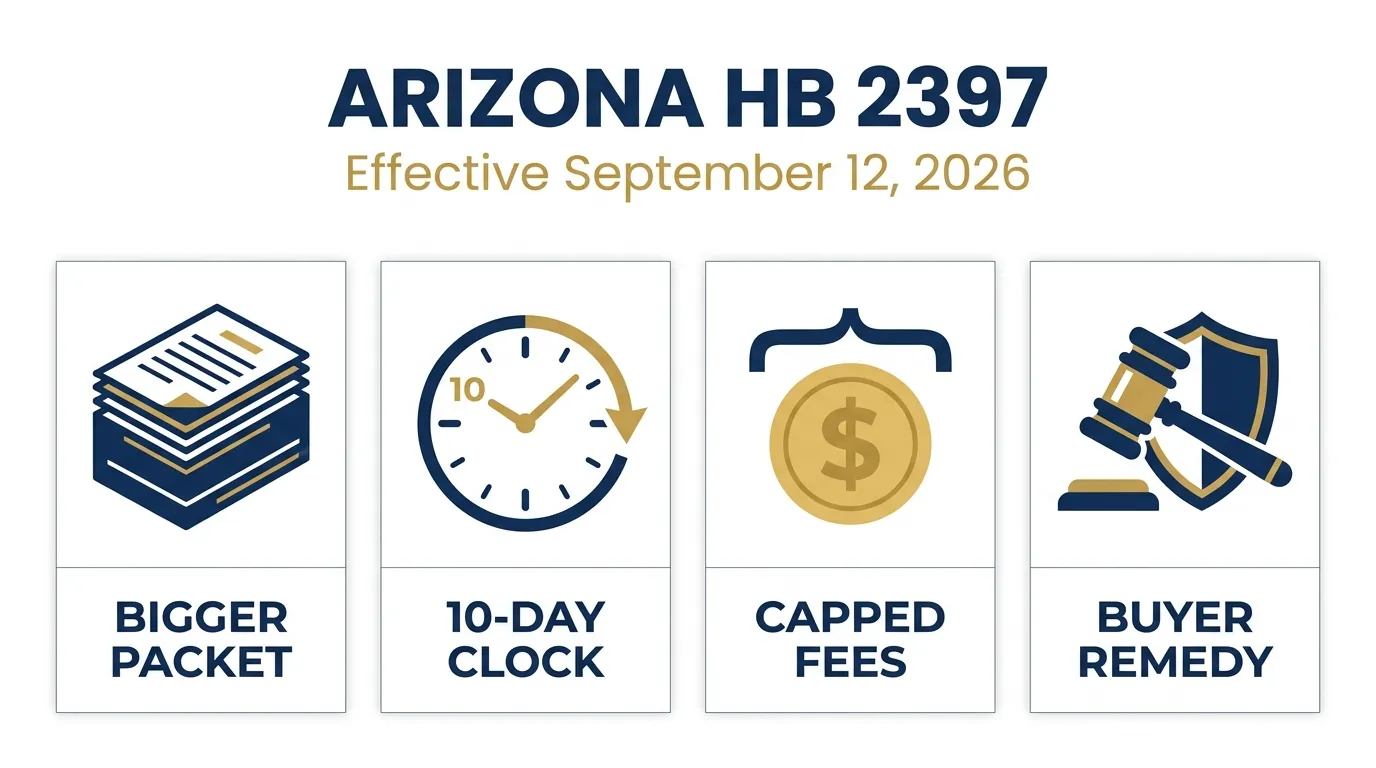
HB 2397 amends A.R.S. §33-1260 and §33-1806 to expand the resale packet, move up the delivery deadline, and cap fees. It took effect September 12, 2026.
HB 2397 moved through the 57th Legislature's second regular session and was signed by Governor Katie Hobbs on June 22, 2026, with an effective date of September 12, 2026 (see the Arizona Legislature's bill history for the official legislative action). It amends the two statutes that govern resale disclosure in Arizona's common-interest communities: A.R.S. §33-1260, which covers condominiums, and A.R.S. §33-1806, which covers planned communities (the single-family HOA world). The two sections were revised in parallel, so the rules below apply to both a Scottsdale condo tower and a master-planned HOA in Gilbert, with a few condo-only items such as insurance certificates.
Three things change at once. The contents of the packet expand. The timing shifts so the clock starts at offer acceptance rather than a later notice. And the fees are capped and can now be charged to the buyer. Each one matters on its own, and together they change how an Arizona buyer should approach the review period. Arizona is not alone in tightening resale disclosure. Our guides to Texas HOA laws in 2026 and Washington's WUCIOA changes cover the same trend in two other large states.
The New Disclosure Packet: What Is Now Required
The packet must now add three meetings of minutes, operating and reserve financials, open violations, and insurance certificates.
The core of the old packet is still there: the declaration (the CC&Rs), the bylaws and rules, the current operating budget, the most recent annual financial report, the most recent reserve study, a dated statement with the association's contact and assessment information, and a summary of any pending litigation. What HB 2397 adds is the material that actually predicts trouble in a building. The table below highlights the notable additions.
| New packet item | Why a buyer should care |
|---|---|
| Board-approved minutes from the previous 3 open board meetings | The clearest running record of assessments being discussed, disputes, deferred repairs, and litigation talk |
| Income and expense statements for the operating AND reserve accounts | Shows whether the association is living within its dues and whether reserve money is actually being set aside |
| Any outstanding, unresolved violation cited against the unit | A problem you would otherwise inherit at closing, from an unpermitted alteration to an unpaid fine |
| Declarant (developer) control status, and, for condos, whether a corporation or LLC owns and leases 35% or more of the units | Signals a developer-controlled or investor-concentrated building, which can affect governance and financing |
| Insurance certificates with coverage limits and deductibles (condominiums) | Reveals coverage gaps that can leave owners exposed after a loss and can complicate a mortgage |
The expanded contents come from the HB 2397 Senate Fact Sheet and the amended statutes, and the 35% corporate-ownership figure is confirmed in the CHDB Law summary of the bill. Read together, these items let a buyer reconstruct the financial and governance health of a building from the documents alone. The reserve study and the reserve-account statements show whether big repairs are funded. The minutes show what the board is worried about. The violation disclosure protects you from inheriting someone else's problem. This is the same document set our free tools are built to read, which is the subject of the last section.
The 10-Day Clock and Who Delivers
Delivery is due within 10 days. Under 50 units, the seller delivers starting at offer acceptance; 50 or more, the association delivers after notice.
The timing change is easy to miss and important. Under HB 2397, who delivers the packet depends on the size of the community, and the clock for smaller communities now starts earlier.
- Communities with fewer than 50 units. The selling owner has to deliver the packet to the buyer within 10 days after the buyer's offer is accepted. Under prior law the clock ran from a later "notice of pending sale," so this pulls the deadline forward and compresses the review window.
- Communities with 50 or more units. The association delivers the packet within 10 days after it receives written notice of the pending sale that includes the buyer's name, email address, and mailing address.
These timing rules and the unit-count split are laid out in the HB 2397 Senate Fact Sheet.
For a buyer, the takeaway is the same either way: the packet is arrives while your inspection and financing contingencies are already running, and you may have only a few days between receiving it and having to decide whether to move forward. That makes fast, structured review the difference between catching a red flag in time and waiving your way past it. Our guide on how to get HOA documents before you make an offer explains how to pull some of this material even earlier.
What the Association Can Charge
HB 2397 caps disclosure fees: up to $400 for the packet, $100 to rush, and $50 to update, charged once per transaction and collected at closing.
Resale disclosure has long carried a fee in Arizona, and HB 2397 keeps a cap on it while adding structure. The reported fee limits, consistent with the fee provisions in A.R.S. §33-1806, are:
- Up to $400 to prepare and deliver the disclosure packet.
- Up to $100 as a rush fee when the packet is requested on an expedited basis (within 72 hours).
- Up to $50 to update a packet when 30 or more days have passed.
Two structural points matter as much as the dollar amounts. The fee may be charged only once per transaction, and it is collected at closing rather than up front. HB 2397 also allows the fee to be charged to the buyer, not only the seller, so an Arizona buyer should expect to see it on the closing statement and budget for it. It is a small number next to the price of the home, but it is one more line item to confirm rather than assume. If you are new to how these charges work, our explainer on HOA transfer fees and hidden closing costs puts it in context, and what a resale certificate actually is covers the document these fees pay for.
The Buyer's New Leverage
HB 2397 lets a buyer pursue damages when an association knowingly or recklessly withholds required information or provides materially false information.
The part of HB 2397 that gives the new packet teeth is the remedy. Under the amended statutes, a buyer may pursue damages when an association knowingly or recklessly fails to disclose the information the packet is supposed to contain, or provides information that is materially false (see the HB 2397 bill text and the CHDB Law summary of HB 2397). That is a meaningful shift. A disclosure obligation with no consequence for ignoring it is easy to treat as a formality; a disclosure obligation backed by a damages claim is one an association's manager and attorney will take seriously.
There is an honest limit worth stating. The remedy protects you from an association that hides or falsifies something, but it does nothing for the buyer who received a complete, accurate packet and simply did not read it. If the reserve study shows the building is badly underfunded and you signed anyway, that was disclosed. The law puts the information in your hands; the diligence is still yours. And because this is a summary of a new statute rather than advice on your specific deal, an Arizona community-association attorney is the right person to interpret the remedy for a particular situation.
How to Read the Packet in 10 Days
Triage the packet: confirm the reserve study is the full report rather than a summary, check its percent funded, scan the minutes for assessment and litigation talk, and confirm no open violations.
The new packet is only useful if you can get through it before your contingency period closes. Work it in order of what can actually kill a deal or cost you money after closing:
- Start with the reserve study, and check that you actually have it. HB 2397 lets an association provide a summary in place of the entire report when the reserve study runs more than ten pages, and a full study, with its component inventory and funding tables, does not fit in ten pages. If what arrived is a summary, the packet has to tell you that you can ask to view the entire report from the association directly, and the association then has ten days after a written request to provide access (A.R.S. §33-1260(A)(7) and (A)(12) for condominiums, §33-1806 for planned communities). Make that request in writing as soon as the summary arrives rather than at the end of your review, because the ten days run from the request. Then check the percent funded. Reserve professionals treat 0 to 30% as weak, 30 to 70% as fair, and 70% or above as strong, and Association Reserves has found that roughly 74% of associations sit below that strong line. A weak number is the leading indicator of a coming special assessment. Our guides on how to read a reserve study and what counts as a good percent funded walk through the number.
- Read the reserve and operating statements together. Confirm that reserve contributions are actually being made, not just budgeted, and that the operating account is not running a chronic deficit.
- Scan the three sets of minutes. Look for special-assessment discussion, big repair bids, insurance-renewal shock, and any mention of litigation or owner disputes. These are the board-approved minutes from the previous three open meetings, and minutes are approved at a later meeting than the one they record, so the most recent meeting may not be in the packet. If the newest set looks months old, ask the association what has met since.
- Confirm there is no open violation on the unit. HB 2397 now requires this disclosure, so its absence should be affirmative, not a gap you assume.
- Check the insurance certificate (condos). Compare the limits and deductibles against the building's replacement cost and watch for coverage gaps that could fall to owners after a loss.
Doing all of that by hand, on a few days' notice, is exactly the diligence that gets skipped under a tight contingency clock. That is what our free tools are for. Drop the reserve study into the reserve study analyzer to pull the percent funded and special-assessment risk in seconds, run the minutes through the meeting minutes analyzer to surface assessment and litigation flags, and use the CC&R analyzer on the declaration for rental, pet, and financing restrictions. For the full pre-offer routine, see the complete condo buying checklist. Anything that lands in the badly-underfunded or active-litigation zone is worth an attorney's eyes before you remove a contingency.
Frequently Asked Questions
When did Arizona HB 2397 take effect?
HB 2397 was signed by Governor Katie Hobbs on June 22, 2026 and took effect September 12, 2026. It amends A.R.S. §33-1260 for condominiums and §33-1806 for planned communities, so it applies to resale disclosures for both condos and single-family HOA communities in Arizona.
What is in the new Arizona disclosure packet?
Along with the existing CC&Rs, bylaws, rules, budget, annual financial report, reserve study, and litigation summary, the packet now must include the minutes of the three most recent open board meetings, income and expense statements for the operating and reserve accounts, any outstanding unresolved violation cited against the unit, declarant control status, and, for condos, whether a corporation or LLC owns and leases 35% or more of the units and insurance certificates with limits and deductibles.
How long does an Arizona HOA have to deliver the disclosure packet?
Within 10 days. For communities with fewer than 50 units, the selling owner must deliver the packet within 10 days after the buyer's offer is accepted. For communities with 50 or more units, the association must deliver it within 10 days after receiving written notice of the pending sale that includes the buyer's name, email, and mailing address.
How much can an Arizona HOA charge for the disclosure packet?
Under HB 2397 the reported caps are up to $400 to prepare and deliver the packet, up to $100 for an expedited or rush request, and up to $50 to update a packet after 30 or more days. The fee may be charged only once per transaction, is collected at closing, and can be charged to the buyer rather than only the seller.
Can I sue if the HOA fails to disclose something under HB 2397?
The amended statutes allow a buyer to pursue damages when an association knowingly or recklessly fails to disclose required information or provides materially false information. That said, the remedy does not help a buyer who received a complete, accurate packet and did not review it, and how it applies to a specific transaction is a question for an Arizona community-association attorney.
Get Your HOA Documents Analyzed
GoverningDocs analyzes CC&Rs, reserve studies, and meeting minutes, identifying red flags, restrictions, and financial risks so you can buy with confidence. Free. No signup required.
Your first full property report is also free. See what you'll get →
Or get your first full report free →Related Articles
Sources & References
- Arizona HB 2397, full bill text (57th Legislature, 2nd Regular Session, 2026)
- HB 2397 Senate Fact Sheet (packet contents, timing, fee structure, manager on-site provisions)
- Arizona Legislature, HB 2397 bill status and history (legislative action, signing, and effective date)
- A.R.S. §33-1806 (planned communities: resale of units, information required, fees, civil penalty)
- A.R.S. §33-1260 (condominiums: resale of units, information required, fees)
- CHDB Law, HB 2397 legislative update (signing date, effective date, fee caps, buyer damages remedy)
- Association Reserves, percent-funded tiers (0-30% weak / 30-70% fair / 70%+ strong) and 74% of associations underfunded
Disclaimer: This article is for educational purposes only and does not constitute legal, financial, or real estate advice. Arizona HB 2397 and the statutes it amends are new, and their exact terms, effective date, and application are subject to interpretation and future change. Figures and citations are current as of September 2026 and may be superseded. Read the association's actual disclosure documents and consult a qualified Arizona community-association attorney for guidance specific to your situation.