
In This Guide
Texas governs HOAs under two separate tracks: subdivision associations fall under the Texas Property Code Chapter 209, and condominiums under Chapter 82. Texas sets no statutory cap on dues or special assessments, so the limits live only in the governing documents. The single document that tells a buyer the most is the resale certificate, which the association must deliver within 10 business days of a written request. Texas also gives owners unusually strong foreclosure protections, including a 180-day right of redemption.
You found a house in a Texas master-planned community, or a condo in a Dallas or Austin high-rise. The listing mentions an HOA, and the monthly dues look manageable. Then the closing paperwork arrives and the real picture starts to surface: deed restrictions you did not expect, a reserve fund that may or may not be funded, and a board that can raise assessments without asking a state regulator's permission.
Texas has more than 20,000 community associations, the third most of any state behind California and Florida, and more than two million Texas homes sit inside one (Foundation for Community Association Research). Yet the rules that govern them are scattered across several chapters of the Property Code, and they work very differently for a subdivision HOA than for a condo. Knowing which set applies, and what documents you are entitled to before you commit, is the difference between an informed purchase and an expensive surprise.
This guide walks through how Texas regulates community associations, the documents you can demand, the absence of any dues cap, the state's owner-friendly foreclosure rules, the laws that changed in 2025, and how the 2026 mortgage changes affect Texas condo buyers.
How Texas Regulates HOAs and Condos
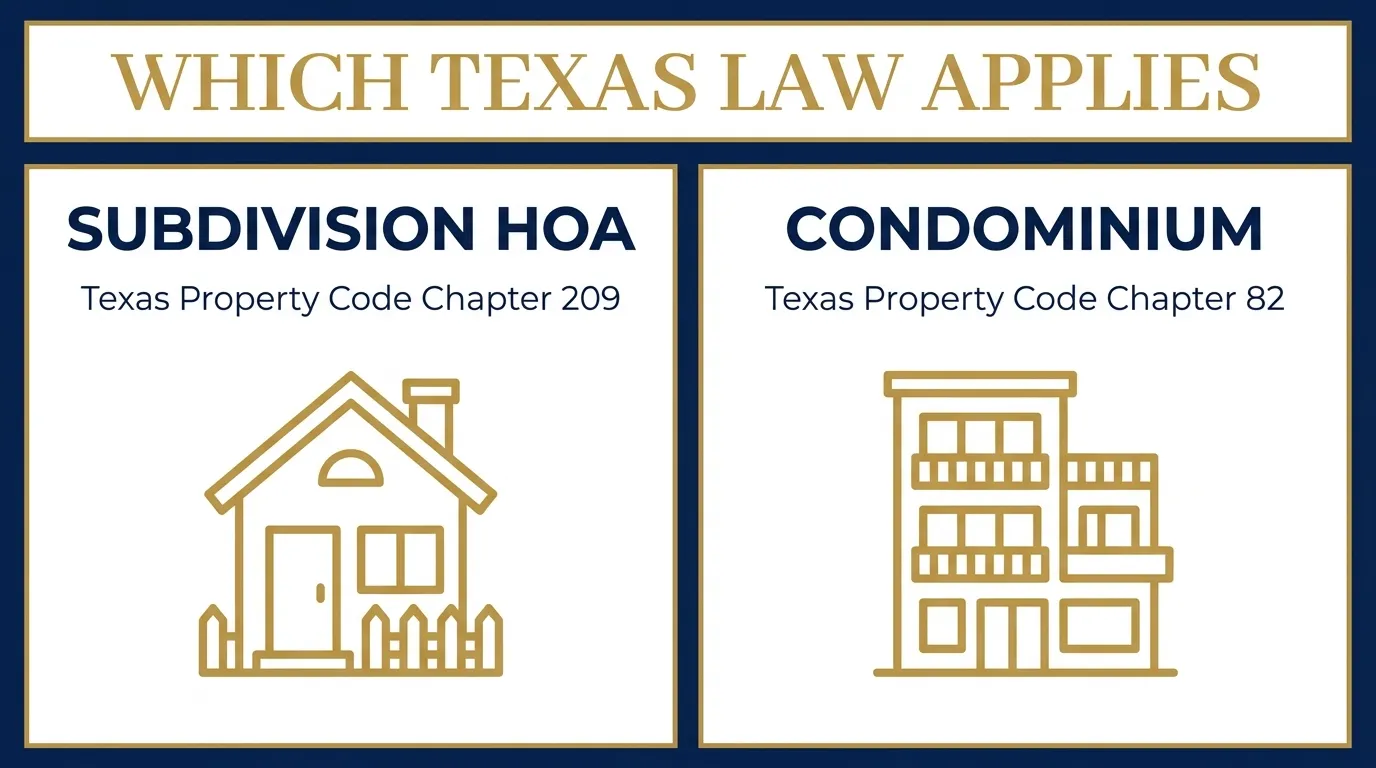
Subdivision HOAs fall under Texas Property Code Chapter 209; condominiums under Chapter 82. The two follow different rules for buyers.
Texas does not have one unified HOA law. Instead, the type of property decides which statute controls.
Subdivision and single-family HOAs are governed by the Texas Residential Property Owners Protection Act, Property Code Chapter 209. This is the law most Texans encounter, and it sets out owner rights on fines, hearings, records access, payment plans, and foreclosure. Disclosure to buyers is handled separately under Chapter 207, and limits on what an HOA can restrict (solar panels, drought-resistant landscaping, flags) live in Chapter 202.
Condominiums are governed by a different statute entirely. Units created on or after January 1, 1994 fall under the Texas Uniform Condominium Act, Chapter 82. Older condos created before 1994 fall under Chapter 81. Chapter 209 does not apply to condominiums, so a condo buyer relies on Chapter 82 for disclosure and cancellation rights.
The practical takeaway: confirm early whether the property is a subdivision lot or a condominium unit, because your disclosure rights, your cancellation rights, and even the document you receive have different names and deadlines depending on the answer.
The Resale Certificate: Your Most Important Document
The resale certificate discloses dues, assessments, unpaid balances, reserves, and the budget, and must be delivered within 10 business days.
If you read only one HOA document before buying in Texas, make it the resale certificate. It is the association's official snapshot of the property's standing and the community's finances, and Texas law dictates both what it must contain and how fast it must be delivered.
For subdivision HOAs, the requirements sit in Property Code §207.003. The association must deliver the certificate within 10 business days of receiving a written request, the certificate must be prepared no earlier than 60 days before delivery, and the fee is capped (currently $375 to assemble and deliver, with a $75 cap on later updates). The certificate must disclose, among other things:
- Any right of first refusal or other restraint on transfer
- The amount and frequency of regular assessments
- Any special assessment that has been approved but is not yet due
- Total amounts currently unpaid on the property
- The reserve balance for capital expenditures
- The current operating budget and balance sheet
For condominiums, the parallel rule is §82.157. The seller must provide the declaration, bylaws, rules, and a resale certificate prepared within the prior three months, and the association must deliver its part within 10 days of a written request. Crucially, a condo buyer also gets a cancellation right: under §82.156, the purchaser may cancel the contract before the sixth day after receiving the resale certificate, and cannot be forced to close until the documents are provided.
Once you have the certificate, the work is in reading it. A low monthly due figure means little if a special assessment is already approved, the reserve balance is thin, or the balance sheet shows the association running on fumes. Our guide to the resale certificate breaks down which lines actually matter, and how to get HOA documents before you make an offer covers timing.
Texas Has No Cap on HOA Dues or Special Assessments
Texas law sets no ceiling on how much or how often an HOA can raise dues or levy assessments. The only limits are whatever the CC&Rs impose.
This is the point that surprises the most buyers. Texas places no statutory cap on the amount or frequency of regular assessment increases or special assessments (Texas State Law Library). If an association needs more money for a new roof, an insurance premium spike, or a deferred repair, the board can raise dues or levy a special assessment, subject only to the process and any limits written into the community's own declaration and bylaws.
That makes the governing documents the only ceiling that exists. Some declarations cap annual increases at a fixed percentage or require a member vote above a threshold. Many do not. Before you buy, read the assessment section of the CC&Rs and look for any cap, any required owner vote, and any history of special assessments in the minutes and budget. A community with rising insurance costs, aging infrastructure, and no cap in its documents can raise your carrying cost faster than you expect.
This is not unique to Texas. Most states leave dues levels to the association, which we cover in can an HOA raise fees with no limit. Dues vary widely by community and amenities, and the average across Texas tells you nothing about the building you are actually buying into. The documents do.
Texas HOA Foreclosure: Stronger Protections Than Most States
A Texas HOA must get a court order to foreclose, cannot foreclose on fines alone, and the owner has 180 days to redeem the home after a sale.
Texas HOAs can foreclose on an assessment lien, and there are real cases of Texans losing homes over relatively small debts. In one widely reported 2023 case, a Mesquite homeowner lost her longtime home when her HOA foreclosed over a roughly $3,500 debt (CandysDirt). The risk is real, but Texas law also builds in protections that are stronger than in many states.
Under Chapter 209, a subdivision HOA generally must:
- Get a court order first. The association must obtain a court order through an expedited judicial foreclosure (Texas Rule of Civil Procedure 736) before foreclosing, unless the owner waives that right in writing (§209.0092).
- Not foreclose on fines alone. An HOA may not foreclose when the debt consists solely of fines or attorney's fees tied to those fines (§209.009).
- Offer a payment plan. The association must adopt payment-plan guidelines, with a minimum term of three months (§209.0062).
- Honor a right of redemption. After a foreclosure sale, the owner has 180 days from the date the association mails notice of the sale to reclaim the home (§209.011), a longer window than most states allow.
For a buyer, two things follow. First, if you are buying a property with a delinquency history, understand that liens and collection costs travel with the title, so confirm the unpaid balance on the resale certificate. Second, if you are buying a home at or after an HOA foreclosure sale, that 180-day redemption window can cloud title, so this is a situation to run past a Texas real estate attorney. We cover related warning signs in HOA lawsuit red flags and the legal risks of buying HOA property.
New Texas HOA Laws Effective in 2025
The 2025 Texas Legislature added transparency, electronic-voting, and landscaping protections, most taking effect September 1, 2025.
The 89th Texas Legislature, which met in 2025, passed several bills that affect community associations. Most took effect September 1, 2025:
- SB 711 requires HOAs that use a management company, and condominiums with 60 or more units, to maintain a member-accessible website where governing documents are posted, improving transparency for owners and prospective buyers.
- SB 2629 allows associations to hold electronic or teleconference meetings and to accept votes by electronic ballot, proxy, or absentee ballot.
- HB 517 bars HOAs from fining owners for brown or dormant lawns during government-imposed drought watering restrictions, with a 60-day grace period after restrictions lift.
- HB 431 adds solar roof tiles to the definition of a protected solar energy device under Property Code §202.010 (which already prevents HOAs from banning most solar installations).
These build on existing Chapter 202 protections, which prevent Texas HOAs from prohibiting drought-resistant landscaping, rain barrels, and composting (§202.007). For a buyer, the practical effect of the transparency rules is that more Texas associations now post their governing documents online, which makes pre-offer due diligence easier than it used to be.
What 2026 Financing Rules Mean for Texas Condo Buyers
Fannie Mae retires Limited Review in August 2026 and raises its reserve requirement to 15% in January 2027, making reserves central to financing.
If you are buying a Texas condominium with a conventional loan, two national changes from Fannie Mae matter even though they are not Texas-specific. Under Lender Letter LL-2026-03:
- Limited Review is being retired. For loan applications dated on or after August 3, 2026, condo projects of more than 10 units must pass a Full Review, which scrutinizes the association's budget, reserves, insurance, and litigation.
- The reserve requirement rises from 10% to 15%. For loan applications dated on or after January 4, 2027, associations must generally allocate at least 15% of budgeted assessment income to reserves, unless a reserve study completed within the prior three years supports a lower figure funded at its highest recommended level.
For Texas condo buyers, this means a building's reserves and budget can decide whether your loan goes through, regardless of your own credit. A condo that fails Full Review becomes harder to finance, which also makes it harder to resell. The earlier you can review the association's reserve funding, the better. See the 2026 Fannie and Freddie condo rules and what the 15% reserve rule means for the full picture, and non-warrantable condos for what happens when a building does not qualify.
Your Texas HOA Buyer Due-Diligence Checklist
Request the resale certificate, read the financials and CC&Rs, check for assessments and litigation, and verify reserves before closing.
Whether you are buying a subdivision home or a condo, work through this list before you commit:
- Request the resale certificate in writing. The association must deliver it within 10 business days (§207.003 for subdivisions, §82.157 for condos). Confirm it was prepared recently.
- Read the financials. The budget and balance sheet are part of the certificate. Check the reserve balance and whether a recent reserve study exists. Use our reserve study guide to spot underfunding.
- Read the CC&Rs and deed restrictions. Look for rental caps, pet limits, architectural-control rules, rights of first refusal, and any cap on assessment increases.
- Check for approved special assessments and pending litigation. An approved-but-not-yet-due assessment appears on the certificate; ask directly about lawsuits, which can affect both safety and financing.
- Verify the unpaid balance on the property. Liens and collection costs follow the title in Texas.
- For condos, mind the financing timeline. Factor in the 2026 Fannie Mae changes and confirm your lender's review of the project early.
- Consult a Texas real estate attorney for anything involving foreclosure history, redemption rights, or unusual deed restrictions.
For a document-by-document walkthrough that applies in any state, see the complete condo buying checklist.
Frequently Asked Questions
What law governs HOAs in Texas?
Subdivision and single-family HOAs are governed by the Texas Residential Property Owners Protection Act, Property Code Chapter 209, with disclosure rules in Chapter 207 and use-restriction limits in Chapter 202. Condominiums are governed separately by Chapter 82 for units created on or after January 1, 1994, or Chapter 81 for older condos. Chapter 209 does not apply to condominiums.
Can a Texas HOA raise dues without a limit?
Texas sets no statutory cap on the amount or frequency of HOA dues increases or special assessments. The only limits are whatever the community's declaration and bylaws impose. Some governing documents cap annual increases or require a member vote above a threshold, but many do not, so read the assessment section of the CC&Rs before buying.
How long does a Texas HOA have to deliver a resale certificate?
An association must deliver the resale certificate within 10 business days of a written request under Property Code §207.003 for subdivision HOAs and §82.157 for condominiums. The certificate must be prepared no earlier than 60 days before delivery, and the fee is capped (currently $375 to prepare and deliver, with a $75 cap on later updates).
Can a Texas HOA foreclose on your home?
Yes, but with protections. A Texas subdivision HOA generally must obtain a court order through expedited judicial foreclosure (§209.0092), cannot foreclose when the debt consists solely of fines (§209.009), and must offer a payment plan with a minimum three-month term (§209.0062). After a foreclosure sale, the owner has 180 days to redeem the home (§209.011).
Can I cancel a Texas condo purchase after seeing the documents?
For condominiums, yes. Under Property Code §82.156, a purchaser may cancel the contract before the sixth day after receiving the resale certificate, and cannot be required to close until the association documents are provided. Subdivision buyers do not have an identical statutory cancellation right, though §207.004 gives strong remedies if the association fails to deliver the required information.
How do the 2026 Fannie Mae rules affect Texas condo buyers?
Fannie Mae is retiring Limited Review for loan applications dated on or after August 3, 2026, meaning condo projects over 10 units must pass a Full Review of budget, reserves, insurance, and litigation. The minimum reserve allocation also rises from 10% to 15% of budgeted income for applications dated on or after January 4, 2027. A Texas condo with weak reserves can become harder to finance and resell.
Get Your HOA Documents Analyzed
GoverningDocs analyzes CC&Rs, reserve studies, and meeting minutes, identifying red flags, restrictions, and financial risks so you can buy with confidence. Free. No signup required.
Your first full property report is also free. See what you'll get →
Or get your first full report free →Related Articles
Sources & References
- Texas Property Code Chapter 209 (Residential Property Owners Protection Act: fines, hearings, records, payment plans, foreclosure, redemption)
- Texas Property Code Chapter 207 (subdivision resale certificate: contents, 10-day delivery, fee caps)
- Texas Property Code Chapter 82 (Uniform Condominium Act: §82.156 cancellation right, §82.157 resale certificate)
- Texas State Law Library (property owners associations overview, no statutory cap on assessments)
- Texas Legislature Online (89th Legislature, 2025: SB 711, SB 2629, HB 517, HB 431)
- Fannie Mae Lender Letter LL-2026-03 (Limited Review retired Aug 3, 2026; reserve minimum rising from 10% to 15% Jan 4, 2027)
- Foundation for Community Association Research (national and state community-association statistics)
- CandysDirt (2023 Mesquite, Texas HOA foreclosure over a roughly $3,500 debt)
Disclaimer: This article is for educational purposes only and does not constitute legal, financial, or real estate advice. Texas HOA and condominium rules vary by the specific community, the governing documents, and the transaction, and the Texas Property Code is amended frequently. Statutes referenced are current as of June 2026 and may be superseded. Consult a qualified Texas real estate attorney for guidance specific to your situation.