
In This Guide
Minnesota rewrote its common interest ownership act in 2026, and almost none of it binds yet. The caps on fines, interest, late fees and foreclosure take effect January 1, 2027.
You are looking at a townhome in Woodbury or a condo in the North Loop, your agent has sent you a stack of association documents, and you have read somewhere that Minnesota just passed a big HOA reform law. You want to know whether it protects you.
The honest answer is that it will, and mostly not yet. Minnesota has 8,050 community associations holding about 628,000 housing units and 1,564,000 residents, on our reading of the state table in the Foundation for Community Association Research's 2025 statistical review. The legislature passed two acts amending the state's association law in 2026. The one with the fine caps, the late-fee caps and the new disclosure duties carries an effective date of January 1, 2027.
So if you are closing in 2026, you are buying under the old rules, and one specific protection is worth more to you than everything in the new act. Here is what Minnesota law actually gives you today, what arrives in January, and what to ask for in the meantime.
1. Whether Minnesota's HOA Law Applies to Your Association
MCIOA covers communities created on or after June 1, 1994. Older ones get only part of it, though the resale rules reach nearly all.
Minnesota's association law is the Common Interest Ownership Act, or MCIOA, at Minn. Stat. ch. 515B. Unlike most state HOA statutes, it does not apply to every association in the state, and which parts apply depends on when the community was created.
The act "applies to all common interest communities created within this state on and after June 1, 1994" (Minn. Stat. 515B.1-102(a)). For anything older, the picture fragments:
- Condominiums created 1980 to 1994 under the earlier chapter 515A get MCIOA for events occurring on and after June 1, 1994, but chapter 515A still governs the developer's rights and any owner claims against that developer (515B.1-102(b)(1)).
- Condominiums created before 1980 under chapter 515 get only an enumerated list of MCIOA sections, which does include the assessment lien, the records right and both resale sections (515B.1-102(b)(2)).
- Cooperatives and planned communities created before June 1, 1994 sit largely outside MCIOA altogether, as do planned communities created between June 1, 1994 and August 1, 2006 that have more than two but fewer than 13 units (515B.1-102(b)(3)).
There is one large exception running through all of it, and it is the most useful sentence in the statute for a buyer. The resale disclosure and cancellation sections apply to all planned communities and cooperatives regardless of when they were created, unless the community is exempt under 515B.1-102(e). The exemption that matters most covers subdivisions of platted lots used for detached single-family dwellings where no association or master association has an obligation to maintain any building containing a dwelling. In Minnesota that describes a large share of single-family HOA neighborhoods, so it is worth asking which side of that line your community falls on.
The practical step: ask the seller or the association what year the community was created and under which chapter. In Minnesota that is a real due-diligence question rather than trivia, because it decides how much of the statute you can rely on.
2. What the Seller Has to Give You Before You Sign
The seller must hand over the governing documents and a resale disclosure certificate dated within 90 days, before you sign.
This is the part Minnesota does better than many states. Under Minn. Stat. 515B.4-107(a), the seller "shall furnish to a purchaser, before execution of any purchase agreement for a unit or otherwise before conveyance" the declaration, articles, bylaws, rules and amendments, any master association documents, and a resale disclosure certificate from the association dated not more than 90 days before the purchase agreement or the conveyance, whichever comes first.
The association has ten days to produce that certificate once an owner or the owner's representative asks for it, and it "may charge a reasonable fee" (515B.4-107(d)). Note what is absent there: Minnesota sets no dollar cap on that fee, unlike Florida, which caps the equivalent estoppel fee by statute (Fla. Stat. 720.30851(6)).
The certificate carries real weight because of what it does to liability. Under 515B.4-107(e), a buyer "is not liable for any unpaid common expense assessments, including special assessments, if any, not set forth in the certificate". If the association leaves a looming special assessment off the certificate, that omission is the association's problem rather than yours. The same subsection also says the seller is not liable to you if the association fails to produce the certificate at all, so the pressure to chase it falls on you and your agent.
Ask for the certificate the day the offer is accepted, and read the assessment lines against the last two annual budgets rather than on their own.
3. Your 10-Day Right to Cancel
If the documents reach you fewer than ten days before signing, you can cancel within ten days of receiving them, without penalty.
This right lives in a different section from the disclosure duty, which is why it gets missed. Under Minn. Stat. 515B.4-108(a), unless you were given the 515B.4-107 information more than ten days before you signed the purchase agreement, you may cancel the agreement within ten days after receiving it, any time before conveyance. Cancellation "is without penalty and all payments made by the purchaser shall be refunded promptly" (515B.4-108(b)).
Minnesota also went to unusual lengths to keep sellers from engineering that right away. Subsection (a) says a seller may not condition the sale on your agreeing to waive it, may not contractually obligate you to waive it, and may not put a waiver in the purchase agreement. A waiver only works if it is "evidenced by an instrument separate from the purchase agreement signed by the purchaser more than three days after the purchaser receives the resale disclosure certificate."
If a waiver of your ten-day right appears anywhere in a Minnesota purchase agreement, that is worth raising with a real estate attorney licensed in Minnesota before you sign anything.
4. Whether Minnesota Requires the Association to Save
Yes. Reserves belong in the annual budget and in an account kept separate from operating funds, with a narrow waiver the board and owners can approve.
Minnesota requires replacement reserves, and the requirement has more teeth than most states. Under Minn. Stat. 515B.3-1141(a), an association "shall include in its annual budgets replacement reserves projected by the board to be adequate" to fund replacement of the components it is obligated to replace through ordinary wear and tear or obsolescence.
Three details matter to a buyer:
- Reserves are ring-fenced. They must be kept in accounts separate from operating funds, and the association "shall not use or borrow from the replacement reserves to fund the association's operating expenses" (515B.3-1141(a)(3)).
- The projection gets rechecked every three years. The association must reevaluate the adequacy of its budgeted reserves "at least every third year" after the declaration was recorded (515B.3-1141(a)(4)).
- Owners can vote to stop funding them. After developer control ends, with board approval and owners holding 51 percent of the votes, the association need not assess for reserves covering components it plans to pay for by special assessment. That approval runs for the current fiscal year plus three more and is renewable (515B.3-1141(a)(5)).
Budgets also need not include reserves for components with a remaining useful life of more than 30 years (515B.3-1141(a)(2)), and the requirement does not reach communities restricted to nonresidential use. It also does not reach the communities that sit outside MCIOA under section 1 above, which is the second reason to find out when and under which chapter your community was created.
The gap worth understanding: nothing in Minnesota law requires a professional reserve study. The board projects its own numbers and rechecks its own projection. Ask for the reserve balance, the last three annual budgets, and whether owners have ever approved a waiver under clause (5). If you want a second read on what the numbers imply, our free reserve study analyzer is built for exactly that.
5. What Minnesota Does Not Have That Florida Does
Minnesota has no milestone inspection and no mandatory structural reserve study. No state law sets an inspection schedule or funding floor.
Buyers who followed the Surfside coverage often ask whether Minnesota has anything like Florida's structural integrity reserve study or milestone inspection regime. It does not. There is no periodic structural inspection requirement, no mandatory professional reserve study, no state-set funding floor, no filing deadline and no state agency collecting any of it.
What MCIOA has instead is narrower and comes earlier. A declaration cannot be recorded until a registered engineer or architect certifies that the structure is substantially complete, and the same certificate is required again for any amendment adding units, so in a phased project it recurs (Minn. Stat. 515B.2-101(c)). And where a building was occupied before the community was created, a converted warehouse or an apartment building turned condo, the developer's disclosure statement must carry an architect's or engineer's written opinion on the current condition of the structural components and the mechanical, electrical and plumbing installations, with the remaining useful life of each (Minn. Stat. 515B.4-105). If you are buying in a converted building, ask the association for that original disclosure statement.
Ongoing upkeep is handled differently, and better than most buyers expect. Every Minnesota association board must prepare and approve a written preventative maintenance plan, maintenance schedule and maintenance budget for the common elements, must follow the approved plan, and must give every owner a copy or electronic access to it (Minn. Stat. 515B.3-107(b)). No engineer signs it and no agency audits it. It is still a document that has to exist, and from August 1, 2026 the resale disclosure certificate has to tell you whether it comes with the certificate or where to get it. Ask for it.
That matters more than it used to, because Minnesota associations have been absorbing sharp insurance increases. In a 2024 survey of 74 Twin Cities association boards, run by the HOA Leadership Network, a Minnesota education and advocacy organization for association board members, and later presented to a Minnesota legislative commission, average master policy premiums among the responding associations rose from $40,397 in 2022 to $76,909 in 2024, moving insurance from about 27 percent to about 34 percent of operating budgets. That was a self-selected survey with a small response count rather than a statewide measurement, so treat it as a signal about what boards are reporting rather than a figure for the state.
A concrete case makes the point better than the averages. The Star Tribune reported that Windwood Condominiums in Edina, built in 1972, saw its property insurance rise 400 percent, with notice arriving on December 29, 2024 for a policy that expired December 31. Monthly dues rose by an average of $262 for a roughly 1,250 square foot two-bedroom. The association later saved around $100,000 a year by changing carriers.
When you read a Minnesota association's budget, find the insurance line and compare it across the last three years. Then ask the board what the current renewal quote looks like.
6. Unpaid Assessments and the Six-Month Rule
Minnesota association liens are automatic and unrecorded. Six months of assessments survive a first mortgage foreclosure.
Under Minn. Stat. 515B.3-116(a), a Minnesota association has a lien on a unit from the moment an assessment becomes due, and "recording of the declaration constitutes record notice and perfection". No separate lien notice gets filed. Searching the county records for a recorded lien will not tell you whether a unit is current.
That lien sits ahead of most encumbrances but behind a first mortgage, real estate taxes and other governmental assessments or charges, any liens recorded before the declaration, and a master association lien under 515B.2-121(h). The same subsection leaves mechanic's lien priority untouched (515B.3-116(b)). The exception is the one buyers of foreclosed units need to know. Where a first mortgage recorded after June 1, 1994 is foreclosed and nobody redeems, whoever takes title does so subject to a lien for the six months of common expenses immediately preceding the end of the redemption period, the window after a foreclosure sale during which the former owner can still reclaim the unit by paying off the debt (515B.3-116(c)). Associations can foreclose their own liens too, either by advertisement under chapter 580 or by action under chapter 581 (515B.3-116(h)).
The tool that settles this before closing is the payoff statement. On written request the association must furnish a statement of unpaid assessments within ten business days, and that statement is "binding on the association and every unit owner" (515B.3-116(g)). Ask the title company to obtain it, and confirm it is dated close to your closing.
One gap worth planning around
Minnesota's association records right at Minn. Stat. 515B.3-118 runs to "any unit owner or the unit owner's authorized agent." A buyer under contract is not an owner yet, so records requests have to go through your seller. Copies are capped at actual cost, or 25 cents a page for requests of 100 or fewer black-and-white pages. If you want minutes or financial records before closing, ask your seller to request them as soon as the offer is accepted.
7. What Changed in 2026, and What Waits Until January 2027
Two 2026 acts amended MCIOA. The technical one took effect August 1, 2026. The substantive one, with the fee and fine caps, arrives January 1, 2027.
Minnesota passed two acts touching chapter 515B in 2026, and keeping them apart is the difference between knowing what protects you today and expecting something that has not arrived.
Laws 2026, chapter 61 was signed on April 29, 2026 and makes clarifying, technical and conforming changes across dozens of sections. It carries no general effective-date clause, so Minnesota's default rule applies: acts take effect on the August 1 following final enactment (Minn. Stat. 645.02), which puts it at August 1, 2026. It leaves every threshold above alone, with one addition worth having: the resale disclosure certificate now has to tell you whether the association's written preventative maintenance plan, maintenance schedule and maintenance budget come with it or where to get them. Chapter 61 also pushed a separate 2024 package of MCIOA amendments, Laws 2024 chapter 96, articles 1 and 2, from August 1, 2026 out to August 1, 2027.
Laws 2026, chapter 82 was signed on May 12, 2026 and is the substantive reform. Apart from its definitions section, essentially every provision carries an effective date of January 1, 2027, and sections 1 through 13 of it apply to communities created before, on or after enactment. The one section limited to new communities is the ban on local governments requiring an HOA as a permit condition.
You may see coverage saying the reform took effect in May 2026. That does not match the session law, which sets January 1, 2027 for the provisions below.
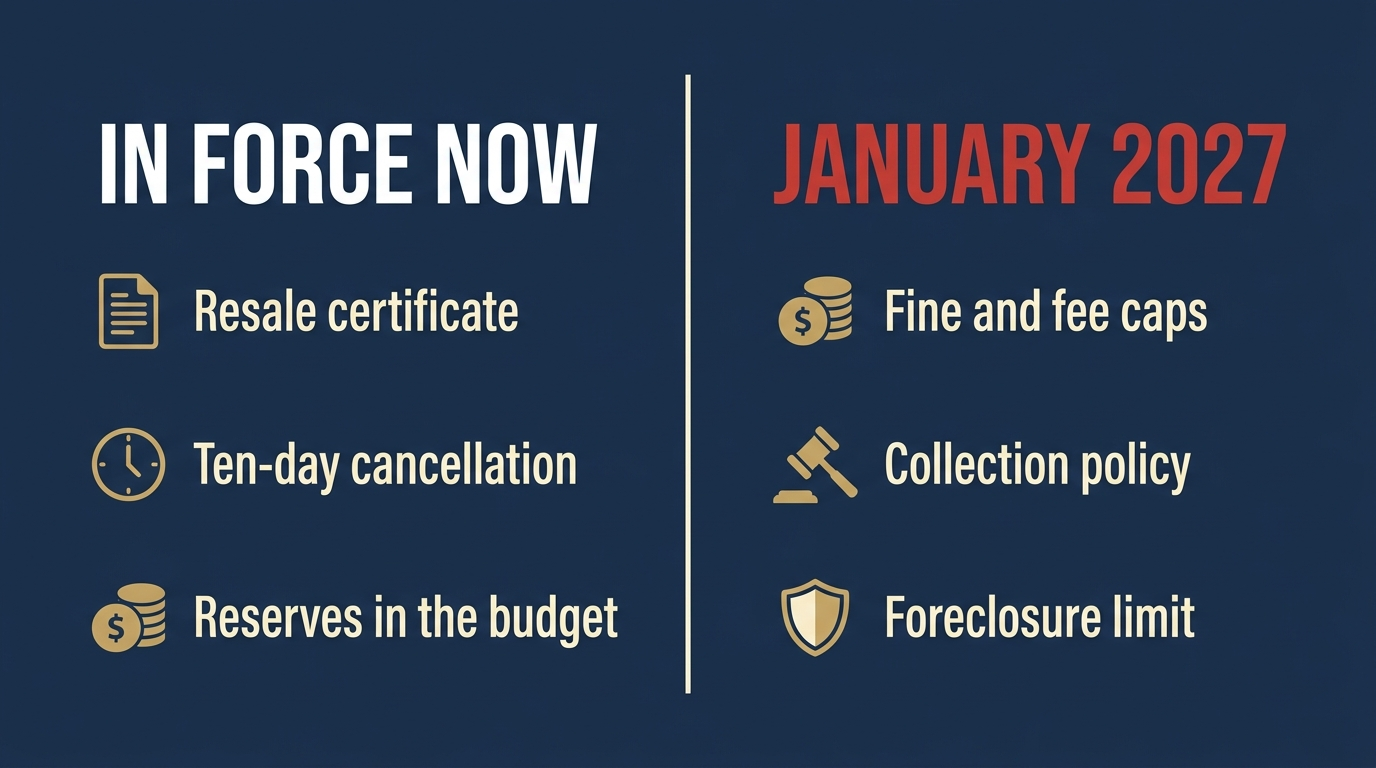
What Minnesota law already gives a buyer, and what arrives January 1, 2027
| What changes | The new rule, effective January 1, 2027 |
|---|---|
| Fines | Capped at $100 for a single violation unless owners holding a majority of the votes approve a higher amount at a board meeting, with exceptions for repeat violations of the same conduct, serious and immediate health or safety impact, physical damage, or prohibited rental activity |
| Interest on delinquencies | Capped at 8 percent |
| Late fees | Capped at the greater of $20 or 5 percent of the amount owed |
| How payments are applied | Applied to assessments before fines and fees, and associations may not refuse a partial payment unless a foreclosure has started |
| Foreclosure | Barred unless the amounts are delinquent more than three months, for foreclosures commenced on or after that date |
| Collections | A written collection policy is required, with three separate notices before an account goes to a law firm or collection agency, at least one by certified mail |
| Big contracts | Three written competitive bids required before contracts over $50,000 for maintenance, construction or repair |
| Resale disclosure | The seller must furnish any reserve study the association obtained in the past three years, plus new disclosure of master-policy deductibles and loss assessments |
That reserve study line is the one to watch as a buyer. It requires the seller to hand over a study if the association has one, and nothing in Minnesota law requires the association to obtain one in the first place. A community with no study will satisfy the new duty by telling you there is nothing to give.
If you are closing before January 2027, none of the caps above apply to your association. Ask the board for its current fine schedule, late fee and interest rate in writing, and read them against the table.
Frequently Asked Questions
Does Minnesota require an HOA to give a buyer documents before closing?
The duty falls on the seller rather than the association. Under Minn. Stat. 515B.4-107(a) the seller must furnish the governing documents and a resale disclosure certificate dated within 90 days, before the purchase agreement is signed or before conveyance. The association must produce that certificate within ten days of an owner's request and may charge a reasonable fee, which Minnesota does not cap in dollars.
Can I cancel a Minnesota condo purchase after I see the documents?
Yes, in one situation. Under Minn. Stat. 515B.4-108(a), if you were not given the required documents more than ten days before signing the purchase agreement, you may cancel within ten days after receiving them and before conveyance. Cancellation is without penalty and payments are refunded. A seller may not condition the sale on waiving this right or put a waiver in the purchase agreement.
Does Minnesota require HOAs to fund reserves?
Yes, with a waiver available. Minn. Stat. 515B.3-1141(a) requires replacement reserves in the annual budget, kept in accounts separate from operating funds, with adequacy reevaluated at least every third year. After developer control ends, the board plus owners holding 51 percent of votes may decide not to assess for reserves covering components planned to be paid by special assessment, for up to four fiscal years at a time. No Minnesota statute requires a professional reserve study.
Am I responsible for the previous owner's unpaid HOA dues in Minnesota?
Minn. Stat. 515B.4-107(e) says a buyer is not liable for unpaid common expense assessments, including special assessments, that were not set forth in the resale disclosure certificate. That makes obtaining an accurate, recent certificate the central protection. Separately, a buyer taking title after a first mortgage foreclosure takes subject to a lien for six months of common expenses under 515B.3-116(c). Ask the title company to obtain the association's payoff statement, which binds the association under 515B.3-116(g).
Does Minnesota have anything like Florida's condo inspection laws?
No. Minnesota has no milestone inspection requirement, no mandatory structural integrity reserve study and no state-set reserve funding floor. Chapter 515B does require an engineer's or architect's certificate of substantial completion before a declaration is recorded (Minn. Stat. 515B.2-101(c)) and a written condition opinion when a previously occupied building is converted (Minn. Stat. 515B.4-105). The completion certificate is required again for any amendment adding units, so it recurs in a phased project, but neither provision is a periodic inspection of a finished building. Boards must also keep and follow a written preventative maintenance plan (Minn. Stat. 515B.3-107(b)).
Did Minnesota pass a new HOA law in 2026, and is it in effect?
Minnesota passed two acts amending chapter 515B in 2026. Laws 2026 chapter 61, signed April 29, makes technical and conforming changes and took effect August 1, 2026 under the default rule at Minn. Stat. 645.02. Laws 2026 chapter 82, signed May 12, is the substantive reform covering fines, interest, late fees, collections, foreclosure and resale disclosure, and apart from its definitions section it takes effect January 1, 2027.
Get a read on the documents before your ten days run out
Upload the declaration, bylaws and budgets and get the rental rules, assessment history and financial red flags pulled out for you, trained on 1,900+ HOA documents.
Your first full property report is also free. See what you'll get →
Or get your first full report free →Related Articles
Sources & References
- Minn. Stat. 515B.1-102 (applicability of the Common Interest Ownership Act)
- Minn. Stat. 515B.4-107 (resale of units, disclosure certificate)
- Minn. Stat. 515B.4-108 (purchaser's right to cancel resale)
- Minn. Stat. 515B.3-1141 (replacement reserves, fiscal years from January 1, 2012)
- Minn. Stat. 515B.3-116 (lien for assessments)
- Minn. Stat. 515B.3-118 (association records)
- Minn. Stat. 515B.2-101 (creation of common interest community, substantial completion certificate)
- Minn. Stat. 515B.4-105 (disclosure for converted buildings)
- Minn. Stat. 515B.3-107 (upkeep and preventative maintenance plan)
- Laws of Minnesota 2026, chapter 61 (technical and conforming MCIOA changes, signed April 29, 2026)
- Laws of Minnesota 2026, chapter 82 (substantive HOA reform, signed May 12, 2026, effective January 1, 2027)
- Minn. Stat. 645.02 (default effective date for Minnesota acts)
- Foundation for Community Association Research, 2025 Statistical Review (Minnesota association, unit and resident counts)
- HOA insurance survey results (2024 survey of 74 Twin Cities association boards, presented to a Minnesota legislative commission)
- Star Tribune, March 21, 2025 (Windwood Condominiums, Edina, insurance and dues increases)
Disclaimer: This article is for educational purposes only and does not constitute legal, financial, or real estate advice. Minnesota's Common Interest Ownership Act applies differently depending on when a community was created, and the recorded declaration for a specific property can impose requirements the statute does not. Consult a qualified real estate attorney licensed in Minnesota for guidance specific to your situation.