
In This Guide
Ohio law gives a condo or HOA buyer less than most people expect: no required resale packet, no cancellation window on a resale, no reserve study requirement. The recorded declaration does that work.
You are under contract on a condo in Columbus or a house in a Cincinnati subdivision with a homeowners association, and you want to know what the state of Ohio guarantees you. It is a reasonable question, and the honest answer surprises people.
Ohio has 8,850 community associations, holding about 690,000 housing units and 1,659,000 residents, thirteenth among the states by number of associations on our reading of the state table in the Foundation for Community Association Research's 2025 statistical review. That is a lot of Ohio households living under association rules. What Ohio does not have is the set of protections buyers in Florida or Washington take for granted: a statutory packet the association must produce, a fee cap on producing it, a clock that starts when it arrives, and a right to walk if it arrives late.
The practical result is that in Ohio the documents do the work the statute does not. Here is what the law actually says, where it stops, and what to ask for in the gap.
1. Which Ohio Law Governs Your Community
Ohio has two association statutes. Condominiums fall under Chapter 5311, planned communities under Chapter 5312, and the rules differ.
Before anything else, work out which of two statutes your community sits under, because several answers below split on it and getting it backwards will send you looking for a protection you do not have.
Condominiums are governed by Ohio Revised Code Chapter 5311, the Condominium Property Act. Coverage is opt-in: the chapter "applies only to property that is specifically submitted to its provisions by the execution and filing for record of a declaration by the owner" (ORC 5311.02). The declaration is the master document recorded at the county recorder's office that creates the community and sets its rules.
Planned communities, which is what most people mean by an HOA, are governed by Chapter 5312, the Ohio Planned Community Law. Coverage here is automatic: "Any planned community in this state is subject to this chapter" (ORC 5312.02). The definition is broad enough to catch a community simply because a deed or a common plan requires owners to join an association or to pay toward shared facilities (ORC 5312.01). An older Ohio subdivision can still be under Chapter 5312 if its deeds or common plan require owners to join an association or support shared facilities, even with no formal HOA paperwork.
The two never overlap. Chapter 5312 says so directly: "A condominium property as defined in section 5311.01 of the Revised Code is not a 'planned community'" (ORC 5312.01).
One difference is worth knowing up front, because it changes how much the rest of the statute is worth to you. In a planned community, where the recorded documents were already in place when the chapter took effect on September 10, 2010, those documents outrank the statute on a specific conflict, and the statute fills the gaps they leave silent (ORC 5312.15). There is no equivalent provision in the condominium chapter.
What to do: pull the recorded declaration for the property and check whether it submits the property to Chapter 5311. Your title company can retrieve it from the county recorder, and your agent can ask the listing agent for it today. If it is a condominium, the rest of this guide's condominium answers apply to you; if not, read the planned-community column.
2. Whether Ohio Gives You a Window to Cancel
Ohio's 15-day right to void a condo purchase is a remedy for a developer breaking the sale rules. On a resale it does not apply at all.
If you have read that Ohio gives condo buyers a 15-day window, that is a real provision and it is probably not yours.
The right exists at ORC 5311.27. A contract signed in violation of the developer's disclosure obligations is "voidable by the purchaser until the later of fifteen days after the contract is entered into" or fifteen days after the buyer signs for the required information. It is worth noticing which way that runs: a late disclosure pushes your deadline out rather than cutting your window short. The same sentence sets a hard stop, though, because "in no case is the contract or agreement voidable after the title to the condominium ownership interest is conveyed to the purchaser." Once you close, the right is gone.
The catch is what triggers it. The right attaches to a violation of the developer sale rules at ORC 5311.25 and ORC 5311.26, and Chapter 5311 expressly removes ordinary resales from those sections. Under ORC 5311.24, sections 5311.25 to 5311.27 "do not apply" to the sale of an interest in an individual dwelling unit "for the account of a person other than a declarant, developer, or agent when the sale is not conducted pursuant to the common promotional plan of the developer for sales in a condominium development," unless the sale was structured that way to dodge the rules.
In plain terms: buying a new unit from the builder brings a disclosure statement, and if the developer gets that disclosure wrong you have 15 days to void the contract. Buying the same unit from the family who has lived in it for nine years brings neither.
Chapter 5312 has no cancellation right at all, for new-build or resale.
What to do: on a resale, your ability to walk comes from your purchase contract rather than from Ohio law, so read the contingency dates in the contract you signed and ask your agent which of them is still open. If you are buying from a developer, ask for the disclosure statement in writing and note the date you signed for it, because if something in it turns out to be missing, that date can be the one the 15 days run from.
3. What the Association Has to Hand Over
Neither Ohio chapter requires an association to produce a resale packet, and the records right belongs to owners rather than to buyers under contract.
This is the gap that catches buyers and agents moving to Ohio from a state with a statutory resale packet, and it is worth being precise about how wide it is.
The word "resale" appears exactly once in each chapter, and both times it appears in a list of things the association may charge a fee for rather than a list of things it must produce. A condominium association may "impose reasonable charges for preparing, recording, or copying amendments to the declaration, resale certificates, or statements of unpaid assessments" (ORC 5311.081). The planned-community chapter carries the same permission (ORC 5312.06).
So Ohio contemplates that a resale certificate might exist and sets no requirement to produce one, no list of what it contains, no deadline, and no dollar cap on the fee beyond a requirement that it be reasonable. Ohio has no equivalent to Florida's law, which caps the fee for and sets a ten-day deadline on the document listing what is owed on a unit.
The inspection right does not fill the gap either, because it runs to the wrong person. Both chapters give an owner the right to examine and copy the association's books, records and minutes, subject to reasonable standards set in the declaration, the bylaws or board rules (ORC 5311.091, ORC 5312.07). A buyer under contract is not yet an owner. The request has to go through your seller.
Both chapters also let the association withhold part of the file from owners unless the board approves the request:
- Anything dating back more than five years before the request
- Property-related personnel matters and communications with legal counsel
- Contracts currently under negotiation
- Information relating to enforcement against individual owners
- Anything state or federal law bars the association from disclosing
The litigation wording differs slightly. The HOA side covers attorney communications about "potential, threatened or pending litigation, or other property-related matters" (ORC 5312.07); the condominium side covers "pending litigation or other condominium property-related matters" (ORC 5311.091). Either way the catch-all at the end does most of the work. Neither chapter sets a deadline for the association to respond, or a penalty if it does not.
What to do: ask the seller in writing to request the declaration, bylaws, the last three annual budgets, the last twelve months of meeting minutes and a written statement of unpaid assessments, and put a date on the request so you can show when the clock started on your side. Because nothing compels a quick response, get the request in the day your offer is accepted rather than the week before closing. If the packet arrives and you would rather not read 200 pages of it, our free CC&R analysis tool pulls out the restrictions and red flags with a citation to the page each one came from.
4. Whether Ohio Requires the Association to Save
Ohio requires reserves in the annual budget, then lets owners waive the requirement. Condominiums have a second exemption that never expires.
If you are trying to work out whether a building is heading for a special assessment, this is the section that matters most, and it is the one place Ohio's two chapters diverge in a way you can check in a document.
Both chapters start the same way. The board must adopt an annual budget, and that budget "shall include reserves in an amount adequate to repair and replace major capital items in the normal course of operations without the necessity of special assessments" (ORC 5311.081 for condominiums, ORC 5312.06 for planned communities). Both sections carry a current effective date of September 13, 2022, though the planned community reserve requirement itself dates to September 10, 2010 and was tightened rather than created in 2022.
Then they part company on how the requirement can be switched off.
| Way out of funding reserves | Condominium (5311) | Planned community (5312) |
|---|---|---|
| Owners waive it in writing, by a majority of the voting power, every year | Yes | Yes |
| Declaration or bylaws limit the board's power to raise assessments without an owner vote | Yes, and no vote is ever needed | No |
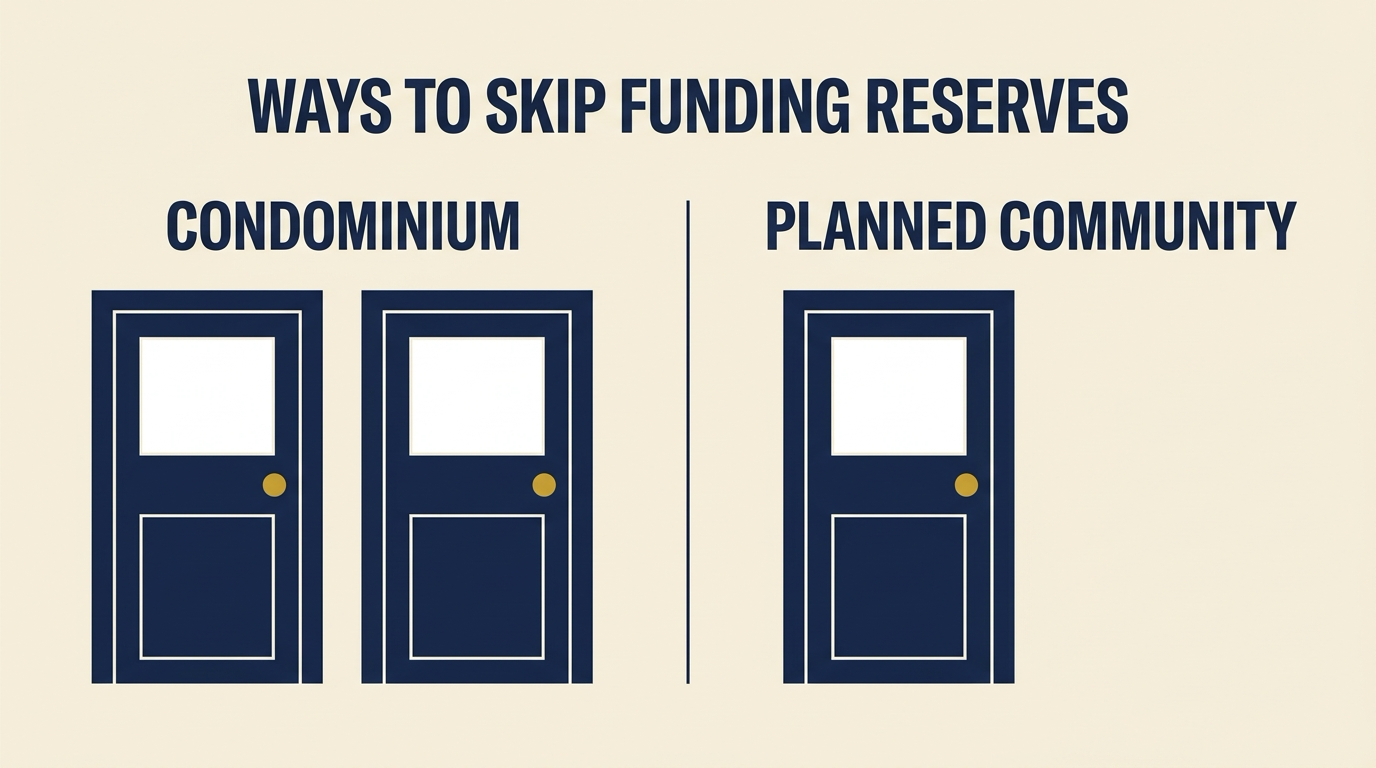
The second row is the one to sit with. An Ohio condominium can be exempt from the reserve requirement permanently, through language that is already sitting in its recorded declaration, with no vote taken at any point by anyone currently living there. An Ohio planned community has no such standing exemption and has to re-waive the requirement in writing every single year.
Both chapters are silent on how you would know the reserves are adequate. Ohio requires no reserve study, sets no funding percentage, prescribes no study interval and mandates no structural inspection. There is no Ohio equivalent to Florida's structural integrity reserve study.
What to do: ask for the last three annual budgets and check whether a reserve line exists and whether it moved. Then read the declaration for language capping what the board can assess without an owner vote, because in a condominium that clause is also a permanent reserve exemption. If the association has a reserve study even though Ohio does not require one, that is worth asking for, and our reserve study tool reads it for percent funded and special assessment risk.
5. What Happens to Unpaid Assessments When You Buy
Unless the documents say otherwise, an Ohio association's lien attaches after ten days unpaid, and is effective only once recorded.
If the seller is behind on dues, the question you are really asking is whether that debt follows the property to you, and Ohio's answer turns on a filing.
In both chapters, unless the declaration or bylaws say otherwise, the association gets a lien on the property for amounts that "remain unpaid for ten days after any portion has become due and payable" (ORC 5311.18, ORC 5312.12). That lien covers more than the dues themselves, reaching interest, late fees, collection costs and attorney fees where the governing documents authorize them.
The part that matters to a buyer is what makes the lien real. It is "effective on the date that a certificate of lien is filed for record in the office of the recorder" of the county (ORC 5311.18, ORC 5312.12). A certificate of lien is a short document naming the owner, the property and the unpaid amount, filed at the county recorder where a title search will find it. Once filed it is good for five years, and in both chapters the recorded amount keeps growing to cover interest, late fees and collection costs as they accrue, without the association filing anything further (ORC 5311.18, ORC 5312.12).
Neither Ohio chapter makes a buyer personally liable for the previous owner's unpaid assessments. There is no successor-liability provision in either statute. What exists is an encumbrance on the property, which a title search will surface and which normally gets paid out of the seller's proceeds at closing. A separate rule bars conveying a unit while a lien reaches both that unit and another part of the condominium property, unless it is paid, released or assumed (ORC 5311.12). Treat this as a title problem to clear at closing rather than a personal debt you inherit.
Two other pieces are worth knowing. Ohio gives the association no priority ahead of a recorded first mortgage or property taxes in either chapter, so the association's lien does not jump ahead of your mortgage or property taxes the way it can in some other states (ORC 5311.18, ORC 5312.12). And unless the declaration, bylaws or association rules set a different order, payments are applied to interest, then late fees, then collection and attorney fees, with principal last (ORC 5311.18, ORC 5312.11), which is how a modest missed payment grows into a lien that outlasts the original debt. In a planned community that ordering rule is written for the individual charges levied under ORC 5312.11, so ask your title company what is actually recorded rather than assuming it covers ordinary dues.
What to do: ask your title company to confirm whether a certificate of lien is recorded against the property, and ask the seller for a written statement of unpaid assessments even though nothing in Ohio law obliges the association to produce one. Get both before your financing contingency expires.
6. What Actually Changed in 2026
Nothing. No section of either Ohio chapter has changed since September 13, 2022, and no 2025 or 2026 bill amending them has been enacted.
If you have been told Ohio passed new HOA rules this year, it is worth checking the claim before acting on it, because the codified law does not show one.
The most recent change to either chapter is Senate Bill 61 of the 134th General Assembly, effective September 13, 2022. That act amended most of the sections a buyer cares about, tightening the reserve waiver so it has to be in writing, removing the declaration's power to switch the reserve requirement off in a planned community (ORC 5312.06), adding a requirement that the association carry insurance protecting its funds against theft by anyone who handles the money (ORC 5311.16), and putting a five-year cutoff on records requests (ORC 5311.091, ORC 5312.07). The underlying reserve, records and fine-hearing rules are older; in the planned community chapter they date to September 10, 2010. Every section of Chapters 5311 and 5312 currently carries an effective date of September 13, 2022 or earlier.
The one bill we found in the current session touching either chapter would reach the condominium chapter. Senate Bill 202, the Chief Steven DiSario Act, would add the thin blue line flag to the flags a condominium association and a deed restriction already cannot prohibit. The Ohio Senate has passed it and the House has not voted on it, so it is not law and has no effective date. It would not change assessments, reserves, disclosure, board governance or resale documents.
There is one 2026 Ohio law worth knowing about even though it is not an association law. Senate Bill 101, effective June 16, 2026, voids certain long-term home service agreements signed, amended or renewed on or after that date, separately bars recording them, and makes a violation a deceptive act enforceable by the Attorney General (ORC 5301.75 through 5301.78). It expressly excludes declarations that create a planned community or a condominium development, amendments to them, and maintenance agreements entered into by an owners association (ORC 5301.76). If someone describes it as a change to your HOA's obligations, that is a misreading of that exclusion.
What to do: treat Ohio's association rules as stable and put your attention on the documents rather than on legislative news. If a seller, board or management company tells you a 2026 law changed something about your community, ask which Revised Code section it amended, and check the effective date printed on that section at codes.ohio.gov.
Frequently Asked Questions
Does Ohio require an HOA to give a buyer documents before closing?
No. Neither the Condominium Property Act nor the Planned Community Law requires an association to produce a resale packet for a buyer, and neither sets a deadline or a fee cap for one. Both chapters mention resale certificates only as something the association may charge a fee to prepare (ORC 5311.081, ORC 5312.06). The inspection right in both chapters belongs to owners, not to buyers under contract, so the request has to go through your seller.
Can I cancel an Ohio condo purchase after I see the documents?
Not under Chapter 5311 if you are buying from an existing owner. The 15-day right to void at ORC 5311.27 is triggered by a developer breaking the sale or disclosure rules at ORC 5311.25 and ORC 5311.26, and ORC 5311.24 removes ordinary owner-to-owner resales from those sections and from the remedy itself. On a resale your cancellation rights come from the contingencies in your purchase contract. Because this turns on your specific contract, confirm your position with a real estate attorney licensed in Ohio.
Does Ohio require HOAs to fund reserves?
Yes, with exceptions that matter. Both chapters require the annual budget to include reserves adequate to repair and replace major capital items without special assessments (ORC 5311.081, ORC 5312.06). Owners can waive that requirement under either chapter, by a majority of the association's voting power, in writing, each year. Condominiums have a second exemption with no annual vote attached: if the declaration or bylaws limit the board's ability to raise assessments without an owner vote, the reserve requirement does not apply. Planned communities have no equivalent.
Am I responsible for the previous owner's unpaid HOA dues in Ohio?
Neither Ohio chapter contains a provision making a buyer personally liable for a prior owner's assessments. What the statutes create is a lien against the property, effective only once a certificate of lien is recorded with the county recorder (ORC 5311.18, ORC 5312.12). A separate rule bars conveying a condominium unit while a lien reaches both the unit and another part of the condominium property, unless it is paid, released or assumed (ORC 5311.12), which is aimed at blanket encumbrances rather than one owner's unpaid dues. Ask your title company to confirm what is recorded, and ask an attorney about your specific closing.
Can I attend my HOA's board meetings in Ohio?
It depends which chapter governs you. In a condominium, meetings of the unit owners association are open to unit owners unless the declaration or bylaws say otherwise (ORC 5311.08); Chapter 5311 says nothing about owner attendance at board meetings, so the declaration and bylaws decide that. In a planned community, no owner who is not a director may attend or participate in a board meeting unless the board expressly authorizes it (ORC 5312.04). Both chapters require associations to keep minutes, which owners may request.
Did Ohio pass new HOA laws in 2026?
No. The most recent amendment to either chapter is Senate Bill 61 of the 134th General Assembly, effective September 13, 2022. Senate Bill 202 would add the thin blue line flag to Ohio's existing flag-display protections; the Senate has passed it and the House has not voted, so it is not law. Senate Bill 101, effective June 16, 2026, is a real 2026 Ohio law but it expressly excludes planned community and condominium declarations (ORC 5301.76).
Get Your CC&Rs Analyzed
Upload your HOA's CC&Rs and get instant analysis of rental restrictions, pet policies, financing red flags, and more. Free. No signup required.
Your first full property report is also free. See what you'll get →
Or get your first full report free →Related Articles
Sources & References
- Ohio Revised Code Chapter 5311, Condominium Property Act (sections 5311.02, 5311.08, 5311.081, 5311.09, 5311.091, 5311.12, 5311.18, 5311.24, 5311.25, 5311.26, 5311.27; current text as of September 2026)
- Ohio Revised Code Chapter 5312, Planned Community Law (sections 5312.01, 5312.02, 5312.04, 5312.06, 5312.07, 5312.11, 5312.12, 5312.15; current text as of September 2026)
- Ohio Revised Code 5301.76 (Senate Bill 101, effective June 16, 2026; the planned community and condominium exclusions)
- Foundation for Community Association Research, 2025 U.S. National and State Statistical Review (Ohio association, housing unit and resident counts, year-end 2025 estimates)
Disclaimer: This article is for educational purposes only and does not constitute legal, financial, or real estate advice. It describes Ohio law only, and association rules differ by state, by chapter and by the specific recorded declaration and bylaws for a community, which can impose obligations the statute does not. Nothing here evaluates the enforceability of any particular provision or your position under any particular contract. Consult a qualified real estate or community association attorney licensed in Ohio for guidance specific to your situation.