In This Guide
Walk away when the building carries a problem that no price reduction can reach: a failed structural inspection, unfunded repairs above $10,000 per unit, or litigation over the building itself. Those three make a condo ineligible for conventional financing, which follows you to resale. A finding with a known cost and a funded plan behind it is a price negotiation.
You are eleven days into a contract. The association packet finally landed, and something in it looks bad. The reserve study is thin, or the minutes mention a garage nobody has repaired, or there is a line about pending litigation with no amount attached.
Search for help and you will find another list of red flags. That is the wrong tool at this point, because you have already found the red flag. The question in front of you is narrower and harder: is this finding worse than what it costs you to leave?
Both sides of that question are numbers, and both are available to you before your deadline. This guide puts them side by side. For what to look for in the first place, we have separate guides on reviewing HOA documents and on the red flags document analysis surfaces.
What Walking Away Actually Costs You
Inside a contingency, your deposit comes back. Outside one, the deposit is the floor on what you can lose rather than the ceiling.
It is easy to assume the worst case is losing the earnest money. That is right inside a contingency window and wrong outside one, and the difference is worth understanding before you decide.
Inside a contingency
Where a state gives you a statutory right to cancel after receiving association documents, the statutes that address the deposit return it in full. Texas says cancellation "is without penalty, and all payments made by the purchaser before cancellation must be refunded" (Tex. Prop. Code §82.156(c)). Nevada (NRS 116.4109), Minnesota (Minn. Stat. §515B.4-108) and Virginia (Va. Code §55.1-2312) use almost the same wording on a resale, and Maryland returns the deposit on a timely rescission (Md. Real Prop. §11-135(f)). Washington words it that way only in the section covering a developer's sale (RCW 64.90.635), not in the resale section (RCW 64.90.640), so do not assume the refund language carries across. Florida returns the deposit with interest on a developer sale (Fla. Stat. §718.503).
Contract contingencies do the same thing by their own terms. TheColorado Contract to Buy and Sell Real Estate, a form the state itself promulgates, lets a buyer terminate on or before the Association Documents Termination Deadline "based on any unsatisfactory provision in any of the Association Documents, in Buyer's sole subjective discretion."
Outside a contingency
Here is the part buyers rarely hear. Losing the deposit is one outcome the seller may choose, and it is not the only one. TheFlorida Realtors and Florida Bar AS IS contract, paragraph 15(a), says a seller "may elect to recover and retain the Deposit … as agreed upon liquidated damages … or Seller, at Seller's option, may … proceed in equity to enforce Seller's rights."
That "or" is the whole point. Enforcing in equity means asking a court to make you complete the purchase. Whether a seller would actually pursue that, and what any of it means for your contract in your state, is a question for a real estate attorney licensed where you are buying. Treat the deposit as the floor on your exposure once the window has closed.
The money you have already spent
Add the costs that do not come back regardless: the inspection, the appraisal if it has been ordered, any rate lock extension fee, and the association's own document or estoppel charges. These are far smaller than the per unit figures in the section above, which is what makes the comparison worth running.
One timing note. A refundable deposit is not the same as a deposit in your hand. This one is a contract term rather than a state law: the Florida AS IS contract, paragraph 16(a), gives buyer and seller ten days after conflicting demands for the deposit to work it out between themselves, and sends the dispute to mediation if they cannot, so a contested deposit can take months. In Maryland, when a licensed broker is holding the money, the refund has to run through that broker's trust account procedures (Md. Real Prop. §11-135(f)(3)). Ask your agent how the escrow release actually works on your contract before you rely on the timing.
What Staying Costs You, in the Same Units
The same $250,000 roof costs $231,823 through budgeted reserves, $250,000 as a special assessment, and $320,071 financed by a bank loan.
The cost of staying is your share of work the building has not paid for yet. That figure is knowable, and the association's own documents contain much of it.
The same repair, three prices
Association Reserves, a reserve study firm founded in 1986, put numbers to this in its April 2026 HOA Reserves: Industry Insights Report. Taking a single $250,000 roof and changing only how the association pays for it:
| How the association funds it | Total cost |
|---|---|
| Budgeted reserves, funded over time | $231,823 |
| Special assessment | $250,000 |
| Bank loan to the association | $320,071 |
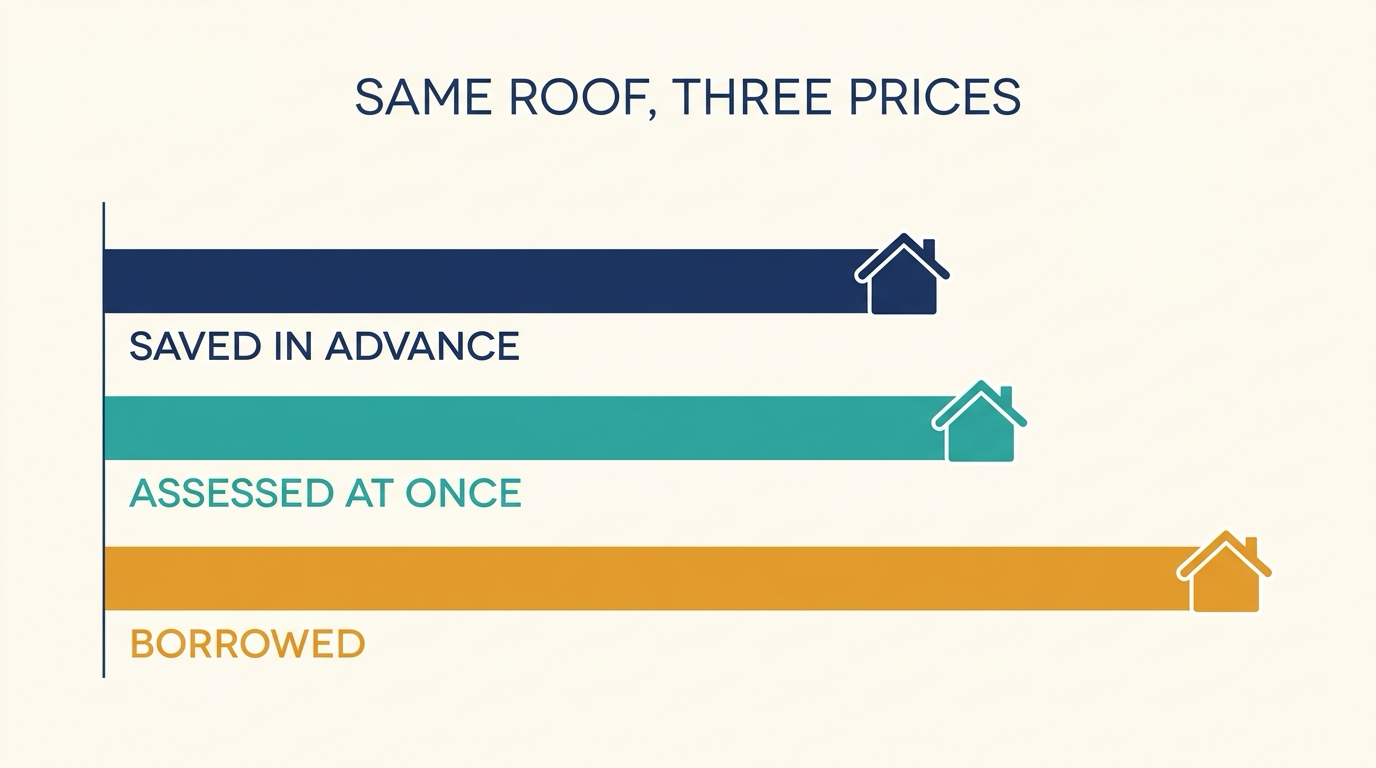
A building that saved for the roof pays about 28% less than one that borrows for it. When you read a reserve study and find the money is not there, that gap is what you are looking at, multiplied across every component the study lists.
What percent funded is telling you
Association Reserves sorts associations into three bands by percent funded, and describes the weakest one as carrying a "high likelihood of special assessments" with deferred maintenance "common in these Associations." The bands are theirs rather than an industry standard:
- 0 to 30% funded, Weak. High likelihood of special assessments.
- 30 to 70% funded, Fair. Moderate risk, needing careful monitoring of projects and spending.
- 70% and above, Strong. Low risk of special assessments.
Among their own clients, 25.7% sit in the Strong band, 40.3% in Fair and 34% in Weak. Read that as a rough benchmark rather than a national census: the report says its figures are drawn entirely from the firm's client base, "a group that may be more financially proactive than the broader industry average," and asks readers to treat them as "directional benchmarks rather than a statistically representative sample." Our guide to reading a reserve study covers where to find the number in the document.
What this has looked like for real owners
Assessments tied to deferred structural work have reached six figures per unit:
| Building | Per unit | For what |
|---|---|---|
| Murano at Portofino, Miami Beach FL (2024) | $66,000 to $322,000 | Pool deck, elevators, lobby, reserve study funding (phase two of two) |
| Palm Bay Yacht Club, Miami FL (2024) | $140,000 | Building improvements; owners have sued, association denies |
| 1060 Brickell, Miami FL (2024) | $30,000 to $110,000 | Repairs recommended by engineering inspections, per owners |
| 499-unit complex, Torrance CA (2026) | Over $49,000, same for every owner | Podium reconstruction, re-piping, elevators |
| Villa Moura, San Clemente CA (2026) | About $26,000 per owner | Emergency roof replacement |
These are the cases that made the news, and no organization publishes a reliable national figure for what a typical assessment costs, so treat them as the visible end of the range rather than an average. They are a reminder that California buildings reach these numbers too, and that some of these figures are disputed by the owners paying them.
Three Findings That End the Deal at Any Price
A failed structural inspection, unfunded repairs over $10,000 per unit, or building litigation can make a condo ineligible for conventional financing.
A price cut does not reach any of these three, because the problem sits with the building and stays there after closing. Each one also follows you to the day you try to sell, since your buyer runs into the same obstacle you did. All three come from Fannie Mae's project eligibility standards, which govern whether a lender can sell your loan and therefore whether a conventional loan is available at all.
1. A failed or missing mandatory structural inspection
Fannie Mae treats failure to pass a state, county or other jurisdictional mandatory inspection or certification for structural safety, soundness and habitability as a critical repair, which makes a project ineligible (Selling Guide B4-2.1-03, updated 08/05/2026). A building under a partial or total evacuation order for an unsafe condition stays ineligible until the condition is remediated and the building is deemed safe.
Florida buildings three habitable stories or more face a milestone inspection by December 31 of the year the building turns 30, then every ten years (Fla. Stat. §553.899(3)(a)). You may have read that buildings within three miles of the coast are on a 25-year clock instead. That was the original 2022 text and it has been replaced: the current statute makes 25 years a determination the local enforcement agency may make based on local circumstances, including proximity to salt water. Ask the county, not a summary.
2. Unfunded repairs above $10,000 per unit
This is the cleanest number in the entire decision. Fannie Mae defines critical repairs to include any unfunded repairs costing more than $10,000 per unit that should be undertaken within the next twelve months, alongside any mold, water intrusion or damaging leaks, and advanced physical deterioration. Fannie's examples are open ended rather than a checklist, and include sea walls, elevators, waterproofing, stairwells, balconies, foundations, electrical systems, parking structures and other load-bearing structures.
Two exclusions apply to that count: repairs made by a unit owner, and repairs funded through a special assessment. Read the second one narrowly. It takes the repair out of the $10,000 arithmetic, and it does not cure anything on its own, because a special assessment tied to a critical repair that has not actually been fixed still leaves the project ineligible. A passed assessment helps only where the work behind it is getting done.
3. Litigation about the building itself
The rule has two limbs, and buyers usually hear only the second one. Where the association itself is named as a party to pending litigation, the project is ineligible whatever the lawsuit is about, subject to the minor-matter exceptions below. Where the sponsor or developer is the named party, the test narrows to litigation "that relates to the safety, structural soundness, habitability, or functional use of the project." Arbitration or mediation reasonably expected to become litigation counts the same way.
Plenty of litigation still does not sink a deal, but the exceptions are gated. They apply only where the lender first determines the matter is minor with no impact on the safety, structural soundness, habitability or functional use of the project. Once past that gate, the list includes non-monetary neighbor disputes, matters the association's carrier has agreed to defend where the amount is covered, and cases where reasonably anticipated or known damages and legal expenses do not exceed 10% of the project's funded reserves. Our guide to HOA litigation red flags covers the distinction in more depth.
Two pieces of perspective are worth holding onto. Fannie Mae reported that as of August 2025, and describing it as reassurance rather than alarm, only 3.6% of projects carried an ineligible status, and named insufficient master property insurance and critical repairs as the top two causes. And a lender may request an exception for a project with merit, so an ineligible finding is not always the end of the conversation. Ask your loan officer whether the project has been run through review yet, and what came back.
One limit is worth knowing before you read a repair list and assume the worst. Where damage or deferred maintenance is isolated to one or a few units and does not affect the overall safety, soundness, structural integrity or habitability of the project, these requirements do not apply at all. A bad balcony on the fourth floor is not the same finding as a bad balcony system.
Three That Are Really Price Negotiations
A finding with a known dollar amount and a funded plan behind it is a number you can trade on rather than a reason to leave.
The test separating this group from the last one is whether the problem has a price attached and a plan to pay it. Where both exist, the question becomes who absorbs the cost.
1. Reserves in the middle band
An association between 30% and 70% funded is carrying real risk, and it is risk you can quantify. Take the components the reserve study lists in the next five years, find your unit's allocated share in the declaration, and apply the funding-route gap from the table above. That produces a number you can bring to a price conversation.
2. A special assessment that has already been approved
Once an assessment is voted and the amount is set, it stops being uncertainty and becomes a line item. Lenders ask for the purpose, approval date, status, original and remaining amount, and expected payoff date, so those details exist in writing somewhere. Who pays the balance is negotiable, and the answer depends on state law and your contract. We cover the split in who pays the special assessment at closing.
One caution carried from the previous section: if the assessment is attached to a critical repair and the work has not been remediated, the project stays ineligible in Fannie Mae's eyes. A funded plan helps only when the plan is actually doing something.
3. Deferred maintenance that is identified, funded and scheduled
Minutes recording a known problem with a contractor engaged and a date set show a building meeting its obligations. The warning sign is the same problem appearing three years running with no contractor and no date, which is the pattern our guide to reading meeting minutes is built around.
Running the Comparison on Your Own File
Weigh your share of unfunded work against your deposit plus sunk costs. Both figures come out of documents you can request.
Here is the method, with a worked illustration. The figures below are an example rather than data, so substitute your own at each step.
- Find the unfunded work. The reserve study lists components, remaining useful life and replacement cost. Total the items due within the window you care about, then subtract the current reserve balance. Say a study shows $2,400,000 of work due within five years against $600,000 on hand, leaving $1,800,000 unfunded.
- Find your share. The declaration assigns each unit a percentage of common expenses. In an evenly divided 120-unit building that is 1/120th, so $15,000.
- Adjust for how they will pay. If the association has to borrow rather than draw on reserves, the roof comparison above suggests roughly 38% more, taking $15,000 to about $20,700.
- Compare that to leaving. Against a deposit and several thousand in sunk costs, a five-figure exposure is a wide gap, and that gap is what the decision turns on. Where the two numbers land close together, the finding is a price conversation.
Run the same arithmetic against the $10,000 per unit critical repair threshold while you are there. If your step 2 figure is above it and the work is due inside twelve months with no assessment funding it, you have crossed from the negotiable group into the financing group, and the building's next buyer will hit the same wall.
The Deadline That Decides Which Door Is Open
In California, Colorado, Illinois, Arizona and New York, no statute gives you a document-review cancellation right. Your contract is the only exit.
All of the above assumes you still have a way out. Two separate rights can give you one, and buyers routinely confuse them.
| Statutory document review | Contract contingency | |
|---|---|---|
| Clock starts | When documents are delivered | The contract effective date |
| Can it be waived | Limited. Florida says any purported waiver is of no effect | Yes, and routinely is in competitive markets |
| Exists everywhere | No. Several large states have none | Only if your contract contains one |
The five states named above are worth checking yourself, because the statute that looks like it should help you is a delivery rule with no cancellation right attached. California tells the seller to hand over the governing documents and stops there (Cal. Civ. Code §4525). Arizona sets a ten day delivery deadline and stops there (A.R.S. §33-1260). Illinois requires the resale package on demand and stops there (765 ILCS 605/22.1). Colorado's Common Interest Ownership Act never mentions cancelling a purchase contract, which is why the state-promulgated contract above carries the exit instead. And New York's Condominium Act has no resale disclosure section at all. In all five, the date in your contract is the only deadline that protects you.
The windows themselves vary from a few days to a month depending on the state and on whether the seller is a developer. Our condo buying checklist carries the state-by-state table. Two details catch people out regardless of state: Florida's resale window runs in business days rather than calendar days, and in Washington and Minnesota the statutory right disappears entirely if the documents were delivered far enough ahead of signing. Washington sets that cutoff at more than five business days before you sign (RCW 64.90.640), Minnesota at more than ten days (Minn. Stat. §515B.4-108). Getting the package early is still the right move; just do not count on a statutory window being there afterward.
The financing notice that converts your contract
This one deserves its own warning for Florida buyers. Under the AS IS contract, paragraph 8(b), a buyer who reaches the end of the Loan Approval Period without delivering any notice "shall proceed forward with this Contract as though Paragraph 8(a), above, had been checked as of the Effective Date." Paragraph 8(a) is the cash box. The financing contingency is gone.
The sequence that hurts runs like this. The buyer says nothing because the loan looks fine, the association returns the lender questionnaire weeks later showing delinquency above the 15% threshold, the lender withdraws, and the contract has already become a cash deal. A buyer who did deliver the notice keeps an exception for "property related conditions of the Loan Approval," and a project failing lender review is a property condition rather than a credit one.
Other states handle this differently. The Texas Third Party Financing Addendum lets a buyer terminate up to the third day before closing if the lender determines the property does not satisfy underwriting requirements, with notice and a written statement from the lender, and the earnest money is refunded. The same finding, in the same week, can end two different ways depending on which form you signed.
So before your window closes, do three things. Ask the association in writing for the reserve study, the last twelve months of minutes, the current budget and any litigation disclosure. Ask your loan officer whether the project has been through review and what the findings were. And ask a real estate attorney licensed in your state what your specific contract requires you to send, and by when, to keep your exit open.
Frequently Asked Questions
Can I get my earnest money back if I walk away over the HOA documents?
Inside a statutory cancellation window or a contract contingency, generally yes. The state statutes that address the deposit return it in full, and contract contingencies do the same by their terms. Outside those windows the deposit is at risk, and in some contracts it is not the limit of your exposure: the Florida AS IS form lets a seller keep the deposit as liquidated damages, or instead ask a court to force you to complete the purchase (a remedy called specific performance). Because this turns on your contract and your state, confirm it with a real estate attorney before relying on it.
The association sent the documents late. Does my deadline move?
Where a statutory right exists, the clock is keyed to delivery of the documents rather than to the contract date, so a late package moves the deadline instead of erasing it. Two states run the other way: in Washington and Minnesota the right disappears if the documents arrived more than a set period before signing. California, Colorado, Illinois, Arizona and New York have no statutory document-review window at all, so the contract deadline is the only one that matters.
Is a special assessment on its own a reason to walk away?
Not by itself, once the amount is known. An approved assessment has a stated amount and payoff schedule in writing, which makes it a number you can negotiate over rather than an unknown. The exception matters: if the assessment funds a critical repair and the work has not been remediated, Fannie Mae still treats the project as ineligible, so the financing problem survives the vote.
How do I find out whether the building can actually be financed?
Ask your loan officer whether the project has been through review and what came back, since that determination sits with the lender rather than with you. A buyer cannot register for or search Fannie Mae's Condo Project Manager. Fannie Mae does run a free Condo Status Finder, but access runs through the association: a board member, the property manager, or an adviser who both provides professional services to the association and has its written permission. If you have a cooperative board, ask them to run it.
The reserve study says 28% funded. Should I walk?
Not on that number alone. It places the association in Association Reserves' weakest band, which they describe as carrying a high likelihood of special assessments, so it is a reason to price the exposure rather than to stop reading. Total the components due in the next five years, subtract the reserve balance, and apply your unit's share from the declaration. If the result clears $10,000 per unit and the work is due within twelve months with nothing funding it, the finding has moved into the financing category.
Get the numbers out of the documents
GoverningDocs is trained on 1,900+ HOA documents and pulls percent funded, contribution trends, special assessment risk and litigation flags out of a reserve study or a CC&R package, with a page-level citation behind every finding. Free, no signup.
Your first full property report is also free. See what you'll get →
Or get your first full report free →Related Articles
Sources & References
- Association Reserves, HOA Reserves: Industry Insights Report (April 2026; funding-route comparison, percent funded bands and client distribution)
- Fannie Mae Selling Guide B4-2.1-03, Ineligible Projects (08/05/2026; critical repairs, the $10,000 per unit threshold, litigation criteria, evacuation orders)
- Fannie Mae Selling Guide B4-2.2-01, Full Review Process (08/05/2026; the 15% delinquency test, measured in units)
- Fannie Mae Condo Status Finder (share of projects with an ineligible status, and access roles)
- Fla. Stat. §718.503 (condominium resale and developer disclosure, cancellation windows, deposit refunds)
- Fla. Stat. §553.899 (milestone inspections, and the local enforcement agency determination at 25 years)
- Tex. Prop. Code Chapter 82 (§82.156 cancellation and refund of all payments)
- TREC No. 40-11, Third Party Financing Addendum (property approval termination up to three days before closing)
- Colorado Division of Real Estate, Contract to Buy and Sell Real Estate (Association Documents Termination Deadline, §7.4)
- Florida Realtors and Florida Bar AS IS Residential Contract (redlined 2026 revision) (paragraph 15(a) seller remedies, and paragraph 8(b) loan approval notice)
- The Real Deal, South Beach condo tower OKs $27M special assessment (Murano at Portofino, December 2024)
- NBC News, A reckoning is coming for Florida's condo owners (Palm Bay Yacht Club and Regency Gardens, 2024)
- NBC Miami, Miami condo owners hit with $21M special assessment (1060 Brickell, 2024)
- ABC7, Torrance condo owners hit with $49K HOA fee (499-unit Torrance complex, 2026)
- ABC7, San Clemente condo owners stunned by sudden $26,000 HOA fee (Villa Moura, 2026)
Disclaimer: This article is for educational purposes only and does not constitute legal, financial, or real estate advice. Cancellation windows, contract forms and deposit remedies vary by state, by contract and by whether the seller is a developer, and several of the statutes referenced here were amended during 2025 and 2026. Lender project standards also change and are applied by the lender rather than by the buyer. Consult a qualified real estate attorney licensed in your state for guidance specific to your situation.