

In This Guide
To compare two condos, line up the same six facts from each HOA packet: reserves, late payers, needed repairs, lawsuits, who owns the units, and the master insurance deductible. Fannie Mae's own project tests give you a number to check each one against.
You have two condos you like and two thick HOA packets. The prices are close, the kitchens are fine, and the monthly fees differ by less than a dinner out. The difference between the two buildings is in the packets, and nobody has time to read two sets of financial statements, minutes and insurance papers page by page.
A lower fee can come from a reserve fund that is not being filled. Either building can be carrying a repair list that the listing never mentions. And a building that fails certain project tests is one where Fannie Mae will not buy the loans, which limits how a buyer can finance a unit there.
This guide gives you six facts to pull from each packet, how to work each one out from the page, and a limit to check it against. Fannie Mae's Selling Guide publishes those limits because a lender that sells loans to Fannie Mae has to check them. They are written for lenders, and they work as a plain list of what a lender considers risky about a building.
Line Up the Same Documents for Both Buildings
Ask both associations for the same papers covering the same period, so every number you compare is measured the same way.
Fannie Mae's project standards list the papers a lender may collect on a building: "project budgets, financial statements, and reserve studies," "evidence of insurance policies and related documentation," and "condominium project questionnaires," along with the recorded declaration. The same Guide, in its section on ineligible projects, adds board meeting minutes, engineer reports and lists of needed repairs and special assessments to the papers a lender can ask for.
For each building, request the same set:
- The current annual budget and the latest financial statements.
- The most recent reserve study.
- The board meeting minutes for the last 12 months.
- The master insurance certificate showing the deductible and the renewal date.
- The lender questionnaire or resale certificate the association fills out for buyers, which asks about late payers and lawsuits, among other things.
Our guide to getting HOA documents before you make an offer covers who to ask and what to request. If one building sends a three-year-old reserve study and the other sends this year's, ask for a newer one from the first.
How Much Each Building Sets Aside
Compare each budget's reserve share and each building's percent funded, measured on the same date, before you read anything into the fees.
Two numbers show how a building is saving for big repairs: how much of this year's budget goes into reserves, and how the reserve balance compares with what the roofs, elevators and pavement will cost to replace.
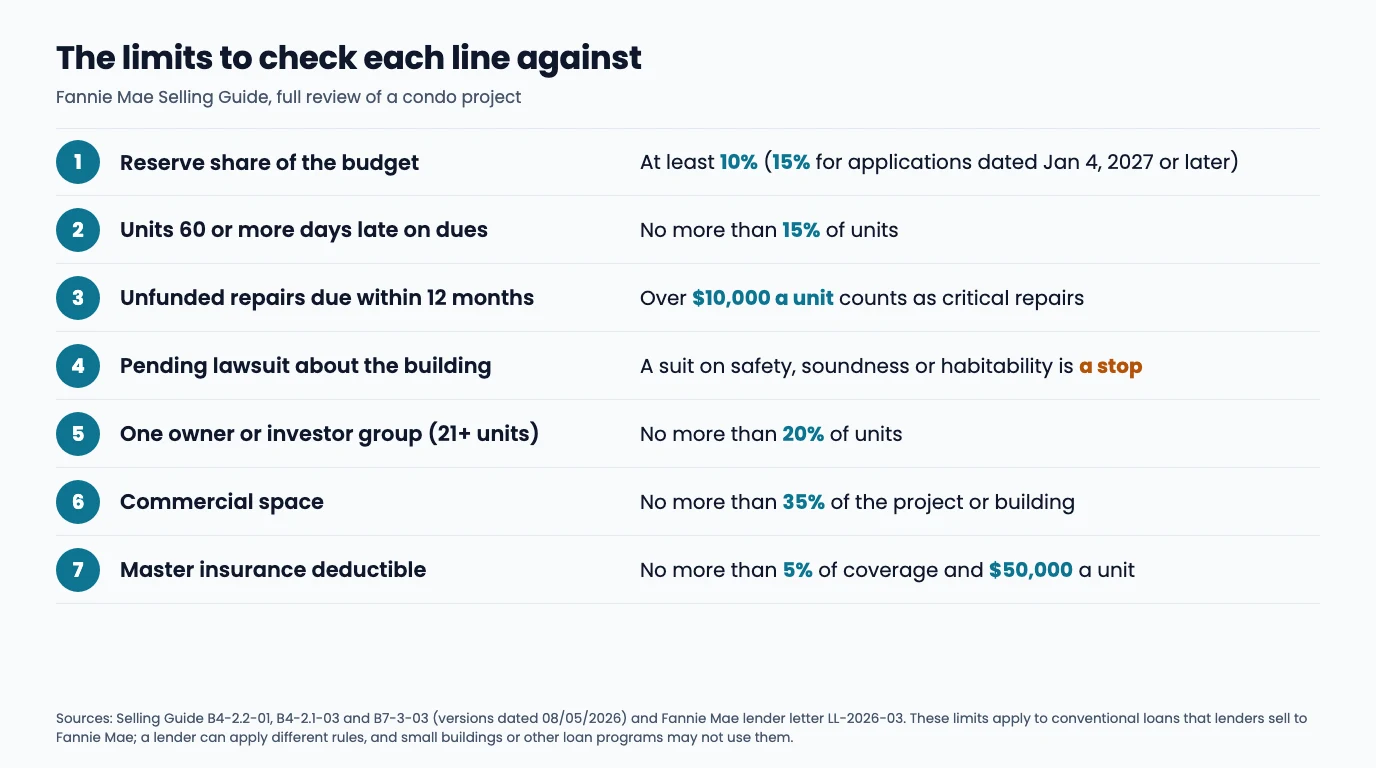
Reserve share of the budget. In its full review rules, Fannie Mae looks for a budget that "provides for the funding of replacement reserves for capital expenditures and deferred maintenance that is at least 10% of the budget." The lender works it out by dividing the annual budgeted reserve allocation by the association's annual budgeted assessment income. You can do the same arithmetic on the budget page of each packet. A lender may use a reserve study in place of this calculation when the study meets Fannie Mae's conditions.
That 10% line, which appears in the Selling Guide's full review rules, is moving. A Fannie Mae lender letter raises it to 15% for loan applications dated on or after January 4, 2027, and our guide to the 15% reserve rule explains who it affects and how the date works. If either building is a few weeks from a contract, ask the lender which version of the test applies to your application date.
Percent funded. This number comes from the reserve study. Association Reserves, a reserve study firm, defines it as the reserve balance divided by the "Fully Funded Balance," a computed figure based on the age and replacement cost of each component of the building. The firm's rule of thumb is that associations under 30% funded "have a high risk of special assessments and deferred maintenance," while at 70% or above those problems "are rare." That guideline comes from one firm and no lender applies it as a test, but it gives you a common scale for two buildings. Our guide to what percent funded means walks through the tiers, and the guide to reading a reserve study shows where to find the number.
Association Reserves describes percent funded as a snapshot, usually taken at the start of a fiscal year, that changes every year as the balance and the replacement costs change. Write down the date next to each building's figure, because a 45% from this year and a 60% from three years ago do not compare.
A low fee means little until you have checked both numbers; see our look at low HOA fees as a red flag for how a building can keep fees down by saving too little.
Who Is Behind on Dues
A lender looks for no more than 15% of units 60 or more days late on dues, so count the late units and divide by total units in each building.
Fannie Mae's full review rules say "no more than 15% of the total units in a project are 60 days or more past due on common expense assessments (also known as HOA fees)." The Guide gives its own example: a 100-unit project may not have more than 15 units that are 60 days or more late. The same limit applies separately to each special assessment.
The late-payer count can appear on the lender questionnaire or in the financial statements as a delinquency report. Divide the late units by the total units for each building. When the figure is not in the packet, ask for it in writing. Our guide to the HOA delinquency rate and condo purchases covers where the number hides and how it changes a loan.
What the Minutes Say Needs Fixing
Read 12 months of minutes in both buildings for the same repair words, then divide the unfunded cost by the number of units.
A reserve study lists what a building expects to replace on a schedule. The minutes show what the board is discussing now. Fannie Mae's rules on critical repairs treat a building as ineligible when it has repairs that affect safety, soundness, structural integrity or habitability, and the Guide counts "any unfunded repairs costing more than $10,000 per unit that should be undertaken within the next 12 months." Repairs paid for by an owner, or already funded through a special assessment, are left out of that count. The Guide also names examples to consider: sea walls, elevators, waterproofing, stairwells, balconies, the foundation, electrical systems and parking structures.
Search both sets of minutes for those words, plus leaks, water intrusion, an engineer's report, a failed inspection, a "special assessment," and a vote to borrow. When you find a repair with a price, divide the part that is not funded by the number of units in the building to get a per-unit figure. Damage that is limited to one or a few units and does not affect the whole building falls outside that rule, so note which kind you are looking at. Our guides to red flags in HOA meeting minutes and to how meeting minutes predict an assessment show what these discussions look like before they become a bill.
Lawsuits, Commercial Space and Who Owns the Units
Check each building for a suit about the building itself, one owner holding over 20% of the units, and shops above 35% of the space.
Lawsuits. The ineligible projects section says projects in which the association is named in pending litigation "that relates to the safety, structural soundness, habitability, or functional use of the project" are ineligible for sale to Fannie Mae. The Guide treats minor matters differently, including non-monetary disputes such as neighbor conflicts and cases where the insurance carrier is defending and the amount is covered by the association's insurance. Our guide to lawsuit red flags for buyers lists the ones that matter most.
Who owns the units. In a project of 21 or more units, the Guide's rule on single-entity ownership treats one owner or investor group holding more than 20% of the units as a problem; for projects of 11 to 20 units, the limit is 2 units. Ask the association for the ownership figure; the minutes sometimes mention a bulk buyer.
Commercial space. Fannie Mae requires that "no more than 35% of a condo or co-op project or 35% of the building in which the project is located be commercial space or allocated to mixed-use." If either condo sits above a restaurant or a hotel, ask what share of the building's square footage those spaces take up. Rental apartments and hotels inside the project count as commercial space under the Guide.
Insurance on the Building
Compare the deductible on each master policy as a percentage of coverage and in dollars per unit, and check the renewal date.
The association's master policy covers the building, and its deductible decides how much of a claim the owners pay. Fannie Mae's master property insurance rules set the maximum: "The maximum allowable deductible for all required property insurance perils is 5% of the master property insurance coverage amount," and the maximum per unit is $50,000. When the master policy has a per-unit deductible, the borrower must carry a unit owners policy. Read the deductible line on each certificate, check whether the policy has separate deductibles for perils such as windstorm or wildfire, and note the renewal date.
Our guides to the HO-6 insurance gap and to the condo insurance crisis and your mortgage explain how to size your own policy once you know the deductible.
A Side-by-Side Scorecard
Put the numbers from both buildings in one table next to the limit, and look for the lines where one building crosses it.
Here is how the comparison looks once the numbers are pulled. The two buildings are made up for this example, and every figure is invented to show the arithmetic.
| Line | Building A | Building B | Limit to check against |
|---|---|---|---|
| Reserve share of budget | 16% ($76,800 of $480,000) | 7.5% ($90,000 of $1,200,000) | At least 10% today; 15% for applications dated on or after Jan 4, 2027 |
| Percent funded (study date) | 62% (Jan 2026) | 28% (Jan 2026) | Under 30% weak, 70% or more strong (one firm's rule of thumb) |
| Units 60+ days late | 4 of 40 (10%) | 21 of 120 (17.5%) | No more than 15% |
| Unfunded repairs due within 12 months | $200,000, or $5,000 a unit | $1,500,000, or $12,500 a unit | Over $10,000 a unit counts as critical repairs |
| Pending lawsuit about the building | None | None | A suit on safety, soundness or habitability is ineligible |
| Largest single owner | 3 units (7.5%) | 30 units (25%) | No more than 20% in a project of 21 or more units |
| Commercial space | 0% | 20% (ground-floor shops) | No more than 35% |
| Master policy deductible | 2% of coverage | 5% of coverage | No more than 5% of coverage and $50,000 a unit |
The last column repeats the Fannie Mae limits quoted and linked in the sections above. Read the table down the columns. Building A clears every limit. Building B crosses four lines: the reserve share, the late-payer count, the repair cost per unit and the single-owner share. It also sits at the top of the insurance limit. Each of those is a question for the lender before you make an offer on B, because each one is a line a lender checks.
When both buildings clear the limits, compare direction: look at the last three budgets for fees, reserve contributions and late payers. Our guide to HOA budget red flags covers what a worrying trend looks like. If one building has a line you cannot resolve, our guide to when to walk away from a condo purchase lists the findings that usually end a deal.
Small Buildings and Other Loan Types
The limits above come from Fannie Mae, and they may not be applied in a building of ten or fewer units or under another loan program.
Fannie Mae's project standards list the cases where a thorough project review is not required, including "units in a two- to ten-unit condo project" and detached condo units. In those buildings the lender may not run the tests in this guide. The papers still tell you the same things about the building, so compare them the same way, and use the limits as a guide to what is worrying.
Lenders also use other loan programs with their own project rules, and some lenders keep loans on their own books. If either buyer is planning an FHA or VA loan or a loan from a local bank, ask the lender which project rules apply to each building before you rely on the table. Our guide to HOA red flags that can end an FHA or VA loan and the explainer on non-warrantable condos cover how those cases work.
What to Ask This Week
Send the same requests to both buildings on the same day, then fill in the scorecard and take any failing line to your lender.
Send these requests to the listing agent, the association or the lender for each building:
- The current budget, the latest reserve study and the last 12 months of board minutes.
- The master insurance certificate, with the deductible and the renewal date.
- The number of units 60 or more days behind on dues, and the same count for each special assessment.
- Any pending or threatened lawsuit, and whether insurance is covering the defense.
- The largest number of units owned by one owner or investor group.
- Any repair the board has priced and not yet funded, and any special assessment under discussion.
A full report from our tools reads each packet and lists these items with the page each one came from. It costs $39 per property, your first full report is free when you sign up, and it works as a first step before an attorney and does not replace one. A typical attorney review of the same documents costs between $300 and $1,500, and our guide to what a document review costs shows where those figures come from.
A licensed real estate attorney can read the documents and advise on a particular building, loan or contract. When the packets arrive, put the numbers in the scorecard that evening, and take any line where one building crosses a limit to the lender before you write an offer.
Frequently Asked Questions
How do I compare two condos before buying?
Ask both associations for the same papers covering the same period: the budget, the latest reserve study, 12 months of minutes, the master insurance certificate and the lender questionnaire. Then compare six facts: the reserve share of the budget, percent funded, units behind on dues, repairs the board has not funded, lawsuits and ownership mix, and the master policy deductible. Put each next to the limit Fannie Mae's Selling Guide uses.
Which line should I check first?
Start with the lines a lender treats as a stop: a pending lawsuit about safety or structure, critical repairs over $10,000 a unit, and more than 15% of units 60 days late. Any of them can end financing on a building, so they come before comparing fees or reserves. Then compare the reserve share and percent funded, which tell you how much repair money is likely to come from you.
What if the two sets of documents have different dates?
Ask the association with the older papers for a newer set. Percent funded is a snapshot that changes every year, so a figure from this year and one from three years ago do not compare. If a newer study does not exist, write the study date beside the figure and treat the comparison as rough.
Do these limits apply to a building with ten or fewer units?
Often not. Fannie Mae's project standards list units in a two- to ten-unit condo project among the cases where a thorough project review is not required, so the lender may not run these tests. The same documents still show the building's finances and repairs, so compare them the same way.
Do the same limits apply to FHA, VA and local bank loans?
The limits in this guide come from Fannie Mae's Selling Guide. Another loan program can use different project rules, so ask the lender which rules apply to each building before you rely on the scorecard.
Check Your Building's Financial Health
Upload your HOA's reserve study and get instant analysis of percent funded, deferred maintenance, and special assessment risk. Free. No signup required.
Your first full property report is also free. See what you'll get →
Or get your first full report free →Related Articles
Sources & References
- Fannie Mae Selling Guide B4-2.2-01, Full Review Process (delinquency and reserve tests; version dated 08/05/2026)
- Fannie Mae Selling Guide B4-2.1-03, Ineligible Projects (critical repairs, litigation, single-entity ownership, commercial space)
- Fannie Mae Selling Guide B4-2.1-01, General Information on Project Standards (project documentation; waiver of project review)
- Fannie Mae Selling Guide B7-3-03, Master Property Insurance Requirements for Project Developments (maximum deductible)
- Association Reserves, What Exactly is Percent Funded? (definition and the 30% and 70% guideline)
Disclaimer: This article is for educational purposes only and does not constitute legal, financial, or real estate advice. The Fannie Mae limits cited are from the Selling Guide versions dated August 5, 2026, apply to conventional loans a lender sells to Fannie Mae, and change over time; a lender can apply different rules. The scorecard uses invented buildings. Consult a qualified real estate attorney for guidance specific to your situation.