

In This Guide
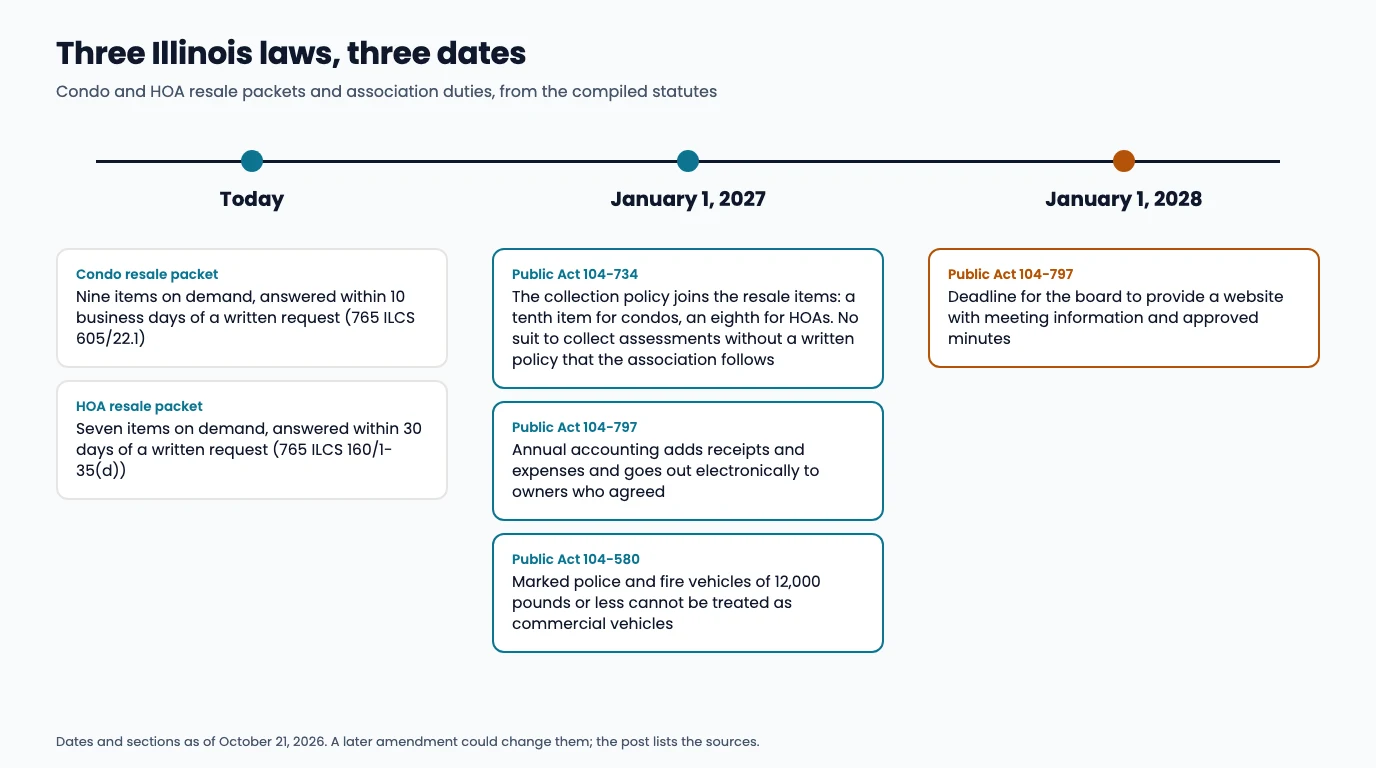
From January 1, 2027, an Illinois condo seller must make the association's written collection policy available to a buyer, alongside nine items already on the list. Two other new laws start the same day, and the association has 10 business days to answer a written request.
If you are buying an Illinois condo or a home in a homeowners' association in the next few months, the packet the association hands over is about to change. On January 1, 2027, three new laws take effect, and one of them adds a document to the list a seller has to make available: the association's written policy for collecting unpaid dues. A buyer who asks for it learns how fast the association moves against a late payer, whether payment plans exist and when an overdue account goes to an attorney. A buyer who never asks may never see it.
This guide covers enacted Illinois law as of October 21, 2026. It reads the Condominium Property Act for condominiums and the Common Interest Community Association Act (the state law for most homeowners' associations) as the state publishes them. It does not cover Chicago or other local ordinances, bills that have been introduced but not passed, or lender rules. For the national dates, see our 2027 HOA compliance calendar; for the resale certificate in general, see our guide to the condo resale certificate.
Which Illinois Law Covers Your Building
Condominiums follow the Condominium Property Act. Most homeowners' associations follow a separate Act, and very small ones can be exempt.
Two Illinois laws sit behind almost every resale packet. A condominium is a building or development where you own your unit and share the common areas through an association run by a board of managers. The Condominium Property Act governs those. The other Act calls a homeowners' association a common interest community association. Its definitions section describes a common interest community as "real estate other than a condominium or cooperative" where owners pay for common areas through an association, and says it "may include, but not be limited to, an attached or detached townhome, villa, or single-family home." The Common Interest Community Association Act governs those associations. It does not cover condominiums or cooperatives, and the definition excludes a master association, an umbrella association that sits over several associations.
Size matters for HOAs. Under 765 ILCS 160/1-75, a common interest community association organized as a nonprofit corporation and having "10 units or less" or "annual budgeted assessments of $100,000 or less" is exempt from the Act "unless the association affirmatively elects to be covered by this Act." In the sections of the Condominium Property Act we read for this guide, we found no comparable size exemption, so we cannot point to one for condominiums. An attorney can confirm how that applies to a particular building.
What the Seller Must Make Available at Resale
A condo seller must obtain nine items from the board for a buyer on demand. From January 1, 2027, the list has ten, adding the collection policy.
For a condo resale, the rule is in 765 ILCS 605/22.1. The owner "shall obtain from the Board of Managers and shall make available for inspection to the prospective purchaser, upon demand," a list of items. A prospective purchaser is the statute's term for someone looking to buy. Section 22 of the same Act is a different rule, for the initial sale of a unit. Section 22 does not govern a resale by an owner.
| Item | What the statute lists | What a buyer checks |
|---|---|---|
| 1 | The declaration, by-laws, other condominium instruments and any rules and regulations | Rental, pet, remodeling and parking rules |
| 2 | A statement of any liens, including the unit's account showing unpaid assessments and other charges (a lien is the association's legal claim against the unit for what is owed) | Whether the seller is behind |
| 3 | Capital expenditures anticipated in the current or next 2 fiscal years (big repairs and replacements the association expects to pay for) | Projects that could become an assessment |
| 4 | The status and amount of the reserve fund, and any part earmarked for a specific project | Cash saved against projects coming due |
| 5 | The association's statement of financial condition for the last fiscal year available | Income, spending and trend |
| 6 | The status of any pending suits or judgments involving the association | Any suit that could become an assessment |
| 7 | What insurance the association provides for all unit owners | What you would have to insure yourself |
| 8 | A statement that the prior owner's improvements or alterations are in good faith believed to comply with the condominium instruments | Work done to the unit without approval |
| 9 | The identity and mailing address of the principal officer or another officer or agent designated to receive notices | Who to send written requests to |
| 10 (from Jan 1, 2027) | A copy of the collection policy adopted under subsection (t) of Section 18.4 | How the association treats a late payer |
Item 10 comes from Public Act 104-734, which the state's compiled text of Section 22.1 marks as effective 1-1-27. The principal officer must furnish the information "when requested to do so in writing and within 10 business days of the request." The section does not define business days, so ask the association which days it counts. The association may charge the seller "a reasonable fee, not to exceed $375," for the out-of-pocket cost of providing and copying the information. The $375 figure is adjusted each year by the percentage change in the federal consumer price index for urban consumers, so the amount in a given year can differ; ask for the current figure. An association may charge "an additional $100 for rush service completed within 72 hours."
Homeowners' associations covered by the other Act have a shorter list. Under 765 ILCS 160/1-35(d), the board must make eight items available to a prospective purchaser on demand: the declaration and rules, a statement of liens and the unit's account, anticipated capital expenditures, the status of reserve or replacement funds, the latest financial statement, pending suits or judgments, the insurance provided and, from January 1, 2027, a copy of the collection policy. The officer has "30 days after receiving a written request," and the association may charge the unit seller "a reasonable fee covering the direct out-of-pocket cost of copying and providing such information." The text sets no dollar cap on that fee.
The Collection Policy Condo and Covered HOA Associations Must Have by January 1
From January 1, 2027, a condo association or covered HOA cannot sue for unpaid assessments without a written policy it follows.
Public Act 104-734 (Senate Bill 3527) adds a requirement to Section 18.4 of the Condominium Property Act. The association, or "a holder or assignee of the association's debt," meaning someone who has bought or taken over the debt, "shall not take legal action to collect common expenses" unless it "has adopted, and follows, a written policy governing the collection of unpaid assessments." Common expenses are the shared costs owners pay through assessments. The homeowners' association version is in 765 ILCS 160/1-45(j).
The statute says the policy must, at a minimum, specify seven things. In plain words, the policy has to say:
- the date assessments are due and when an assessment counts as delinquent;
- any late fees and interest the association can charge;
- any returned-check charges;
- whether a payment plan is available and, if so, its minimum terms;
- how much time passes before the account is referred to an attorney for legal action;
- how payments are applied to the delinquent account; and
- the legal remedies the association can use, under its governing documents and Illinois law.
The statute requires those seven topics but does not set the late fee, the payment plan terms or the number of days before an attorney is involved. Each association decides. After closing you are the owner who pays the assessments, so the policy shows what happens if you fall behind. A buyer comparing two buildings can compare the two policies.
Two More Laws That Start January 1
Two other Illinois laws take effect January 1, 2027: one on the annual accounting and board websites, one on marked police and fire vehicles.
Public Act 104-797 (House Bill 5449) changes what a condo board gives owners each year. The itemized accounting of the common expenses, a line-by-line list of what the association spent and collected, must now include "receipts and expenses," and the information must be supplied electronically to owners who have given the association their details and authorized that delivery, under 765 ILCS 605/18(a)(7), which the state's compiled text marks as effective 1-1-27. The homeowners' association Act gets the same electronic-delivery sentence in 765 ILCS 160/1-45(b). The same Act says the board "must provide a website no later than January 1, 2028" that owners can reach and that includes "information about board and membership meetings and the approved minutes from a meeting of the board." That sentence appears as a new subsection (t) of Section 18.4 for condominiums and as subsection (l) of Section 1-30 for HOAs.
One wrinkle for anyone reading the statute itself: the state's compiled text of Section 18.4 shows two versions, because Public Act 104-734 and Public Act 104-797 each add a new subsection (t). They cover different things, the collection policy and the board website. When you ask for the collection policy, you can name Public Act 104-734 to avoid confusion.
A fourth act shows up in the compiled text, but it is a cleanup act. Public Act 104-852 is the First 2026 General Revisory Act, which says it "is not intended to make any substantive change in the law." The compiled text of Section 9.1 of the Condominium Property Act lists it as effective August 21, 2026, so it is not one of the three January 1 laws above.
The third law is Public Act 104-580 (House Bill 67). An association "may not define or designate a marked law enforcement vehicle that is assigned to a law enforcement officer" or "a marked firefighter vehicle that is assigned to a firefighter" as a commercial vehicle and subject it to a restriction, "as long as the vehicle does not exceed 12,000 pounds," and a rule that does is "void and unenforceable." The condominium version is Section 18.14 and the HOA version is Section 1-73. The compiled text of both sections marks Public Act 104-580 as effective 1-1-27.
Rules Already in Force That a Buyer Meets
Two older condo rules matter before closing: a petition right when a budget jumps more than 15%, and limits on what a board can refuse in a resale.
The first is in 765 ILCS 605/18(a)(8)(ii). If an adopted budget or a separate assessment (the statute's term for a special assessment) would push the total of regular and separate assessments for the year above 115% of the prior year's total, unit owners holding 20 percent of the votes can petition within 21 days, and the board must call a meeting within 30 days. Unless a majority of the total votes are cast at that meeting to reject the budget or assessment, it is "ratified," the statute's word for approved. Separate assessments for emergencies or those mandated by law are not subject to owner approval. Our guide to HOA fee increases compares this rule with other states.
The second is 765 ILCS 605/22.2. In a condo resale, "no condominium association shall exercise any right of refusal, option to purchase, or right to disapprove the sale" because the buyer's financing is guaranteed by the Federal Housing Administration, or "for a discriminatory or otherwise unlawful purpose." A person who is harmed by a violation can sue the association in state circuit court. A right of first refusal is a right to match a buyer's offer and buy the unit instead.
What the Resale Statute Does Not Say
The resale statute names no deadline tied to your contract or closing, and the text we read gives a buyer no stated remedy for a late answer.
Read closely, Section 22.1 says what the owner must obtain, to whom it must be made available, how a request is made and how long the association has to answer. In the text we read, it does not say when in the sale the documents must reach the buyer, that a contract must exist first, or what a buyer can do if the association is late. The words "prospective purchaser" can be read as covering someone still deciding, but the text does not turn that into a right before an offer, and we are not describing it as one. The same is true of the 30-day clock for homeowners' associations in Section 1-35(d).
That leaves timing to the contract and to local practice. Our guide to getting HOA documents before an offer covers how buyers ask in other states. For Illinois, the seller's agent and the title company can tell you how the packet is handled in your area, and an Illinois real estate attorney can say whether a deadline in your contract depends on it.
Questions to Ask Before You Close
Eight questions turn the new rules into a checklist to send the seller's agent or the association before you close on the unit.
- Is the property a condominium or an HOA, and which Act does the association say it follows?
- On what date did the association receive our written request for the items on the list?
- Does the packet contain every item, including the collection policy if the request is made after January 1, 2027?
- What does the collection policy say about the due date, late fees, payment plans and the point where an account goes to an attorney?
- What is the fee for the packet, who pays it, and was it adjusted for inflation this year?
- Does the association have a website, and where are approved minutes posted?
- Did the budget or any special assessment rise more than 15% over last year?
- Do the governing documents include a right of first refusal or a board approval step for sales?
A full report from our tools reads each document in the packet and lists these items with the page each one came from. It costs $39 per property, and it works as a first step before an attorney and does not replace one. A typical attorney review of the same documents costs between $300 and $1,500, according to our attorney cost guide. For a walk through reading the full set, see how to review HOA documents.
Frequently Asked Questions
What changes for Illinois condo and HOA buyers on January 1, 2027?
Three Public Acts take effect. Public Act 104-734 adds the association's collection policy to the resale items and bars suits to collect unpaid assessments without one. Public Act 104-797 expands the annual accounting, adds electronic delivery and requires a board website with meeting information and approved minutes by January 1, 2028. Public Act 104-580 bars treating marked police and fire vehicles of 12,000 pounds or less as commercial vehicles.
How long does an Illinois association have to give me the documents?
For a condominium, the principal officer must furnish the items within 10 business days of a written request, under 765 ILCS 605/22.1(b). For a homeowners' association covered by the Common Interest Community Association Act, the officer has 30 days after receiving a written request, under 765 ILCS 160/1-35(d). The condominium section does not define business days.
Who pays for the resale documents in Illinois?
The statutes let the association charge the unit seller for the packet. For condominiums the fee may not exceed $375, adjusted yearly for inflation, with an additional $100 allowed for rush service within 72 hours. For homeowners' associations the text allows a reasonable fee for copying and providing the information and sets no dollar cap.
Which Illinois associations does the collection policy rule cover?
It applies to condominiums under the Condominium Property Act, and to homeowners' associations under the Common Interest Community Association Act. A nonprofit homeowners' association with 10 units or less, or annual budgeted assessments of $100,000 or less, is exempt from that Act unless it elects coverage. We found no size exemption in the sections of the Condominium Property Act we read.
Can I demand the association's documents before I make an offer?
The statute says the owner must make the items available to a prospective purchaser on demand, but the text we read names no deadline tied to a contract or closing and does not describe the request as a right before an offer. Ask the seller's agent and the title company how it works in your area, and ask an Illinois attorney if a contract deadline depends on it.
Did Illinois change anything else for condos in 2026?
The state's compiled Condominium Property Act marks each of the three Public Acts above as effective January 1, 2027; the board website deadline in Public Act 104-797 is January 1, 2028. Public Act 104-852 also touches Section 9.1, but it is the First 2026 General Revisory Act and says it "is not intended to make any substantive change in the law." We did not read local ordinances, lender rules or bills that have not passed.
Get Your CC&Rs Analyzed
Upload your HOA's CC&Rs and get instant analysis of rental restrictions, pet policies, financing red flags, and more. Free. No signup required.
Your first full property report is also free. See what you'll get →
Or get your first full report free →Related Articles
Sources & References
- 765 ILCS 605/22.1 (Condominium Property Act: resale items, response time, fee)
- 765 ILCS 605/18.4 (board powers and duties: collection policy, board website)
- 765 ILCS 605/18 (by-laws: annual accounting, 115% budget petition)
- 765 ILCS 605/18.14 (marked law enforcement and firefighter vehicles)
- 765 ILCS 605/22.2 (resale approval limits)
- 765 ILCS 160/1-5 (Common Interest Community Association Act: definitions)
- 765 ILCS 160/1-35 (Common Interest Community Association Act: resale items)
- 765 ILCS 160/1-45 (finances and the collection policy)
- 765 ILCS 160/1-30 (board duties: website)
- 765 ILCS 160/1-73 (marked law enforcement and firefighter vehicles)
- 765 ILCS 160/1-75 (exemptions for small common interest communities)
- Public Act 104-734, 104-797 and 104-580 (enrolled text; effective dates from the compiled statutes)
- Public Act 104-852 (First 2026 General Revisory Act)
Disclaimer: This article is for educational purposes only and does not constitute legal, financial, or real estate advice. Illinois statutes change, and the sections cited are current as of October 21, 2026 and may be amended, including in the veto session or the spring session. This article covers enacted state law for Illinois condominiums and common interest community associations; local ordinances, cooperatives, lender rules and bills that have not passed are not covered. Consult a qualified Illinois real estate attorney for guidance specific to your situation.