
In This Guide
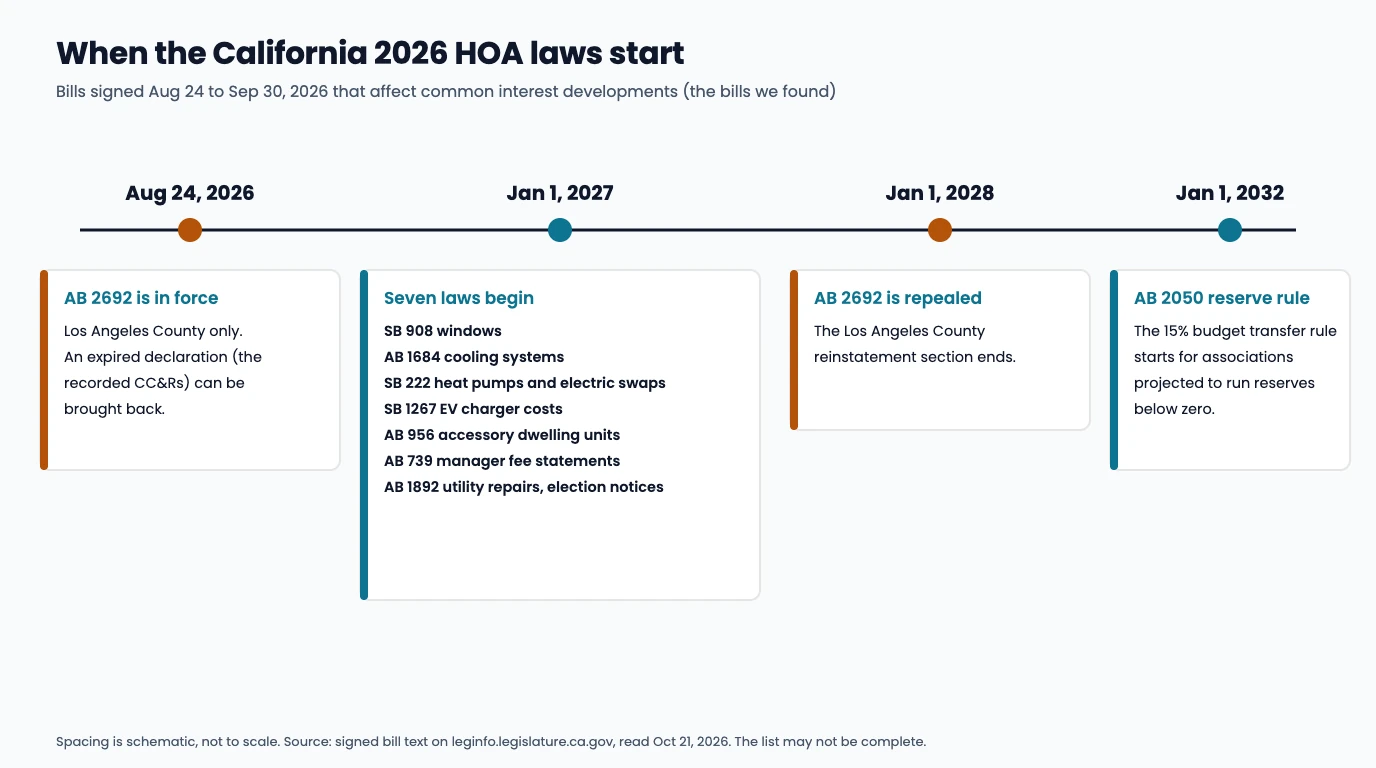
Most of the California HOA laws signed in 2026 take effect on January 1, 2027. They limit an HOA's power to block windows, air conditioning and heat pumps, pass EV charger costs to the next owner, and make manager fee statements association records. The AB 2050 reserve rule starts in 2032.
Suppose you are about to buy a California condo, and the seller's packet mentions new windows, a heat pump and an owner-installed EV charger in the parking space. Several of the 2026 laws change what the association can do about each of those on January 1, 2027, and some of the costs stay with the unit when it sells.
This guide lists the 2026 laws that affect common interest developments, says when each one starts, and turns each into something to check in the HOA packet. It covers the bills we found among the 2026 signed bills, so a bill we missed is possible; a California real estate attorney can confirm what applies to your building. Our guide to SB 326 balcony inspections and our all-states 2027 date calendar cover related items and are not repeated here.
What Takes Effect on January 1, 2027, and What Does Not
Seven bills start January 1, 2027, one reserve rule takes effect in 2032, and one Los Angeles County law is already in force.
California's Constitution says a statute passed in a regular session goes into effect on January 1 next following a 90-day period after it is enacted. These bills were signed between August 24 and September 30, 2026, and we found no urgency clause (a clause that makes a law take effect immediately instead of on January 1) in the text of any of them except AB 2692, so the others take effect on January 1, 2027 unless the bill sets a later date, as AB 2050 does.
| Law | What it does | Where it applies | Starts |
|---|---|---|---|
| SB 908 (ch. 787) | Voids rules that effectively prohibit or restrict replacing windows with Energy Code-compliant ones | Owners' windows and some common-area windows that serve one unit | Jan 1, 2027 |
| AB 1684 (ch. 887) | Voids rules that prohibit or restrict a code-compliant cooling system | Inside the owner's unit (its separate interest) | Jan 1, 2027 |
| SB 222 (ch. 738) | Voids rules that block electric replacements for gas appliances or heat pumps | Appliances and heat pumps in a unit | Jan 1, 2027 |
| SB 1267 (ch. 350) | Owner and each later owner carry a common-area EV charger's costs and must disclose it to buyers | Chargers in a common area | Jan 1, 2027 |
| AB 956 (ch. 791) | Extends accessory dwelling unit protection to lots zoned to allow single-family homes | Planned developments | Jan 1, 2027 |
| AB 739 (ch. 506) | Annual managing agent fee statement becomes an association record | Associations with a managing agent | Jan 1, 2027 |
| AB 1892 (ch. 169) | Rewords the utility repair duty and shortens some election notices | Associations | Jan 1, 2027 |
| AB 2050 (ch. 796) | Minimum reserve funding and a 15% budget transfer | Associations whose study projects reserves below zero | Takes effect Jan 1, 2032 |
| AB 2692 (ch. 124) | Lets an expired declaration (the recorded CC&Rs) be brought back | Los Angeles County only | In force now; repealed Jan 1, 2028 |
These rules sit in the Davis-Stirling Common Interest Development Act (Civil Code 4000 et seq.), which covers four kinds of developments: community apartment projects, condominium projects, planned developments and stock cooperatives. The new sections are not in the online Civil Code until they take effect, so each row links to the signed bill. Before you rely on a rule the seller or the association cites, check its effective date in the last column: a rule from one of these bills does not apply before the date shown.
Upgrades an HOA Can No Longer Block
SB 908, AB 1684 and SB 222 void HOA rules that block windows, cooling systems and heat pumps, with permit and damage limits.
SB 908 adds Civil Code 4754. It voids any rule that "effectively prohibits or restricts the owner of a separate interest from completing a residential window replacement project" (a separate interest is the part you own yourself, such as your unit), and any rule that imposes requirements on California Energy Code-compliant windows. Reasonable installation rules survive if they do not significantly raise the cost or lower the energy efficiency of the project, and so do reasonable aesthetic rules, but only for windows that change a window's exterior look in a multifamily building of more than 20 units that is not townhomes. If an association's governing documents place no reasonable restrictions on a window project, it cannot subject the project to design review or any other form of approval. Where approval is allowed, the association must decide in writing, and if it has not approved or disapproved within 45 days, silence counts as approval (the bill says the application is "deemed approved") unless the delay comes from information the owner did not supply. For windows that serve one owner but are treated as common area, the association must approve a project if the owner agrees in writing to follow its standards, hire a licensed contractor, get permits and pay the costs.
AB 1684 adds Civil Code 4738. It voids a governing-document or architectural-guideline provision if the provision "prohibits or restricts the installation, upgrade, replacement, or use of a cooling system that complies with all applicable state and local building codes." A cooling system includes portable and window air conditioners, evaporative coolers, cooling fans and heat pumps. Inside a unit, the association cannot charge a fee, require a particular system, contractor or product, or demand removal, unless the installation would break a law or a required permit is not granted. It can still make the owner or a later owner repair damage to common area or another unit, and require the owner to "Disclose to prospective buyers of the separate interest the existence of the cooling system and related responsibilities of the owner under this section" (the separate interest is the owner's unit). An association that willfully violates the section owes the member actual damages and a civil penalty of up to $2,000.
SB 222 adds Civil Code 4737. It voids any rule that "prevents the replacement of a fuel-gas-burning appliance with an electric appliance that complies with all applicable state and local building codes," and it voids rules that effectively prohibit or restrict a residential heat pump water heater or heat pump HVAC system. As with cooling systems, the association cannot charge a fee, require a specific product or contractor, or demand removal, unless the work is illegal or a needed permit is not granted, and the owner stays responsible for damage to common area.
EV Chargers: Costs Follow the Charger to the Next Owner
Under SB 1267, the owner and each later owner of a common-area EV charger carry its costs and insurance, and must disclose it to buyers.
Civil Code 4745 already lets an owner install an EV charger for their own use, with association approval where it goes in a common area. SB 1267 changes the cost rules. Where a charger is in a common area or an exclusive use common area (a parking space or other area the association owns but only one owner may use), "the owner and each successive owner of the charging station" is responsible for the cost of damage from installing, using, maintaining, repairing, removing or replacing it, for maintaining and replacing it until it is removed and restoring the common area afterward, and for its electricity. The same list makes the owner responsible for "Disclosing to prospective buyers the existence of any charging station of the owner and the related responsibilities of the owner under this section."
The owner must also keep a liability policy in force, and the owner and each successor give the association a certificate of insurance every year. The installer must indemnify (cover the association's costs if something goes wrong) or reimburse the association or its members for loss caused by the installation. The words "each successive owner" are why a buyer of a unit with such a charger will want to read that list before closing.
Fee Statements, Records and What the Seller Must Hand You
AB 739 makes managing agent fee statements association records. The seller's packet under Civil Code 4525 is what a buyer gets before closing.
AB 739 requires an association's board to "Review, on an annual basis, a statement of fees charged by the managing agent." The statement shows the period covered, how many units (separate interests) the association has, the total billed and paid, and a breakdown into base management fees, fee schedule charges and reimbursable expenses. An employee of the association is not a managing agent for this purpose. The bill adds the statement to the association records that a member can inspect. The statement is not on the list of documents a seller must give a buyer, so a buyer can ask the seller whether the association has one for the last year.
Before closing, Civil Code 4525 requires the seller to give the buyer, "as soon as practicable before the transfer of title or the execution of a real property sales contract," a set of documents. The list, as it reads in 2026, includes:
- the governing documents,
- the most recent annual budget report and the other documents the association sent to members under Civil Code 5300, which include a reserve summary and a statement of any expected special assessment,
- a written statement from the association of the current regular and special assessments and fees, any unpaid assessments and fines, and the late charges, interest and collection costs that could become a lien,
- a copy or summary of any unresolved violation notice,
- any board-approved change to assessments that is not yet due,
- a statement describing any rental ban in the governing documents,
- if the buyer asks, board meeting minutes from the previous 12 months, leaving out the closed-door (executive session) parts, and
- "A copy of the report issued pursuant to the most recent inspection conducted pursuant to Section 5551," the balcony and walkway inspection report.
The last item has applied since January 1, 2026, when SB 410 amended the section. The minutes are included only if the buyer asks, so ask in writing. The seller asks the association for the documents, and under Civil Code 4530 the association must provide them within 10 days of the written request, for "a reasonable fee ... based upon the association's actual cost" charged to the seller. The section does not apply to an owner subject to Business and Professions Code 11018.6. Our guide to hidden transfer and document fees compares what other states allow.
AB 2050: Signed in 2026, Takes Effect in 2032
AB 2050's reserve funding rule takes effect January 1, 2032. The reserve study rule in Civil Code 5550 applies until then.
AB 2050 was approved on September 29, 2026 (Chapter 796). It adds Civil Code 5552: "An association shall fund the reserve account on an annual basis in at least the minimum reserve contribution level" from its latest reserve study. If the study projects the reserve balance falling below zero at any time over the next 30 years, the association "shall transfer a minimum of 15 percent of its gross annual budget to its reserve account each year" until that projection ends. An association that cannot meet the minimum through its budget must levy a reserve funding special assessment under the same limits as a standard one, with a member vote to go above the cap, and may not levy one "more than once every nine years." Subdivision (f) says "This section shall become operative on January 1, 2032," meaning the rule starts working that day. A second version of Civil Code 5550 in the bill would have worked only alongside SB 1238, which the Governor vetoed on September 20, 2026, so it does not operate.
Until 2032 the rule is the existing Civil Code 5550: at least every three years, the board must cause a visual inspection of the major components as part of a study of the reserve account requirements, if their replacement value is at least half of the gross budget excluding reserves, with a funding plan for components with 30 years or less of life left. Our guides to a good percent funded and the reserve fund calculator explain the numbers, and the free reserve study tool reads a study you upload. A buyer can read the study now: ask for the latest one, ask when it was last updated and whether the board has adopted its funding plan.
Rules Already in Force That a 2027 Buyer Will Meet
A $100 fine cap, assessment increase limits and the balcony inspection report are already law and apply to a 2027 purchase.
Civil Code 5850 caps a monetary penalty at the lesser of the amount in the association's schedule or $100 per violation, with a higher penalty allowed where the violation "may result in an adverse health or safety impact on the common area or another association member's property," after a written finding at an open board meeting. The current text comes from AB 130 and took effect June 30, 2025.
Civil Code 5605 limits what a board can do without a member vote: a regular assessment may not rise more than 20 percent over the prior year, and special assessments may not exceed 5 percent of budgeted gross expenses for the year in total, without the approval of a majority of a quorum of members, which Civil Code 4070 explains as a majority of the votes cast in a valid election where enough members take part, with the yes votes also a majority of the quorum. For an association whose original declaration was recorded on or after January 1, 2025, subdivision (c) sets a lower cap on increases for owners of deed-restricted affordable housing units, with listed exceptions. None of the 2026 bills we found changes those limits. Our guide to assessment limits by state compares California with other states.
Balcony and walkway inspections have their own guide, California SB 326 and balcony inspections. For a buyer the connection is Civil Code 4525(a)(11), which puts the latest inspection report in the seller's packet. Ask for the association's fine schedule and its last two annual budget reports, so you can see recent fines and how the regular assessment has moved.
Narrower Changes: ADUs, Los Angeles County and Utility Repairs
AB 956 widens ADU protection, AB 2692 applies only in Los Angeles County, and AB 1892 adjusts utility repairs and election notices.
AB 956 changes Civil Code 4751, which covers planned developments, and Civil Code 714.3, so that the protection for accessory dwelling units and junior accessory dwelling units applies to a lot "zoned to allow single-family residential use." The earlier wording, per the bill's digest, was "zoned for single-family residential use." Reasonable restrictions that do not unreasonably raise the cost of building a unit remain allowed. If you plan to add a unit, ask whether the CC&Rs mention one.
AB 2692 added Civil Code 4276 as an urgency law, which takes effect immediately instead of on January 1, and it has been in force since August 24, 2026. A declaration is the recorded document that sets an association's rules, and some have an initial term (a set number of years) after which they end unless extended. For Los Angeles County only, a declaration that has ended that way can be reinstated (brought back) if approved by the share of members the declaration required for extending its term, or by a majority of all members if it names none, with the approval certified and the declaration recorded. The extension equals the initial term or 20 years, whichever is less. The Legislature wrote it for communities damaged or destroyed in the 2025 Palisades and Eaton fires, and the section is repealed on January 1, 2028. If the building is in Los Angeles County, pull the recorded declaration and check whether its term has run out and, if so, whether the owners voted to reinstate it and recorded the result.
AB 1892 rewords the association's duty to restore interrupted gas, heat, water or electrical service so that it applies when an interruption "begins in the common area," and, per its digest, shortens the first notice for an election by acclamation (a seat filled without a vote because no one else ran) to at least 30 days before the nomination deadline, with a reminder at least 10 days before it. If the seller mentions a recent gas, water or electrical outage, ask whether it began in a common area and who paid for the repair.
Questions to Ask Before You Close
Use these questions with the listing agent, the seller or the association's manager before your packet deadline runs out.
- Can I have the governing documents as they read today, including any rules adopted for windows, cooling systems, heat pumps or EV chargers?
- Was any window, cooling system, heat pump or EV charger added to this unit or its parking space, and who approved it?
- If there is an EV charger in a common area: what are the approval, any license agreement, the insurance certificate and the last 12 months of electricity charges?
- Does the association use a managing agent, and can the seller share the most recent annual statement of fees?
- Can I have the approved board minutes from the previous 12 months, in writing, and the latest reserve study with its percent funded?
- If the building has elevated balconies or walkways, what does the most recent inspection report say?
- What is the fine schedule, and is any violation notice or fine pending against the unit?
- In Los Angeles County: has the declaration (the recorded CC&Rs) reached the end of its set term, and was it brought back and recorded?
A California real estate attorney can say how these laws apply to a specific building. A GoverningDocs report costs $39 per property and works as a first step before an attorney and does not replace one; a typical attorney review of the same documents costs between $300 and $1,500, as our attorney cost guide explains. Either way, the packet is only useful if you read it before the deadline in your contract.
Frequently Asked Questions
Do the 2026 California HOA laws apply to every HOA?
They apply to common interest developments under the Davis-Stirling Act: community apartment projects, condominium projects, planned developments and stock cooperatives. Each bill has its own scope: the cooling and heat pump rules cover what happens inside a unit, SB 1267 covers chargers in a common area, and AB 2692 covers Los Angeles County only.
When do the new California HOA laws take effect?
Seven of the bills we found start on January 1, 2027, because a statute passed in a regular session takes effect on January 1 after a 90-day period. AB 2050's reserve funding rule takes effect on January 1, 2032, and AB 2692 for Los Angeles County has been in force since August 24, 2026.
Can an HOA still require approval for new windows?
In some cases. Under SB 908, if an association's governing documents place no reasonable restrictions on a window replacement project, it cannot subject the project to design review or any other form of approval. Where approval is allowed, the association must decide in writing, and if it has not decided within 45 days the application is deemed approved (silence counts as approval), unless the delay comes from information the owner did not provide.
Will I inherit the costs of an EV charger if I buy a unit that has one?
For a charger in a common area or an exclusive use common area (an area only one owner may use), SB 1267 makes "the owner and each successive owner" responsible for costs of damage, maintenance and repair and for its electricity. Ask the seller for the approval, any license agreement and the current insurance certificate.
Does AB 2050 change my assessments in 2027?
Its reserve funding rule in Civil Code 5552 takes effect on January 1, 2032, per AB 2050. Until then the limits in Civil Code 5605 apply: no more than a 20 percent rise in a regular assessment, and no more than 5 percent of budgeted gross expenses in special assessments, without a member vote.
Get Your CC&Rs Analyzed
Upload your HOA's CC&Rs and get instant analysis of rental restrictions, pet policies, financing red flags, and more. Free. No signup required.
Your first full property report is also free. See what you'll get →
Or get your first full report free →Related Articles
- California SB 326 Balcony Law: What Condo Buyers Must Know
- The 2027 HOA Compliance Calendar: Dates That Change a Condo or HOA Purchase
- Can an HOA Raise Fees With No Limit? What Your CC&Rs Actually Allow
- What is a Good Percent Funded for an HOA? (2026 Benchmarks)
- How to Review HOA Documents Before You Buy
Sources & References
- Cal. Const. art. IV, sec. 8 (effective date of a statute enacted at a regular session)
- Civil Code 4100 (definition of a common interest development)
- Civil Code 4525 (documents an owner gives a prospective purchaser; amended by SB 410, effective January 1, 2026)
- Civil Code 4070 (meaning of approval by a majority of a quorum of the members)
- Civil Code 4745 (EV charging stations, current text before SB 1267 takes effect)
- SB 410 (Grayson), Chapter 516, Statutes of 2025 (amends Civil Code 4525 and 5551; approved October 10, 2025)
- Civil Code 5300 (annual budget report contents)
- Civil Code 4530 (delivery within 10 days and the fee for the documents)
- Civil Code 5550 (reserve study at least every three years)
- Civil Code 5605 (limits on assessment increases)
- Civil Code 5850 (limit on monetary penalties; AB 130, effective June 30, 2025)
- SB 908 (Wiener), Chapter 787, Statutes of 2026 (windows; adds Civil Code 4754)
- AB 1684 (Ward), Chapter 887, Statutes of 2026 (cooling systems; adds Civil Code 4738)
- SB 222 (Wiener), Chapter 738, Statutes of 2026 (heat pumps and electric appliances; adds Civil Code 4737)
- SB 1267 (Allen), Chapter 350, Statutes of 2026 (EV charging stations; amends Civil Code 4745)
- AB 956 (Quirk-Silva), Chapter 791, Statutes of 2026 (accessory dwelling units; amends Civil Code 714.3 and 4751)
- AB 739 (Jackson), Chapter 506, Statutes of 2026 (managing agent fee statement; amends Civil Code 5200 and 5500)
- AB 1892 (Davies), Chapter 169, Statutes of 2026 (utility repairs and election notices; amends Civil Code 4775, 5103 and 5105)
- AB 2050 (Caloza), Chapter 796, Statutes of 2026 (reserve funding; adds Civil Code 5552, operative January 1, 2032)
- AB 2692 (Irwin), Chapter 124, Statutes of 2026 (Los Angeles County declaration reinstatement; adds Civil Code 4276)
- SB 1238 bill status (vetoed September 20, 2026)
Disclaimer: This article is for educational purposes only and does not constitute legal, financial, or real estate advice. California statutes and bills change, and the sections and bills cited are current as of October 21, 2026 and may be amended. This article covers California common interest developments under the Davis-Stirling Act; mobilehome parks, rental buildings and other housing may follow different rules. The list of 2026 bills is the set we found and may not be complete. Consult a qualified California real estate attorney for guidance specific to your situation.