

In This Guide
A Texas condo association must issue the resale certificate within 10 days of a written request and may charge up to $375 for it, and a buyer who had no certificate when signing can cancel before the sixth day after receiving it.
You are under contract on a Texas condo, or about to be, and the listing agent says the HOA resale certificate is on its way. Suppose it arrives the day before closing and shows a special assessment the seller never mentioned. Texas gives condo buyers several tools for that moment, and almost all of them sit in Chapter 82 of the Property Code, the condominium chapter. The better-known resale certificate chapter, Chapter 207, covers subdivision HOAs, and it says it does not apply to condominiums.
This guide covers Texas condominiums only. It explains which chapter governs, what the seller must hand you, what the certificate must say, how long the association has, when you can cancel, who pays the fee and what protects you if the certificate is wrong. Our Texas HOA laws guide covers subdivision HOAs and the rest of the Texas picture.
Which Texas Chapter Covers Your Condo
Texas condominiums follow Chapter 82 of the Property Code. Chapter 207, the HOA resale certificate chapter, covers subdivision HOAs and excludes condos.
Chapter 82, the Texas Uniform Condominium Act, applies to condominiums whose declaration, the recorded document that creates the condo, was recorded on or after January 1, 1994 (Property Code 82.002(a)). Chapter 207 says it "does not apply to a condominium council of owners governed by Chapter 81 or a condominium unit owners' association governed by Chapter 82" (Property Code 207.002(b)). So a guide that quotes a 10-business-day deadline or a $75 update fee for your condo is describing the HOA chapter (207.003).
An older condo, one whose declaration was recorded before 1994, follows Chapter 82 only in part. The statute lists the sections that reach it. The resale certificate section (82.157) is on that list and the buyer's cancel right (82.156) is not, unless the owners voted to bring the condo under Chapter 82 or the declaration says the chapter applies in its entirety (Property Code 82.002(a) and (c)).
| Question | Condominium (Chapter 82) | Subdivision HOA (Chapter 207) |
|---|---|---|
| Who it covers | Condo unit owners' associations (82.002) | A subdivision with a property owners' association that can levy assessments (207.002(a)) |
| Certificate must be no older than | Three months before delivery (82.157(a)) | 60 days before delivery (207.003(a)) |
| Association's delivery deadline | The 10th day after a written request (82.157(b)) | The 10th business day (207.003(a)) |
| Fee ceiling | $375 to furnish the certificate (82.157(f)) | $375, plus $75 for an update (207.003(c)) |
What the Seller Must Give You Before You Sign
Before a contract is signed, a condo seller must give the buyer the declaration, the bylaws, any association rules and a resale certificate prepared in the last three months.
When a unit owner other than the declarant (the party that created the condominium, usually the developer) sells a unit, "before executing a contract or conveying the unit, the unit owner must furnish to the purchaser a current copy of the declaration, bylaws, any association rules, and a resale certificate that must have been prepared not earlier than three months before the date it is delivered to the purchaser" (Property Code 82.157(a)). The association issues the certificate, and it must include the association's current operating budget.
The standard Texas Real Estate Commission contract builds those steps into check boxes. The Residential Condominium Contract (Resale), TREC form 30-18 dated 05-04-2026, has one set of boxes for the documents and another for the certificate. For the certificate, box (1) says the buyer has received it; box (2) says the buyer has not, and the seller will deliver it within a number of days written into the form; and box (3) says the buyer has the seller's sworn statement that the association did not provide one, and the buyer and seller agree to waive the certificate (TREC 30-18). The same form says the certificate "must have been prepared, at Seller's expense, no more than 3 months before the date it is delivered to Buyer" and must be "in a form promulgated by TREC or required by the parties."
TREC publishes its own certificate form, number 32-5 dated 11-04-2024. It runs from item A through item P and asks for three attachments: the operating budget, an insurance summary and a balance sheet (TREC 32-5). Our guide to the condo resale certificate explains which lines carry the most weight across states.
What the Certificate Must Say
The statute lists 14 statements the certificate must make, plus the operating budget. They answer four questions: what the seller owes, what the building owes, what could change your plans and who runs it.
What the seller owes, and what you may pay. The certificate must state the regular assessment and any unpaid common expenses or special assessments currently due from the seller, other unpaid fees the seller owes the association, and "all fees payable to the association or an agent of the association that are associated with the transfer of ownership, including a description of each fee, to whom the fee is paid, and the amount of the fee" (Property Code 82.157(a)(2), (3) and (14)).
What the building has and owes. It must state the reserves set aside for capital expenditures, the capital expenditures the association approved for the next 12 months, any unsatisfied judgments against the association, the nature of any pending lawsuits and the insurance the association carries for unit owners (82.157(a)(4) through (8)). Our guide to reading a reserve study shows how to judge the reserve figure.
What could change your plans. The certificate must say whether the declaration contains a right of first refusal or other restraint on transfer (a right of the association or others to buy before an outside buyer), whether the board knows of alterations to the unit or its limited common elements (parts of the common areas reserved for one or a few units, for example a balcony or an assigned parking space) that violate the governing documents, whether the board has notice from a government authority of health or building code violations, and the remaining term of any leasehold that affects the condominium (a lease of land that is part of the condo, where the lease ending could shrink or end the condominium) (82.157(a)(1), (9), (10) and (11); the two terms are defined in 82.003).
Who runs it, and the numbers. It must give the name, address and telephone number of the association's managing agent, if there is one, and attach the current operating budget and balance sheet (82.157(a)(12) and (13)).
Ten Days to Issue It, and What a Late One Means
The association has 10 days after a written request. If it runs late, the seller can give the buyer a sworn statement, and both sides can agree in writing to skip the certificate.
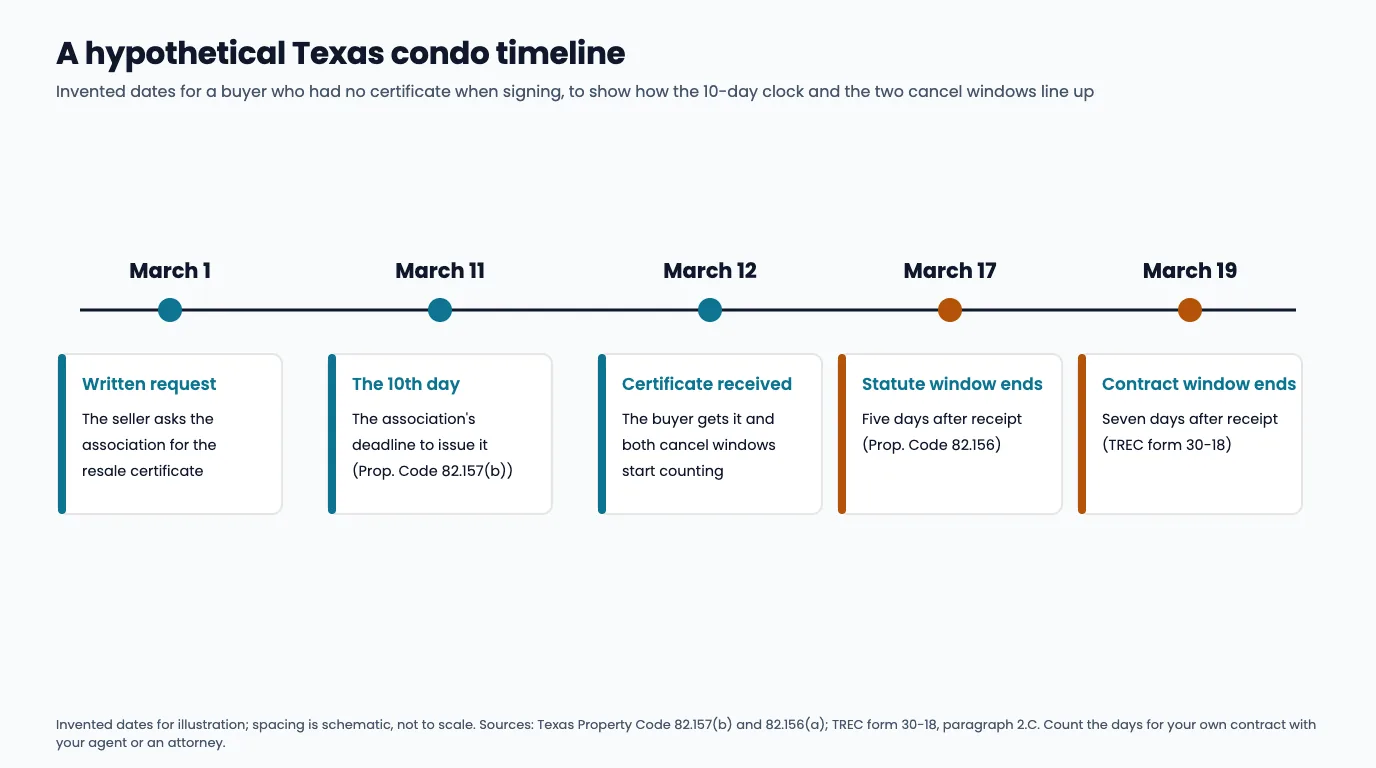
"Not later than the 10th day after the date of receiving a written request by a unit owner, an association shall furnish to the selling unit owner or the owner's agent a resale certificate signed and dated by an officer or authorized agent of the association" (Property Code 82.157(b)). The clock runs from the date the association receives the owner's written request, a date the buyer sees only if the seller or the agent shares it.
If the association misses the deadline, the same section lets the unit owner give the buyer an affidavit (a sworn written statement) "in lieu of the certificate." The affidavit must say the owner asked the association for the information and that the association did not provide it on time, and the owner and the buyer "may agree in writing to waive the requirement to furnish a resale certificate" (82.157(b)). Box (3) of the contract's certificate paragraph, described above, records that waiver (TREC 30-18).
A late or missing certificate does not undo the sale. The section says "Failure to provide a resale certificate does not void a deed to a purchaser" (82.157(b)), and signing a waiver also starts the buyer's cancel window, as the next section explains.
Your Cancel Window: Five Days in the Statute, Seven in the Contract
A buyer who had no certificate when signing can cancel before the sixth day after receiving it. The standard TREC contract gives seven days.
Section 82.156 gives the buyer a way out: "If a purchaser has not received a resale certificate before executing a contract of sale, the purchaser may cancel the contract before the sixth day after the date the purchaser receives the resale certificate or executes a waiver under Section 82.157, whichever occurs first." The same window applies if the buyer did not receive the declaration, bylaws and association rules before signing, or if the contract lacks an underlined or bold-print acknowledgement that the buyer received them (Property Code 82.156(a)). Remember the older-condo limit from the first section: 82.156 reaches a pre-1994 condo only if the owners adopted Chapter 82 in full (82.002(a) and (c)).
How you cancel matters. The statute requires "hand-delivering written notice of cancellation to the declarant or selling unit owner or by mailing notice of cancellation by certified United States mail, return receipt requested" within the five-day period. It adds that "Cancellation is without penalty, and all payments made by the purchaser before cancellation must be refunded" (82.156(c)).
The standard contract is more generous. If the buyer has not received the certificate, the form says the buyer "may terminate the contract within 7 days after the date Buyer receives the Certificate by giving written notice of termination to Seller," and it adds that the buyer "retains rights to terminate under Section 82.156, Texas Property Code" (TREC 30-18). A seller also cannot require a buyer to close until the buyer has the declaration, bylaws and rules (82.156(d)).
Who Pays, and the $375 Limit
A condo association may charge up to $375 to furnish the certificate. The statute does not say who pays; the standard contract puts the certificate on the seller.
"An association may charge a reasonable and necessary fee, not to exceed $375, to furnish a resale certificate under Subsection (a)" (Property Code 82.157(f)). Senate Bill 711 added that subsection, and it took effect September 1, 2025 (S.B. 711, section 4 and section 9). Explainers written before that date will not show the ceiling.
The ceiling covers the fee to furnish the certificate. The certificate itself must list every other fee tied to the transfer, with a description, who is paid and the amount (82.157(a)(14)), and subsection (f) does not mention those other fees. The standard contract splits the cost this way: the certificate is prepared "at Seller's expense," while "Buyer shall pay any and all Association fees, deposits, reserves and other charges resulting from the transfer of the Property not to exceed $" an amount the parties fill in, with the seller paying any excess. Regular dues that are prorated at closing are left out of that sentence (TREC 30-18, paragraphs 2 and 12.A(3)).
TREC's certificate form has two lines for this. Item O lists "Association fees resulting from the transfer of the unit," each with a description, a payee and an amount, and item P asks for any "Required contribution, if any, to the capital reserves account," a payment into the building's reserve fund that some associations require at purchase (TREC 32-5). Our guide to HOA transfer fees and hidden closing costs compares these fees across states.
If the Certificate Is Wrong or Missing
If the certificate understates what the seller owes, the buyer is not liable for the extra overdue amounts. A buyer who relies on a certificate is not liable for debts it does not disclose.
Section 82.157(c) says: "If a properly executed resale certificate incorrectly states the total of delinquent sums owed by the selling unit owner to the association, the purchaser is not liable for payment of additional delinquencies that are unpaid on the date the certificate is prepared and that exceed the total sum stated in the certificate" (Property Code 82.157(c)). Delinquent sums are overdue assessments and fees.
Subsection (e) goes further: "A purchaser, lender, or title insurer who relies on a resale certificate is not liable for any debt or claim that is not disclosed in the certificate. An association may not deny the validity of any statement in the certificate" (82.157(e)).
The certificate has limits. It does not affect the association's right to recover debts that arise or come due after the date it was prepared, or the association's lien (its legal claim against the unit) for future assessments (82.157(d)). The delivery rules also do not apply to every transfer. A certificate need not be prepared or delivered for a gift, a court-ordered sale, a sale by a government agency, a foreclosure or a deed in lieu of foreclosure (the owner hands the unit to the lender to avoid foreclosure), or a disposition that may be canceled at any time, for any reason and without penalty (82.151(b)).
Check the Association Yourself: The Public Database
Every Texas condo association must record a management certificate, and since September 1, 2025 it must also file it with the Texas Real Estate Commission, which posts the filings on a public website.
The management certificate gives the condo's name and location, the association's mailing address, any management company's contact information, and "the amount and description of a fee or fees charged to a unit seller or buyer relating to a transfer of a property interest in a unit of the condominium" (Property Code 82.116(a)). That gives you a second source to compare against the certificate's fee list.
Subsection (b-1) requires the association to file each certificate with the Texas Real Estate Commission within seven days of recording it, and the Commission collects them "for the purpose of making the data accessible to the public through an Internet website" (82.116(b-1)). Senate Bill 711 added that filing rule, and condo associations that had already recorded a certificate were told to file it with the Commission by March 1, 2026 (S.B. 711, sections 3 and 8). The state's HOA management certificate site counts 17,399 management certificates as of October 21, 2026, 2,210 of them for condominium unit owners' associations (hoa.texas.gov).
One more rule protects owners after closing. A unit owner is not liable for the association's attorney's fees for collecting a delinquent assessment, or for interest on it, for the period when no management certificate is recorded or filed as required (82.116(d)).
Questions to Ask Before You Sign
Nine questions cover the dates, the fees and the contents of the certificate for a Texas condo purchase.
- When was the condo's declaration recorded, and is the building under Chapter 82 in full?
- Did the seller ask the association in writing, and on what date?
- How old is the certificate? The statute allows three months before delivery (82.157(a)).
- Does it list every transfer fee by name, payee and amount, and any capital reserve contribution?
- What did the association charge to furnish it, and is that $375 or less (82.157(f))?
- Is a special assessment or capital project approved for the next 12 months, and what is the reserve balance?
- What lawsuits and unsatisfied judgments does the association have, and what does its insurance cover?
- Is the association's management certificate on the state database, and do its fees match?
- When does my cancel window end under the statute, and when under my contract?
A GoverningDocs report reads the certificate with the rest of the association's packet and lists each finding with the page it came from. It costs $39 per property, your first full report is free when you sign up, and it works as a first step before an attorney and does not replace one. A typical attorney review of the same documents costs between $300 and $1,500 (what an attorney review costs). For a deadline question about your own contract, ask a Texas real estate attorney.
Frequently Asked Questions
How long does a Texas condo association have to issue a resale certificate?
Ten days. Under Property Code 82.157(b), an association must furnish the certificate "not later than the 10th day after the date of receiving a written request by a unit owner." The deadline for a subdivision HOA is different: Chapter 207 counts 10 business days, and it excludes condominiums.
How much can a Texas condo association charge for a resale certificate?
Up to $375. Section 82.157(f), added by Senate Bill 711 effective September 1, 2025, lets an association charge "a reasonable and necessary fee, not to exceed $375, to furnish a resale certificate." The statute does not say who pays it. The standard TREC condominium contract (form 30-18) says the certificate is prepared at the seller's expense.
Can a Texas condo buyer cancel if the resale certificate arrives late?
A buyer who had not received a certificate before signing may cancel before the sixth day after receiving it or signing a waiver, under Property Code 82.156(a), by hand delivery or certified mail. The standard TREC contract gives seven days after the buyer receives the certificate. Section 82.156 reaches a condo recorded before 1994 only if the owners adopted Chapter 82 in full, so ask which applies to your building.
Does Texas Property Code Chapter 207 apply to condos?
No. Section 207.002(b) says Chapter 207 does not apply to a condominium unit owners' association governed by Chapter 82. Condo buyers rely on Chapter 82, including sections 82.156 and 82.157.
What if the Texas condo resale certificate leaves out something the seller owes?
If a properly executed certificate understates the seller's delinquent sums, the buyer is not liable for additional delinquencies that were unpaid when the certificate was prepared and exceed the stated total (82.157(c)). A buyer, lender or title insurer who relies on the certificate is not liable for a debt it does not disclose (82.157(e)). Debts that come due after the certificate was prepared are not covered (82.157(d)).
Where can I check a Texas condo association's management certificate?
On the Texas Real Estate Commission's HOA management certificate website, hoa.texas.gov. Under Property Code 82.116(b-1), condo associations must file each management certificate with the Commission within seven days of recording it, and the certificate lists the fees charged to a seller or buyer on a transfer.
Get Your CC&Rs Analyzed
Upload your HOA's CC&Rs and get instant analysis of rental restrictions, pet policies, financing red flags, and more. Free. No signup required.
Your first full property report is also free. See what you'll get →
Or get your first full report free →Related Articles
Sources & References
- Texas Property Code, Chapter 82 (Uniform Condominium Act) (sections 82.002, 82.116, 82.151, 82.156 and 82.157; the site lists the statutes as current through the 2025 legislative sessions)
- Texas Property Code, Chapter 207 (Disclosure of Information by Property Owners' Associations) (sections 207.002 and 207.003, subdivision HOAs)
- Senate Bill 711 (89th Legislature, 2025), enrolled ($375 certificate fee ceiling; management certificate filing; effective September 1, 2025)
- TREC Residential Condominium Contract (Resale), form 30-18 (dated 05-04-2026)
- TREC Condominium Resale Certificate, form 32-5 (dated 11-04-2024)
- Texas Real Estate Commission HOA Management Certificate Database (public search of filed management certificates)
Disclaimer: This article is for educational purposes only and does not constitute legal, financial, or real estate advice. Texas statutes and TREC forms change, and the sections and forms cited are as published on October 21, 2026. This article covers Texas condominiums under Chapter 82 of the Property Code; subdivision HOAs, condominiums governed by Chapter 81 and other communities may follow different rules. Consult a qualified Texas real estate attorney for guidance specific to your situation.