

In This Guide
Since July 1, 2026, a Nevada HOA board can add rental rules only if the declaration allows limits, and resale packages must show the association's insurance.
If you are under contract on a Nevada condo or a home in an HOA, the resale package from the association starts a clock. You have until midnight of the fifth calendar day after you receive it to cancel in writing, and one thing in that package reads differently than it did a year ago: proof of the association's insurance.
The 2025 Legislature passed five bills that amended Nevada's HOA and condo law, and the biggest one took effect on July 1, 2026. It rewrote the rule on when an association can limit renting, which matters most if you plan to lease the unit out now or later. It also added proof of the association's insurance to the resale package.
Nevada keeps condos, planned communities (most HOAs) and co-ops, with a few narrow exceptions, under one law, NRS Chapter 116. This guide walks through what changed, what the resale package has to contain, what the paperwork can cost, and the questions to ask before your five days run out.
What Nevada Changed in 2025 and 2026
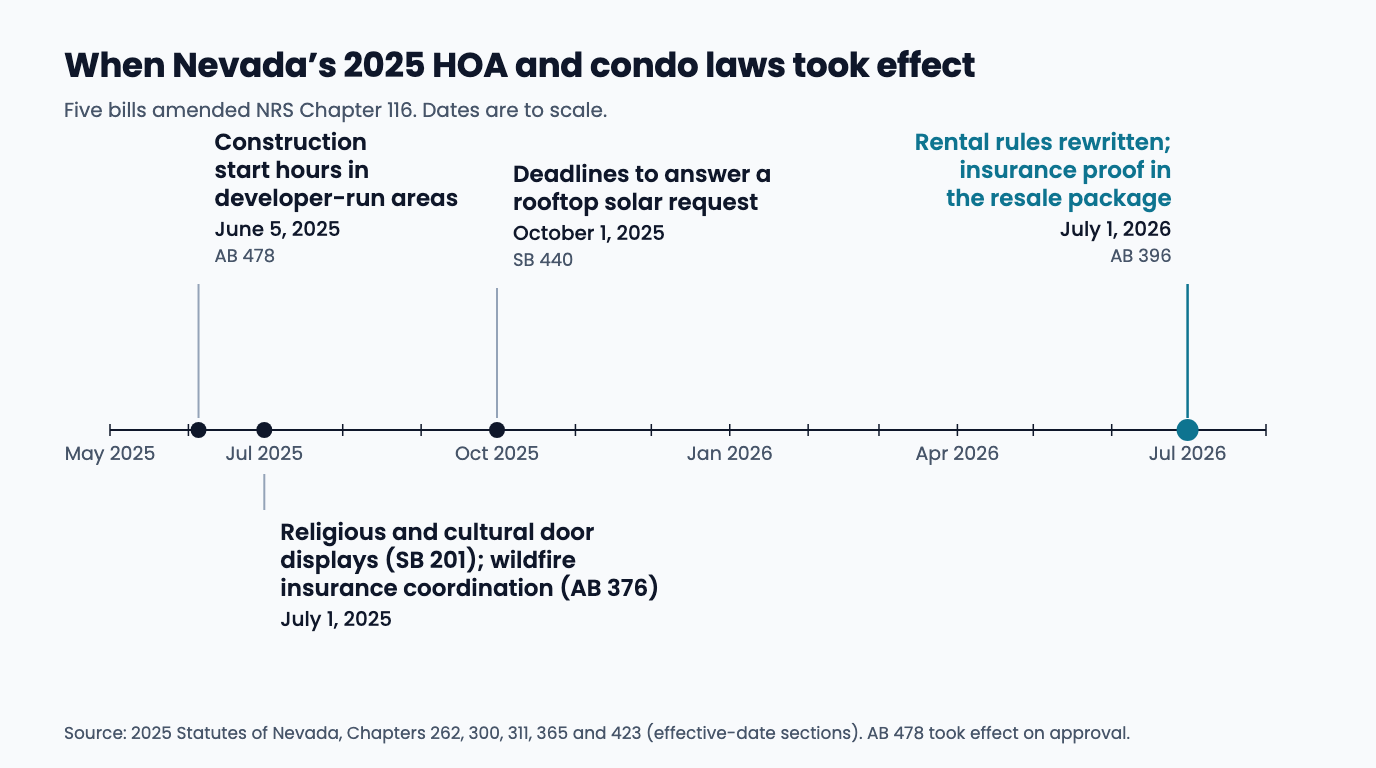
Five 2025 bills changed NRS 116. The rental rewrite and the insurance proof in resale packages took effect July 1, 2026.
These are the five 2025 bills that amended NRS Chapter 116, and no 2026 law has changed it since. Each row below comes from the bill as printed in the 2025 Statutes of Nevada, including the date it took effect.
| Bill | What it changed for owners and buyers | In effect |
|---|---|---|
| AB 396 (Chapter 365) | Rewrote the rental section (NRS 116.335); lets owners amend the declaration to limit leasing for lender or insurer requirements (116.2117); adds insurance proof to the resale package (116.4109); requires a vote to dissolve the community to include 80% of the votes of units the developer does not own (116.2118); raises the most the state Commission for Common-Interest Communities and Condominium Hotels can fine per violation from $1,000 to $5,000 (116.785) | July 1, 2026 |
| SB 201 (Chapter 300) | Protects religious and cultural displays on a unit's entry door or frame, with size and safety limits (new NRS 116.323) | July 1, 2025 |
| AB 376 (Chapter 423) | Lets an association's wildfire property coverage coordinate with owners' own wildfire policies instead of including the units (NRS 116.3113) | July 1, 2025 |
| AB 478 (Chapter 311) | Extends the construction-hours rule for developer-run communities from Clark County to any county or city with a local hours ordinance (NRS 116.347) | On approval, June 5, 2025 |
| SB 440 (Chapter 262) | Sets deadlines for an association to answer an owner's rooftop solar request (new NRS 116.333 and 116.334) | October 1, 2025 |
AB 396 also told Nevada's larger counties and cities to allow accessory dwelling units by July 1, 2026. That part of the bill is a local zoning rule, and its text does not mention associations, so whether your CC&Rs allow a second unit is a separate question for the declaration and an attorney.
Planning to Rent the Unit? Read the New Rental Rule First
The board can now limit renting by rule only if the declaration allows limits or sets a cap, and only as far as lender or insurer rules require.
Before July 1, 2026, Nevada protected an owner according to what the declaration said on the day they bought. If it did not prohibit renting then, the association could not ban it later. It also could not add an approval step that was not in the declaration at purchase, or charge a fee to register a tenant. AB 396 struck those sentences from NRS 116.335, along with the rule that a declaration's rental cap could not be amended downward.
The section now works this way. If the declaration authorizes the association to restrict renting, or sets a maximum number or percentage of rented units, the board may adopt rental rules "to the extent that the restriction is reasonably related to meet underwriting requirements" of mortgage lenders, or of insurers that cover associations or units. If the declaration says neither, this section does not give the board that power. The section also keeps the association able to enforce rental rules found in state or local law, including local limits on short-term rentals.
The owner vote that can reach current owners
AB 396 also added a new route through the declaration itself. Under NRS 116.2117(9), owners can amend the declaration to restrict leasing "to the extent that the restriction is reasonably designed to meet underwriting requirements" of the same lenders and insurers.
Nevada still shields an owner from a later amendment that limits how a unit can be used, as long as they keep owning it. The 2026 text now opens that shield with "Except as otherwise provided in subsection 9." Read together, a leasing amendment adopted for lender or insurer reasons appears able to apply to owners who bought before it passed. How it applies to a given unit is a question for a Nevada real estate attorney.
What the 2026 text kept
- A hardship waiver. If a rental cap is full, an owner can ask the board to waive it for economic hardship. The board "may" grant it; nothing requires it to.
- Developer units do not count toward the cap. Units the developer still owns are left out when the association works out whether the cap is reached.
- Short-term rentals in HOAs have their own test. In a planned community whose declaration limits units to residential use, NRS 116.340 allows a short-term ("transient commercial") rental only if the governing documents do not prohibit it, the board approves it, and the unit is zoned and licensed for it. That section covers planned communities, not condos.
The Resale Package Now Shows the Insurance
The seller must hand over a resale package. Since July 1, 2026 it includes proof of the insurance the association has to carry.
On a resale, the seller (at the seller's expense) gives you a resale package under NRS 116.4109. The association has 10 calendar days after the seller's written request to supply its part. The package must include:
- The declaration, bylaws, rules and the state information statement
- The monthly assessment and any unpaid amount the seller owes, including fines, interest, collection costs and attorney's fees
- The current budget and year-to-date financial statement, with a summary of the reserves
- Any unsatisfied judgments or pending lawsuits against the association
- Transfer fees and other resale fees, plus a list of current and expected charges for the unit
- New since July 1, 2026: proof of the insurance policies the association is required to carry under NRS 116.3113
The insurance item pairs with a 2025 change. Under AB 376, an association's wildfire property coverage no longer has to include the units themselves if it coordinates with the owners' own wildfire policies. If the proof shows that kind of arrangement, your own policy may be the one covering the unit against wildfire, so take the proof to your insurance agent before day five.
Your five days, and what the package protects
- Cancel in writing until midnight of the fifth calendar day after you receive the package, by hand delivery, mail or electronic transmission to the seller or the seller's agent. All payments are refunded. The right ends once you accept the deed.
- You are not liable for more than the package shows. A buyer owes no unpaid assessment or fee above the amount in the association's certificate. If the association misses its 10-day deadline, the buyer is not liable for the delinquent assessment.
- The package is good for 90 calendar days. A closing that slips past that may need a fresh one.
- You can ask to see the entire reserve study and inspect, copy and audit it.
Some sales need no resale package, including foreclosure sales and some planned communities of 12 or fewer units (NRS 116.4101). If you are buying at foreclosure or in a very small HOA, ask early whether you will get one at all. Our guide to getting HOA documents before an offer compares Nevada's timeline with other states.
Check Your Building's Financial Health
Upload your HOA's reserve study and get instant analysis of percent funded, deferred maintenance, and special assessment risk. Free. No signup required.
Your first full property report is also free. See what you'll get →
Or get your first full report free →What the Association Can Charge for the Paperwork
The base caps are $185 for the certificate and $165 for a payoff statement, plus $100 to rush. Each may rise up to 3% a year.
Nevada's statute puts dollar caps on both documents. The certificate fee is charged to the seller, and it must be based on what the association actually spends to prepare it.
| Document | Base cap in the statute | Rush (under 3 business days) | Deadline |
|---|---|---|---|
| Resale certificate (116.4109(4)) | $185 | up to $100 more | 10 calendar days |
| Statement of demand, the payoff figure (116.4109(7)) | $165 | up to $100 more | 10 calendar days |
Both base caps can rise each year by the increase in the Consumer Price Index, but by no more than 3 percent a year. The statute does not print the adjusted figure, so the cap in force today can be higher than $185 or $165. Ask the association for its current fee and how it got there instead of relying on a number from a website, including this one.
Apart from the certificate and rush fees, and a per-page charge for paper copies when a document is not available electronically, the association may not charge the seller other fees for preparing or furnishing the package documents. Transfer fees are a separate line, and the package has to list them. For the wider picture, see our post on HOA transfer fees.
Door Displays, Rooftop Solar and Construction Hours
Three 2025 laws limit what an HOA can stop: door displays, rooftop solar requests left unanswered, and some summer construction-hour limits.
Religious and cultural door displays (SB 201)
Since July 1, 2025, NRS 116.323 bars an association, or an owner renting out a unit, from prohibiting a religious or cultural display on the part of the property an owner or occupant uses exclusively. The protection has limits. It does not cover a display larger than what the statute calls "36 by 12 square inches" or larger than the door, one that blocks the door from opening or closing, threatens health or safety, or breaks other law, among other limits. The association can still set reasonable rules on placement. For door repairs it can take the display down after 7 days' written notice (except in an emergency), and the occupant can put it back within 72 hours after the work is done.
Rooftop solar requests (SB 440)
Since October 1, 2025, an owner in an association with architectural control can ask to install a solar system on the part of the property they use exclusively. If the association has adopted solar rules, it must approve or deny within 35 days, with written reasons for a denial, or the request is treated as approved. A corrected resubmission gets an answer within 15 days. An association with no solar rules must approve within 15 days and cannot attach conditions (NRS 116.333). If you are buying a home with panels, ask for the approval letter.
Construction hours in developer-run communities (AB 478)
In a community the developer still controls, where the city or county has a construction-hours ordinance, the board and the governing documents cannot restrict the start of construction work from April 1 to September 30 to hours other than the ones in that local ordinance (NRS 116.347). The rule covered only Clark County before 2025 and now reaches any county or city with such an ordinance. If you are buying in a new phase of a large development, ask the developer which hours apply to the lots still being built around you.
The Nine Months of Dues That Can Outrank a Mortgage
Up to 9 months of unpaid dues can take priority over a first mortgage in Nevada, so the payoff statement needs to be right.
Nevada gives an association lien priority over a first mortgage for up to 9 months of assessments before a foreclosure notice is recorded, plus certain capped collection costs, or a shorter period if Fannie Mae or Freddie Mac rules require one (NRS 116.3116). This rule did not change in 2025. The statement of demand is the document that shows the payoff, and the seller, the seller's agent or the lender can request it.
In an ordinary resale, the buyer is not liable above the association's certificate amount, so the risk sits in the payoff. If you are buying a bank-owned or foreclosed unit, the history is longer. Our guide to buying a foreclosure condo covers it, including Nevada's 2014 court ruling.
Questions to Ask Before Your Five Days Run Out
Five questions cover the 2026 changes: rental rules, the insurance proof, unpaid amounts, the reserve study and pending owner votes.
- To the association: Does the declaration allow rental limits or set a rental cap, and has the board adopted any rental rule since July 1, 2026? Which lender or insurer requirement does it cite?
- To the association: Are owners voting on any declaration amendment about leasing or use?
- To your insurance agent: Does the association's insurance proof cover the units, or does it coordinate with an owner's own wildfire policy?
- To the title company: Does the statement of demand match the unpaid amounts in the certificate, and is the package still inside its 90 days?
- To the association: May we inspect the full reserve study, as the statute allows?
Our free CC&R analysis tool pulls the rental and use provisions out of the declaration, and the reserve study tool reads the funding level. For anything about how the 2026 rental rules apply to a specific unit, talk to a Nevada real estate attorney before your cancellation window closes.
Frequently Asked Questions
Can a Nevada HOA ban rentals after I buy?
Since July 1, 2026, the board can limit renting by rule only if the declaration allows rental limits or sets a cap, and only as far as lender or insurer underwriting requires. Owners can also amend the declaration to limit leasing for those reasons, and that kind of amendment appears able to reach current owners. Ask a Nevada attorney how it applies to your unit.
How long do I have to cancel after getting the resale package in Nevada?
Until midnight of the fifth calendar day after you receive it. The notice has to be in writing, by hand delivery, mail or electronic transmission to the seller or the seller's agent, and your payments are refunded. The right ends once you accept the deed.
How much can a Nevada HOA charge for a resale certificate?
The statute sets a base cap of $185, plus up to $100 for delivery in under 3 business days. The cap can rise each year with inflation, by no more than 3 percent, so ask the association for its current figure. The fee is charged to the seller.
What changed in Nevada HOA law in 2025 and 2026?
AB 396 rewrote the rental rules and added insurance proof to resale packages (July 1, 2026). SB 201 protects religious and cultural door displays (July 1, 2025), SB 440 sets deadlines for solar requests (October 1, 2025), and AB 478 and AB 376 changed construction-hour and wildfire insurance rules.
Am I responsible for the seller's unpaid HOA dues in Nevada?
Not above the amount in the association's certificate. If the association misses its 10-day deadline to provide the documents, the buyer is not liable for the delinquent assessment. Separately, up to 9 months of dues can take priority over a first mortgage, which is why the payoff statement matters at closing.
Check the Rental Rules Before Day Five
Upload the declaration or reserve study and see the rental and use limits, the funding level and the red flags, each linked to the page it came from.
Related Articles
Sources & References
- NRS Chapter 116, Common-Interest Ownership (sections 116.2117, 116.2118, 116.3113, 116.3116, 116.323, 116.333, 116.334, 116.335, 116.340, 116.347, 116.4101, 116.4109, 116.785)
- 2025 Statutes of Nevada, Chapter 365 (AB 396) (approved June 6, 2025; association sections effective July 1, 2026)
- 2025 Statutes of Nevada, Chapters 300 (SB 201) and 311 (AB 478)
- 2025 Statutes of Nevada, Chapter 262 (SB 440)
- 2025 Statutes of Nevada, Chapter 423 (AB 376)
- Nevada Department of Business and Industry: homeowners association complaints
Disclaimer: This article is for educational purposes only and does not constitute legal, financial, or real estate advice. It covers Nevada law only. Which rules apply depends on your community's declaration, whether it is a condo or a planned community, and the date a rule took effect, and the Legislature can change these rules in its 2027 session. Consult a qualified Nevada real estate attorney for guidance specific to your situation.