

In This Guide
The rules about your dog, your cars and your neighbors' noise sit in the declaration, the bylaws and the board's own rules, and in some buildings the board can change its rules without a vote of owners, so read all three before you make an offer.
Suppose you are about to buy a condo with a medium-sized dog and two cars, and you plan to replace the bedroom carpet with wood floors. The listing shows a price and a monthly fee. It does not show whether the building caps a dog's weight, whether the second car has anywhere to go, or whether the new floor needs the board's written approval first. Those answers are in rules that most buyers never open before closing.
This guide shows where pet, parking and noise rules are written, what four published sets of rules and one sample set actually say, where a state statute limits what a rule can do, how fines and hearings work, and which questions to ask before you commit. The quotes show what rules can say in four buildings and one sample set. Your building's own documents decide which of these terms apply to you.
Where Daily-Life Rules Are Written
Pet, parking and noise terms can sit in the declaration, the bylaws or the board's rules, so a buyer who reads one document can miss a limit.
A community's governing documents come in layers. The declaration is the recorded document that creates the community and sets its basic restrictions; Florida's condominium statute calls it "the instrument or instruments by which a condominium is created" (Fla. Stat. 718.103). The bylaws are the association's operating rules. The rules and regulations are the detailed day-to-day rules the board adopts. A pet limit might be in the declaration, a guest-parking rule in the rules and regulations, and a quiet-hours schedule in either. The Versailles Condominiums rules, for example, say they apply together with the declaration, the bylaws and Colorado's common interest ownership act, which is a reminder that a rules document is one piece of a set (Versailles Condominiums Rules & Regulations).
Rules also differ in how easily they change. The same Versailles document says its rules stay in effect "until otherwise rescinded, modified, or amended by a majority of the Board of Directors" (Versailles Condominiums Rules & Regulations). A declaration is changed by an amendment, and our guide to the HOA amendment process explains how owners vote on one. A buyer who reads only the declaration can miss a board rule adopted last year.
Pet Rules: What to Look For
Pet rules can set weight and number limits, require registration and fees, and let the board demand removal of an animal, so read them first.
Pet rules are where buildings differ most. The 9th Fairway Condominium rules say "No pet may exceed the weight limit of 24 pounds," require "written certification from a licensed veterinarian verifying the pet's weight and verifying that the pet is current on all vaccinations required by law," and set "No more than 2 pets (including those of visiting guests)" for a unit. The same rules say that if the board finds a pet has become a nuisance or an unreasonable source of annoyance, "the Board of Directors may demand that the pet be permanently removed" (9th Fairway Rules and Regulations, approved October 18, 2021).
Versailles takes a different approach. Its rules say "Residents must register their pet by submitting a completed Pet Registration and Agreement Form," charge dog owners "a one-time non-refundable fee per dog," listed as "Dog Ownership Fee: $150 per dog," and say "No person shall keep an animal which by frequent or habitual howling, yelping, barking or making other noises annoys or disturbs another Resident or guest" (Versailles Condominiums Rules & Regulations). A fee and a registration form are easy to miss in a packet, and they are easy to ask about.
A published sample of pet rules from the Lotus Homeowners Association, dated June 5, 2019 with its effective date left blank, shows a term a buyer might not expect. It says the board "reserves the right to declare after further study and review that such breeds of dogs shall not be permitted to be kept on the Property," so a breed list can grow after you move in, and it requires that a registration form "be completed without delay by any Occupant desiring to keep a dog or cat on the Property" (Lotus Homeowners Association, Rules for Keeping Pets). Because the effective date is blank, treat it as a sample of how pet rules are worded.
A state statute can limit a pet clause. In California, "No governing documents shall prohibit the owner of a separate interest within a common interest development from keeping at least one pet within the common interest development, subject to reasonable rules and regulations of the association" (a common interest development is California's legal term for a condo or HOA community) (Cal. Civ. Code 4715(a)). A "separate interest" is the part you own yourself, such as your unit. The section applies to California common interest developments and to governing documents entered into, amended or modified on or after January 1, 2001. We opened only California's version, so whether your state has a similar rule is a question for a real estate attorney.
Assistance Animals: What Is Current
A no-pets rule can still meet a disability-related request, and HUD's 2025 and 2026 changes mean many older articles are out of date.
Federal fair housing law treats a refusal to make a reasonable accommodation, meaning an exception to a rule that a person with a disability needs to use and enjoy a home equally, as discrimination. The statute says discrimination includes "a refusal to make reasonable accommodations in rules, policies, practices, or services, when such accommodations may be necessary to afford such person equal opportunity to use and enjoy a dwelling" (42 U.S.C. 3604(f)(3)(B)).
What HUD says about animals has changed. HUD's fair housing office withdrew its 2013 and 2020 assistance-animal notices, with an effective date of September 17, 2025. On May 22, 2026, a HUD enforcement memo said that, effective immediately, for animal-related accommodation complaints the office "will find reasonable cause and recommend charges only for those cases involving animals trained to provide disability-related assistance." That memo sets which complaints HUD will pursue, and it does not amend the statute quoted above. Our guide to unenforceable HOA provisions walks through this area, so this guide does not repeat it.
Parking: Your Space, Guests and Towing
Parking rules say which space is yours, whether guests can park, and what happens to a car left in the wrong place, so find the guest rule first.
A parking space can be reserved for one unit in the declaration, which fits what Florida's condominium statute calls a limited common element: "those common elements which are reserved for the use of a certain unit or units to the exclusion of all other units, as specified in the declaration" (Fla. Stat. 718.103). In plain terms, the declaration can say a space is yours and no one else's. Florida also limits what a board can do to that space as a penalty: the statute's paragraph letting an association suspend an owner's right to use common areas "does not apply to" several things, including "parking spaces" (Fla. Stat. 718.303(3)(a)). That is a Florida condominium rule, and other states differ.
Published rules show how much the details vary. Versailles says "Residents may park only in their designated spaces," that "Guest vehicle parking is not available at The Versailles," and that a resident who finds an unauthorized vehicle in a space "may call the designated towing company to have that vehicle immediately towed at the vehicle owner's expense" (Versailles Condominiums Rules & Regulations). The same rules say "No recreational or other vehicle that interferes with parking or impedes normal traffic may be parked in the garage or on the parking deck." Oxford Square takes a decal approach: "Anyone who lives at Oxford Square and has a vehicle must have a parking decal," "Frequent visitors and guests staying with a resident for more than a week must obtain a 'Guest Decal' for their vehicle," and "Vehicle violations are subject to fines and/or towing at owner's expense" (Oxford Square Rules and Regulations).
We did not open a towing statute for this guide. Whether a towing rule is valid where you live depends on your documents, state law and local law, so ask the association for its towing policy in writing.
Noise, Quiet Hours and Flooring
Quiet hours, a noise rule and flooring approval decide how loud a building can be, and some rules require sound underlayment under hard floors.
Quiet hours are written as a schedule. Versailles lists building-wide quiet hours of 10:00 PM to 8:00 AM Sunday through Thursday, 11:00 PM to 8:00 AM on Friday, and 11:00 PM to 9:00 AM on Saturday (Versailles Condominiums Rules & Regulations). The St. Augustine Ocean & Racquet Club rules say "Excessive noise between the hours of 10:00 pm and 7:00 am will be considered a more serious violation and may result in a fine or immediate removal from the property" (Ocean & Racquet Club Rules and Regulations, adopted April 7, 2022). Other rules use a general standard instead of a clock. The 9th Fairway rules say "Residents of a Unit may not unreasonably infringe on the 'peaceful enjoyment' of another resident with unreasonable, loud, disruptive, or prolonged noises" (9th Fairway Rules and Regulations, approved October 18, 2021).
Flooring is where a noise rule meets your renovation plans. At 9th Fairway, "Any Owner wishing to install hard surface flooring (anything other than carpet), is required to use a sound proofing underlayment with an STR (Sound Transmission Rating) of 60 or higher," and an owner who installs flooring before written approval "will be solely responsible for restoring the flooring to its original state" (9th Fairway Rules and Regulations, approved October 18, 2021). Oxford Square says "unit owners must obtain written approval from the Association prior to installing any flooring material (including but not limited to ceramic tile, marble, wood, etc)" (Oxford Square Rules and Regulations), and Ocean & Racquet says "All hard surface flooring is required to have an underlayment of sound attenuation material" (Ocean & Racquet Club Rules and Regulations, adopted April 7, 2022). A buyer who plans to tear out carpet can find out the approval steps before closing.
How Rules Are Enforced: Fines and Hearings
Florida and Minnesota statutes set fine limits, and the published rules quoted here promise notice and a hearing, so ask for the fine schedule.
In a Florida condominium, the statute says the association "may levy reasonable fines" but that "the fine may not exceed $100 per violation, or $1,000 in the aggregate," and that "A fine may not become a lien against a unit." A fine also cannot be imposed "unless the board first provides at least 14 days' written notice" and "an opportunity for a hearing before a committee of at least three members appointed by the board who are not officers, directors, or employees of the association" (Fla. Stat. 718.303(3)). A lien is a legal claim against the unit for money owed, which is why the statute's limit on fines becoming one matters to a buyer.
If you are buying in a Minnesota condo or HOA after January 1, 2027, the board's default fine for a single violation is capped at $100, unless owners holding a majority of the votes approve a higher amount, and the cap has four exceptions listed below. If the property is in Minnesota, ask whether the association has adopted a higher fine with owner approval. Minnesota changed its fine rule in 2026. Under a law that takes effect January 1, 2027, an association may, "unless, at a board meeting, a greater amount is approved by owners of units to which a majority of the votes in the association are allocated, impose a fine not to exceed $100 for a single violation of the declaration, bylaws, and rules and regulations," with exceptions for a subsequent violation of the same conduct, a serious and immediate health or safety impact, physical damage to another unit or a common element, and using the property for financial enrichment, including renting a unit in violation of the documents. The text says the section "is effective January 1, 2027, and applies to action taken by an association on or after that date" (2026 Minnesota Laws chapter 82, section 3).
Associations also describe their own process. The Lotus sample gives a pet owner "a reasonable period of time but not less than three days" to correct a violation after notice, lets the owner ask for a hearing "within five days after the notice of violation was given," and sets that hearing "not less than fifteen nor more than thirty days following the date that the request for a hearing was given to the Board" (Lotus Homeowners Association, Rules for Keeping Pets). Versailles says only that "All fines will be levied according to the enforcement and fine policy adopted by the Board" (Versailles Condominiums Rules & Regulations), which means the amounts are in a separate document a buyer has to ask for.
What Can Change After You Buy
A rule that fits your life today can change after closing, so ask what changed recently and whether existing pets or cars would be protected.
State law decides how a board changes its rules, and it varies. California is one scoped example. It requires the board to give general notice of a proposed rule change "at least 28 days before making the rule change," with an exception for an emergency rule change made to address "an imminent threat to public health or safety or imminent risk of substantial economic loss" (Cal. Civ. Code 4360). It also lets "Members of an association owning 5 percent or more of the separate interests" call a special vote to reverse a rule change, with the written request due no more than 30 days after the association gives general notice of the change (Cal. Civ. Code 4365). Other states have different notice and reversal rules, and some have none that we opened.
Existing pets can be protected from a new limit. California's pet section says that if an association restricts the number of pets, the new rule "shall not apply to prohibit an owner from continuing to keep any pet that the owner currently keeps" if the pet conformed to the earlier rules (Cal. Civ. Code 4715(c)). That protection comes from a California statute and may not exist where you are buying. Changing the declaration itself is a different and slower step, covered in our guide to reading CC&R amendments before you vote.
The Documents and Questions to Take Into the Offer
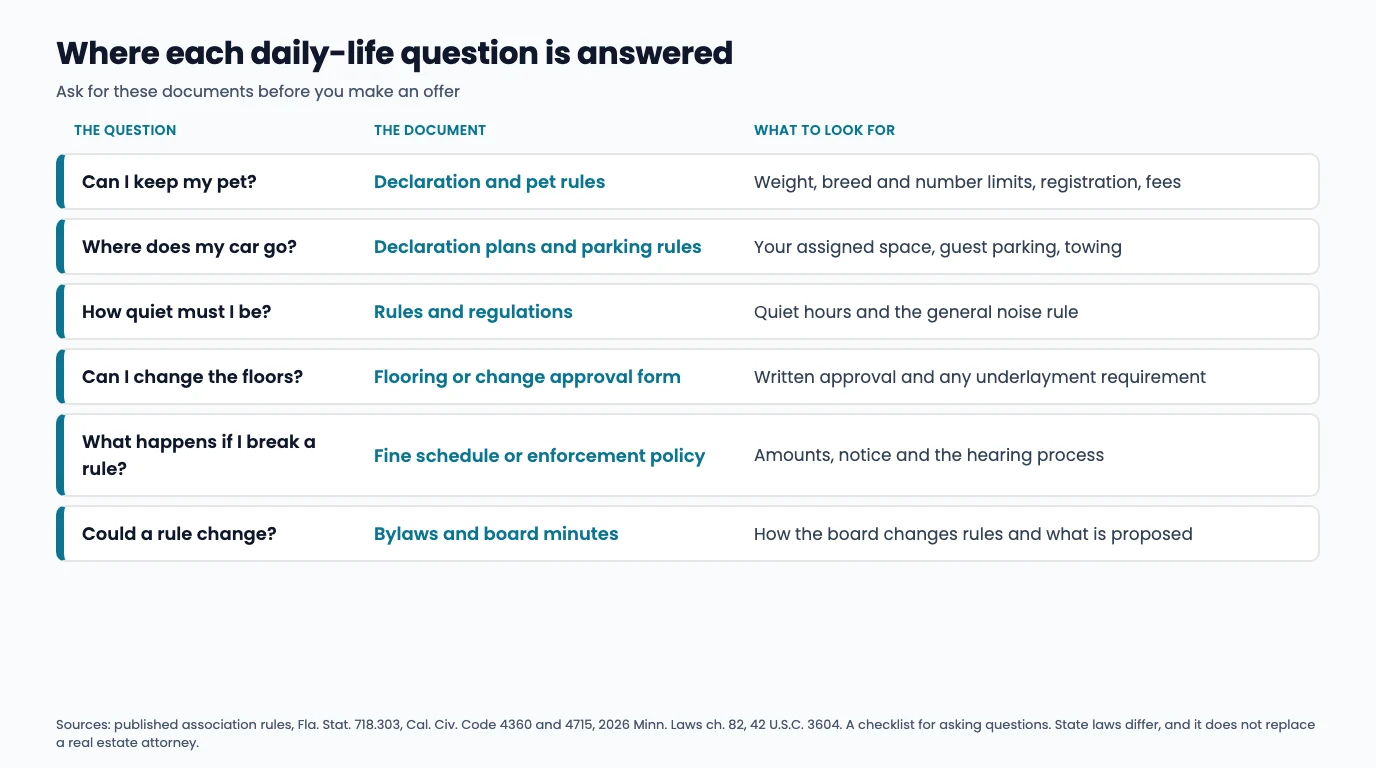
Eight documents and a short list of questions show whether your pets, cars and plans fit the building before you commit to it.
Send this list to the listing agent. Our guide to reviewing HOA documents before you buy covers the rest of the packet, and our post on whether an HOA can ban rentals after you buy covers a rule that matters if you might rent the unit out later.
- The declaration, for pet, parking and use restrictions and the exhibit that shows your space
- The bylaws, for how the board adopts and changes rules
- The current rules and regulations, with the date each rule was adopted
- The fine schedule or enforcement policy, and the hearing process
- The pet registration form and the fee schedule
- The flooring or architectural change form, if you plan renovations
- The parking plan, guest parking rule and towing policy
- The last two or three years of board minutes, for fines, complaints and rule changes
Then put these questions to the association or the listing agent, and ask for the answers in writing:
- Which parking space belongs to the unit, and where do the documents show it?
- Can guests park, for how long, and is a permit needed?
- What are the pet limits, registration steps and fees?
- What are the quiet hours, and what does the flooring rule require?
- What are the fines, and does an owner get notice and a hearing first?
- Has any of these rules changed in the last two years, or is a change proposed?
A GoverningDocs report reads that packet and lists each finding with the page it came from. It costs $39 per property, and it works as a first step before an attorney and does not replace one. A typical attorney review of the same documents costs between $300 and $1,500 (what an attorney review costs). For a question about your own contract or your state's law, ask a real estate attorney.
Frequently Asked Questions
Can an HOA limit how many pets I have or how big they are?
Some associations do. The 9th Fairway rules cap a pet at 24 pounds and a unit at two pets, including visitors' pets. A state statute can limit a pet clause too: California says governing documents may not prohibit keeping at least one pet, subject to reasonable rules. Which limits apply to you depends on your documents and your state's law.
Do I have to register my pet or pay a pet fee?
Some rules require it. Versailles requires a pet registration form and a one-time fee of $150 per dog, and the Lotus sample rules require a registration form for a dog or cat. Ask for the registration form and the fee schedule before you buy.
Can the HOA tow my guest's car?
Some rules say so. Versailles says an unauthorized vehicle in a resident's space can be towed at the owner's expense, and Oxford Square says vehicle violations are subject to fines and towing. Whether a towing rule is valid depends on your documents, state law and local law, and this guide did not research a towing statute, so ask for the association's towing policy in writing.
How loud is too loud in a condo?
The rules we quoted give no decibel number. Versailles sets quiet hours by clock time, Ocean & Racquet treats excessive noise between 10:00 pm and 7:00 am as a more serious violation, and 9th Fairway bars noises that unreasonably infringe on a neighbor's peaceful enjoyment. Ask for the quiet-hours schedule and the noise rule in your building's documents.
Can I put hard flooring in a condo?
Some associations require approval first and sound underlayment under hard floors. 9th Fairway requires an underlayment rated STR 60 or higher and written approval, Oxford Square requires written approval before any flooring is installed, and Ocean & Racquet requires a sound attenuation underlayment. Ask for the flooring rule and its approval form before you plan a renovation.
Can an HOA fine me without a hearing?
In a Florida condominium, the statute says a fine may not be imposed unless the board first gives at least 14 days' written notice and an opportunity for a hearing before a committee of at least three members who are not officers, directors or employees. Other states and other kinds of associations have different rules. The Lotus sample describes notice followed by a hearing, so ask for your association's enforcement policy.
Get Your CC&Rs Analyzed
Upload your HOA's CC&Rs and get instant analysis of rental restrictions, pet policies, financing red flags, and more. Free. No signup required.
Your first full property report is also free. See what you'll get →
Or get your first full report free →Related Articles
Sources & References
- 42 U.S.C. 3604 (Fair Housing Act, discrimination in sale or rental) (2023 Code edition, subsection (f)(3)(B))
- HUD: Notification of Withdrawal of Fair Housing and Equal Opportunity Guidance Documents (Docket FR-6571-N-01, scheduled for Federal Register publication April 6, 2026; effective date of withdrawal September 17, 2025)
- HUD: Enforcement Guidance, Assessing Requests for the Use of an Animal as a Reasonable Accommodation (memorandum dated May 22, 2026)
- California Civil Code 4715 (pets in common interest developments) (used as a scoped example)
- California Civil Code 4360 (rule change notice) and 4365 (reversing a rule change)
- Florida Statutes, section 718.303 (obligations of owners; fines and suspensions) and 718.103 (definitions)
- 2026 Minnesota Laws chapter 82 (section 3 amends Minn. Stat. 515B.3-102; effective January 1, 2027)
- Versailles Condominiums Homeowners Association Rules & Regulations (published rules of one association; quoted as an example)
- 9th Fairway Condominium at Green Dolphin Park, Inc., Rules and Regulations (approved October 18, 2021; quoted as an example)
- Oxford Square Condominium Association Inc Rules and Regulations (marked revised January 10, 2022; quoted as an example)
- St. Augustine Ocean & Racquet Club Condominium Association, Inc., Rules and Regulations (adopted April 7, 2022; quoted as an example)
- Lotus Homeowners Association, Rules for Keeping Pets (dated June 5, 2019, effective date left blank; quoted as a sample)
Disclaimer: This article is for educational purposes only and does not constitute legal, financial, or real estate advice. HOA and condominium laws differ by state; the California, Florida and Minnesota provisions are scoped examples, and the association rules quoted are one building's published rules as posted online, which may have changed since. HUD guidance on assistance animals changed in 2025 and 2026 and may change again. Consult a qualified real estate attorney for guidance specific to your situation.