
In This Guide
Before you vote on a California CC&R amendment, read the amendment text itself rather than the cover letter, confirm the association followed the secret-ballot and 30-day notice rules, check who the amendment binds and when, look for new fines or enforcement powers, and remember it is not effective until it is recorded with the county.
The envelope arrives with a cover letter, a ballot, and somewhere in the stack, the actual amendment. The letter explains what the board is trying to accomplish and why owners should support it. Most owners read that letter, decide it sounds reasonable enough, and mark the ballot.
The problem is that the cover letter is not what gets recorded against your title. The amendment text is. Once it passes and is recorded, it binds you, it binds the next buyer, and it binds the board that comes after this one. A summary that says the amendment "clarifies architectural standards" can sit on top of language that hands the board approval power over anything visible from the street. The two documents are not the same document, and only one of them is enforceable.
This guide walks through what to look for in the amendment itself before you cast a ballot, under California's Davis-Stirling Common Interest Development Act. If you want the underlying mechanics of how amendments pass, what thresholds apply, and whether an amendment can reach owners who bought earlier, that is covered separately in our guide to CC&R amendments and how they work.
1. What the Ballot Is Actually Asking You to Approve
You are voting on the exact amendment language, not the board's summary of it. Read the redline against the recorded declaration.
Ask for the amendment as it would be recorded, ideally as a redline showing what is being struck and what is being added. A summary compresses; a redline does not. The words that survive the vote are the words a court will read years from now, and California courts read them literally.
That literalism cuts in a direction owners often do not expect. In Ekstrom v. Marquesa at Monarch Beach Homeowners Association (168 Cal.App.4th 1111), the declaration required owners to keep trees below the height of the house unless the trees did not obstruct a neighbor's view, and the association was responsible for enforcing that provision. The board adopted a policy exempting all palm trees from it. The Court of Appeal rejected that, holding a board has no discretion to ignore the express requirements of the CC&Rs, and that a board interpretation inconsistent with the plain meaning of the document gets no judicial deference. (Ekstrom v. Marquesa at Monarch Beach HOA)
Read that as good news and as a warning. The text binds the board too, so a well-drafted amendment is a real constraint on future boards. But it also means an ambiguous or overbroad phrase is not something a friendly board can quietly decline to enforce later. Whatever the amendment says is what the association is stuck with.
Recorded restrictions also carry real weight once they are in place. Under Nahrstedt v. Lakeside Village Condominium Association (8 Cal.4th 361), use restrictions in a recorded declaration are presumed reasonable and are enforced unless they are arbitrary, impose burdens on the use of the affected land that substantially outweigh the benefits to residents, or violate a fundamental public policy. Reasonableness is judged against the development as a whole rather than the objecting owner's particular circumstances, and the burden of proof sits with the challenger. (Nahrstedt v. Lakeside Village) That presumption is exactly why the reading matters more at the ballot stage than after.
Practical questions to hold against the text: What behavior does this newly prohibit or require? Who decides whether someone has complied? Is any term left undefined? Does it create a cost, and who pays it?
2. Check the Procedure Before You Check the Politics
California requires a secret ballot, 30 days advance general notice, and an independent inspector of elections for amendment votes.
Davis-Stirling treats a governing-document amendment as an election, with the same procedural machinery as a board election. Civil Code §5100(a) provides that elections regarding assessments legally requiring a vote, election and removal of directors, amendments to the governing documents, and grants of exclusive use of common area shall be held by secret ballot.
Three procedural markers are worth confirming before you vote:
- Timing. The association must give general notice at least 30 days before the ballots are distributed, and that notice must include the date, time, and location of the meeting at which ballots will be counted (Civ. Code §5115).
- Who is counting. The inspector of elections may not be a director, a candidate for director, related to either, or a person or business currently employed or under contract to the association for other compensable services (Civ. Code §5110). The association's management company handling the count is the kind of arrangement that draws challenges.
- Ballot secrecy. The inspector receives the ballots and tabulates the votes. Where an association uses electronic voting, the system must permanently separate authenticating or identifying information from the ballot itself, so a vote cannot be traced back to the member who cast it (Civ. Code §5110).
Procedure sits separately from merits. A sensible amendment can still fail to bind anyone if the election behind it was defective, and that failure tends to surface late, when an owner tries to sell and a buyer's attorney reads the recorded documents.
3. Read for Scope: Who It Binds, and Starting When
Look for whether the amendment applies to everyone immediately or only to owners who buy afterward. The text should say.
A well-drafted amendment states its own reach. Does it apply to all owners on recording, or only prospectively to future buyers? Does it grandfather anyone currently doing the thing being restricted? Is there a phase-in period, and does the text actually fix a date rather than leaving it to the board?
California layers statutory protections on top of whatever the amendment says, and those protections vary by subject matter. Rental restrictions are the most developed example: Civil Code §4740 protects owners against rental prohibitions adopted after they took title. Because the rental rules and the general retroactivity question are their own topic, they are covered in depth in our CC&R amendment guide and in can an HOA ban rentals after you buy.
For the ballot in front of you, the useful move is narrower: find the sentence that says who is bound and when. If you cannot find that sentence, that absence is itself worth raising with the board before the vote closes.
4. Read for Enforcement Teeth
If an amendment creates fines or discipline, California still requires 10 days written notice and a hearing before the board imposes them.
Restrictions without consequences tend to be ignored, so amendments frequently arrive with an enforcement mechanism attached. Look for language creating monetary penalties, suspension of privileges, or a schedule of fines, and check whether the amendment sets the amounts or leaves them to a board-adopted policy.
An amendment cannot write around the statutory discipline procedure. Under Civil Code §5855, before a board may impose a monetary penalty or discipline a member for a governing-document violation, it must notify the member in writing at least 10 days before the meeting. That notice must state the date, time, and place of the meeting, the nature of the alleged violation, and that the member has a right to attend and address the board. The board must meet in executive session if the member requests it.
So an amendment that appears to authorize immediate fines still runs through §5855 in practice. What varies, and what is worth reading closely, is the fine schedule itself, whether penalties accrue daily, and whether the amendment shifts attorney's fees onto the owner in a dispute.
5. It Is Not Effective Until It Is Recorded
A California amendment takes effect only after member approval, written certification, and recording in each county where the development sits.
Civil Code §4270(a) sets out three steps. The amendment must be approved by the percentage of members the declaration requires, along with anyone else whose approval the declaration requires. That approval must be certified in a writing executed and acknowledged by the officer the declaration designates, or by the association's president if none is designated. And the amendment must be recorded in each county in which a portion of the development is located. Where the declaration specifies no percentage, §4270(b) allows approval by a majority of all members.
A passed-but-unrecorded amendment is a common loose end. If you are tracking whether an amendment took effect, the county recorder is the place that answers it, not the association newsletter.
A failed vote is also not always the end of the matter. Civil Code §4275 lets the association or any member petition the superior court to reduce the percentage of votes needed, where members holding more than 50 percent of the votes actually voted in favor. The court may grant the petition only on findings that include at least 15 days written notice to members and lenders, balloting conducted in accordance with the governing documents, a reasonably diligent effort to let all eligible members vote, and that the amendment is reasonable. An amendment that falls short of a steep supermajority can still be confirmed by a court on that record.
6. If the Election Was Run Wrong
California law gives members a civil remedy for election violations, with a one-year window and a penalty of up to $500 per violation.
Suppose the notice never arrived, or the inspector was the association's own vendor, or ballots were counted somewhere other than the noticed meeting. Civil Code §5145 provides that a member may bring a civil action for declaratory or equitable relief for a violation of the election article, including injunctive relief and restitution.
The provision has a few features worth knowing about in general terms:
- The action must be brought within one year of the date the inspector notifies the board and membership of the election results, or the date the cause of action accrues, whichever is later.
- A court may impose a civil penalty of up to $500 for each violation, though identical violations affecting all members equally count as a single penalty.
- A member who prevails is entitled to reasonable attorney's fees and court costs, and the action may be brought in superior court or in small claims court where the amount fits that court's jurisdiction.
Whether any of that applies to a particular election is a legal question that turns on facts this article cannot evaluate. If you think an amendment vote in your association was conducted improperly, talk to a California community-association attorney, and do it early, because the one-year period runs from the results notification.
The Short Version
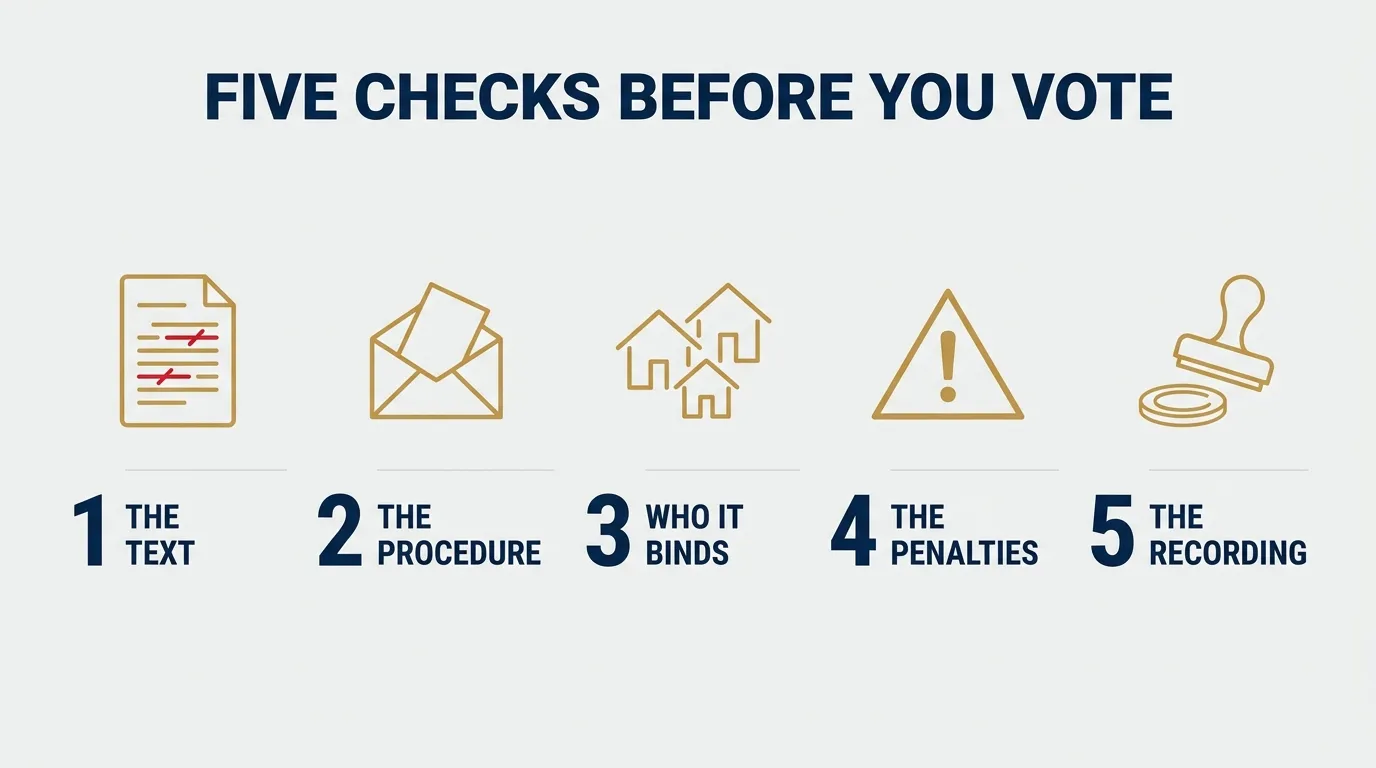
Get the redline, confirm the notice and secret-ballot procedure, find who it binds, look for fines, and verify recording afterward.
An amendment ballot is one of the few moments when an individual owner has direct leverage over the document that governs their property. The board drafted the language, but the members approve it, and once recorded it outlasts everyone currently involved.
Five things to do before the ballot goes back: request the amendment as a redline against the recorded declaration; confirm you received general notice at least 30 days before ballots went out, with the counting meeting identified; find the sentence stating who the amendment binds and when; check whether it creates fines and on what schedule; and after the vote, verify with the county recorder that what passed was actually recorded.
Frequently Asked Questions
Does the board's summary letter count as the amendment?
No. What gets recorded against title and enforced later is the amendment text, not the cover letter describing it. Request the amendment as it would be recorded, ideally as a redline showing additions and deletions against the current declaration. California courts read the recorded language literally, and in Ekstrom v. Marquesa at Monarch Beach (2008) the Court of Appeal held a board has no discretion to ignore the express requirements of the CC&Rs.
How much notice does a California association have to give before an amendment vote?
Civil Code §5115 requires general notice at least 30 days before the ballots are distributed, and that notice must include the date, time, and location of the meeting at which ballots will be counted. Amendments to governing documents must also be held by secret ballot under Civil Code §5100(a).
Who is allowed to count the ballots?
Under Civil Code §5110, the inspector of elections cannot be a director, a candidate for director, or someone related to either. The inspector also cannot be a person or business currently employed or under contract to the association for other compensable services. The inspector receives the ballots and tabulates the votes, and electronic voting systems must permanently separate identifying information from the ballot itself.
When does a CC&R amendment actually take effect in California?
Under Civil Code §4270, an amendment is effective after three steps: approval by the percentage of members the declaration requires, certification in a writing executed and acknowledged by the designated officer or the association president, and recording in each county where a portion of the development is located. If the declaration specifies no percentage, a majority of all members may approve it.
Can the board fine me under a brand-new amendment right away?
An amendment does not bypass the statutory discipline procedure. Civil Code §5855 requires the board to notify the member in writing at least 10 days before the meeting, stating the date, time, and place, the nature of the alleged violation, and the member's right to attend and address the board. The board must meet in executive session if the member requests it. Whether a specific fine is proper is a question for a California attorney.
Get Your HOA Documents Analyzed
GoverningDocs analyzes CC&Rs, reserve studies, and meeting minutes, identifying red flags, restrictions, and financial risks so you can buy with confidence. Free. No signup required.
Your first full property report is also free. See what you'll get →
Or get your first full report free →Related Articles
Sources & References
- Cal. Civ. Code §5100 (secret ballot required for amendments to the governing documents)
- Cal. Civ. Code §5110 (inspector of elections independence, ballot custody, electronic ballot separation)
- Cal. Civ. Code §5115 (30-day general notice before ballots are distributed; counting meeting details)
- Cal. Civ. Code §5145 (member civil action, one-year period, civil penalty up to $500, attorney's fees)
- Cal. Civ. Code §4270 (approval, certification, and recording requirements for amendments)
- Cal. Civ. Code §4275 (petition to reduce the required approval percentage)
- Cal. Civ. Code §5855 (10-day notice and hearing before monetary penalty or discipline)
- Cal. Civ. Code §4740 (protection against rental prohibitions adopted after an owner takes title)
- Ekstrom v. Marquesa at Monarch Beach HOA, 168 Cal.App.4th 1111 (2008) (a board may not ignore express CC&R requirements; no deference to an interpretation contrary to plain meaning)
- Nahrstedt v. Lakeside Village Condominium Ass'n, 8 Cal.4th 361 (1994) (recorded use restrictions are presumed reasonable unless arbitrary, substantially more burdensome than beneficial, or contrary to fundamental public policy)
Disclaimer: This article is for educational purposes only and does not constitute legal, financial, or real estate advice. It describes California's Davis-Stirling Act in general terms; amendment procedures, election requirements, and enforcement rules vary by community and change over time, and other states follow different rules entirely. Whether a particular amendment or election is valid depends on facts this article cannot evaluate. Citations are current as of July 2026 and may be superseded. Read your community's actual recorded declaration and consult a qualified California community-association attorney for guidance specific to your situation.