

In This Guide
Many community associations restrict short-term rentals, yet a generic "residential use only" clause usually does not ban Airbnb on its own. To actually restrict short-term rentals, most associations need explicit language recorded in the CC&Rs, not a board rule passed at a meeting. Whether a new restriction can reach owners who already rent depends heavily on the state. This guide covers what the covenants really say, where boards overreach, and the financing risk buyers miss on both sides.
Two very different people search for this answer. One is a buyer planning to offset the mortgage with a few weekends on Airbnb, who wants to know whether the CC&Rs will allow it. The other is a board member fielding neighbor complaints about a revolving door of weekend guests, who wants to shut the rentals down. Both tend to assume the documents already say what they want them to say. Both are often wrong.
The gap between what people think their CC&Rs say about short-term rentals and what the covenants actually say is where the fights start, and where boards lose in court. A vague "residential purposes" clause is not the airtight ban many boards believe it is, and a rule adopted on a Tuesday night is not the same legal instrument as a recorded declaration. Restrictions are common: Foundation for Community Association Research survey data puts the share of responding associations that prohibit rentals shorter than 30 days at 64%, though the rules and how they were adopted vary widely. This guide walks through what it takes to restrict short-term rentals, how the rules differ by state, and the financing trap that catches buyers coming and going.
A CC&R Is Not the Same as a Board Rule
Courts treat recorded declaration restrictions very differently from board-adopted rules. A short-term rental ban usually has to live in the CC&Rs.
Community-association law generally sorts restrictions into two categories, and they carry very different legal weight. The framework traces back to the Florida case Hidden Harbour Estates v. Basso (393 So. 2d 637), which courts around the country still cite. Restrictions written into the recorded declaration, the CC&Rs, enjoy a strong presumption of validity. Rules a board adopts by resolution get only a "reasonableness" review and cannot exceed the authority the declaration actually grants. (Hidden Harbour Estates v. Basso)
That distinction is the single most important thing a buyer or a board can understand about short-term rentals. A use restriction that reshapes what an owner can do with their property, like a ban on rentals under 30 days, is the kind of thing courts expect to see in the recorded declaration, approved by the owners, not announced by the board. When a board tries to ban short-term rentals through a rule or policy alone, it is standing on the weaker of the two legal footings, and owners challenge those rules successfully all the time. The durable route is a recorded amendment to the CC&Rs, which is a much heavier lift. For the mechanics of how that amendment process works, see our guide to understanding CC&R amendments.
Why "Residential Use" Usually Doesn't Ban Airbnb
Most courts hold that a bare "residential use" or "single-family" covenant does not, by itself, prohibit short-term rentals.
The most common mistake boards make is assuming their existing "residential use only" or "single-family residential" clause already outlaws Airbnb. Under the majority view, it does not. The leading modern case is Tarr v. Timberwood Park Owners Association (556 S.W.3d 274), where the Texas Supreme Court held in 2018 that renting a single-family home on a short-term basis is still a residential use, no matter how brief the stay. The occupants were eating, sleeping, and living in the home, which is residential activity. The court refused to "inject restrictions" the covenant never actually stated, noting the deed restrictions said nothing about leasing, minimum stays, or vacation use. (Tarr v. Timberwood Park)
Colorado reached the same result in Houston v. Wilson Mesa Ranch Homeowners Association (2015 COA 113): covenants requiring residential use and barring commercial use did not clearly prohibit short-term rentals, and courts construe ambiguity in favor of the free use of property. A board could not accomplish through a rule what the covenants themselves would have to be amended to do. (Houston v. Wilson Mesa Ranch HOA) Washington's Supreme Court came out the same way in Wilkinson v. Chiwawa Communities Association (327 P.3d 614). The pattern is consistent: if the covenant does not expressly address rental duration or transient occupancy, courts are reluctant to read a short-term rental ban into it.
The Split Over "No Commercial Use"
Courts disagree on whether a "no commercial use" clause catches short-term rentals, so your state's answer may differ from the board's.
Boards often fall back on a second argument: that renting to a stream of paying guests is a prohibited commercial use. Here the law is genuinely split, and that split is where a lot of the litigation happens. Some courts agree with the board. In Michigan, Eager v. Peasley (911 N.W.2d 470) held that short-term renting is a "commercial use, even if the activity is residential in nature," and violated covenants limiting the property to private occupancy and barring commercial use. (Eager v. Peasley analysis)
Other courts see it the opposite way. The Colorado and Washington decisions above treated a home used for living as residential regardless of the money changing hands, so a "no commercial use" clause did not reach the rental. The takeaway for both buyers and boards is the same: the meaning of a "commercial use" clause is not settled nationally, and a board that treats a favorable out-of-state case as the last word may find its own state courts go the other way. This is exactly the kind of question where the covenant language and the controlling state precedent both matter, and where an owner facing enforcement, or a board planning it, should get a local attorney's read.
What It Actually Takes to Restrict Short-Term Rentals
A durable short-term rental restriction generally requires an owner supermajority vote, a recorded amendment, and sometimes lender consent.
If a bare residential-use clause will not do the job, what will? For an association that genuinely wants to restrict short-term rentals, the reliable path is amending the recorded declaration, and that is deliberately hard. A few pieces have to line up:
- An owner supermajority. Amendment thresholds are set by each declaration and state statute, and in many states they commonly run two-thirds or 75% of the membership, sometimes higher. This is the practical barrier: getting that many owners to agree, and to vote, is far harder than passing a board rule.
- Recording with the county. An amendment that is never recorded does not bind future buyers. The recorded declaration is what runs with the land.
- Mortgagee consent, sometimes. Some declarations require consent from a percentage of lenders holding mortgages in the community before certain amendments take effect.
There is one more wrinkle boards trip over. If the declaration only grants a power to amend existing covenants, some courts have held that adopting a brand-new restriction of a different character, like a short-term rental ban where none existed, exceeds that power. In Wilkinson v. Chiwawa, the Washington Supreme Court struck down a 2011 amendment banning rentals under 30 days on exactly that reasoning. (Wilkinson v. Chiwawa) The lesson for buyers reading a set of documents is to check whether a rental restriction is actually in the recorded declaration, properly adopted, rather than sitting in a board resolution or a set of rules and regulations that may not hold up.
Can a New Ban Reach Owners Who Already Rent?
It depends on the state. Several states grandfather existing owners against new rental bans, but short-term carve-outs are inconsistent.
Say an association does everything right and passes a valid recorded amendment banning short-term rentals. Can it enforce that ban against an owner who was already running an Airbnb before the vote? The old common-law answer, from the Florida Supreme Court in Woodside Village Condominium Association v. Jahren (806 So. 2d 452), was often yes: a properly adopted declaration amendment could bind even owners who bought before it passed, because declaration restrictions carry a strong presumption of validity. (Woodside Village v. Jahren)
Since then, several legislatures have narrowed that rule for rentals specifically, and this is where it gets state-specific in a way that catches boards off guard. In Florida, the condo and HOA statutes now point in opposite directions. For condominiums, an amendment prohibiting rentals or altering rental duration applies only to owners who consent and owners who take title after it, with no short-term exception (Fla. Stat. §718.110(13)). But for HOAs, rental rules adopted after July 1, 2021 reach only owners who agree or who buy afterward, while amendments banning or regulating rentals shorter than six months, or more than three rentals a year, apply to all owners regardless of when they bought (Fla. Stat. §720.306(1)(h)). Same state, and a condo owner is protected against a short-term rental ban while an HOA owner is not.
California draws the clearest line between long-term and short-term. An association generally cannot ban ordinary leasing below 25% of units and cannot enforce a rental prohibition against owners who bought before it took effect (Cal. Civ. Code §4741 for the 25% floor, §4740 for earlier owners). But the same statute scheme expressly allows an association to prohibit transient or short-term rentals of 30 days or less (Cal. Civ. Code §4741). Long-term tenants are protected; the weekend Airbnb is fair game.
Short-Term Rental Rules, State by State
Whether an association can ban short-term rentals, and whether existing owners are grandfathered, varies sharply across the major HOA states.
There is no national rule, so the state your property sits in changes the answer. Here is how the major HOA states compare on an association's power to restrict short-term rentals and on whether existing owners are protected.
| State | Can the association restrict short-term rentals? | Existing owners grandfathered? | Statute |
|---|---|---|---|
| Florida (condo) | Yes, but only against consenting owners and future buyers | Yes, broadly (no short-term exception) | §718.110(13) |
| Florida (HOA) | Yes; rules on terms under 6 months and 3x/year bind all owners | Long-term: yes. Short-term (under 6 mo): no | §720.306(1)(h) |
| California | Yes; bans on rentals of 30 days or less are expressly allowed | Yes for prohibitions (owners before the rule) | Civ. Code §4740, §4741 |
| Arizona | Yes, if the restriction is in the recorded declaration | No statutory grandfather | §33-1260.01, §33-1806.01 |
| Texas | Only if the covenant says so explicitly (Tarr, 2018) | No statute; covenant-driven | Prop. Code Ch. 202 |
| Colorado | Yes, by amending the declaration; a change to how units may be used needs at least 67% of the owners' votes (§38-33.3-217(4.5)) | No grandfather statute; covenant law applies | CCIOA §38-33.3-217 |
| Nevada | Yes, through the governing documents. In a planned community (an HOA that is not a condo or co-op) whose declaration limits units to residential use, an owner can rent for under 30 days only if those documents allow it, the board approves, and the unit is zoned and licensed for it | No statute protects current owners. A board rule limiting leasing is allowed only where the declaration permits it, and only as far as lender or insurer requirements call for | NRS 116.335, 116.340 |
| Washington | Yes, via the declaration; board rules tied to lender underwriting | No statutory grandfather | WUCIOA §64.90.510 |
Sources for the table: Fla. Stat. §718.110(13) and §720.306(1)(h); Cal. Civ. Code §4740 and §4741; Ariz. Rev. Stat. §33-1260.01 and §33-1806.01; Tex. Prop. Code Ch. 202; C.R.S. §38-33.3-217; NRS 116.335 and 116.340; RCW 64.90.510.
Two patterns are worth pulling out. Florida's condo-versus-HOA split is the sharpest reminder that "what state am I in" is not a fine enough question; you also have to know which statute governs your specific community. Washington makes that point too: the modern act, WUCIOA (Chapter 64.90), fully governs only communities created on or after July 1, 2018, while older condos fall under RCW 64.34 and older HOAs under RCW 64.38 until WUCIOA becomes universal on January 1, 2028 (RCW 64.90.090). And Texas is the state where the covenant text carries almost all the weight, because there is no statute filling the gaps, so a vague declaration will lose to the owner under Tarr.
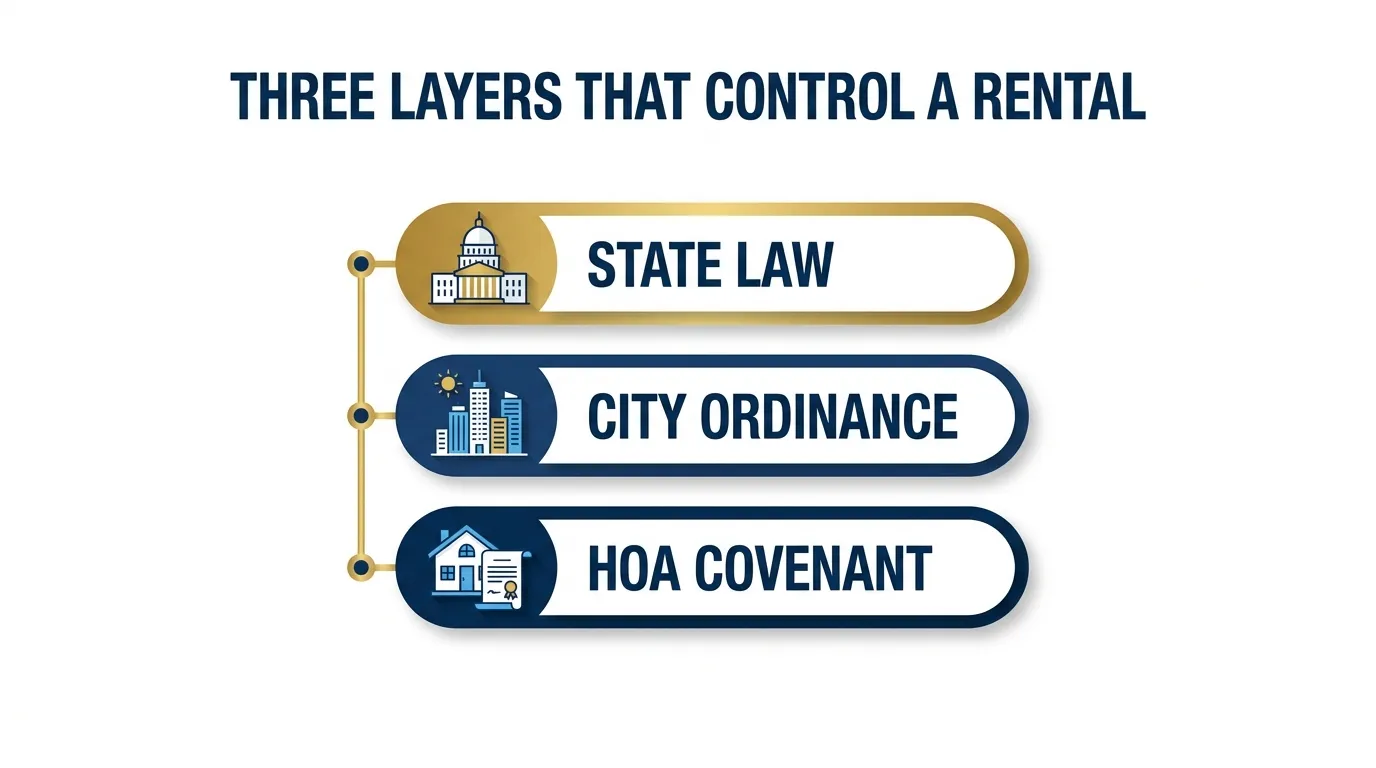
Three Layers: State, City, and the Covenant
A short-term rental can be legal under state law and a city permit, and still banned by the HOA covenant. The three layers are independent.
One reason owners get blindsided is that a single short-term rental is governed by up to three separate legal layers, and they do not override each other:
- State statute sets the outer bounds: whether an association can restrict rentals at all, and whether existing owners are grandfathered.
- Municipal or county ordinance is the permit, licensing, occupancy-tax, and zoning layer, where most day-to-day short-term rental regulation actually lives.
- The HOA or condo covenant is a private recorded contract, enforceable only as far as state law allows and only if the restriction is actually in the recorded declaration.
A city permit does not override a CC&R ban, and an association's blessing does not exempt an owner from city licensing. Arizona is the trap that makes this concrete. State law bars cities from prohibiting short-term rentals outright (Ariz. Rev. Stat. §9-500.39), so Arizona owners often assume their Airbnb is protected. It is not. That preemption applies to municipalities, not to HOAs, so the recorded declaration can still ban short-term rentals even where the city cannot. Check all three layers, not just the one that gives you the answer you want.
The Reverse Risk: When Too Many Airbnbs Kill Financing
A building saturated with short-term rentals can be flagged as a condotel, which Fannie Mae and Freddie Mac will not finance.
There is a second financing risk that runs the opposite direction, and buyers chasing rental income miss it constantly. A condo project with too many short-term rentals and hotel-like features can be classified as a condotel, a transient or hotel-type project, and lose conventional financing entirely. Under the Fannie Mae Selling Guide, a project is ineligible when it has hotel, motel, resort, or transient characteristics: mandatory rental pooling, registration or front-desk services, daily cleaning, central key systems, professional hotel management that facilitates short-term rentals, or marketing as a hotel, resort, or investment opportunity (Fannie Mae Selling Guide B4-2.1-03). Ads for daily or short-term rental rates do not by themselves make a project ineligible. The Guide lists them as a red flag that tells the lender to look harder at the project, so if the building or its units are advertised by the night, expect the lender to ask more questions. Freddie Mac applies a parallel standard in its Seller/Servicer Guide §5701.3.
The practical effect is severe. If the building where you are buying leans heavily on transient rentals and carries those hotel-style services, a conventional lender may decline the entire project, not just your unit. That drops the pool of future buyers to cash purchasers, which pushes prices down and makes your eventual exit harder. It is the mirror image of the buyer who wanted Airbnb income: here, other people's Airbnbs become your resale problem. Our explainers on what a non-warrantable condo means and what happens when a condo fails the lender questionnaire walk through how a project ends up on the wrong side of that line.
What Boards Get Wrong (and What Buyers Should Check)
The common board errors are enforcing a rule that should be a recorded amendment, misreading covenant language, and enforcing selectively.
Whether you are a board planning to restrict short-term rentals or a buyer trying to gauge whether an existing restriction will actually hold, the same failure points come up again and again:
- Banning by board rule instead of amending the CC&Rs. A rental ban announced by resolution, without clear declaration authority, is the most challengeable action a board can take.
- Assuming a "residential use" clause already bans Airbnb. Under the majority view, it does not, unless the covenant addresses rental duration or transient use.
- Assuming a "no commercial use" clause automatically applies. Courts are split; the answer depends on the state.
- Trying to bind every existing owner. Statutes in states like Florida and California grandfather owners against certain new rental restrictions, so a fresh ban may not reach current short-term rental operators.
- Bootstrapping a ban out of the nuisance clause. A general no-nuisance provision does not put owners on notice that short-term rentals could later be banned; nuisance language is for reacting to actual noise, parking, and traffic problems, not for preventing rentals.
- Enforcing selectively or overreaching on fees. Where an association is allowed to charge short-term rental fees, courts have required those fees to be a reasonable, good-faith estimate of the actual added costs (as in California's Watts v. Oak Shores). Letting some owners rent while penalizing others hands defendants a selective-enforcement or waiver defense.
For a buyer, the practical move is to read the actual recorded declaration, not the marketing or the board's summary, and confirm whether a short-term rental restriction is genuinely in the CC&Rs, how it was adopted, and whether your intended use is grandfathered or explicitly barred. If you are relying on rental income, or worried about a building full of transient renters, that language deserves a careful read and, where the stakes are high, an attorney's review. Our overview of the legal risks buyers miss in HOA properties and the guide to finding rental restrictions in HOA documents are good next steps.
Frequently Asked Questions
Can an HOA ban Airbnb and short-term rentals?
Yes, but usually only through a restriction recorded in the CC&Rs, not a board rule alone. Most courts hold that a generic "residential use" clause does not by itself prohibit short-term rentals. A durable ban generally requires an owner supermajority to amend the declaration, and whether it reaches owners who already rent depends on the state.
Does a "residential use only" covenant prohibit short-term rentals?
Usually not on its own. In Tarr v. Timberwood Park (Tex. 2018) and Houston v. Wilson Mesa Ranch (Colo. App. 2015), courts held that short-term guests still use a home for residential purposes, so a bare residential-use clause did not ban the rentals. Courts read ambiguity in favor of the free use of property. To restrict short-term rentals, the covenant generally has to say so explicitly.
Can an HOA make a new short-term rental ban apply to me if I already rent?
It depends on the state. Florida condominiums grandfather existing owners against rental amendments with no short-term exception, but Florida HOAs can apply rules on terms under six months to all owners. California protects owners against rental prohibitions adopted after they bought, yet expressly allows bans on rentals of 30 days or less. Arizona, Texas, and Washington have no statutory grandfather, so the covenant and case law control.
If my city allows short-term rentals, can my HOA still ban them?
Yes. State law, city ordinance, and the HOA covenant are three independent layers. A city permit does not override a recorded CC&R restriction, and the association's permission does not exempt you from city licensing. In Arizona, for example, state law bars cities from banning short-term rentals, but that preemption does not apply to HOAs, so the declaration can still prohibit them.
Can short-term rentals make a condo non-warrantable?
Yes. A project with heavy transient rental activity and hotel-like features (rental pooling, front-desk or registration services, daily cleaning, professional hotel management, or marketing as a hotel or resort) can be classified as a condotel and become ineligible for conventional Fannie Mae and Freddie Mac financing. Advertised daily rates alone do not disqualify a project, but they prompt the lender to look more closely. That shrinks the buyer pool to cash purchasers and can lower resale value across the building.
Get Your HOA Documents Analyzed
GoverningDocs analyzes CC&Rs, reserve studies, and meeting minutes, identifying red flags, restrictions, and financial risks so you can buy with confidence. Free. No signup required.
Your first full property report is also free. See what you'll get →
Or get your first full report free →Related Articles
Sources & References
- Tarr v. Timberwood Park Owners Ass'n (Tex. 2018) (short-term rental of a single-family home is still residential use)
- Houston v. Wilson Mesa Ranch HOA (Colo. App. 2015) (residential/commercial covenants did not clearly bar short-term rentals)
- Wilkinson v. Chiwawa Communities Ass'n (Wash. 2014) (amendment power over existing covenants did not authorize a new short-term rental ban)
- Eager v. Peasley (Mich. App. 2017) (short-term renting treated as a prohibited commercial use, the other side of the split)
- Woodside Village Condominium Ass'n v. Jahren (Fla. 2002) (declaration amendments carry a strong presumption of validity)
- Hidden Harbour Estates v. Basso (Fla. 4th DCA 1981) (two-tier framework: recorded restrictions vs. board rules)
- Watts v. Oak Shores Community Ass'n (Cal. App. 2015) (short-term rental fees must be a reasonable, good-faith estimate of added costs)
- Fla. Stat. §718.110(13) (condo rental amendments apply only to consenting owners and future buyers)
- Fla. Stat. §720.306(1)(h) (HOA under-6-month and 3x/year rental rules apply to all owners)
- Cal. Civ. Code §4740 (grandfather protection against rental prohibitions) and §4741 (25% rental floor; express authority to ban rentals of 30 days or less)
- Ariz. Rev. Stat. §33-1260.01 (owner may rent unless prohibited by the declaration) and §9-500.39 (cities preempted from banning short-term rentals)
- Tex. Prop. Code Ch. 202 (restrictive covenants; covenant text controls, per Tarr)
- C.R.S. §38-33.3-217 (CCIOA amendment thresholds; (4.5) sets at least 67% for use-restriction changes)
- NRS 116.335 (board leasing rules allowed only where the declaration permits them and only as far as lender or insurer underwriting requires) and NRS 116.340 (rentals under 30 days in planned communities need the governing documents to allow them, board approval, and local zoning and licensing)
- RCW 64.90.510 (WUCIOA) (declaration governs leasing; board rules tied to lender underwriting)
- Fannie Mae Selling Guide B4-2.1-03 (ineligible hotel/motel/resort/transient projects) and Freddie Mac Guide §5701.3
- Foundation for Community Association Research, Rentals and Leasing Snap Survey (April 2022) (64% of responding associations prohibit rentals shorter than 30 days)
Disclaimer: This article is for educational purposes only and does not constitute legal, financial, or real estate advice. Short-term rental rules, covenant enforcement, state statutes, municipal ordinances, and lending standards vary by state and by community and change over time. Court decisions on covenant interpretation are jurisdiction-specific and can conflict. Figures and citations are current as of October 2026 and may be superseded. Read your community's actual recorded declaration and consult a qualified real estate attorney for guidance specific to your situation.