

In This Guide
Pennsylvania condo and HOA buyers get a resale certificate and five days after it arrives to cancel, until closing. No 2026 law changed these rules.
If you are buying a condo or a home in a Pennsylvania HOA, the seller owes you a packet from the association before you sign the contract, or at the latest before closing, and the timing of that packet decides how long you can walk away.
Pennsylvania has about 7,200 community associations with roughly 1.37 million residents, and two state laws set most of the rules a buyer runs into. Nothing in either law changed in 2024, 2025 or 2026, so the details below describe what applies to a purchase now.
This guide covers which law applies to your community, what the resale certificate must contain, your window to cancel, the fees and dues rules, and the questions to ask before you sign.
Which Pennsylvania Law Covers Your Community?
Condos follow the Uniform Condominium Act and HOAs the Uniform Planned Community Act. Key buyer rules reach older communities too.
Pennsylvania splits community associations into two groups. Condos fall under the Uniform Condominium Act (68 Pa.C.S. 3101 and following, enacted in 1980). Single-family HOAs and townhome communities are usually planned communities under the Uniform Planned Community Act (68 Pa.C.S. 5101 and following, enacted in 1996).
Each Act covers communities created after it took effect, but older communities are not left out of the rules that matter most at a sale. Both Acts apply their resale certificate, lien and records sections to older communities as well (3102, 5102). Older condos otherwise remain under the Unit Property Act of 1963.
What the Resale Certificate Must Tell You
The seller must give you the declaration, bylaws, rules and a certificate with 17 items. The association has ten days to supply it.
The condo section (3407) and the HOA section (5407) read the same. On a resale, the seller must give you a copy of the declaration, the bylaws, the rules and a resale certificate "before execution of any contract for sale of a unit, or otherwise before conveyance". The association must supply the certificate within ten days after the seller asks for it.
The items that matter most to a buyer:
- The monthly assessment, and any unpaid regular or special assessment the seller owes
- Any other fees owners pay
- Capital expenditures the association has proposed for this year and the next two
- The amount of reserves for capital expenditures, and any part set aside for a specific project
- The latest balance sheet and income and expense statement, if any, and the current operating budget
- Any judgments against the association and the status of lawsuits it is part of
- Insurance the association carries for owners
- Whether the board knows of alterations to your unit that break the declaration, or of code violations or hazardous conditions
- Whether owners are voting on a plan to end the condominium or community, and whether it belongs to a master association
One protection is easy to miss. Under both sections, a buyer "is not liable for any unpaid assessment or fee greater than the amount set forth in the certificate". If the certificate understates what the seller owes, the association cannot collect the difference from you.
The seller is not liable to you for errors the association makes in the certificate, or for the association being late with it.
Your Five Days to Cancel
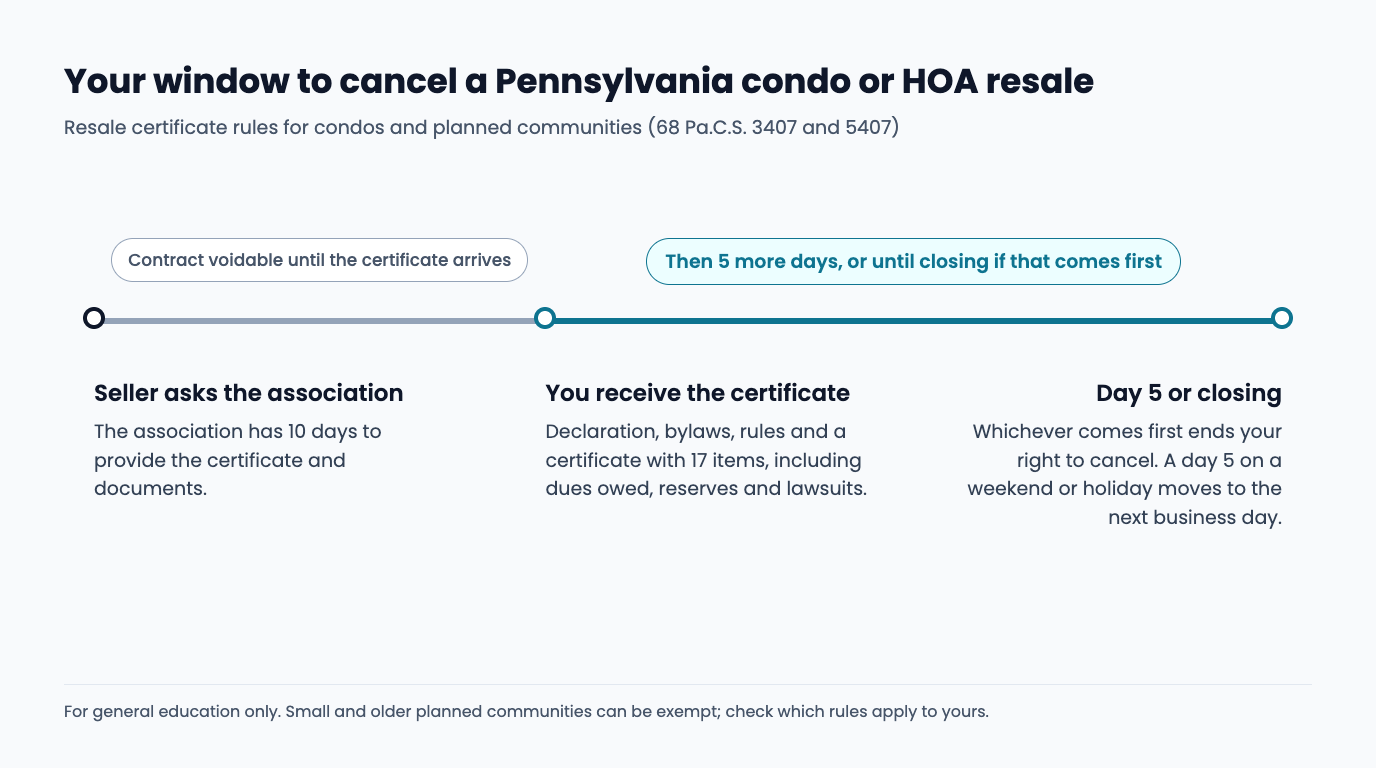
You can void the contract until the certificate arrives and for five days after, but the right ends at closing if closing comes first.
Both sections give the buyer the same right: the contract "is voidable by the purchaser until the certificate has been provided and for five days thereafter or until conveyance, whichever first occurs." Three details decide how it works on a real deal:
- The clock starts when you receive the certificate. Until then, you can cancel at any time.
- It ends at closing. If you close before the five days run out, the right is gone.
- The statute says "five days" and does not say business days, so weekends in the middle count. If the fifth day lands on a weekend or legal holiday, Pennsylvania's general rule for counting deadlines pushes it to the next business day. Confirm the end date in writing either way.
Five days is not long, which is why it pays to have the certificate before you sign rather than after. Our guide to short HOA review windows compares it with other states, and how to get HOA documents before an offer covers asking for them early.
Fees an Association Can Charge at Resale
A "reasonable" certificate fee with no dollar cap, and one transfer fee: a capital improvement fee capped at a year of dues.
The certificate fee has no dollar limit in either Act. An association may charge "reasonable charges" for preparing it (3302, 5302), subject to the declaration.
Beyond that, and also subject to the declaration, the Acts allow an association to impose a capital improvement fee, "but no other fees," on a resale or transfer. That fee comes with limits:
- It cannot exceed the annual general common expense assessments charged to that unit in the association's most recently completed fiscal year (half that for unimproved land or a unit added during that year).
- It is not refundable when you sell later.
- It must go into a separate capital account and may be spent only on new capital improvements or replacing common elements, and never on operations or maintenance.
- It cannot be charged on certain family transfers, or on a foreclosure sale or deed in lieu of foreclosure to a lender.
Our breakdown of HOA transfer fees explains who usually pays them at closing, which your purchase contract decides.
Dues, Liens and the Six-Month Rule
Unpaid dues become a lien. At a sheriff sale, six months of dues survive unless the sale pays them. Late interest is capped at 15%.
An association has a lien on a unit for unpaid assessments and fines from the day they come due, and it can foreclose the lien like a mortgage (3315, 5315). Unless the declaration says otherwise, late fees, interest and the association's reasonable legal costs of collecting are collected as assessments too. Interest on late assessments is capped at 15% a year (3314, 5314).
The lien ranks ahead of almost everything else on the unit. The exceptions are liens recorded before the declaration, a first mortgage recorded before the unpaid assessment came due, and real estate taxes and other government charges.
Six months of dues survive a sheriff sale
When a unit is sold at a judicial (sheriff) sale, unpaid common expense assessments that came due in the six months before the sale are wiped out only to the extent the sale proceeds pay them. Older unpaid assessments are wiped out. So a buyer at a sheriff sale can inherit up to six months of the prior owner's dues (3315, 5315).
In Foxfield at Naaman's Creek HOA v. Eventoff (Pa. Super. Ct., Dec. 31, 2024), the court held that in an HOA foreclosure, a refinanced mortgage that was the first mortgage on the record at the time of the sale, and was recorded before the dues went unpaid, counted as a "first mortgage" and survived the sheriff sale. The buyer at that sale took the property with the mortgage still attached. Our guide to buying a foreclosed condo covers what else to check.
A binding payoff figure in ten business days
On written request, the association must give the owner a recordable statement of unpaid assessments within ten business days, and that figure binds the association (3315, 5315). This is a separate clock from the resale certificate's ten days.
Owners also have a check on spending. Under 3303 and 5303, owners can reject a budget or capital expenditure the board approves, by majority vote (or a larger vote if the declaration says so), within 30 days. Neither Act sets a separate vote or cap for special assessments.
Reserves and Rental Rules
Pennsylvania does not require reserves or a reserve study. A 2024 court voided a bylaw rental cap the declaration did not authorize.
No reserve requirement
Neither Act requires an association to fund reserves or commission a reserve study. Associations may budget for reserves, and the resale certificate must state how much is in them and what capital spending is proposed for the next three years. Those two items and the budget are often the closest thing you will get to a funding picture, so read them together. Our state-by-state reserve study guide shows where other states set requirements.
Rental limits after Chan v. Hideout
Both Acts say a restriction on leasing is not one of the "uses" that would need every owner to agree (3219, 5219). The general vote to amend a declaration is 67% of the association's votes, or more if the declaration requires it.
How it is adopted matters. In Chan v. Association of Property Owners of The Hideout (Pa. Commw. Ct., Aug. 20, 2024), a bylaw amendment capping short-term rentals, proposed by the board and approved by 58.7% of the ballots returned, was void because the community's declaration did not authorize it. The court did not decide whether a properly adopted declaration amendment could restrict rentals. If renting matters to you, read the recorded declaration and its amendments rather than a rules summary. Our rental restrictions guide covers what to look for.
Get Your CC&Rs Analyzed
Upload your HOA's CC&Rs and get instant analysis of rental restrictions, pet policies, financing red flags, and more. Free. No signup required.
Your first full property report is also free. See what you'll get →
Or get your first full report free →What Is Pending in 2026, and Where Owners Can Complain
Several HOA bills are moving, including one on solar panels, but none is law. Any not passed by Nov. 30, 2026 dies with the session.
We checked every bill the legislature lists as amending Title 68 in the 2023-24 and 2025-26 sessions. None enacted in 2024, 2025 or 2026 changes the condo or planned community chapters. The bills worth watching are all pending, and the two-year session ends November 30, 2026, the day before a newly elected legislature takes office under the Pennsylvania Constitution:
- HB 1239 (solar panels) would bar an association from prohibiting or restricting solar panels on a roof that one owner alone owns and that is not a common area (for condos, also one the association does not maintain or replace), while still allowing reasonable safety and placement rules. It passed the House 109-93 on July 1, 2026 and is in a Senate committee.
- HB 2746 would require disclosure at sale of who owns and maintains community roads, stormwater facilities and similar items, with penalties on associations. It went to a House committee Aug. 25, 2026.
- Others in committee would open board meetings (HB 1174), protect EV chargers (HB 2463, SB 561) and allow outdoor clothes drying (HB 67, which passed the House in May 2025).
The Attorney General takes complaints on a few topics
An owner in good standing can file a complaint with the Attorney General's Bureau of Consumer Protection, but only about meetings, quorums, voting and proxies, and records (3322, 5322, 5316). Except for complaints about an HOA's financial statements, if the association's documents offer a dispute resolution process, the owner must first finish it or wait 100 days after starting it.
What to Ask Before You Sign
Ask for the certificate before you sign, and check unpaid dues, the transfer fee, reserves, lawsuits and the rental rules in it.
- To the seller or listing agent: Can I have the resale certificate, declaration, bylaws and rules before I sign? If not, when has the association been asked for them?
- To your agent or attorney: When I receive the certificate, which date starts my five days, and does closing fall inside that window?
- Reading the certificate: What does the seller owe, is a capital improvement fee charged and how much, how large are the reserves, and what capital spending is proposed for the next three years?
- To the association: Are any lawsuits pending, has the board approved a budget or special assessment owners have not yet seen, and does the declaration restrict rentals?
- If buying at a sheriff sale: How many months of dues are unpaid, and which mortgage was first on the record?
Our free reserve study tool pulls the funding figures out of a reserve study if the association has one, and the CC&R analysis tool finds the rental and use rules in the declaration. For questions about your specific contract, talk to a Pennsylvania real estate attorney.
Frequently Asked Questions
How long do I have to cancel after getting HOA documents in Pennsylvania?
Five days after the resale certificate is provided, or until closing if that comes first. Until the certificate arrives, you can cancel the contract. Weekends in the middle count, and a fifth day that falls on a weekend or holiday moves to the next business day.
How long does a Pennsylvania HOA have to provide a resale certificate?
Ten days after the seller asks for it. The same rule applies to condos and planned communities, including most older communities.
Is there a cap on the resale certificate fee in Pennsylvania?
No dollar cap. The fee must be reasonable. Apart from reasonable charges for the certificate or a statement of unpaid dues, the only fee an association may charge on a resale is a capital improvement fee, capped at one year of the unit's general common expense assessments.
Am I responsible for the seller's unpaid HOA dues in Pennsylvania?
Not beyond the amount the resale certificate shows. A buyer is not liable for any unpaid assessment or fee greater than the amount in the certificate. Buyers at a sheriff sale are different: up to six months of dues can survive the sale.
Do Pennsylvania HOAs have to have a reserve study?
No. Neither the condo nor the planned community law requires reserves or a reserve study. The resale certificate must state the amount of reserves and the capital spending proposed for the current and next two fiscal years.
Can a Pennsylvania HOA ban rentals after I buy?
A leasing restriction does not need every owner to agree; an ordinary declaration amendment, usually 67% of the votes, is the route. In 2024 a court struck down a short-term rental cap adopted as a bylaw amendment, even though owners voted for it, because the declaration did not allow it.
Read the Documents Inside Your Five Days
Upload the declaration or reserve study and see the rental rules, funding level and red flags in minutes, from tools built on 1,900+ HOA documents.
Related Articles
Sources & References
- 68 Pa.C.S. 3407 and 5407 (resale certificate, five-day right to cancel)
- 68 Pa.C.S. 3315 and 5315 (lien, priority, six-month rule, statement of unpaid assessments)
- 68 Pa.C.S. 3302 and 5302 (certificate fee, capital improvement fee)
- Chan v. Association of Property Owners of The Hideout (Pa. Commw. Ct., Nos. 70 & 71 C.D. 2023, Aug. 20, 2024)
- Foxfield at Naaman's Creek HOA v. Eventoff (2024 PA Super 316, Dec. 31, 2024)
- Foundation for Community Association Research: 2025 Statistical Review (Pennsylvania association counts, rounded estimates)
- Pennsylvania General Assembly: bills amending Title 68, 2025-26 session
- Pennsylvania General Assembly: bills amending Title 68, 2023-24 session
- Other sections cited: 68 Pa.C.S. 3102, 3219, 3303, 3314, 3322, 5102, 5219, 5303, 5314, 5316, 5322; 1 Pa.C.S. 1908 (computing time)
Disclaimer: This article is for educational purposes only and does not constitute legal, financial, or real estate advice. Which rules apply depends on when and how your community was created, its size, and what its own declaration says, and pending bills may change. Consult a qualified Pennsylvania real estate attorney for guidance specific to your situation.