

In This Guide
In Massachusetts, unpaid condo fees need no recorded lien against the unit. A recorded 6(d) certificate gives the buyer a binding number.
If you are buying a condo in Massachusetts, the title report can come back clean while the seller still owes the association months of fees. The association does not have to file anything at the registry of deeds to protect that debt, and part of it can rank ahead of your lender's mortgage.
The statute that governs Massachusetts condos, Chapter 183A of the General Laws, lets the association collect up to six months of regular fees ahead of the first mortgage, and the state's highest court has held that the association can do it more than once on the same unit. The state has more than 11,500 community associations, by the Community Associations Institute's estimate (condos, HOAs and co-ops combined).
Massachusetts answers the problem with one document: the 6(d) certificate, a statement from the association of what the unit owes. This guide covers residential condos under Chapter 183A; commercial condos can opt out of several of these rules.
Why a Massachusetts Title Search Can Miss Unpaid Condo Fees
Recording the master deed puts the fee lien on record for every unit, so the association need not file a lien for one unit's arrears.
Every condo starts with a master deed, the recorded document that creates the condominium and describes the units and shared areas. The statute calls the association that runs the building the organization of unit owners; the master deed names it. The monthly fees you pay it are common charges, or common expenses.
Under Section 6 of Chapter 183A, the association has a lien on a unit for any assessment from the day it becomes due, and that lien also covers late charges, fines, legal fees and interest. The same section says "recording of the master deed constitutes record notice and perfection of this lien; no further recordation of any claim of lien for assessment under this section is required."
So a title examiner searching the registry finds the master deed, which every unit shares, and nothing in the law requires a document showing that this seller is behind. The debt follows the unit, but the public record need not show its size.
The question to ask your agent or closing attorney early is simple: who is ordering the association's 6(d) certificate, and when will it arrive?
The 6(d) Certificate and the Moment It Protects You
The 6(d) certificate states what a unit owes and binds the association. Its power to clear other unpaid sums starts when it is recorded.
The certificate takes its name from Section 6(d). It lists the unpaid common expenses and other sums assessed against the unit, including the amount the association claims has priority over the mortgage. Other states call a similar document an estoppel certificate or a resale certificate. The Massachusetts version also changes what the title carries.
The statute says the statement "shall operate to discharge the unit from any lien for other sums then unpaid when recorded in the appropriate registry of deeds." The discharge happens when the certificate is recorded. A certificate that never reaches the registry does not get that effect from this sentence. The discharge clears the lien on the unit; by its words it does not cancel the seller's personal debt to the association.
Because the statute leaves the requester open, settle it in the offer: who orders the certificate, who pays the fee, and whether it will be recorded with the deed at closing. Then ask the closing attorney to confirm the recording happened.
Six Months Ahead of the Mortgage: The Super-Lien Math
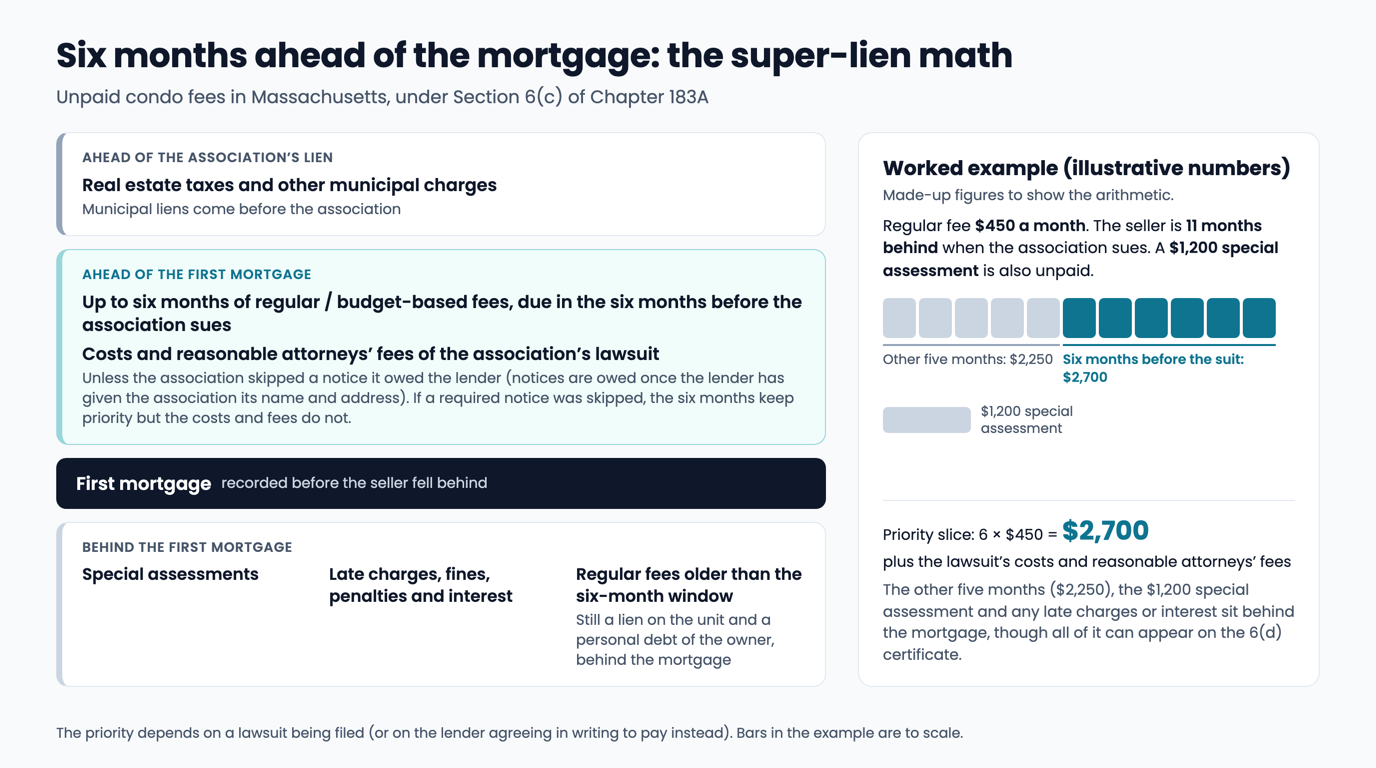
Up to six months of regular fees, plus the lawsuit's costs and attorneys' fees, can outrank a first mortgage; special assessments are excluded.
Most of the association's lien ranks behind a first mortgage recorded before the seller fell behind. One slice ranks ahead of it, and that slice is what people mean by the condo "super-lien." Under Section 6(c), that slice is the regular fees from the association's annual budget that came due in the six months before it sued to enforce the lien, plus the costs and reasonable attorneys' fees of that lawsuit. The priority depends on a lawsuit being filed (or on the lender agreeing in writing to pay instead).
| What the seller owes | Ahead of the first mortgage? | What Section 6(c) says |
|---|---|---|
| Regular budgeted fees for the six months before the association sues | Yes | Assessments "based on the budget" due in the six months before the action |
| Court costs and reasonable attorneys' fees of that lawsuit | Yes, unless the association skipped a notice it owed the lender (notices are owed once the lender has given the association its name and address) | If a required notice was skipped, the six months keep priority but the costs and fees do not |
| Special assessments | No | "Shall not include any amounts attributable to special assessments" |
| Late charges, fines, penalties and interest | No | Listed by name as excluded from the priority amount |
| Regular fees older than the six-month window | No | Still a lien on the unit and a personal debt of the owner, behind the mortgage |
| Real estate taxes and other municipal charges | Ahead of the association's lien | Municipal liens come before the association |
The six months can repeat. In Drummer Boy Homes Ass'n v. Britton, 474 Mass. 17 (2016), the Supreme Judicial Court held that the statute allows an association to establish multiple priority liens on one unit by filing successive lawsuits for fresh runs of unpaid fees. So the priority figure on a certificate can cover more than one six-month period.
Lenders care about this figure. Fannie Mae's Selling Guide B4-2.1-01 says that, outside a few states whose laws allowed a longer period before 2014, "no more than six months of regular common expense assessments may have priority over Fannie Mae's mortgage lien." If the certificate shows a priority amount larger than six months of fees, ask the association whether any collection suits are open against the unit, and ask your lender how it will treat the figure.
Pay First, Argue Later
Massachusetts owners cannot hold back condo fees over a dispute. They pay, then challenge the charge, and investors can lose rent to the association.
Section 7 says no unit owner is entitled to "an offset, deduction, or waiver" of common expenses or other charges lawfully assessed. The Appeals Court applied that in Blood v. Edgar's, Inc., 36 Mass. App. Ct. 402 (1994): "Self-help remedies, such as withholding condominium common expense assessments, are not available." The court suggested paying under protest, then challenging the charge.
For a buyer, a charge on the 6(d) certificate that looks wrong is easiest to resolve before closing, while the seller still has a reason to fix it.
Investor buyers should know one more rule. Under Section 6(c), once an owner is at least 25 days late, the association can collect rent directly from the tenant, subject to the rights of the first mortgage holder, after written notice to the owner and a 10-day window for the owner to dispute the amount. If you plan to rent, ask the association how it handles late payment by landlord owners.
Reserves Are Required, but the Law Sets No Number
Massachusetts condos must keep an adequate reserve fund, but the statute sets no percentage, requires no study and lets owners vote to modify it.
Section 10(i) says "all condominiums shall be required to maintain an adequate replacement reserve fund," held in an account separate from operating money. The statute does not define "adequate," set a percentage, or require a reserve study. And under Section 10(m), after the developer hands control to the owners, the association can modify the reserve requirement by an annual vote of owners holding 67% or more of the "beneficial interest," meaning each unit's percentage share of the common areas, as set in the master deed. A majority vote can undo that change.
That makes the budget and the minutes your best evidence. Ask whether the association has ever voted under Section 10(m), what share of the budget goes to reserves, and whether a reserve study exists even though none is required. Large assessments have a history here: in 2007, owners at Boston's Harbor Towers faced a $75 million special assessment to fix the heating and cooling system and corroded pipes, averaging $120,000 per unit and topping $400,000 for the larger units, as the Boston Globe reported. See how meeting minutes predict an assessment.
The loan can impose a stricter test than the statute. For Fannie Mae and Freddie Mac loans with applications dated on or after January 4, 2027, Fannie Mae and Freddie Mac raise the minimum budgeted reserve contribution from 10% to 15% for buildings that go through their full project review (see our 2027 HOA compliance calendar and 2026 Fannie Mae condo rules guide). FHA buyers face a separate list: as of October 16, 2026, HUD's condo approval database showed 255 approved Massachusetts condo projects; our FHA and VA condo approval guide covers buildings that are not on it.
Check Your Building's Financial Health
Upload your HOA's reserve study and get instant analysis of percent funded, deferred maintenance, and special assessment risk. Free. No signup required.
Your first full property report is also free. See what you'll get →
Or get your first full report free →On insurance, Section 10(b)(3) gives the association the power to insure the common areas, but the statute does not require a master property policy. The one policy it does require, in Section 10(h), is fidelity coverage (protection against theft of association funds) for condos with more than 10 units, in an amount equal to at least one-fourth of annual assessments, not counting special assessments, and the 67% vote can modify that too. Ask for the master policy and what it covers, and ask whether the fidelity coverage is still in place.
What Massachusetts Condo Law Leaves the Buyer to Find
Chapter 183A gives buyers no resale package and no cancellation period. Owners and lenders can inspect records; buyers rely on the seller.
We read every section of Chapter 183A in force. None gives a purchaser a resale disclosure package or a window to cancel after reading the documents, and the 6(d) certificate is the only resale document the statute requires the association to issue. Other Massachusetts laws may give buyers rights of their own.
Section 10(c) lets unit owners and first mortgage holders inspect the master deed, by-laws, minutes and financial records, with no deadline for producing them. A prospective buyer has no statutory right to them, so ask the seller in the offer for the master deed, by-laws, rules, two years of minutes, the budget, the latest annual financial report and the master policy.
Three other rules shape what you should look for:
- Sellers cannot require an inspection waiver on a condo unit. Chapter 143, Section 101, added in 2024, directs the state housing office to bar a seller of "a residential condominium unit" from making a sale conditional on the buyer waiving an inspection. The state's housing office says the regulation applies to sales after October 15, 2025 and requires sellers to give buyers a separate written disclosure that acceptance of their offer is not contingent on waiving a home inspection. A few sale types are exempt, and the rule covers the unit, so the association's finances still need their own review.
- Some improvements come with a buyout. Under Section 18, if 50% to under 75% of unit owners approve an improvement to the common areas, only the owners who agreed pay for it. At 75% or more, everyone pays, and if the improvement costs more than 10% of the condo's value, an owner who did not agree can ask the Superior Court to order the association to buy the unit. Ask whether any improvement vote is planned; ordinary repairs are common expenses.
- Additions into common space need recorded approval. In Strauss v. Oyster River Condominium Trust, 417 Mass. 442 (1994), the Supreme Judicial Court held that unit expansions into common area were unlawful because they changed every owner's share of the common area without the unanimous consent the statute required. Removal is the usual remedy, though on that case's facts the court let most of the expansions stay and had the ownership shares recalculated. Today, under Section 5, an expansion like that generally takes a recorded master deed amendment signed by every owner whose share is materially affected. The board can grant a unit exclusive use of a common area such as a deck only with the consent of the neighboring owners and their lenders, plus approval from a majority of the building's mortgage lenders that asked to be notified, and more consent if the area blocks access to another unit. If a unit has an addition, a deck or finished space that looks like it came out of common area, ask for the recorded document behind it.
What Changed in 2024 and What Is Still Pending
2024 laws added EV charger rights plus remote meetings and voting. Bills requiring reserve studies were still pending in October 2026.
Three 2024 changes, from two laws, touch condo buyers directly:
- Remote meetings and voting. Section 24, added by Chapter 150 of the Acts of 2024, approved August 6, 2024, lets boards meet by phone or video even if the condo documents say otherwise, lets the board hold owner meetings remotely, and lets the board allow owners to vote by mail or electronically as long as a quorum of owners takes part.
- EV chargers. Section 10A, added by Chapter 239 of the Acts of 2024, bars an association from prohibiting or unreasonably restricting a charger in an owner's unit or exclusive-use parking space. An application not denied in writing within 60 days is deemed approved, unless the delay came from a reasonable request for more information. A selling owner must disclose the charger, its owner and the related responsibilities to prospective buyers (more in our EV charging guide).
- Condo conversions of small rentals. Section 57 of the same 2024 Chapter 150 narrowed the small-building exclusion in the state condo conversion law to owner-occupied buildings, which Senator Lydia Edwards's office says brought certain two- and three-family buildings where the owner does not live into its tenant protections. In a recently converted building, ask the seller whether a protected tenant is still in the unit.
We found no law passed in 2025 or 2026 that changes Chapter 183A; the 2024 changes above took effect between August 2024 and February 2025. Formal sessions of the 2025-2026 Legislature ended July 31, 2026, and the two-year session has its final adjournment on January 5, 2027, according to the Community Associations Institute. As of October 2026, we found no condo bill enacted this session. These are pending:
| Bill | What it would do | Last action |
|---|---|---|
| S.980 | Reserve contributions of at least 10% of the operating budget (or HUD guidance, if higher); a reserve study, including a safety inspection, at least every ten years for 50+ units; deadlines for records requests; an ombudsman | Oct 23, 2025: reported favorably, sent to Senate Ways and Means |
| H.4826 | House version of S.980 with the same text | Mar 31, 2026: hearing scheduled for Apr 7, 2026 (Judiciary) |
| H.1523 | Creates an office of the condominium ombudsman | Aug 11, 2025: reported favorably, sent to House Ways and Means |
| H.5314 | Lets one co-owner of a two-unit building petition the Land Court to split it into two condo units | Aug 17, 2026: reported favorably, sent to House Steering, Policy and Scheduling |
If any of these passes before the session ends on January 5, 2027, the rules above could change, so ask your closing attorney whether anything new took effect before your closing date.
Before You Sign the Purchase and Sale Agreement
Settle who orders and records the 6(d) certificate, then get the budget, minutes and master policy from the seller before your deadlines pass.
A working list for the offer and the purchase and sale agreement:
- The 6(d) certificate. Who orders it, who pays the fee, and confirmation that it will be recorded at closing.
- The priority figure. If it is more than six months of regular fees, ask whether collection suits are open and how your lender will treat it.
- Disputed charges. Resolve them with the seller before closing, since you cannot withhold fees afterward.
- Reserves. Has the association voted to modify the reserve requirement? What share of the budget goes to reserves? Is there a reserve study?
- The loan. Is it Fannie Mae, Freddie Mac or FHA, and does the building meet that program's test on your application date?
- Insurance. What does the master policy cover, and is fidelity coverage in place?
- The unit itself. Any addition or exclusive space backed by a recorded document? Any charger or tenant to account for?
These rules are general, and a building's documents and loan program change how they apply. A Massachusetts real estate attorney can review the certificate and documents for your specific purchase.
Frequently Asked Questions
What is a 6(d) certificate in Massachusetts?
It is a statement from the condo association of what a unit owes, named for Section 6(d) of Chapter 183A. The association must provide it within ten business days of a written request, for a reasonable fee. It binds the association and every unit owner, and once recorded at the registry of deeds it clears the unit of liens for other sums then unpaid.
Do I have to pay the seller's unpaid condo fees in Massachusetts?
The association's lien follows the unit, and a title search may not show it. That is why the 6(d) certificate matters: it states the amount owed, binds the association, and once recorded clears the unit of liens for other sums then unpaid. Ask your closing attorney how the amount on the certificate will be paid at closing.
How much of an unpaid condo fee balance has priority over the mortgage in Massachusetts?
Up to six months of regular fees based on the annual budget, counted back from when the association sues, plus the costs and reasonable attorneys' fees of that suit. Special assessments, late charges, fines and interest are excluded, and real estate taxes and municipal charges come first. The state's highest court held in 2016 that repeat lawsuits can each carry their own six months.
Does Massachusetts require condo associations to have a reserve study?
No. Chapter 183A requires an adequate replacement reserve fund in a separate account but sets no percentage and requires no reserve study, and owners can modify the requirement by a 67% annual vote after the developer hands over control. Bills that would require studies for buildings of 50 or more units were pending as of October 2026.
Can a Massachusetts seller make me waive the home inspection on a condo?
For sales after October 15, 2025, a seller cannot condition acceptance of an offer on the buyer waiving an inspection of a residential condo unit, and must give the buyer a separate written disclosure saying so. A few sale types are exempt. The rule covers inspecting the unit, so the association's documents still need their own review.
Read the Condo Documents Before Your Deadlines Pass
Upload a reserve study to check percent funded, lending implications and special assessment risk. Upload the master deed or by-laws to find rental restrictions, pet policies and red flags. Upload meeting minutes to spot deferred maintenance, litigation and upcoming assessments. Free, no signup.
Related Articles
Sources & References
- M.G.L. c. 183A, § 5 (changing ownership shares, exclusive use of common areas)
- M.G.L. c. 183A, § 6 (lien, priority over first mortgage, 6(d) certificate, rent from tenants)
- M.G.L. c. 183A, § 7 (no offset, deduction or waiver of common expenses)
- M.G.L. c. 183A, § 10 (reserves, insurance, records, 67% modification vote, rental repair contact)
- M.G.L. c. 183A, § 10A (EV charging equipment)
- M.G.L. c. 183A, § 18 (improvement votes and buyout petition)
- M.G.L. c. 183A, § 24 (remote meetings, mail and electronic voting)
- M.G.L. c. 143, § 101 (sellers cannot require a home inspection waiver, including on condo units)
- Mass.gov: inspection rights regulation announcement (June 6, 2025; applies to sales after Oct. 15, 2025)
- St. 2024, c. 150 (Affordable Homes Act; approved Aug. 6, 2024)
- St. 2024, c. 239 (added the EV charging section)
- Drummer Boy Homes Ass'n v. Britton, 474 Mass. 17 (2016) (Caselaw Access Project)
- Blood v. Edgar's, Inc., 36 Mass. App. Ct. 402 (1994) (Caselaw Access Project)
- Strauss v. Oyster River Condominium Trust, 417 Mass. 442 (1994) (Caselaw Access Project)
- Fannie Mae Selling Guide B4-2.1-01 (six-month limit on priority of regular assessments)
- Fannie Mae Lender Letter LL-2026-03 and Freddie Mac Bulletin 2026-C (15% reserve rule for applications dated on or after Jan. 4, 2027)
- HUD FHA condominium approval database (Massachusetts approved projects, queried Oct. 16, 2026)
- S.980, H.4826, H.1523 and H.5314 (194th General Court, pending)
- CAI: 2026 Massachusetts End of Legislative Session Report
- CAI: Massachusetts community association facts and figures (estimates, all association types)
- Boston Globe: special assessments and condo costs (Dec. 5, 2021; Harbor Towers 2007 assessment)
Disclaimer: This article is for educational purposes only and does not constitute legal, financial, or real estate advice. It describes residential condos under Massachusetts General Laws Chapter 183A as of October 2026; commercial condos, other Massachusetts laws, a building's own master deed and by-laws, and lender rules can change how these rules apply. Pending bills may be enacted, or die when the session ends on January 5, 2027. Consult a qualified Massachusetts real estate attorney for guidance specific to your situation.