

In This Guide
In Florida, the association must issue an estoppel certificate within 10 business days of a request. It is good for 30 days (35 if mailed), the base fee is capped at $299 under the state's current schedule, and it shows what the seller owes today and what comes due before closing.
If you are buying a condo or a home in a homeowners' association in Florida, somebody in the deal will soon tell you the estoppel is in. It is a short form from the association, and it shows what the seller owes the association and what is scheduled to come due before closing.
Florida law can make a new condo owner answerable too. Fla. Stat. 718.116(1)(a) says a condo owner is liable together with the previous owner for unpaid assessments that came due up to the transfer of title, which in plain terms means the association can collect the full amount from the new owner or the old one. The estoppel certificate is the document that says what that amount is, so a buyer or an agent who can read it line by line catches the problem while the seller can still fix it.
This guide walks through the Florida form as the statute writes it, what each line is telling you, what the certificate costs, and what it does not cover. It applies to Florida condominiums and Florida homeowners' associations, and a short section near the end covers two other states. The word estoppel is also used for lease documents that a tenant signs; this post is only about the one an HOA or condo association issues when a unit or home is sold.
Which Document Are You Holding?
The estoppel certificate is the seller's account statement from the association. The resale package covers the building's documents and finances.
In Florida the estoppel certificate is a statutory form that the association signs. It states what the owner owes now, what is scheduled to come due, and a handful of yes-or-no questions about fees, violations and approvals. The set of governing documents, budgets and financial disclosures a condo buyer receives is a different thing, and our guide to the condo resale certificate covers it. If your paperwork has a page headed "estoppel certificate" with an assessment section and a list of fees, you are holding the document this post explains.
States name these documents differently. In Texas, for example, a condo resale certificate carries the account statement and a wider set of disclosures together. Check the title of the page in your hands and your property's state before relying on anything below, because the Florida statutes cited here do not apply to a property in another state.
Who Orders It and How Fast
The owner, the owner's designee, or the owner's lender requests it, and the association has 10 business days to issue it.
For condominiums, Fla. Stat. 718.116(8) says the association must issue the certificate within 10 business days after it receives a written or electronic request from the unit owner, the owner's designee, or the unit's mortgage lender or that lender's designee. Each association must post a person or entity on its website, with a street or email address, to receive these requests. Florida's statute for homeowners' associations, Fla. Stat. 720.30851, uses the same timing and the same form, with "parcel" in place of "unit," and carries the same fee ceilings and refund rule.
The statute lists the owner, the owner's designee and the owner's lender as the people who can request the certificate, so a buyer is not among them unless the owner names the buyer as a designee. Ask the listing agent or the title company who is ordering it, on what date, and whether you can receive a copy the day it is issued. The association must deliver it by hand, regular mail or email on the date of issuance.
The Form, Line by Line
The statute prescribes the entries on the form. Most of them can be checked against the purchase contract in a few minutes.
The statute says the certificate must contain the following information and be "substantially in the following form." The association may add more. Here is what each group of entries tells you and what to compare it to.
| Entry on the form | What to check |
|---|---|
| Date of issuance | The start of the 30-day or 35-day window. Write the date on your closing checklist. |
| Owner names, unit and address, parking or garage space | Match each against the purchase contract. A parking space that differs from the contract is a question to settle before closing. |
| Attorney name and contact | Filled in only if the account is delinquent and has been turned over to an attorney for collection. A name here means the account has gone to collections. |
| Fee for the certificate; name of the requestor | Compare the fee to the ceilings in the fee section below. The requestor line shows who ordered it. |
| Regular assessment, paid-through date, next installment | The dues amount and frequency, the date the seller has paid through, and the next due date and amount. Compare these with the dues figure on your closing statement. |
| Itemized list of everything owed on the issue date | Assessments, special assessments and other money the owner owes on the issue date. Ask the title company how each item will be paid at closing. |
| Itemized list of amounts scheduled to come due during the window | Upcoming installments and any special assessment with a due date inside the window. The association may assume that overdue amounts stay overdue through the window. |
| Capital contribution, resale, transfer or other fee due? (yes or no) | If yes, the form asks for the type and the amount. These are fees tied to the sale itself, so ask who pays under your contract. |
| Open violation noticed to the owner? (yes or no) | A yes means the association's records show a notice of a rule violation to the owner. Ask what the violation is and whether a fine is attached. |
| Does a transfer need board approval, and has it been given? | If approval is required and not yet given, closing depends on a board decision. Ask for the approval date. |
| Right of first refusal, and has it been exercised? | A right of first refusal gives the members or the association the first chance to buy. If one exists, ask the association to confirm in writing that it will not use it for your contract. |
| Other associations the unit belongs to | The form asks for a list of these associations with contact information. Each one may keep its own account, so ask each for its own statement. |
| Insurance contacts; signature | The form asks only for contact information for the association's insurance, so it does not show coverage amounts or deductibles. Confirm that an officer or authorized agent signed it. |
How Long It Is Good For
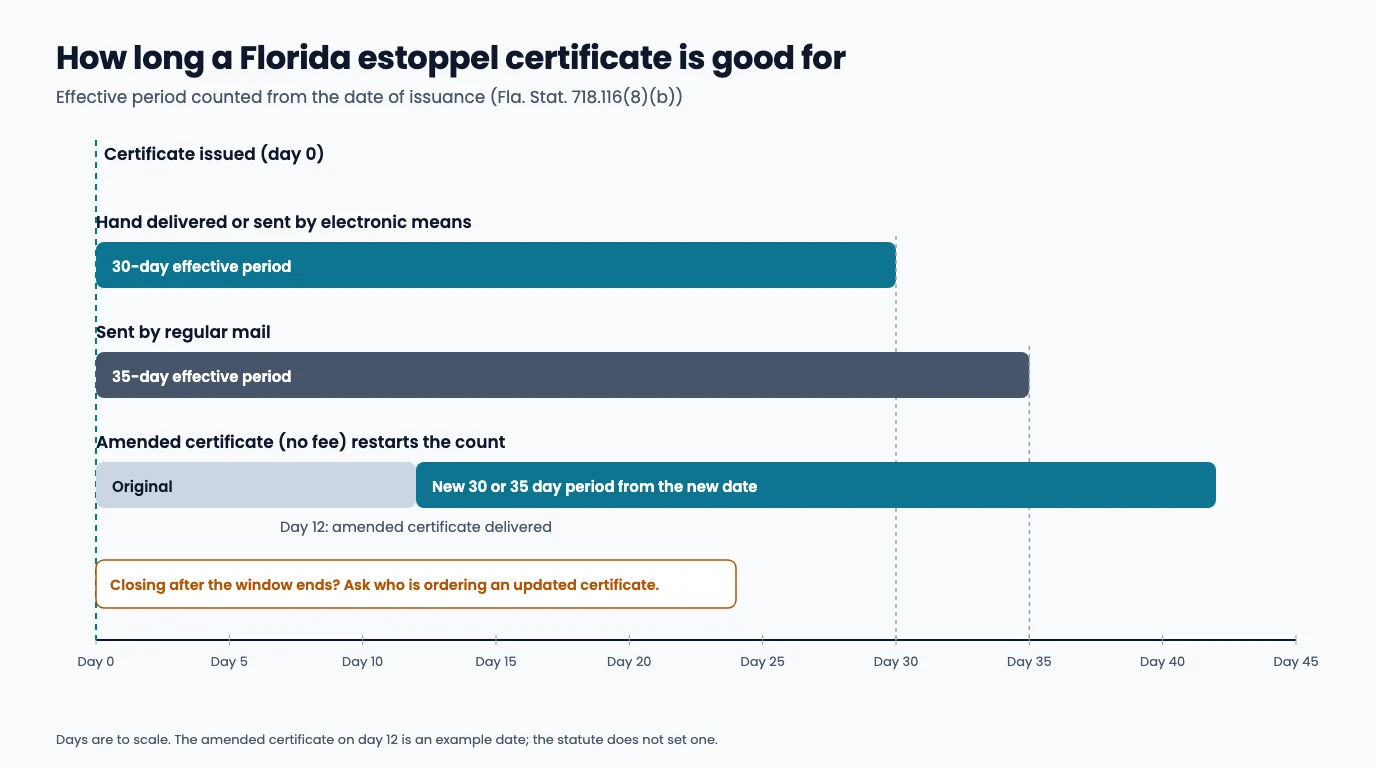
A certificate delivered by hand or electronically is good for 30 days, and one sent by regular mail is good for 35 days.
Under Fla. Stat. 718.116(8)(b), a certificate that is hand delivered or sent by electronic means has a 30-day effective period, and one sent by regular mail has a 35-day effective period. If your closing date moves past that window, ask who is ordering an updated certificate and when it will arrive.
If the association learns of new information or a mistake while the certificate is in effect, it may deliver an amended certificate. An amended certificate becomes effective if the sale or refinancing has not been completed during the effective period, it carries no fee, and it starts a new 30-day or 35-day period on the date it is delivered.
The statute also protects people who rely on the certificate. If you rely on it in good faith, the association cannot later collect more than the amounts it lists, from you or from whoever later takes title from you. In the statute's words, the association "waives the right to collect any moneys owed in excess of the amounts specified in the estoppel certificate" (Fla. Stat. 718.116(8)(c)). That protection covers only the amounts the certificate states, not matters its form does not ask about, so the sections below on what it leaves out still matter. Before closing, check the date the certificate was issued against the 30-day or 35-day window, and keep your own copy.
What It Costs and When It Is Free
The statute sets a $250 base, Florida's regulator publishes a higher adjusted figure of $299, and a late certificate is free.
Fla. Stat. 718.116(8)(f) caps the fee at $250 when no delinquent amounts are owed, allows an additional $100 for delivery within 3 business days, and allows an additional fee of up to $150 when the unit is delinquent. The statute (subsection (8)(i)) also requires the fees to be adjusted every five years for inflation, and the Department of Business and Professional Regulation (DBPR) publishes the adjusted amounts. Its current schedule applies to condominiums, cooperatives and homeowners' associations, and says the next update will be released by July 1, 2027.
| Fee | Statute base | DBPR schedule |
|---|---|---|
| Certificate, no delinquent amounts | $250 | not more than $299 |
| Added for delivery within 3 business days | $100 | an additional $119 |
| Added if the unit is delinquent | $150 (may not exceed) | an additional fee not to exceed $179 |
A few rules sit around those numbers. The right to charge a fee must come from a written board resolution or a written management, bookkeeping or maintenance contract. If the association does not deliver the certificate within 10 business days of a request, it may not charge a fee for that certificate. An amended certificate carries no fee.
If the certificate was ordered for a sale or mortgage and the closing does not happen, someone other than the owner who paid for it can ask for the fee back. The written request, with reasonable documentation that the sale did not occur, has to reach whoever prepared the certificate no later than 30 days after the closing date, and the refund is due within 30 days of the request. The statute makes the refund the owner's obligation, and it cannot be waived by contract (Fla. Stat. 718.116(8)(h)). Which side pays the fee at closing is something the statute does not decide, so it comes down to the purchase contract: read the closing-costs clause before you sign, and ask the title company to show the certificate fee on the draft closing statement. Our guide to HOA transfer fees and other closing costs covers the other fees that can appear on a closing statement.
What It Leaves Out
The form covers the seller's account and a few status questions. It does not cover reserves, minutes, lawsuits or the budget.
Every entry on the Florida form is about the account of this unit or about the sale itself. Nothing on it shows whether the building has set aside money for a roof, whether the board has been discussing a special assessment that has not been levied yet, or whether the association is in a lawsuit. A special assessment that is owed now or scheduled to come due will appear in the itemized lists. One that is still being discussed will not, and the place to find it is in the board minutes. Our guide to red flags in HOA meeting minutes shows what to look for, and the free meeting minutes analysis tool reads them for you. The reserve study analysis tool covers the funding side, and who pays a special assessment at closing explains how the cost is divided between buyer and seller.
Insurance is a similar case. The form asks the association for contact information for the insurance it maintains and nothing else, so deductibles and coverage limits come from the policy itself. A lender may also ask the association for its own condo questionnaire, which is a separate document with a different set of questions.
Outside Florida
Other states cover the same job under other names, with different deadlines and fee limits, so check which statute governs your property.
In Illinois, a condo seller must obtain a set of documents from the board and make them available to a prospective purchaser upon demand. They include a statement of unpaid assessments and other charges and a statement of any liens. The board must furnish them within 10 business days of a written request, and the association may charge the unit seller a reasonable fee not to exceed $375, adjusted yearly for inflation, plus $100 for rush service completed within 72 hours (765 ILCS 605/22.1). The statute shows a later version that takes effect January 1, 2027.
In Texas, a condo owner who intends to sell generally must furnish the buyer a resale certificate prepared no earlier than three months before delivery, and the association must furnish it to the owner within 10 days of a written request (Tex. Prop. Code 82.157). Texas Property Code chapter 207 covers resale certificates for property owners' associations in subdivisions, and by its own terms it does not apply to condominiums (Tex. Prop. Code 207.002). If your property is outside these states, the same advice applies: find the document the association issues about the owner's account, check the statute for your state, and ask the title company which document they have ordered.
Questions to Ask Before Closing
Six questions for the listing agent, title company, association manager and seller turn the certificate into a closing checklist.
- To the listing agent or title company: Who ordered the estoppel certificate, on what date, and when will I get a copy?
- To the title company: Does the closing date fall inside the 30-day or 35-day window, and who is requesting an updated certificate if it moves?
- To the association manager: The form lists a fee. Was the fee authorized by a board resolution or a management contract, and did the certificate arrive within 10 business days?
- To the association manager: If a transfer approval or a right of first refusal is listed, when was the decision made, and can you confirm it in writing?
- To the seller's side: Which of the fees marked yes (capital contribution, transfer, resale) does our contract assign to me?
- To yourself: Have I read the last 12 months of board minutes for anything the certificate cannot show?
For specific questions about a particular certificate, a deadline or a fee dispute, a Florida real estate attorney can read the documents and advise on your situation.
Frequently Asked Questions
What is an HOA estoppel certificate?
It is a statement the association signs when a unit or home is being sold. In Florida it shows what the owner owes the association on the issue date, what is scheduled to come due during the certificate's effective period, and yes-or-no answers about fees, open violations, transfer approval and a right of first refusal.
How much does a Florida estoppel certificate cost?
The statute sets a base of $250, with an additional $100 for delivery within 3 business days and up to $150 more if the unit is delinquent. DBPR's current schedule, which adjusts those amounts for inflation, says not more than $299, an additional $119 for expedited delivery, and an additional fee not to exceed $179 if the unit is delinquent. The next update is due by July 1, 2027.
How long is a Florida estoppel certificate good for?
Thirty days if it is hand delivered or sent by electronic means, and 35 days if it is sent by regular mail. If the association learns of new information or a mistake in that period it can issue an amended certificate at no charge, which starts a new period.
Who pays for the estoppel certificate, the buyer or the seller?
The Florida statute sets the ceilings and says the fee is payable when the certificate is prepared. It does not say which side of the sale pays, so the purchase contract decides. If the closing does not happen, someone other than the owner who paid for the certificate can request a refund within the deadlines in Fla. Stat. 718.116(8)(h).
Is an estoppel certificate the same as a resale certificate?
In Florida they are different documents. The estoppel certificate covers the owner's account with the association. The resale package covers the association's governing documents and finances. Some other states, such as Texas for condominiums, use the name resale certificate for a single document that carries the account statement along with wider disclosures.
Get Your Meeting Minutes Analyzed
Upload your HOA's meeting minutes and get instant analysis of key decisions, recurring issues, litigation flags, and governance patterns. Free. No signup required.
Your first full property report is also free. See what you'll get →
Or get your first full report free →Related Articles
Sources & References
- Fla. Stat. 718.116 (condominium estoppel certificate, subsection (8); owner liability, subsection (1)(a))
- Fla. Stat. 720.30851 (homeowners' association estoppel certificate)
- DBPR: Estoppel Certificate Fees (published schedule: not more than $299, an additional $119 expedited, an additional fee not to exceed $179 if delinquent; next update by July 1, 2027)
- 765 ILCS 605/22.1 (Illinois condominium seller disclosures)
- Tex. Prop. Code 82.157 (Texas condominium resale certificate)
- Tex. Prop. Code 207.002 (applicability of the subdivision resale certificate chapter)
Disclaimer: This article is for educational purposes only and does not constitute legal, financial, or real estate advice. Florida statutes and DBPR fee schedules change, and the subsections cited are current as of October 2026 and may be amended. This article covers Florida condominiums and homeowners' associations, with short notes on Illinois and Texas condominiums. Consult a qualified Florida real estate attorney for guidance specific to your situation.