

In This Guide
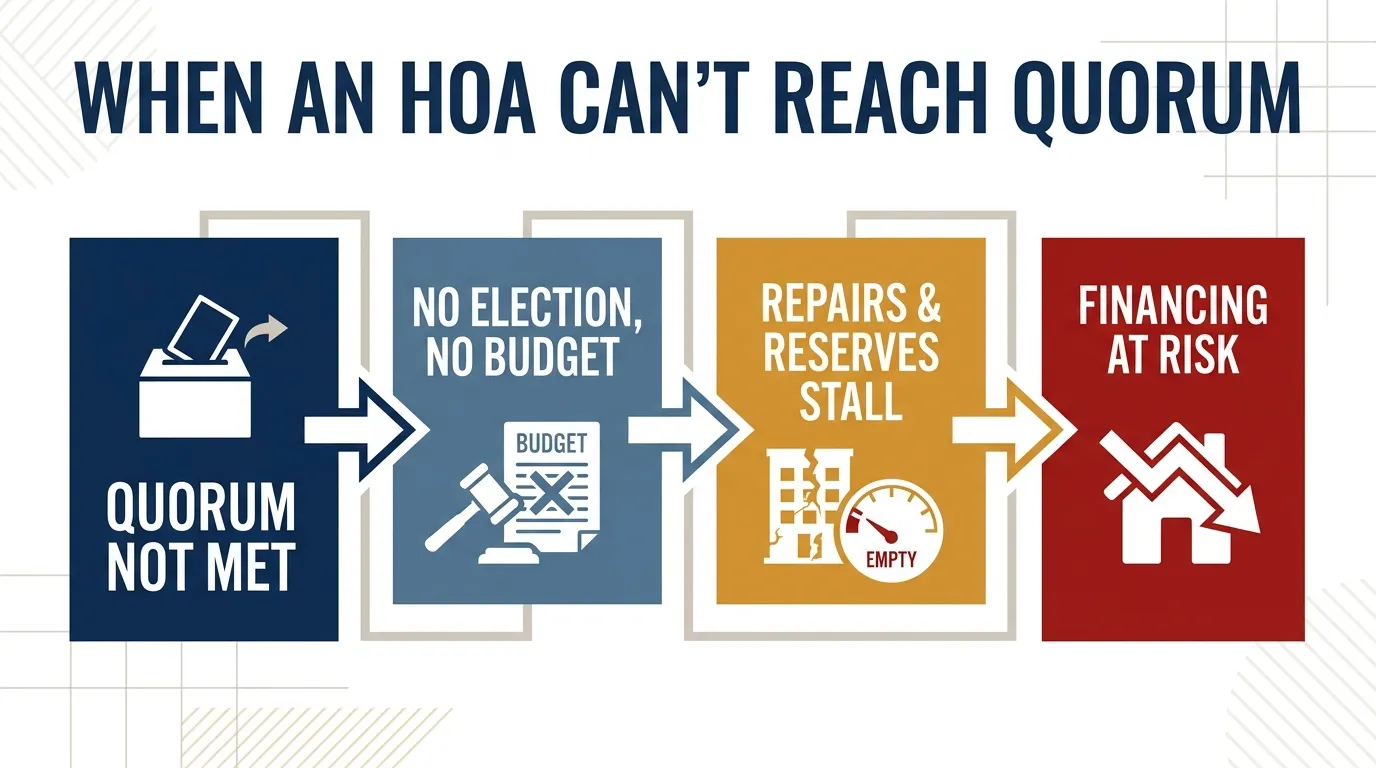
A quorum is the minimum share of owners who must participate before an association can hold a valid vote. When a community can't reach it, the practical damage is real: elections fail and the same board stays in place, budgets go unratified, reserves stay underfunded, and the declaration can't be amended to fix any of it. For a buyer, repeated "adjourned for lack of quorum" entries in the minutes are a governance red flag, an early warning of the reserve, repair, and litigation problems that lenders actually reject.
You are three days into a contingency window on a condo you like. The disclosure packet is a foot thick, and buried in last year's annual-meeting minutes is a single line: "Meeting adjourned, quorum not met. Rescheduled." The line before it, from the year before, says almost the same thing. It is the kind of detail that is easy to skip, because it sounds procedural and dull.
It is neither. An association that cannot get enough owners to show up cannot govern itself, and a building that cannot govern itself tends to drift toward exactly the conditions that cap financing and resale value. Quorum failure will never appear on an inspection report or an appraisal. But it is one of the clearest leading indicators of trouble a buyer can find, and it is sitting right there in documents the seller already has to hand over. This guide explains what quorum is, what happens when a community keeps missing it, how the rules differ by state, and how to read the warning signs before you remove a contingency.
What a Quorum Actually Is
A quorum is the minimum number of owners who must participate before a members' meeting can transact business or hold a valid vote.
A quorum is the minimum number of owners, or voting interests, that must participate before an association can transact business at a meeting. Below that threshold, whatever happens in the room has no legal force. According to the Community Associations Institute, a quorum is simply the count of owners who must be present, in person or by proxy, before business can be conducted. Proxies count. That last point matters, because proxies are the main tool associations use to scrape a quorum together when turnout is thin.
There are really two different quorums, and buyers should keep them straight:
- Member (owner) meeting quorum. This is a percentage of the whole membership, set by the bylaws or declaration and sometimes by state statute. It governs annual meetings, board elections, budget ratification, declaration amendments, and special-assessment votes. This is the one that fails.
- Board meeting quorum. This is almost always a simple majority of the seated directors. A five-member board needs three present; a seven-member board needs four. This one rarely fails, because there are few people involved.
When people say a community "can't make quorum," they mean the member-meeting quorum, the one that depends on rank-and-file owners actually showing up. That is the number worth your attention.
What Breaks When a Community Can't Reach Quorum
No quorum means no valid vote. Elections fail, budgets go unratified, the declaration can't be amended, and in the worst cases a court steps in.
A quorum failure is not a one-meeting inconvenience. When it happens year after year, the association slowly loses the ability to make the decisions that keep a building solvent and safe. Here is what actually stalls.
- Elections fail and the board becomes a holdover. Under most governing documents, sitting directors "remain in their positions until successors are elected and qualified." If no election can be validly held, the same directors stay in power indefinitely, even ones who want to leave. A board nobody voted for keeps running the money. (Kaman & Cusimano)
- Budgets go unratified. In many communities the membership has to ratify the annual budget. No quorum, no ratification, so the prior year's budget rolls forward and the increases a building actually needs never take effect. (CAI)
- The declaration can't be amended. Amending the CC&Rs or approving a large special assessment usually takes a supermajority of the membership. A community that can't even hit a basic quorum has no path to that higher bar, so structural fixes stay frozen. (FindHOALaw)
- Board decisions become legally shaky. As one community-association firm puts it, "a board elected without quorum can have all its decisions undermined by the improper election." Contracts and assessments approved by a questionable board invite challenge. (Kaman & Cusimano)
- A court can take over. When a board is deadlocked or can't function, courts can appoint a receiver to run the association, an outcome one firm describes as "costly and disruptive" and reserved as a last resort. A receiver can raise assessments or levy new ones to fund operations. In California, a member (or a director or officer) can petition the superior court under Corporations Code §7515 to reduce or dispense with the quorum requirement altogether. (CHDB Law)
Read that list as a buyer and a pattern jumps out. Every consequence of chronic quorum failure, a stuck board, a frozen budget, deferred repairs, an eventual special assessment, is also a thing that hurts your financing or your resale. Quorum is the mechanism. The mechanism jamming is the warning.
Typical Thresholds and the Reduced-Quorum Trick
Member-meeting quorums commonly run 10% to 33% of owners. Many bylaws also let a reconvened meeting proceed on a much lower quorum.
There is no single national quorum figure, because the number is set community by community. Pull together the state statutes and community bylaws that get discussed most, and a practical pattern emerges: member-meeting quorums most often land somewhere between 10% and a third of the membership, though some communities set the bar as high as a simple majority. (For a sampling of these state-by-state examples, see Condo Control.) Board quorums, by contrast, are just a majority of directors.
The detail buyers miss is the reduced-quorum-on-adjournment provision. Many bylaws, and several state statutes, say that if the first meeting fails for lack of quorum, the association can reconvene later on a much lower threshold. California wrote this straight into statute: for a director election, an association that misses quorum may adjourn for at least 20 days and reconvene needing only 20% of members to vote (Cal. Civ. Code §5115). That mechanism is genuinely useful for keeping a functional community running. But it cuts the other way too. A building that only ever passes its budget or seats its board on the second-try reduced quorum is telling you that the vast majority of its owners are checked out, and that the smallest organized faction can steer decisions. It keeps the lights on while masking how thin real participation has become.
Quorum Rules, State by State
Defaults run from 20% in most UCIOA states to 30% for Florida HOAs and a full majority for Florida condos. Bylaws can often set a lower bar.
Most states set a default quorum by statute that applies unless the governing documents provide otherwise. The defaults are lower than most buyers assume, which is a hint at how common thin turnout really is. Here is how the major HOA states compare for member meetings.
| State | Default member-meeting quorum | Statute |
|---|---|---|
| Florida (condo) | Majority of voting interests, unless bylaws set a lower number | §718.112(2)(b) |
| Florida (HOA) | 30% of total voting interests, unless bylaws set a lower number | §720.306(1)(a) |
| California | Set by the governing documents; a reconvened director election needs only 20% | Civ. Code §5115 |
| Texas (condo) | 20% of votes, unless bylaws specify; bylaws can't go below 10% | Prop. Code §82.109 |
| Texas (HOA) | No statutory quorum; left to the bylaws or dedicatory instrument | Prop. Code Ch. 209 |
| Nevada | 20% of votes, unless the governing documents provide otherwise | NRS 116.3109 |
| Arizona (condo) | 25% of votes, unless the bylaws provide otherwise | A.R.S. §33-1249 |
| Colorado | 20% of votes (10% if more than 1,000 owners), unless bylaws provide otherwise | C.R.S. §38-33.3-309 |
| Washington | 20% of votes, unless the organizational documents provide otherwise | RCW 64.90.450 |
Sources for the table: Fla. Stat. §718.112 and §720.306; Cal. Civ. Code §5115; Tex. Prop. Code §82.109 and Ch. 209; NRS 116.3109; Ariz. Rev. Stat. §33-1249; C.R.S. §38-33.3-309; RCW 64.90.450.
Two things stand out. First, the low defaults, mostly 20% to 30%, tell you the drafters of these statutes expected turnout to be a struggle and set the bar where a functioning community could still clear it. Second, the split within Florida is instructive: a Florida condo needs a full majority of voting interests by default, while a Florida HOA needs only 30%. Same state, very different bar, which is why you always have to read the actual governing documents rather than assume. Whatever the statutory default, a community's own bylaws can set a different number, so the quorum clause in the bylaws is the figure that governs your building.
The Apathy Problem
Low turnout is common, and associations lean on proxies, reduced-quorum provisions, and electronic voting to reach quorum at all.
Owner turnout at HOA meetings is chronically low, which is why quorum is a recurring headache even in healthy communities. Most owners are busy, assume someone else will handle it, or simply do not read the notices. The interesting part is that low turnout is not the same as unhappiness. The Community Associations Institute's 2024 national survey found that 86% of residents rate their overall community-association experience as positive or neutral, and 82% say their board serves the community's best interest. People are largely content, they just do not show up to vote. That makes apathy a design-and-engagement problem, not proof that a community is on fire.
To fight it, associations lean on a few tools, all of which you will see referenced in the documents:
- Proxies. An owner who can't attend assigns their vote to someone who will. Proxies count toward quorum, so proxy drives are the most common way boards reach the threshold.
- Reduced quorum on adjournment. The reconvened-meeting mechanism described above, letting a second meeting proceed on a lower bar.
- Electronic and absentee voting. Online and mailed ballots lower the friction of participating, and a growing number of states now expressly authorize them.
None of these are red flags on their own. But if the minutes show a board that has to run a heavy proxy campaign or invoke the reduced quorum every single year just to seat itself, that is a community running on fumes, and it is worth understanding why so few owners engage.
When Paralysis Becomes a Financing Problem
No lender rule says "low quorum equals non-warrantable." But the paralysis it causes produces the exact conditions that make a condo ineligible.
Let's be precise here, because it is easy to overstate. There is no Fannie Mae or Freddie Mac rule that says a low quorum makes a condo non-warrantable. Quorum is not a line item on the lender questionnaire. The connection is indirect, and it runs through the conditions that governance paralysis produces.
A community that can't ratify a budget or pass a special assessment lets repairs and reserves slide. That is where it collides with the rules lenders do enforce. Under Fannie Mae's project eligibility standards, a condo project is ineligible for a conventional loan when it has unaddressed critical repairs affecting safety, soundness, structural integrity, or habitability, or when the association is a party to litigation relating to those same things, or when the project is in receivership (Fannie Mae Selling Guide B4-2.1-03). Each of those is a plausible endpoint of a community that lost the ability to govern itself. Our explainer on what happens when a condo fails the lender questionnaire covers how that plays out at the closing table.
Reserves are the sharpest example. According to Association Reserves, which has analyzed more than 100,000 reserve studies, roughly 74% of associations are underfunded, sitting below the 70% funded level that reserve professionals call "strong." A board that can't get a budget ratified can't raise the contributions needed to climb out of that hole, and the bar is about to rise. Under Fannie Mae Lender Letter LL-2026-03, the minimum reserve contribution increases from 10% to 15% of budgeted assessment income for loan applications dated on or after January 4, 2027, and the Limited Review shortcut for established projects is retired for applications dated on or after August 3, 2026 (Fannie Mae LL-2026-03). A gridlocked community that was already marginal on reserves is exactly the kind that falls below the new line. The mechanics of that federal shift are covered in our guide to the 2026 Fannie and Freddie condo rules.
So quorum health is a leading indicator, not a lending rule. A building that can't seat a board or pass a budget is on a path toward the reserve, repair, litigation, and receivership problems that lenders explicitly reject. Spotting the quorum failure early is how you get ahead of the financing problem it foreshadows.
How to Spot It in the Documents
Read the bylaws quorum clause, then scan 12 to 24 months of minutes for adjourned meetings, repeat election notices, and holdover boards.
The good news is that quorum health is one of the more visible things in an HOA document package, if you know where to look. Work through this before you remove a contingency.
- Find the quorum clause in the bylaws. Note the stated percentage and whether there is a reduced-quorum-on-adjournment provision. A high bar plus a history of adjournments is a worse combination than a low bar the community usually clears.
- Read 12 to 24 months of meeting minutes. Look for the tell-tale phrases: "adjourned for lack of quorum," "rescheduled," "reconvened," or an annual meeting that had to be noticed two or three times. One miss is normal. A pattern is not.
- Watch for a holdover board. If the same directors appear year after year with no record of a contested or completed election, the community may not be electing anyone at all, just carrying the incumbents forward for lack of a quorum.
- Look for repeated proxy solicitations. Second-notice mailings and heavy proxy campaigns in the record mean the association routinely can't hit quorum on the first try.
- Connect it to the money. Pull the reserve study and the budget. If governance is stuck, check whether reserves are stagnant and whether any needed assessment keeps getting deferred.
Reading two years of minutes and a reserve study by hand is slow, and it is exactly the diligence that gets skipped under a tight contingency clock. That is what our tools are for. The free meeting minutes analyzer surfaces adjourned meetings, failed elections, and unresolved disputes buried in the record, and the reserve study analyzer pulls the percent funded and special-assessment risk in seconds. For the full pre-offer routine, see the complete condo buying checklist, and if the governance picture looks genuinely unstable, have a real estate attorney review before you commit.
Frequently Asked Questions
What is a quorum in an HOA?
A quorum is the minimum number of owners, or voting interests, that must participate in a members' meeting before the association can transact business or hold a valid vote. It applies to annual meetings, board elections, budget ratification, and declaration amendments. Proxies count toward it. Board meetings have a separate, simpler quorum, usually a majority of the directors.
What happens if an HOA can't reach quorum?
No valid business can be conducted. Elections can't be held, so the existing board stays in place as a holdover; the budget can't be ratified, so the prior year's rolls forward; and the declaration can't be amended. Many bylaws allow a reconvened meeting to proceed on a lower quorum. In severe cases of deadlock, a court can appoint a receiver to run the association.
What is a typical HOA quorum requirement?
It varies by community and state. Member-meeting quorums in governing documents commonly run between 10% and 33% of owners. Statutory defaults are often 20% (Nevada, Colorado, Washington, and Texas condos), 25% in Arizona condos, and 30% for Florida HOAs, while Florida condos default to a full majority. Whatever the statutory default, the community's own bylaws control if they set a different number.
Does a low HOA quorum affect condo financing?
Not directly. No Fannie Mae or Freddie Mac rule says a low quorum makes a condo non-warrantable. The risk is indirect: a community that can't reach quorum can't ratify budgets, fund reserves, or approve repairs, which can lead to the unaddressed critical repairs, litigation, or receivership that do make a project ineligible for a conventional loan. Treat quorum failure as an early warning, not a lending rule.
How can I tell if an HOA has quorum problems before I buy?
Read the quorum clause in the bylaws, then scan 12 to 24 months of meeting minutes for phrases like "adjourned for lack of quorum," rescheduled or reconvened annual meetings, repeated proxy solicitations, and the same directors serving year after year with no completed election. A single miss is normal; a repeating pattern signals chronic disengagement worth investigating alongside the reserves and budget.
Get Your HOA Documents Analyzed
GoverningDocs analyzes CC&Rs, reserve studies, and meeting minutes, identifying red flags, restrictions, and financial risks so you can buy with confidence. Free. No signup required.
Your first full property report is also free. See what you'll get →
Or get your first full report free →Related Articles
Sources & References
- Community Associations Institute (definition of quorum, proxies, and why it matters to a board)
- Kaman & Cusimano (holdover directors, unratified budgets, and legally exposed board actions when quorum fails)
- FindHOALaw (amendments to the declaration/CC&Rs commonly require a supermajority membership vote)
- CHDB Law (court-appointed receivership triggered by board deadlock or inability to function)
- Fla. Stat. §718.112(2)(b) (Florida condominium quorum: majority of voting interests unless bylaws set lower)
- Fla. Stat. §720.306(1)(a) (Florida HOA quorum: 30% of total voting interests unless bylaws set lower)
- Cal. Civ. Code §5115 (California 20% reconvened-meeting quorum for director elections, added by AB 1458)
- Tex. Prop. Code §82.109 (Texas condominium quorum: 20% default, bylaws cannot reduce below 10%) and §209.00592 (Texas HOA voting; no statutory quorum percentage)
- NRS 116.3109 (Nevada 20% default quorum) and Ariz. Rev. Stat. §33-1249 (Arizona condo 25% default quorum)
- C.R.S. §38-33.3-309 (Colorado 20% default, 10% for associations over 1,000 owners) and RCW 64.90.450 (Washington WUCIOA 20% default quorum)
- Fannie Mae Selling Guide B4-2.1-03 (ineligible projects: unaddressed critical repairs, safety/structure/habitability litigation, receivership)
- Association Reserves (74% of associations underfunded, below the 70% "strong" level)
- Fannie Mae Lender Letter LL-2026-03 (reserve minimum 10% to 15% on Jan 4, 2027; Limited Review retired Aug 3, 2026)
- CAI 2024 Homeowner Satisfaction Survey (86% of residents rate their experience positively or neutrally; 82% say the board serves the community's interest)
Disclaimer: This article is for educational purposes only and does not constitute legal, financial, or real estate advice. HOA quorum rules, voting procedures, lending standards, and reserve requirements vary by state and by community and change over time. Statutory defaults can be overridden by a community's own governing documents. Figures and citations are current as of July 2026 and may be superseded. Read your community's actual bylaws and consult a qualified real estate attorney for guidance specific to your situation.