
In This Guide
A board recall is when an association's members vote to remove sitting directors before their terms end, usually with or without cause. For a buyer, a recent or contested recall is a governance red flag. Boards rarely get recalled over nothing, and the problems that drive a recall, such as pending litigation, underfunded reserves, and looming special assessments, are the ones that actually threaten a unit's financeability and resale value. The recall tells you where to dig. The minutes, reserve study, and litigation disclosure tell you how bad it is.
Somewhere in the disclosure packet on a condo you like, the meeting minutes mention that three directors were removed at a special meeting last spring. Or the seller's agent mentions, a little too casually, that "the board had some turnover." It is easy to wave off. Boards change. People move. But a recall is not an ordinary board change, and treating it like one is how buyers walk into a building with problems the seller already knows about.
A recall is the community formally voting no confidence in the people running its money and its maintenance. It happens after something goes wrong, and the something is usually financial. The recall itself will not appear on an inspection report or an appraisal, but the conditions that triggered it can quietly cap the pool of buyers who can finance a unit and the price the seller can command. This guide explains what a recall is, why boards get removed, how the process differs by state, and exactly what a buyer should read before removing a contingency.
What Is an HOA Board Recall?
A recall is the members removing one or more directors mid-term, usually without having to prove cause. It is not an election or a resignation.
A recall is the process by which an association's members, meaning the owners, remove one or more sitting directors before their terms are up. In most states it can be done "with or without cause," which means the owners do not have to prove wrongdoing. They only have to follow the procedure and reach the required vote.
It helps to separate a recall from the things it resembles:
- An election fills seats on a schedule. A recall interrupts a term in the middle.
- A resignation is voluntary. A recall is the membership forcing a director out.
- Board removal for cause is when the board itself removes a member for missing meetings or losing eligibility. A recall is owner-driven, usually needs no cause, and in several states is protected even if the bylaws try to limit it.
The mechanics, meaning the petition threshold, the vote required, whether it happens by written ballot or at a meeting, and what happens if the board resists, are set by state statute in some places and left entirely to the association's bylaws in others. That variation matters more than most buyers expect, and it is the subject of a later section.
Why Boards Get Recalled
The common triggers are financial mismanagement, deferred maintenance, selective enforcement, self-dealing, and refusing owners access to records.
Because a recall can be done without a stated reason, the absence of an explanation in the record is not reassuring. The reason is usually there anyway, sitting in the months of minutes that came before the vote. The motivations that show up again and again in HOA practice are a short and telling list:
- Financial mismanagement or budget disputes. Contested budgets, a surprise special assessment, reserves that were spent or never funded.
- Failure to maintain common areas. Deferred repairs that owners have raised for months with no action.
- Selective or arbitrary rule enforcement. Fines and approvals that seem to depend on who you are.
- Conflict of interest and self-dealing. Vendor contracts steered to a director's relative, or board members benefiting from association decisions.
- Refusing access to records. Owners asking to see the books and being stonewalled, which is often what finally triggers the petition.
Notice that nearly every item is something a buyer can detect in the paperwork. Budget fights appear as contested assessment votes. Self-dealing shows up as vendor-contract objections and demands for a financial review. Maintenance failures appear as the same repair item raised meeting after meeting. The recall is the endpoint of a pattern the minutes usually record long before the vote happens. Our guide to the red flags hiding in HOA meeting minutes walks through how to read that pattern.
How a Recall Works, State by State
Recall rights vary by state. Florida and Nevada give owners strong statutory rights, Colorado sets a high 67% bar, and Texas leaves it to the bylaws.
How hard it is to recall a board is itself a governance signal, and it is set almost entirely by the state. Some states give owners a fast, statute-backed right that a board cannot stall. Others say nothing at all, leaving owners at the mercy of whatever the bylaws happen to say. Here is how seven large HOA states compare.
| State | How directors are recalled | Owner-friendly? |
|---|---|---|
| Florida | Majority of all voting interests, with or without cause; board must certify within 5 business days (§718.112(2)(l) condo; §720.303(10) HOA) | Strong |
| Nevada | Removal passes only if the votes in favor total at least 35% of all members and also a majority of votes cast (NRS 116.31036) | Strong |
| California | 5% of members can petition a special meeting (§7510(e)); removal without cause under Corp. Code §7222; disputes go to court | Moderate |
| Colorado | 67% of those present and entitled to vote at a quorum meeting (CRS §38-33.3-303(8)) | Moderate |
| Arizona | Size-scaled petition (25% or 100 votes for smaller associations); special meeting within 30 days; majority of those voting removes (ARS §33-1243 / §33-1813) | Moderate |
| Washington | Owner-vote removal under WUCIOA, in person, by proxy, or by absentee ballot (RCW 64.90.520); confirm the specific threshold in the governing documents | Moderate |
| Texas | No recall-by-vote statute; removal governed by the bylaws or Business Organizations Code §22.211 | Depends on bylaws |
Sources for the table: Fla. Stat. §718.112 and §720.303; NRS 116.31036; Cal. Corp. Code §7222 and §7510; Colo. Rev. Stat. §38-33.3-303; Ariz. Rev. Stat. §33-1813; Wash. Rev. Code 64.90.520; Tex. Prop. Code Ch. 209.
The practical read for a buyer: in Florida and Nevada, owners have a robust statutory right and a recall on the record means the community actually cleared a meaningful bar to remove its board. In Texas, where there is no recall statute, a difficult board can be much harder to dislodge, and a recall that did happen usually means the owners organized around bylaws that were never designed for it.
When a Board Won't Step Down
In Florida, a board has 5 business days to certify a recall or take it to binding arbitration. In California, a stonewalled recall goes to court.
The most revealing part of a recall is not the vote. It is what happens when the sitting board does not want to leave. This is where governance dysfunction becomes a paper trail a buyer can request, and the two big states handle it very differently.
In Florida, the board must notice and hold a meeting within 5 full business days of the recall to certify it. If the board declines to certify, it has to file a petition for binding arbitration with the state (the DBPR), or in the HOA context a court action, within that same window. If the board simply does nothing, the recall is deemed effective automatically and the outgoing directors must turn over the association's records immediately (Fla. Stat. §720.303(10); condo arbitration under Fla. Admin. Code R. 61B-80.102, the HOA recall-arbitration rule; condo recall arbitration runs through Chapter 61B-50). Florida maintains a standing recall-arbitration process, which tells you these disputes are common enough for the state to have built a dedicated track.
In California, there is no administrative arbitrator for recalls. An owner whose valid recall the board refuses to honor has to go to superior court, usually seeking an injunction under the Davis-Stirling Act and Corporations Code §7222. That is slower and more expensive than Florida's track, which matters because it means a Californian community fighting its board can stay in limbo far longer.
For a buyer, a board that stonewalled a lawful recall, or a community with a history of recall-arbitration filings, is one of the clearest governance red flags there is, and it lives in the minutes and correspondence you can ask for.
What a Recall Signals to a Buyer
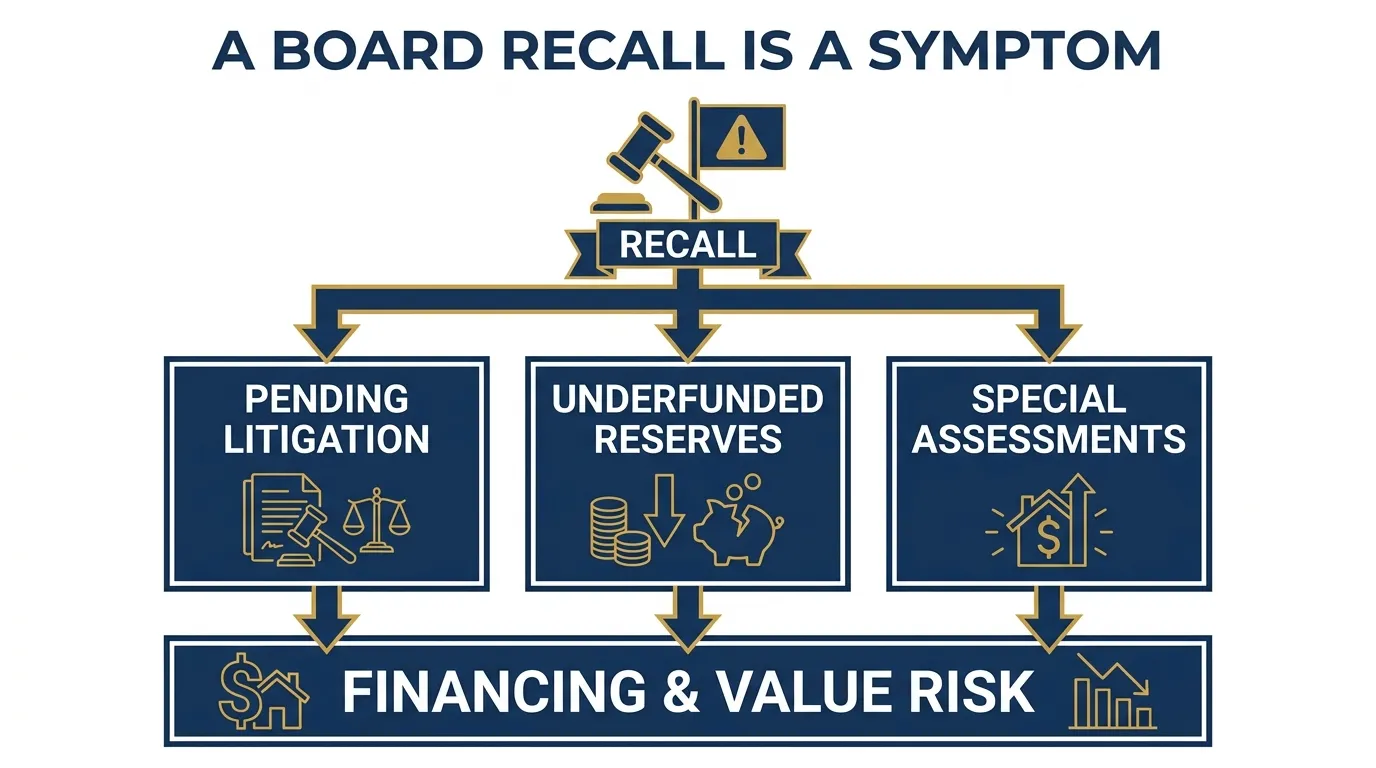
A recall is a symptom. The underlying problems it points to, not the recall itself, are what affect your financing and your resale.
It is tempting to read a recall as a good sign, proof that the owners are engaged and cleaned house. Sometimes it is. But from a buyer's seat, the recall is a symptom, and the diagnosis is what matters. A community that had to remove its board is a community that had a serious enough problem to organize around, and the underlying problem does not disappear when the directors do.
There is an honest limit here worth stating plainly. There is no reliable public dataset that isolates "board recall" and measures its effect on sale prices or days on market, so no one can tell you a recall lowers value by a specific percentage. What is well documented is the chain underneath it. The issues that drive recalls, meaning pending litigation, underfunded reserves, and looming special assessments, have clear and measurable effects on whether a unit can be financed and what it will sell for. A recall is the flare that tells you to go look for those.
The Real Risk: Financing and Reserves
Certain HOA litigation makes a condo ineligible for a conventional loan, and thin reserves are about to face a higher federal bar.
This is where a recall stops being a governance story and becomes a financing story. Two mechanisms do most of the damage.
First, litigation. Under Fannie Mae's project eligibility rules, a condo project is ineligible for a conventional loan when the association is a party to litigation relating to the safety, structural soundness, habitability, or functional use of the project. Litigation is treated as acceptable only under narrow carve-outs, one of which is a financial test: the anticipated damages and legal expenses must not be expected to exceed 10% of the project's funded reserves (Fannie Mae Selling Guide B4-2.1-03). When a recall coincides with the kind of dispute that turns into a lawsuit, conventional financing can come off the table, which shrinks the buyer pool toward cash and drags on price. Our explainer on what happens when a condo fails the lender questionnaire covers how that plays out at the closing table.
Second, reserves. The problem that most often gets a board recalled is money that was never set aside for big repairs. According to Association Reserves, which has analyzed more than 100,000 reserve studies, roughly 74% of associations are underfunded, sitting below the 70% funded level that reserve professionals consider "strong." Their percent-funded tiers put 0 to 30% funded in the "weak" band, 30 to 70% as "fair," and 70% or above as "strong." That bar is about to rise. Under Fannie Mae Lender Letter LL-2026-03, the minimum reserve contribution climbs from 10% to 15% of budgeted assessment income for loan applications dated on or after January 4, 2027, and the Limited Review shortcut for established projects is retired for applications dated on or after August 3, 2026 (sources: Whiteford client alert; Association Reserves). A community that was already marginal on reserves, the kind that tends to get its board recalled, is exactly the kind that falls below the new line.
The takeaway ties the whole post together. The recall points you at the money. The reserve study and the budget tell you whether the money problem is bad enough to threaten your own financing and your eventual resale.
How to Spot It in the Documents
Read 12 to 24 months of minutes, request the recall certification, check for litigation, and pull the reserve study and budget.
Everything above is discoverable before you remove a contingency, using documents the association already produces. When a recall shows up, or when the governance just feels unstable, work through this list:
- Read 12 to 24 months of meeting minutes. Look for recall petitions, "special" or "emergency" meeting notices, contested or annulled elections, mass resignations, and quorum failures. This reconstructs what actually triggered the recall.
- Request the recall certification record. In Florida, ask for the certification-meeting minutes and any DBPR arbitration filing. Whether the recall was certified, contested, or is still unresolved tells you how healthy the governance is right now.
- Check for pending litigation. The estoppel or resale certificate and the minutes should disclose it. Map it against the Fannie rule above and confirm financeability with your lender early, not after you are in contract.
- Pull the reserve study and current budget. Check the percent funded against the 70% "strong" and 30% "weak" tiers, look for any special assessment already approved or on the horizon, and see whether reserve contributions clear the incoming 15% federal minimum.
- Look for management-company turnover. Repeated changes of the management company or on-site manager, recorded in the minutes and contracts, is its own instability signal.
Reading two years of minutes and a reserve study by hand is slow, and it is exactly the diligence that gets skipped under a tight contingency clock. That is what our tools are for. The free meeting minutes analyzer surfaces recall petitions, contested elections, and unresolved disputes buried in the record, and the reserve study analyzer pulls the percent funded and special-assessment risk in seconds. For the full pre-offer routine, see the complete condo buying checklist. Anything that lands in the disqualifying-litigation or major-assessment zone is worth an attorney's eyes before you commit.
Frequently Asked Questions
What does it mean when an HOA board is recalled?
It means the owners voted to remove one or more directors before their terms ended, usually without having to prove cause. A recall is different from an election or a resignation: it is the membership forcing sitting directors out, typically after a dispute over finances, maintenance, enforcement, or access to records. For a buyer, it signals that the community had a serious enough problem to organize around.
Does a recalled HOA board lower property values?
There is no public dataset that isolates board recalls and measures their effect on price or days on market, so no one can honestly claim a specific percentage. What does affect value and financing are the problems that usually cause a recall: pending litigation that can make a unit non-warrantable, underfunded reserves, and looming special assessments. The recall is a symptom that tells a buyer where to investigate.
How do owners recall an HOA board in Florida?
Under Fla. Stat. §718.112(2)(l) (condos) and §720.303(10) (HOAs), a majority of all voting interests can recall directors with or without cause, either by a vote at a members' meeting or by written agreement. The board must meet within 5 full business days to certify the recall. If it refuses, it must file for binding arbitration with the state or a court action; if it does nothing, the recall is automatically effective and records must be turned over.
Can a board refuse to step down after a recall?
It can try, but there is a process for that. In Florida, a board that will not certify a recall must take it to binding arbitration or court within 5 business days, and inaction makes the recall effective by default. In California, an owner whose valid recall the board ignores has to seek an injunction in superior court. A board that stonewalls a lawful recall is itself a significant governance red flag for a buyer.
Should I still buy a condo where the board was recalled?
A recall is not an automatic dealbreaker, but it is a reason to do more diligence, not less. Read 12 to 24 months of minutes to understand what triggered it, check the estoppel certificate and minutes for pending litigation, and pull the reserve study and budget to gauge the financial health underneath. If the recall grew out of disqualifying litigation or a major assessment, have an attorney review before you remove contingencies.
Get Your HOA Documents Analyzed
GoverningDocs analyzes CC&Rs, reserve studies, and meeting minutes, identifying red flags, restrictions, and financial risks so you can buy with confidence. Free. No signup required.
Your first full property report is also free. See what you'll get →
Or get your first full report free →Related Articles
Sources & References
- Fla. Stat. §718.112 (condominium board recall: majority of voting interests, 5-business-day certification, subsection (2)(l))
- Fla. Stat. §720.303(10) (HOA board recall, certification window, and records turnover)
- Fla. Admin. Code R. 61B-80.102 (HOA recall dispute arbitration procedure; condo recall arbitration is in Chapter 61B-50)
- NRS 116.31036 (Nevada removal of a unit-owner-elected board member: votes in favor must total at least 35% of all members and a majority of votes cast)
- Cal. Corp. Code §7222 and §7510 (California removal without cause and 5% special-meeting petition)
- Colo. Rev. Stat. §38-33.3-303(8) (Colorado removal by 67% of those present and voting)
- Ariz. Rev. Stat. §33-1813 (Arizona planned-community board removal; §33-1243 for condos)
- Wash. Rev. Code 64.90.520 (WUCIOA officer and board-member removal)
- Tex. Prop. Code Ch. 209 (Texas Residential Property Owners Protection Act; no standalone recall statute)
- Fannie Mae Selling Guide B4-2.1-03 (ineligible projects: litigation relating to safety/structure/habitability; 10%-of-reserves minor-litigation test)
- Association Reserves (74% of associations underfunded) and percent-funded tiers (0-30% weak / 30-70% fair / 70%+ strong)
- Whiteford client alert on Fannie Mae LL-2026-03 (reserve minimum 10% to 15% on Jan 4, 2027; Limited Review retired Aug 3, 2026)
Disclaimer: This article is for educational purposes only and does not constitute legal, financial, or real estate advice. HOA recall procedures, lending rules, and reserve requirements vary by state and change over time, and courts and regulators apply them to the specific facts of each case. Figures and citations are current as of July 2026 and may be superseded. Read your community's actual governing documents and consult a qualified real estate attorney for guidance specific to your situation.