

In This Guide
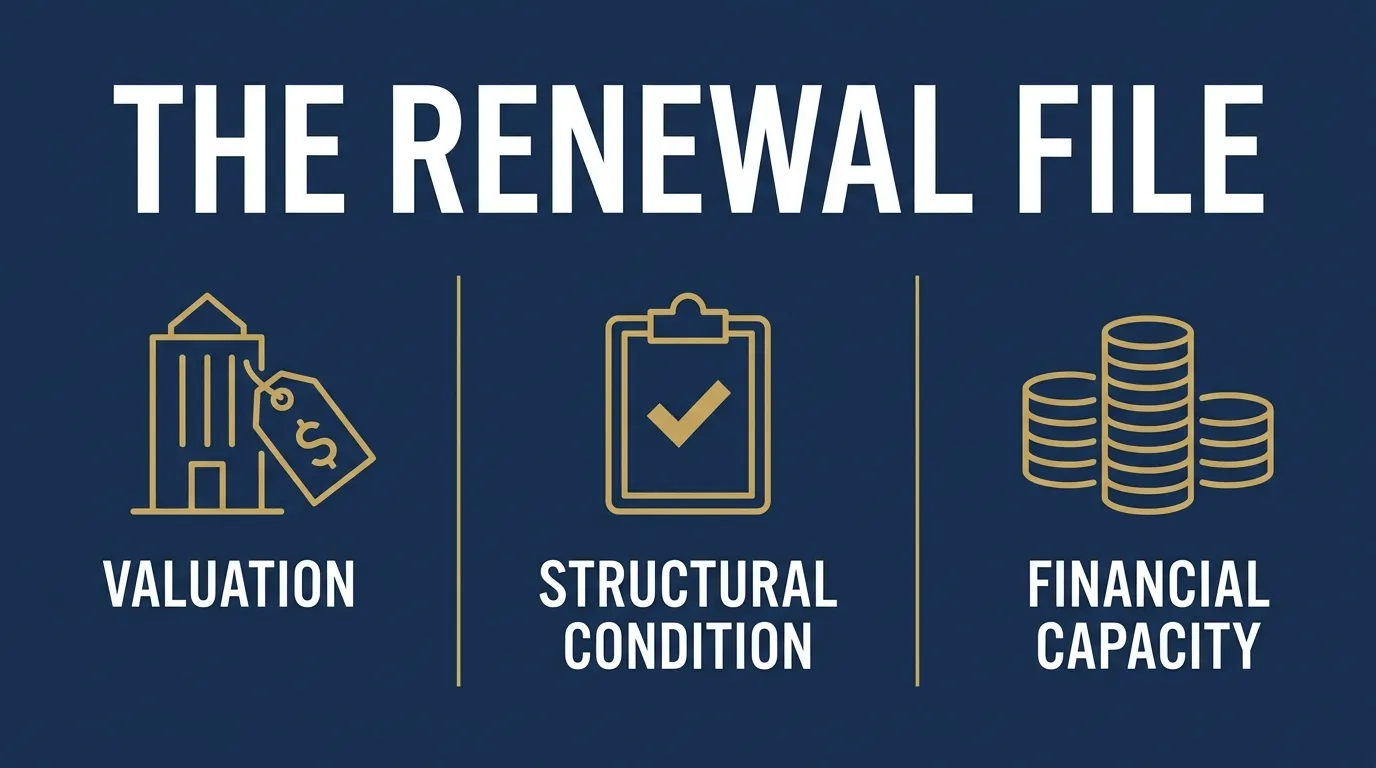
At renewal, an underwriter is testing three things about your association: what the property would cost to rebuild, what condition it is in, and what the association can absorb financially. Each one is answered by a document, most of those documents are on a statutory clock, and the same file is read again every time a unit in the building is financed.
Every board eventually has the same meeting. The renewal quote lands, the number is worse than expected, and somebody asks why. The manager explains that the market is difficult. Everyone nods, approves the budget line, and the conversation ends.
That explanation is getting harder to sustain, because the market is no longer uniformly difficult. Marsh's quarterly index put global commercial insurance rates down 6% on average in the second quarter of 2026, with property rates down 12%, following a first quarter that was the seventh consecutive quarter of declines. Rates in the United States moved less, with the overall composite down 2% in Q2. Capacity came back, and competition came with it. (Insurance Journal, reporting the Marsh Q2 2026 index)
So a softer market exists. The open question for any individual association is whether it gets to participate. Marsh described the same quarter this way: "Risk differentiation continued to increase, with underwriting outcomes increasingly driven by exposure quality and risk management." Differentiation is the whole story for a condominium board, because differentiation is done on paper. An underwriter cannot walk your roof or interview your engineer. They read your file, and they price what the file proves.
This guide walks through what is in that file, what each document is actually being used to test, and which of them your association is legally required to have regardless of what any carrier asks. If you want the buyer-side and financing version of this topic, that is covered separately in our guide to the condo insurance crisis and mortgage approval, and the complete guide to HOA insurance covers how the master policy, HO-6 and flood coverage fit together.
1. The Market Softened. Your Renewal Might Not Have.
Global property rates fell 12% in Q2 2026, but underwriters are differentiating harder. Rate relief follows accounts that can document quality.
The Marsh figures come with an important caveat, and it is worth stating plainly before a board takes them into a renewal meeting. Those are global composite figures across all of commercial insurance, and Insurance Journal notes that the Marsh index "skews toward larger account business." They describe the direction of a market. They are not a forecast for a specific condominium tower in a coastal county, and a 12% global property decline does not entitle any association to a 12% reduction.
What the numbers do establish is that the excuse has narrowed. When every account was being non-renewed, a bad quote proved nothing about a particular building. In a market with returning capacity, a bad quote starts to say something specific about the risk being presented. Marsh noted that catastrophe-exposed programs in the US above $1 million in premium saw rates decline 20% in Q2, while non-catastrophe programs under $1 million in premium dropped 10%. The relief is real, and it is uneven. (Marsh Q2 2026 index, via Insurance Journal)
The rest of this guide is about the part a board actually controls. You cannot move reinsurance pricing or hurricane frequency. You can control whether the underwriter reviewing your account is working from a complete, current, internally consistent file, or from gaps they will price conservatively.
2. The Valuation File: What Your Limit Is Built On
Where replacement cost sets the coverage amount, Florida requires it be redetermined at least once every 3 years under §718.111(11)(a)2.
The single most load-bearing document in a renewal file is the one that establishes what the property would cost to rebuild. Everything else in the policy is derivative. The limit comes from it, the premium is rated against it, and at claim time the adequacy of the coverage is measured by it.
Florida turns this into a statutory duty rather than a best practice. Section 718.111(11)(a) opens by requiring that "[e]very condominium association shall have adequate property insurance as determined under this paragraph." Subparagraph (a)2 then sets the mechanics: the amount of adequate coverage for full insurable value or replacement cost "may be based on the replacement cost of the property to be insured, as determined by an independent insurance appraisal or an update of a previous appraisal," and where it is, the statute is explicit about the cycle: "The replacement cost must be determined at least once every 3 years, at minimum." (Fla. Stat. §718.111(11))
The obligation to obtain the coverage itself is framed as a best-efforts standard. For associations controlled by unit owners, §718.111(11)(d) requires the association to "use its best efforts to obtain and maintain adequate property insurance." (Fla. Stat. §718.111(11)(d)) That is a meaningful distinction. The statute does not guarantee that adequate coverage is always available at a price the association can pay. It does expect the association to be able to show what it did about it.
An expired appraisal creates two separate problems at once. The compliance problem is visible on its face. The coverage problem is quieter and usually worse: construction costs have moved considerably over any three-year window, so a stale valuation tends to understate the rebuild number, and a limit built on an understated number is a coinsurance and shortfall exposure that nobody discovers until there is a loss.
The same statute also draws the line between what the association's policy covers and what belongs to the unit owner. Under §718.111(11)(f), the association policy reaches "[a]ll portions of the condominium property as originally installed or replacement of like kind and quality" along with alterations or additions made to the condominium property, while the policy must exclude personal property within the unit along with floor, wall, and ceiling coverings, electrical fixtures, appliances, water heaters, water filters, built-in cabinets and countertops, and window treatments located within the unit boundaries and serving only that unit. Subparagraph (f)3 puts that property, and the insurance on it, with the unit owner. (Fla. Stat. §718.111(11)(f)) Boards that cannot articulate that boundary tend to discover it during a claim, which is the most expensive time to learn it.
3. The Structural File: Milestone, SIRS, and Balconies
Florida milestone inspections start at 30 years for buildings three habitable stories or more. California balcony reports were due January 1, 2025.
Structural condition reports were written into state law for life-safety reasons, not underwriting ones. But they now function as the most credible third-party statement available about the physical condition of a building, which makes them exactly the kind of document that separates one account from another.
Florida: the milestone inspection
Under Fla. Stat. §553.899, condominium and cooperative buildings "three habitable stories or more in height" require a milestone inspection by December 31 of the year the building reaches 30 years of age, and every 10 years after that. Local enforcement agencies may pull that trigger forward to 25 years where local circumstances, including environmental conditions such as proximity to salt water, warrant it. (Fla. Stat. §553.899)
Phase one is a visual examination producing a qualitative assessment of structural condition. Phase two happens only if phase one identifies substantial structural deterioration, and it may involve destructive or nondestructive testing. Two clocks matter for a board's calendar: the phase one report is due within 180 days of receiving notice, and the association must distribute the summary to unit owners within 45 days after receiving the report.
Florida: the structural integrity reserve study
The SIRS requirement under Fla. Stat. §718.112(2)(g) applies to each building on the condominium property that is three habitable stories or higher, at least every 10 years. It covers roof, structure and load-bearing walls, fireproofing, plumbing, electrical, waterproofing and exterior painting, windows and doors, plus a narrower catch-all than it first appears. Sub-subparagraph (g)1.h reaches "[a]ny other item that has a deferred maintenance expense or replacement cost that exceeds $25,000 or the inflation-adjusted amount determined by the division…whichever is greater, and the failure to replace or maintain such item negatively affects the items listed in sub-subparagraphs a.-g., as determined by the visual inspection portion of the structural integrity reserve study." Both conditions have to be met, so the threshold alone does not pull an item in. The division adjusts that threshold annually for inflation and posts the updated figure by February 1. (Fla. Stat. §718.112(2)(g))
Associations existing on or before July 1, 2022 and controlled by unit owners were required to complete the study by December 31, 2025. An association required to complete a milestone inspection on or before December 31, 2026 may run the two simultaneously, but the statute closes the door behind that option: "In no event may the structural integrity reserve study be completed after December 31, 2026." Any board that is still without one is out of compliance and is also missing the document that most directly answers an underwriter's condition question.
California: exterior elevated elements
California's analog sits in Cal. Civ. Code §5551. At least once every nine years, the board of a condominium association must cause a visual inspection by a licensed structural or civil engineer or architect of a random and statistically significant sample of exterior elevated elements, meaning the balconies, decks, stairways, and walkways it maintains. The statute applies to buildings containing three or more attached multifamily dwelling units. (Cal. Civ. Code §5551)
Two details get misreported often enough to be worth stating precisely. First, the deadline: §5551(i) says "[t]he first inspection shall be completed by January 1, 2025, and then every nine years thereafter." The January 1, 2026 date that circulates in balcony-law coverage belongs to SB 721 and apartment buildings, not to community associations. Second, the report does not stop at the board. Under §5551(f) it is "presented to the board, and incorporated into the study required by Section 5550," the reserve study. A finding becomes a funding obligation by operation of statute.
If an inspector finds an immediate threat to occupant safety, §5551(g) requires the report to go to the association immediately and to local code enforcement within 15 days, and the association must take preventive measures right away, including preventing access until repairs are inspected and approved. Deeper treatment of these inspections lives in our guides to Florida milestone inspections and California's SB 326 balcony law.
4. The Money File: Reserves and Deductible Capacity
Florida boards set deductibles based on available funds and assessment authority, so reserves and coverage decisions are the same conversation.
Boards tend to treat reserves as an accounting subject and insurance as a procurement subject. Florida law connects them directly. Under §718.111(11)(c)3, "[t]he board shall establish the amount of deductibles based upon the level of available funds and predetermined assessment authority at a meeting of the board in the manner set forth in s. 718.112(2)(e)." The same paragraph requires that the deductibles "be consistent with industry standards and prevailing practice for communities of similar size and age, and having similar construction and facilities in the locale where the condominium property is situated." (Fla. Stat. §718.111(11)(c)3)
Read that as an instruction about sequence. The deductible an association can responsibly carry is a function of what it can actually absorb, which is a function of reserves and assessment capacity. A board that raises its deductible purely to hold the premium down, without the funds behind it, has not reduced its cost of risk. It has moved the risk onto a balance sheet that may not be able to hold it.
The structural reports feed the same equation. For a budget adopted on or after December 31, 2024, the members of a unit-owner-controlled association that must obtain a structural integrity reserve study "may not determine to provide no reserves or less reserves than required by this subsection for items listed in paragraph (g)," with an exception for associations operating a multicondominium where the division has approved an alternative funding method. Note the wording: the no-waiver rule attaches to the statutory component categories in paragraph (g), not to whatever a particular study happens to recommend. (Fla. Stat. §718.112(2)(g)) The practical effect is that for the structural categories the statute enumerates, the reserve line stops being discretionary, and that funding obligation is what an underwriter is indirectly assessing when they ask about reserves.
California reaches a similar place by a different route, since §5551(f) pushes the balcony findings into the §5550 reserve study rather than leaving them as a standalone engineering opinion. In both states, the honest summary is that the condition report and the funding plan are supposed to be one document set, and a board whose reserve study does not reflect its most recent structural findings has an internal inconsistency that a careful reader will notice.
If you want to see how a reserve study reads to someone evaluating it from outside, our free reserve study analysis tool pulls out percent funded, deferred maintenance, and contribution trends without a signup.
5. The Same Documents Get Read Twice
Fannie Mae caps the master policy deductible at 5% of the coverage amount, so a deductible chosen for premium relief can affect financing.
The renewal file has a second audience the board rarely has in mind while assembling it. Mortgage underwriting reviews the same master policy, against fixed published standards, every time a unit in the building is financed.
Fannie Mae's Selling Guide requires master property coverage "at least equal to 100% of the replacement cost value of the project improvements, including common elements and residential structures." On deductibles it is specific: "The maximum allowable deductible for all required property insurance perils is 5% of the master property insurance coverage amount," and where multiple deductibles apply, the total for a single occurrence must also stay within 5% of the coverage amount. Fannie will allow a per-unit deductible whose applicable sum exceeds 5% of the coverage amount only where several conditions are met, one of which is that unit owner policies carry loss assessment coverage sufficient to cover assessments above 5% of the master coverage amount divided by the number of units. (Fannie Mae Selling Guide B7-3-03)
Put the two standards side by side and the trap is obvious. A board under premium pressure raises the deductible. That decision is legitimate under Florida law if the funds and assessment authority support it. It can simultaneously push the building past a secondary-market threshold, which shows up months later as financing friction on resales that nobody connects back to the renewal meeting.
Fidelity and crime coverage works the same way. Fannie requires it for condo and cooperative projects, with exceptions that include projects qualifying for a waiver of project review, "condo or co-op projects consisting of 20 units or less," and projects that would need $5,000 or less of coverage. Where financial controls are in place, the required amount is "the sum of three months of assessments on all units in the project." Without those controls, it rises to the maximum funds in the custody of the association or its management agent at any time. (Fannie Mae Selling Guide B7-4-02)
The unit-owner side of this, including how loss assessment coverage actually behaves when a special assessment lands, is covered in our guide to the HO-6 loss assessment gap.
6. Building the File Before the Carrier Asks
Work backward from the statutory cycles. An appraisal, a structural report, and a reserve study each take months to obtain, not weeks.
There is no published industry checklist that every carrier uses, and boards should be skeptical of anything presented as one. What does exist is a set of statutory cycles that determine whether the underlying document is current on the day the underwriter looks, and those cycles are the schedule worth managing to.
- The three-year clock. In Florida, replacement cost must be redetermined at least every three years under §718.111(11)(a)2. Know the date of the last appraisal, not the year.
- The age clock. Milestone inspections trigger at 30 years, or 25 in jurisdictions that adopted the earlier trigger. This is knowable a decade in advance.
- The ten-year clock. SIRS at least every 10 years for buildings three habitable stories or higher; milestone re-inspection every 10 years after the first.
- The nine-year clock. California exterior elevated element inspections, coordinated with the §5550 reserve study.
- The consistency check. Whatever the most recent structural report found should appear in the reserve study and in the funding plan. If it does not, fix that before a third party notices it.
One point on disclosure. When a board has a gap, the instinct is sometimes to present the cleanest possible picture and hope the question is not asked. Insurance applications are answered by the association, and a material misstatement on an application is a coverage problem of a completely different order than a bad quote. A documented deficiency with a funded repair plan attached is a far better position than a deficiency that surfaces during a claim investigation.
Boards also underestimate lead time. An independent appraisal, an engineer's structural inspection, and an updated reserve study are professional engagements with scheduling queues, and in markets where every association in the county is under the same statutory deadline, those queues get long. A renewal file assembled the month before expiration is assembled from whatever already exists.
The recurring theme across all six of these is that the documents are not paperwork produced for the carrier. They are the association's own record of what it owns, what condition it is in, and what it has set aside. The carrier is simply the reader who prices the answer. Older buildings carry more of these obligations at once, and how the documents of an aging building read to an outside reviewer is covered in our guide to what a condo's age reveals in its HOA documents.
Frequently Asked Questions
How often does a Florida condominium association need a new insurance appraisal?
Section 718.111(11)(a) requires every condominium association to have adequate property insurance as determined under that paragraph. Under subparagraph (a)2, the amount of that coverage may be based on the replacement cost of the property to be insured, as determined by an independent insurance appraisal or an update of a previous appraisal, and where it is, the replacement cost must be determined at least once every 3 years, at minimum. An update of a prior appraisal satisfies the requirement, so the engagement is often smaller than a first-time appraisal.
Which buildings need a Florida milestone inspection, and when?
Fla. Stat. §553.899 applies to condominium and cooperative buildings three habitable stories or more in height. The inspection is due by December 31 of the year the building reaches 30 years of age, then every 10 years. Local enforcement agencies may require it at 25 years where local circumstances such as proximity to salt water warrant. Phase one is due within 180 days of notice, and the association distributes the summary to owners within 45 days of receiving the report.
Was the California balcony inspection deadline January 1, 2025 or January 1, 2026?
For community associations, Cal. Civ. Code §5551(i) states that the first inspection shall be completed by January 1, 2025, and then every nine years thereafter in coordination with the reserve study under §5550. The January 1, 2026 date that appears in much of the balcony-law coverage comes from SB 721, which governs apartment buildings rather than condominium associations.
Can a board raise the master policy deductible to lower the premium?
In Florida, §718.111(11)(c)3 requires the board to establish deductibles based upon the level of available funds and predetermined assessment authority, at a meeting of the board. Separately, Fannie Mae's Selling Guide caps the maximum allowable deductible for required property insurance perils at 5% of the master property insurance coverage amount, so a deductible set above that threshold can affect financing for units in the project even where the association's own analysis supports it.
Does a structural inspection finding have to be funded?
In Florida, for a budget adopted on or after December 31, 2024, the members of a unit-owner-controlled association that must obtain a structural integrity reserve study may not determine to provide no reserves or less reserves than required for the items listed in §718.112(2)(g), with an exception for multicondominium associations using a division-approved alternative funding method. The rule attaches to those statutory component categories rather than to every recommendation a study contains. In California, §5551(f) requires the exterior elevated element report to be incorporated into the reserve study under §5550. Specific obligations depend on the association's documents and circumstances, so a community association attorney should review any particular situation.
Get Your HOA Documents Analyzed
GoverningDocs analyzes CC&Rs, reserve studies, and meeting minutes, identifying red flags, restrictions, and financial risks so you can buy with confidence. Free. No signup required.
Your first full property report is also free. See what you'll get →
Or get your first full report free →Related Articles
Sources & References
- Fla. Stat. §718.111(11) (adequate property insurance, replacement cost determined at least once every 3 years, deductibles set at a board meeting, association vs unit owner coverage allocation)
- Fla. Stat. §553.899 (milestone structural inspections, 30-year trigger with 25-year local option, phase one and phase two, 180-day and 45-day reporting)
- Fla. Stat. §718.112(2)(g) (structural integrity reserve study scope, components, $25,000 inflation-adjusted threshold, deadlines, reserve no-waiver rule)
- Cal. Civ. Code §5551 (exterior elevated element inspections, nine-year cycle, January 1 2025 first deadline, incorporation into the §5550 reserve study, immediate-threat procedure)
- Fannie Mae Selling Guide B7-3-03 (100% replacement cost value, 5% maximum deductible, per-unit deductible and loss assessment requirement)
- Fannie Mae Selling Guide B7-4-02 (fidelity and crime insurance requirements, exceptions, three-months-of-assessments formula)
- Insurance Journal, July 23, 2026 (Marsh Q2 2026 Global Insurance Market Index: composite down 6%, property down 12%, US down 2%, risk differentiation commentary)
- Marsh, Q1 2026 Global Insurance Market Index (composite down 5%, property down 9% globally, seventh consecutive quarter of decreases)
Disclaimer: This article is for educational purposes only and does not constitute legal, financial, insurance, or real estate advice. Insurance requirements, statutory inspection cycles, and secondary-market standards vary by state and by community, and they change over time. Nothing here evaluates the adequacy of any particular policy, limit, or deductible. Citations are current as of July 2026 and may be superseded. Consult your association's insurance professional and a qualified community association attorney for guidance specific to your situation.