
In This Guide
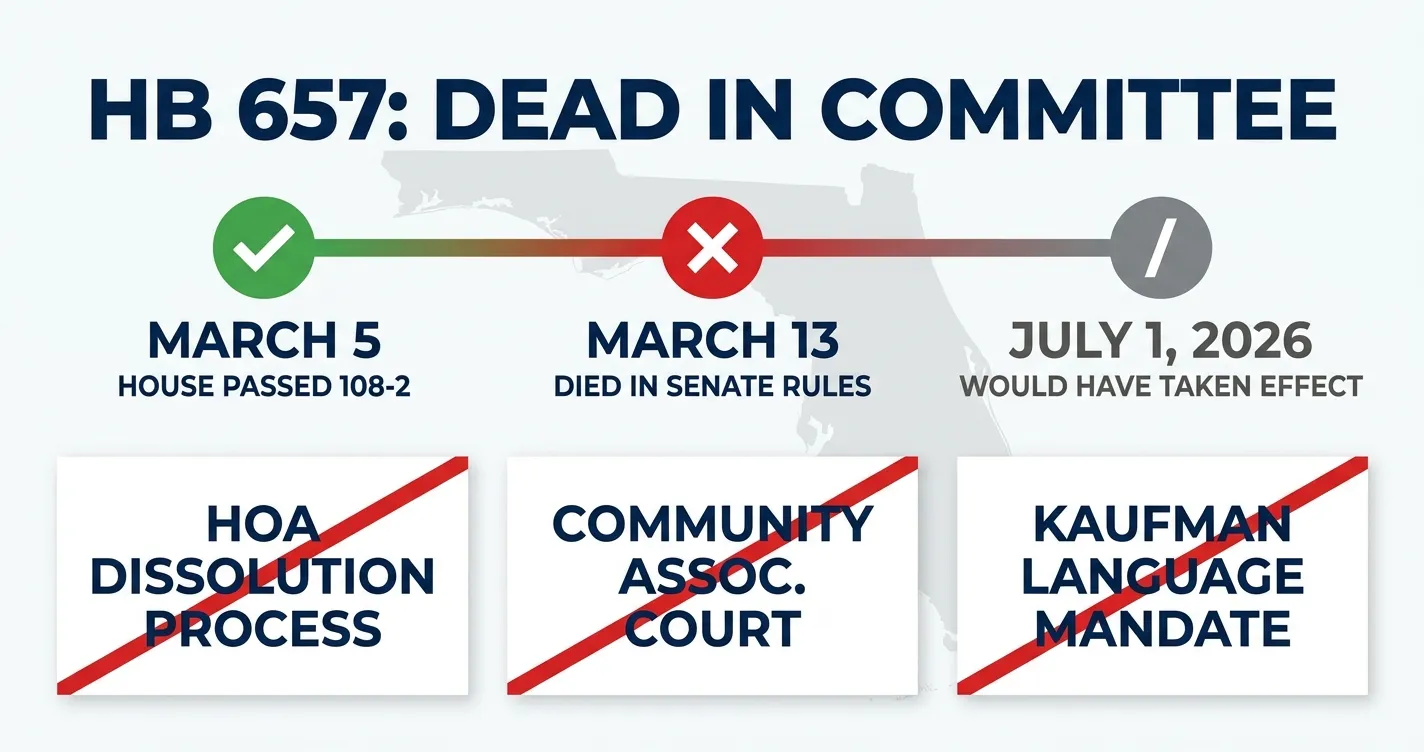
Florida HB 657, the 2026 session's largest HOA reform package, died in the Senate Rules Committee on March 13, 2026 without ever receiving a hearing. The bill passed the House 108 to 2 but stalled in the Senate. For Florida condo and HOA buyers, that means no new dissolution process, no state community-association court, and no mandatory Kaufman language in 2026 or 2027. Buyer-side due diligence is the only path.
What Happened: HB 657 Died in Senate Rules
HB 657 passed the Florida House 108 to 2 on March 5, 2026. Eight days later, the Senate adjourned without ever bringing it up for a committee vote.
Rep. Juan Carlos ("JC") Porras (R-Miami) filed HB 657 as what he called the largest community-association reform bill in a decade. It sailed through the House on March 5 with only two no votes, from Rep. Linda Chaney (R-St. Pete Beach) and Rep. Lindsay Cross (D-St. Petersburg), per Florida Politics.
From there it went to the Senate, where companion bills SB 924 and SB 1498 were waiting. None of the three moved. The Senate Rules Committee never scheduled HB 657 for a hearing. On March 13, 2026, the Legislature adjourned sine die. Per the official Florida Senate bill page, HB 657's last recorded action that day is: died in Rules.
Porras has publicly conceded the bill is finished for the 2026 session, telling Florida Politics the Senate had been "largely silent" on what he described as landmark legislation for the millions of Floridians living under unaccountable associations. This is the second year in a row a version of HB 657 has died without a Senate hearing.
What HB 657 Would Have Changed
Three structural reforms: a formal HOA dissolution process, a specialized state court for association disputes, and mandatory Kaufman language in governing documents. All dead.
Per the final House staff analysis, the bill would have taken effect July 1, 2026 and would have done four things that matter for buyers:
- Formal HOA dissolution process. Owners could file a petition signed by at least 20% of voting interests to force the board to call a termination meeting. A supermajority vote of two-thirds of all voting interests, plus judicial oversight, would be required to actually terminate the association and distribute assets. There is no clean equivalent in current Chapter 720.
- Community Association Court Program. The bill would have authorized each judicial circuit to establish a dedicated track for disputes under Chapters 718, 719, and 720. That court would have had power to enforce statutory rights, order dissolution, impose civil penalties, and issue injunctive relief.
- Kaufman language mandate. HOAs and condo associations formed after July 1, 2026 would have been required to include Kaufman language in their governing documents. Older associations would have had to hold a member vote by January 1, 2027 to decide whether to add it. Kaufman language (from the 1977 FL 3d DCA case Kaufman v. Shere) is the phrase "as amended from time to time," and its presence means future statute changes apply to the association automatically. Without it, new Florida condo and HOA laws often do not reach associations formed before the law passed.
- End of presuit mediation. The bill would have removed the mandatory presuit mediation step for many association disputes, replacing it with direct access to arbitration or the new court track.
None of these are law. Current FL Chapter 720 and Chapter 718 continue unchanged.
Get Your CC&Rs Analyzed
Upload your HOA's CC&Rs and get instant analysis of rental restrictions, pet policies, financing red flags, and more. Free. No signup required.
Your first full property report is also free. See what you'll get →
Or get your first full report free →What Didn't Change: FL Condo Law as It Stands Today
With HB 657 dead, buyers still face the patchwork dissolution rules, the presuit mediation requirement, and the Kaufman gap that the bill was trying to fix.
Here is what Florida condo and HOA buyers should know about the current legal landscape in April 2026:
- No unified dissolution process. Chapter 720 does not provide a clean statutory path to dissolve a homeowners association. Dissolution falls back on whatever is written in the association's declaration, combined with the general nonprofit-dissolution procedures under Chapter 617 (the Not-for-Profit Corporation Act). If the declaration is silent or sets an extremely high threshold, there is effectively no path.
- Presuit mediation still required. Many association disputes still have to go through presuit mediation before an owner can file suit. That remains a significant cost and time barrier.
- Kaufman gap persists. Associations without Kaufman language in their declaration are often not automatically subject to later statutory changes. An older condo declaration may be frozen under the law that existed when it was recorded decades ago.
- SIRS and milestone inspection deadlines unchanged. The big post-Surfside requirements still apply. Three-story-plus residential condos and cooperatives still face milestone inspection deadlines, Structural Integrity Reserve Studies, and the ban on reserve waivers for eight critical building components. That part of Florida law is fully active, and Fannie Mae and Freddie Mac are now enforcing reserve requirements on the financing side as of March 2026.
In other words, the parts of Florida condo law that squeeze owners with special assessments and hard deadlines remain in place. The parts that would have given owners new remedies did not pass.
What Buyers and Agents Should Do Instead
If the state is not going to add guardrails, the only remaining guardrail is the buyer's own due diligence on the governing documents.
Without HB 657, there is no new state-level accountability mechanism coming for Florida HOAs and condos until at least the 2027 session, and even that is speculative. Until then, buyers and their agents carry the risk. A practical checklist:
- Check the declaration for Kaufman language. Look for the phrase "as amended from time to time" or equivalent language in the recitals of the declaration. If it is missing, newer statutory protections may not apply to that association, which affects everything from reserve requirements to director term limits. Our CC&R analysis tool surfaces this automatically.
- Pull 12 to 24 months of board meeting minutes. Minutes reveal governance dysfunction, insurance non-renewals, reserve shortfalls, and pending litigation long before any of it shows up in a budget. See what to look for in meeting minutes.
- Read the most recent reserve study. Confirm the percent funded, required contributions, and component conditions. Florida's structural integrity reserve study is separately mandatory for qualifying buildings.
- Check the delinquency rate. Fannie Mae and Freddie Mac already enforce a 15% delinquency cap for warrantability. If more than 15% of units are 60+ days past due, conventional financing may not be available for any buyer in the project.
- Review pending litigation. Ask for the association's current litigation disclosure. Active lawsuits against the association can cascade into special assessments, insurance non-renewal, and warrantability issues.
- Match insurance to risk. After the master policy changes tied to the condo insurance crisis, confirm the building's coverage meets current Fannie Mae Selling Guide B7-3-03 requirements.
That six-item checklist is what HB 657 was trying to make less necessary. With the bill dead, the checklist stays.
Frequently Asked Questions
Did Florida HB 657 pass in 2026?
No. HB 657 passed the Florida House 108 to 2 on March 5, 2026 but died in the Senate Rules Committee on March 13, 2026, the same day the Legislature adjourned sine die. The bill never received a Senate committee hearing. Companion bills SB 924 and SB 1498 also died.
Could HB 657 come back in a special session or in 2027?
Florida has scheduled two special sessions in 2026, but those are expected to focus on the state budget. Community association reform is not on the announced call. Rep. Porras filed similar legislation in 2025 and 2026, and both died in the Senate. A third attempt in 2027 is plausible but not confirmed.
What should Florida condo buyers do now that HB 657 is dead?
Since no new state-level accountability mechanism is coming, buyers and their agents should lean harder on document-level due diligence before making an offer. That means reading the declaration (including checking for Kaufman language), pulling 12 to 24 months of board meeting minutes, reviewing the most recent reserve study, confirming the delinquency rate is under 15%, asking for the litigation disclosure, and verifying the master insurance policy meets Fannie Mae Selling Guide B7-3-03.
The state isn't adding guardrails. Your documents are the guardrail.
Upload the declaration, reserve study, or meeting minutes. Get an instant risk report: Kaufman language presence, delinquency signals, reserve shortfalls, pending litigation, and insurance red flags. Built on analysis of 1,900+ HOA documents. No signup required.
Related Articles
Sources & References
- Florida Senate - HB 657 (2026) Bill Page - Primary source showing last action: died in Rules March 13, 2026
- HB 657 Final House Staff Analysis (h0657g.COM.PDF) - Detailed provisions, dissolution thresholds, Kaufman mandate timing
- Florida Politics - House Passes HOA Bill (March 5, 2026) - 108-2 vote, Chaney and Cross as nays
- Florida Politics - Senate Cold Shoulder Likely Dooms HB 657 - Porras concedes the bill is dead
- FastDemocracy - HB 657 Bill Tracking - Companion bills SB 924 and SB 1498, both also died
- WCTV - Florida Legislature Ends Session (March 13, 2026) - Sine die date, two special sessions planned
- Axela - What Is Kaufman Language - Kaufman v. Shere (1977 FL 3d DCA) origin and "as amended from time to time" phrasing
- Florida Bar Journal - Community Association Law and the Contracts Clause - How Kaufman language affects retroactive statute application
- How to Dissolve a Florida HOA - Current law patchwork under Chapter 720 + Chapter 617
- Bryan Law - HB 657 Explained - July 1, 2026 effective date summary
Disclaimer: This article is for educational purposes only and does not constitute legal, financial, or real estate advice. Florida community association law is complex and changes frequently. Bill status, statute interpretations, and enforcement practices can change. Anyone considering action based on the status of HB 657, an HOA dissolution question, or a specific governing document issue should consult a qualified Florida attorney.