
In This Guide
In most states an agent owes no duty to obtain and interpret association documents, and the statutory protections that do exist attach to delivering the package rather than explaining it. Four rule changes landed in 2026. Two of them never appear in the packet at all, which makes them a conversation with the loan officer rather than something to catch in your own review.
You have a condo under contract. The inspection period is running, the appraisal is ordered, and the association's document package has not arrived. Your client is asking whether the building is a problem, and the honest answer is that nobody can tell yet.
The file is now moving on two clocks you do not control: the association's delivery deadline, and whatever contingency your client signed. In several states those clocks are connected, because the buyer's review right runs from the day the documents arrive rather than the day the contract was signed. A late package can extend your buyer's exit and leave your seller thinking the deal is firm when it is not.
This guide covers the transaction rather than the documents: what you owe, when each clock starts, and which 2026 changes you can catch by reading the packet versus which only surface at underwriting. For the reading itself, our guide on how to review HOA documents covers what is inside the package.
What You Actually Owe on Association Documents
Most states impose a duty not to conceal what you know. Arizona is the exception and requires the licensee to obtain material information.
The duty here is narrower than the topic suggests. Across most of the states below, license law asks you not to conceal a material fact you actually know, rather than to go get the association's records and form a view about them.
Arizona is the outlier. Its commissioner's rules require a licensee to "exercise reasonable care in ensuring that the salesperson or broker obtains information material to a client's interests and relevant to the contemplated transaction" (A.A.C. R4-28-1101). That is an affirmative duty to go and get the information, which reaches further than passing along what landed in your inbox.
Washington states the boundary out loud, and puts it in a list of duties the parties cannot waive. A broker must disclose material facts known to them, "provided that this subsection shall not be construed to imply any duty to investigate matters that the broker has not agreed to investigate" (RCW 18.86.030(1)(d)). The same chapter separately requires a buyer's agent to advise the buyer to seek expert advice on matters beyond the agent's expertise (RCW 18.86.050(1)(c)). Nevada sits between the two, on a standard that reaches what a licensee knew or should have known (NRS 645.252), and whose written exceptions cover the condition of the property and the finances of the parties without addressing association records either way.
Worth separating out: the NAR Code of Ethics is a membership obligation enforced by local board tribunals. It binds REALTORS®, it is not law, and NAR's own text says that where the Code and the law conflict the law takes precedence. It is a real obligation that can reach a different distance than your license law.
So in most of these states your exposure comes from what you say about the documents rather than from failing to chase them. Before you rely on any of that, ask your broker which version your state and your agency agreement put you under, because a national summary will not tell you.
Your Protection Attaches to Moving Them, Not Reading Them
Where a statute protects an agent, it protects you for delivering the documents. None of them protect you for characterizing what is inside.
Florida gives a licensee an express shield for errors contained in the resale documents themselves (Fla. Stat. §718.503(2)(c)). Arizona carries a matching pair for its condominium and planned community sections. Both are about the contents being wrong, not about your reading of them.
California draws it most sharply, because its protection comes with a condition attached. An agent's inspection duty stops at the unit and does not extend to areas outside it, but only "if the seller or the broker complies with" the sections governing the association document package (Cal. Civ. Code §2079.3, referring to §§4525 to 4580).
That conditional is the shape of the job. The protection is tied to the package actually moving, so an agent who lets the request sit is standing outside the condition at the same moment the buyer's review clock has not started. The same boundary shows up from the ethics side, where NAR Article 13 tells members not to engage in the unauthorized practice of law and to recommend counsel when it is indicated.
Three instruments pointing the same way gives you a workable division of labor. Order early, track receipt in writing, put the package in front of your client and their lender with time to read it, and send the legal questions to a real estate attorney licensed in the state.
Get Your HOA Documents Analyzed
GoverningDocs analyzes CC&Rs, reserve studies, and meeting minutes, identifying red flags, restrictions, and financial risks so you can buy with confidence. Free. No signup required.
Your first full property report is also free. See what you'll get →
Or get your first full report free →When the Clock Starts, State by State
Several states run the buyer's review right from the date of receipt rather than the contract date, so a late package moves the deadline.
The cost of the package ordinarily falls to the seller, though Arizona's amended statute now permits the fee to be charged to a purchaser. What differs more is who has to produce it, how long they get, and whether the buyer's exit is measured from signing or from delivery.
| State | Delivery | Buyer's exit |
|---|---|---|
| Florida (condo resale) | Seller delivers | 7 days, excluding Saturdays, Sundays and legal holidays, from the later of signing and receipt of the milestone summary and reserve study |
| Arizona | Under 50 units, seller. 50 or more, the association, after written notice | No statutory cancellation right. The state association's HOA addendum gives the buyer a window measured from receipt |
| California | Seller, through the association | No statutory cancellation right tied to the package. Contingency is contractual |
| Texas | Two separate regimes: one for subdivisions, one for condominiums | Contractual, and the subdivision addendum is marked not for use with condominiums |
| Washington | Association, for communities under the 2018 act | Five business days from receipt, for communities the act covers |
| Nevada | Association, on the seller's request | Until midnight of the fifth calendar day after receipt of the resale package |
| Colorado | No resale delivery statute | Entirely contractual, under the state-approved contract |
Two gaps in that table are worth more than the rows themselves.
Colorado has no HOA resale delivery statute at all. The provision pointed to in its place, C.R.S. §38-33.3-209.4, is an annual disclosure the association owes its own members, not a resale clock. In Colorado the deadline is whatever the contract says, which means the contract is the only thing protecting your buyer's review window.
Washington's five business days only reaches communities the 2018 act covers. A Washington homeowners association created before July 1, 2018 that has not opted into that act has no statutory resale certificate and no statutory cancellation right attached to one. Before you promise a client a review window in Washington, find out which regime the community is under. Our Washington WUCIOA guide covers which communities the act reaches.
One more piece of plumbing. The request may not go to the association at all. It goes to the management company, which routes it through an online portal carrying its own account requirements, forms and payment steps. An email to a board member is not a started clock. Confirm in writing what was ordered, on what date, and through which channel.
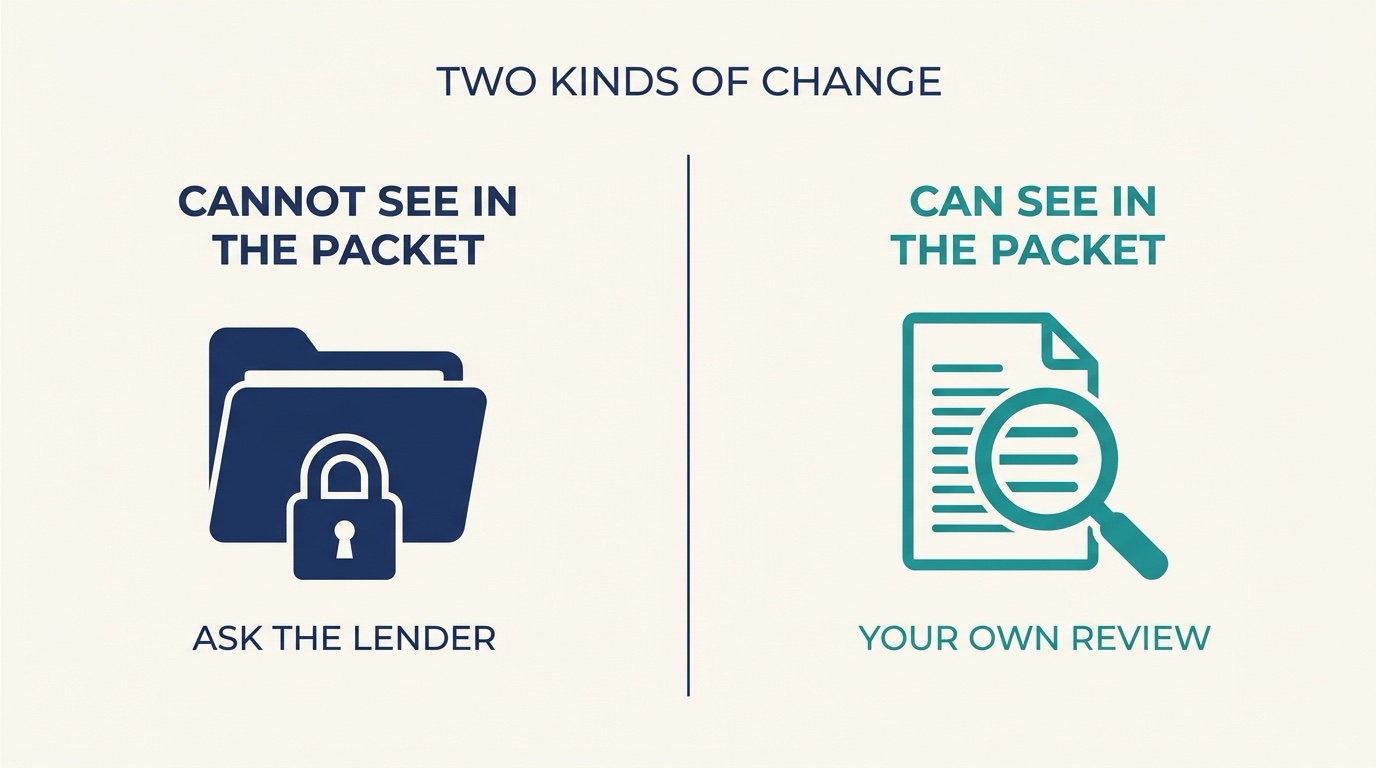
The 2026 Changes You Cannot See in the Packet
Two financing changes key off the loan application date, not the closing date, and neither is visible in the association's documents.
These catch agents out because nothing in the package reveals them and the trigger is a date on the lender's file rather than yours.
The reserve minimum rises on January 4, 2027
Fannie Mae raises its minimum replacement reserve allocation from 10% to 15%, and Freddie Mac's bulletin carries the same increase and the same date (Lender Letter LL-2026-03). Two boundaries matter for an agent. It attaches to loan applications dated on or after that day rather than closings, and Fannie's letter applies it when the lender uses the Full Review process. Projects that qualify for a review waiver, which the same letter expanded to cover projects of ten or fewer units, do not run the test at all.
The trap is a Q4 offer with a slow application: a file written in December on a building at 12% clears the old threshold, and if the application slips into January the same building is measured against 15%. That 15% is measured against budgeted assessment income rather than the total budget, with several categories permitted to come out of that figure first, so a quick division off the wrong line overstates the problem. Our worked example of the 15% calculation runs the arithmetic both ways.
Limited Review retired on August 3, 2026
Fannie retired the Limited Review process and Freddie retired its Streamlined Review equivalent, again on application date. Established projects that used to take the light path now go through Full Review, which means the lender has to obtain and read the budget, the reserve figure, litigation, insurance and repair status. The practical effect on your file is schedule. Document requests that used to be optional are now on the critical path, and they run on the management company's turnaround rather than yours.
The half that gets left out is that the same letter loosened several things at once. It expanded the review waiver to small projects, retired the Florida geographic restrictions, and retired investor concentration limits. Freddie Mac's bulletin separately retired its owner occupancy requirement for established projects. Small buildings and Florida buildings came out of August easier to finance.
What to do with both: ask the loan officer, before the offer where you can, which review path the project is taking, what they need from the association, and what application date they are working to. Then get that document list to the listing agent or the management company the same day.
The 2026 Changes You Can
The insurance deductible rule and the Arizona packet rewrite both show up in documents you can request and read yourself.
The master policy deductible, and the bill it hands your buyer
For applications dated on or after July 1, 2026, a master property policy's per unit deductible is capped at $50,000 per unit, and where the master policy has a per unit deductible the borrower must carry a unit owner policy with a limit at least equal to it (LL-2026-03). In a coastal building where the association has pushed its wind deductible up to hold the master premium down, that is a real number in your buyer's monthly cost, and it belongs in the affordability conversation before the appraisal rather than after.
Ask the association or the management company for the master policy declarations page and its endorsements, and ask directly whether there is a per unit deductible and what it is by peril. A certificate of insurance summary may not carry that figure. Then hand the figure to your buyer's insurance agent for a quote.
Arizona's resale packet changed on September 12, 2026
Arizona HB 2397 rewrote what goes into the resale disclosure packet and moved the delivery trigger to acceptance of the purchaser's offer. The packet now has to include insurance certificates showing coverage limits and deductibles, declarant control status, whether a corporation or LLC owns and leases 35% or more of the units, any unresolved violation cited against the unit, and board approved minutes from the previous three open meetings.
Two operational notes for Arizona agents. In communities of 50 or more units the seller has to give the association written notice of acceptance containing the buyer's name, email and mailing address, so if you do not supply the buyer's email the clock does not start. And the association may now deliver a summary in place of a reserve study running more than ten pages, in which case the packet must tell the purchaser they can request the entire report, and the association has ten days after a written request to provide access. Our guide to the Arizona packet rules covers the rest.
Those two changes pair neatly, because Arizona now puts the insurance certificates with limits and deductibles into the packet, which is exactly the document the federal deductible rule turns on.
Six Things Repeated in Agent Coverage That Are Out of Date
Each of these appears in agent-facing material, and each one either misdates a change or states a rule that has since been replaced.
- "Florida requires a milestone inspection at 25 years within three miles of the coast." That was the 2022 version. The statewide trigger is now 30 years for buildings three habitable stories or more, and 25 years is a determination the local enforcement agency may make based on local circumstances including proximity to salt water (Fla. Stat. §553.899(3)). The three mile distance is not in the statute. Ask the local building department, not the association, whether that jurisdiction adopted the earlier trigger.
- "The 15% reserve rule takes effect in 2026." It attaches to applications dated on or after January 4, 2027.
- "Reserves have to be 15% of the budget." The denominator is budgeted assessment income, and several categories may be excluded from it first.
- "Limited Review is gone, so condos are harder to finance now." Half of it. The same letter expanded the review waiver to projects of ten or fewer units and retired the Florida geographic restrictions.
- "HB 913 is the 2026 Florida condo law." It became chapter 2025-175, effective July 1, 2025. Describing it as a 2026 change misdates your client's obligations by a year.
- "Florida's condo resale cancellation window is three days." It is seven days, excluding weekends and legal holidays, and it changed on July 1, 2025. Content written before that date was correct when it was written.
A note on the last two. Both were accurate once, which is what makes them durable. When you are checking a date in this area, check when the summary you are reading was written before you rely on it.
What This Looks Like on a Live File
Order the package the day the offer is accepted, confirm receipt in writing, and split the questions between your lender and an attorney.
Order through whatever channel the association actually uses, on the day acceptance happens, and keep the confirmation. Put the receipt date in writing to both sides, because in several states that date sets the deadline and in Colorado nothing sets it except your contract. Route the review-path and application-date questions to the loan officer, the master policy declarations to the buyer's insurance agent, and anything turning on what a recorded document means to a real estate attorney licensed in the state. If the reserve study arrives as a summary, ask for the entire report in writing that day, because where that right exists the clock runs from the written request.
Frequently Asked Questions
Am I required to read the HOA documents for my client?
In most states license law asks you not to conceal a material fact you know, rather than to obtain and interpret the association's records. Arizona is the exception and requires a licensee to exercise reasonable care in ensuring they obtain material information. Washington states directly that a broker has no duty to investigate matters the broker has not agreed to investigate. Because the answer turns on your state's license law and your agency agreement, confirm your own obligations with your broker or an attorney rather than with a national summary.
Does a late document package extend my buyer's contingency?
In several states the buyer's review or cancellation right runs from the date of receipt rather than the contract date, so a late package moves the deadline rather than forfeiting it. Florida's condo resale right runs from the later of signing and receipt of the required reports. Washington and Nevada measure from receipt as well. Colorado has no resale delivery statute, so the answer there is whatever the contract says.
When does the 15% reserve requirement start affecting my deals?
It attaches to loan applications dated on or after January 4, 2027, and Fannie Mae applies it when the lender uses the Full Review process. Projects eligible for a review waiver, which now includes projects of ten or fewer units, do not run the percentage test. The trigger is the application date rather than the closing date, so a file written near the end of 2026 with a slow application can end up measured against the new figure. Ask the loan officer which review path they are using.
What do I ask for that is new in 2026?
The master policy declarations page and its endorsements, and specifically whether there is a per unit deductible and what it is by peril. Where the master policy carries one, the buyer must hold a unit owner policy with a limit at least equal to that deductible, which is a cost worth knowing before the appraisal. In Arizona, the packet now also carries insurance certificates with limits and deductibles, declarant control status, and board approved minutes from the previous three open meetings.
The reserve study came as a two page summary. Is that allowed?
In Arizona it is. Where the reserve study runs more than ten pages the association may provide a summary in place of the entire report, and the packet has to state that the purchaser may request to view the whole thing, with the association given ten days after a written request to provide access. Make that request in writing the day the summary arrives rather than at the end of your review, because those ten days run from the request. Rules on substituting a summary differ by state, so check the rule where the property sits.
Read the package faster than the contingency clock
Our free tools are trained on 1,900+ HOA documents and pull the reserve position, the restrictions and the red flags out of a package in minutes, so you can get your client a straight answer inside the review window.
Related Articles
Sources & References
- Fannie Mae Lender Letter LL-2026-03 (reserve allocation, Limited Review retirement, review waiver expansion, insurance requirements)
- Freddie Mac Guide Bulletin 2026-C (matching reserve increase and effective date)
- Fla. Stat. §553.899 (milestone inspection trigger and the local agency determination)
- Fla. Stat. §718.503 (resale disclosure, the buyer's voidability window, licensee shield)
- Florida chapter law 2025-175 (HB 913) (effective date of the 2025 Florida condo legislation)
- Arizona HB 2397, Senate Engrossed (packet contents, delivery trigger, summary provision)
- A.A.C. R4-28-1101 (Arizona licensee duty to obtain material information)
- RCW 18.86.030 (Washington broker duties, the non-waivable list, and the investigation limit)
- Cal. Civ. Code §2079.3 (scope of the agent inspection duty, conditioned on the document package)
- RCW 18.86.050 (Washington buyer's agent duties, including advising the buyer to seek expert advice beyond the agent's expertise)
- C.R.S. §38-33.3-209.4 (Colorado annual public disclosure to owners, which is not a resale delivery clock)
- NRS 645.252 (Nevada licensee duties)
Disclaimer: This article is for educational purposes only and does not constitute legal, financial, or real estate advice. Agent duties, disclosure obligations and contract deadlines vary by state, by community and by the form agreement in use, and several of the rules described here changed during 2025 and 2026. Nothing here describes your obligations under your own license law or agency agreement. Confirm those with your broker, and consult a qualified real estate attorney licensed in the state for guidance specific to your situation.