

In This Guide
In Virginia, an association has 14 days after a written request to deliver the resale certificate. If the contract sets no cancellation period, a buyer has three days to cancel, counted from the day the contract is fully signed (ratification) when the certificate arrived first and from the day the buyer receives it when it arrived later.
If you are buying a condo, a townhome or a house in a homeowners' association in Virginia, one document decides how much you know about the association before you are committed to it: the resale certificate. The seller has to get it from the association, on the association's timetable. A buyer or agent who knows the deadlines can use the days that remain, and a buyer who does not can let the right to cancel lapse at settlement.
The rules sit in Virginia's Resale Disclosure Act, which starts at Va. Code 55.1-2307. Its sections date from 2023 and were amended in 2024 and 2025. This guide covers what the Act gives a buyer in a condominium or a property owners' association, what an association can charge, what changed in 2025 and 2026, and what is already scheduled for 2027. Our post on a Virginia court decision about assessment provisions covers a different question and is not repeated here.
What Virginia Requires the Seller to Get You
The seller must obtain the resale certificate from the association and hand it to the buyer, and a contract cannot waive that duty.
Under Va. Code 55.1-2309, the seller or the seller's agent "shall obtain the resale certificate from the association and provide such resale certificate to the purchaser or the purchaser's agent," and that requirement "shall not be waived or changed by agreement." The association has 14 days after a written request to deliver it. If it does not, the certificate "shall be deemed unavailable," which matters for the cancellation right below. Days in this Act are calendar days. Since 2025 an association also cannot require the buyer's name before it prepares the certificate, so a seller does not have to wait for a buyer to order it.
What is inside the certificate
The certificate is a standard form from the Common Interest Community Board plus supporting documents in a set order. Va. Code 55.1-2310(A) lists 30 items. These are the ones a buyer should read first, with the item number so you can find each one in the packet.
| Item | What the statute says it must contain | What to check |
|---|---|---|
| 2 | Governing documents and rules | Rules that affect how you plan to use the unit |
| 4 and 7 | Assessments and schedules, unpaid assessments, and any approved special assessment | Whether the seller is behind and money is already voted |
| 9 to 12 | Reserves, the latest balance sheet and income and expense statement, the operating budget, and the current reserve study or a summary of it | The study date, and cash saved against its recommendation |
| 13 | Unsatisfied judgments and pending actions that could have a material impact | Any suit that could become a special assessment |
| 14 | The association's insurance, and a statement that owners may be responsible for all or part of the deductible | What you would owe in a claim |
| 17 and 18 | Approved board minutes from the last six months, and the latest association meeting minutes | Repairs, disputes and assessments discussed early |
| 26 | Any restriction on an owner's ability to rent the unit | Whether a future rental is allowed at all |
| 30 | Certification that the association filed its annual report with the Common Interest Community Board, with filing number | That the number is present and current |
Item 12 is the current reserve study "or a summary of such study," so a summary satisfies the statute. Our guides to reading a reserve study and to what a good percent funded looks like cover how to judge the numbers in items 9 to 12.
Which sales and which associations
The Act does not reach every community or every sale. It covers condominiums and property owners' associations subject to the Virginia Property Owners' Association Act (its definitions also reach real estate cooperatives and horizontal property regimes, an older condominium-style form of ownership; this guide does not cover them separately), per its definitions in 55.1-2307. That Act applies under 55.1-1801(A) to developments whose declaration (the recorded document that creates the community) was first recorded after January 1, 1959, to associations organized after that date, and to subdivisions created under the older Subdivided Land Sales Act (an earlier Virginia law for subdivisions). Some sales need no certificate at all: the six exemptions in 55.1-2317 include gifts, foreclosures, court-ordered sales if the court so directs, and certain auction sales.
What to do with this: ask the seller's agent for the date the certificate was requested in writing and the issue date printed on it. Those two dates tell you whether the 14 days have run and how old the numbers are. If the community is very old or the sale is a foreclosure, gift or auction, ask the seller's agent or an attorney whether a certificate is required at all.
How Long You Have to Cancel
Unless the contract sets its own period, a Virginia buyer has three days to cancel, and the start date depends on when the certificate arrived.
Va. Code 55.1-2312 ties the buyer's right to cancel to the certificate, or to a notice that the certificate is unavailable. There are three cases, and which one you are in depends on the order of events.
| When the certificate (or an unavailable notice) is delivered | Buyer's window to cancel | Subsection |
|---|---|---|
| Before the contract is ratified | Within the period the ratified contract sets. If it sets none, three days from the date of ratification | (A) |
| After the contract is ratified | Within the period the contract sets. If it sets none, three days from receipt of the certificate or notice | (B) |
| Not delivered at all | At any time prior to settlement | (C) |
Ratification means the date the contract is fully signed by all parties, which is how Virginia's Residential Property Disclosure Act defines the word for its own chapter: "the full execution of a real estate purchase contract by all parties." The Resale Disclosure Act does not define it separately, so read how the contract you sign defines the date of ratification.
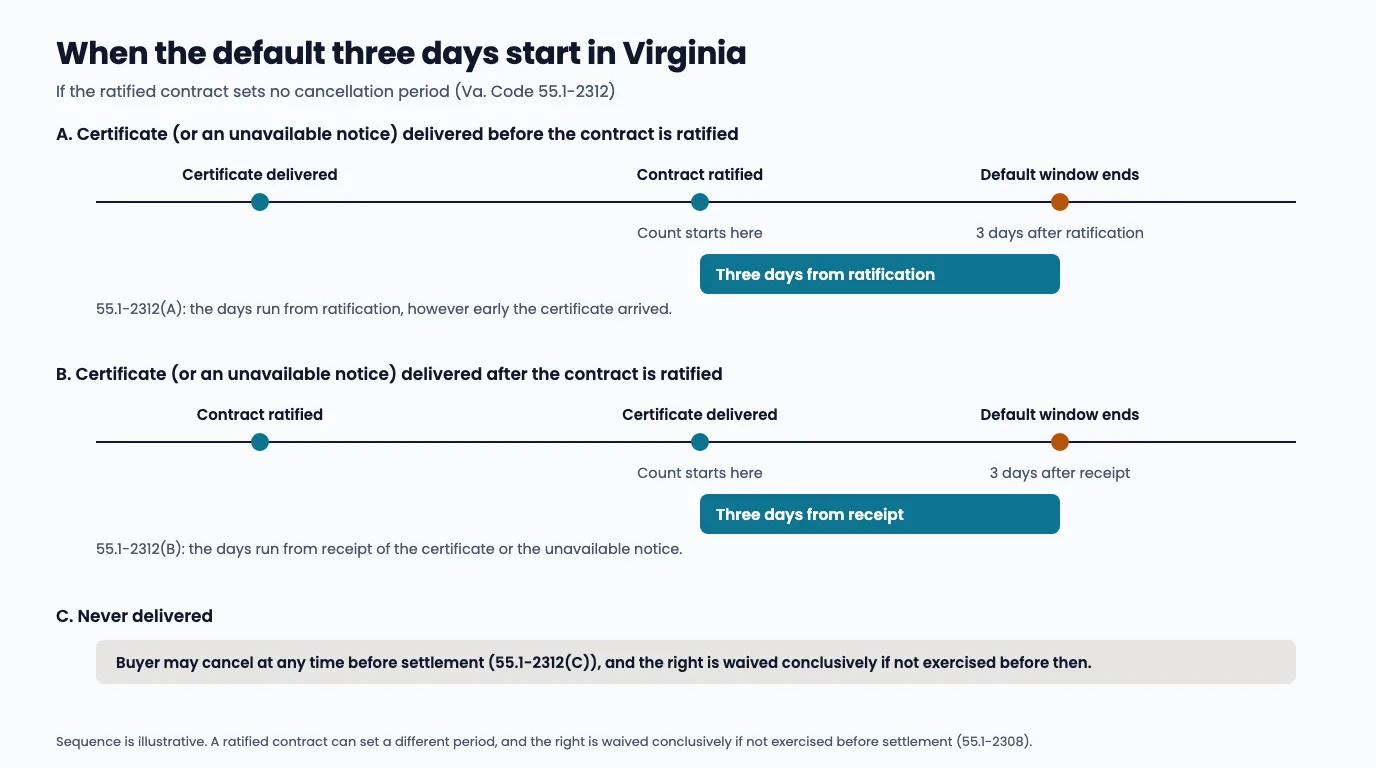
The right also has an end date. Va. Code 55.1-2308 requires the contract to disclose that "the purchaser's right to receive the resale certificate and the right to cancel the contract are waived conclusively if not exercised before settlement." If the contract leaves out the required disclosures, "the purchaser's sole remedy is to cancel the contract prior to settlement."
Three mechanics in 55.1-2312 are easy to miss. Notice must be written and follow the contract's own notice terms, and the buyer has "the burden to demonstrate delivery of the notice of cancellation." If a unit is governed by more than one association, the window runs from delivery of the last certificate. Cancellation is "without penalty," and the seller must see that any deposit or escrowed funds are returned promptly. A buyer can also ask for an updated certificate under 55.1-2311, available when a certificate was issued more than 30 days but less than 12 months before settlement, and the association must deliver it within 10 days of a written request.
What to do with this: ask your agent to write the ratification date, the certificate delivery date and the last day to cancel on one line of the transaction timeline.
What the Certificate Costs and Who Pays
The seller pays for the certificate, the Common Interest Community Board caps the fees, and a buyer may owe a post-closing fee at settlement.
Va. Code 55.1-2316 says "the seller shall be responsible for all fees associated with the preparation and delivery of the resale certificate, including any fees for inspection of the unit." The party who requests an updated certificate pays for it. A settlement agent or other requesting party may pay up front and ask to be reimbursed by the seller. The statute leaves the dollar amounts to the Board, which publishes the ceilings below.
| Fee | Board maximum | Who pays |
|---|---|---|
| Resale certificate, paper (up to two copies) | $211.96 | Seller |
| Resale certificate, electronic | $176.64 | Seller |
| Expedited delivery (within five business days), only if the preparer agrees | $70.66 additional | Optional, at the request of the seller or agent |
| Inspection of the unit, if the declaration authorizes it | $141.31 | Seller |
| Pre-settlement update of the certificate | $70.66 | Requesting party |
| Post-closing fee to update the association's ownership records | $70.66 | Purchaser, collected at settlement |
The figures come from the Board's Maximum Allowable Preparation Fees sheet (dated January 12, 2023, amended July 1, 2023) and are the most an association may charge. The statute says the maximums must be adjusted "no less than every five years," and the sheet says the next adjustment will occur in 2028.
An association may collect these fees only if it meets four conditions in 55.1-2316(F): it is registered with the Common Interest Community Board, current in its annual report and fee, current in any Board assessment, and it offers the certificate electronically. The certificate must carry the annual report filing number (item 30 above), and the Board's sheet points to the Department of Professional and Occupational Regulation's license lookup for checking an association's registration. For fees at closing in other states, see our guide to HOA transfer fees and hidden closing costs.
What to do with this: ask the seller's agent for the association's invoice for the certificate and compare it with the table.
What Changed in 2025 and 2026, and What Is Set for 2027
The 2025 session changed two resale-certificate details. The 2026 session left the three main Acts alone, and HB 444 is set for July 1, 2027.
Under Virginia's Constitution, laws enacted at a regular session take effect on the first day of July after adjournment unless the act sets another date, which dates the 2025 changes below.
| When | What changed | What a buyer notices |
|---|---|---|
| July 1, 2025 | No association may require the buyer's name to prepare or print the certificate (HB 2110, Chapter 247) | A seller can order it before a buyer is under contract |
| 2025 (July 1 under the general rule) | The insurance item (item 14) must say the governing documents may make an owner responsible for all or part of the deductible (2025 amendment) | Read it for what you would owe in a claim |
| 2026 session | No section of the Property Owners' Association Act, the Condominium Act or the Resale Disclosure Act is on the legislature's 2026 update list | The rules above are the current ones |
| July 1, 2027 | A 2026 law on default judgments in consumer debt suits (HB 444 per Woods Rogers; 2026 Acts, Chapter 395 in the Code) creates new rules | A question for an attorney |
| 2028 | Next scheduled adjustment of the Board's fee maximums | The fee table above is replaced |
The name rule comes from Chapter 247 of the 2025 Acts of Assembly, approved March 21, 2025. For the insurance item, compare that chapter's text with today's 55.1-2310(A)(14): the older wording stops after the coverage "recommended or required to be obtained by the owners," and the current item adds the deductible statement. The section's history line cites chapters 14, 16 and 247 of the 2025 Acts.
For 2026, the legislature's list of Title 55.1 sections updated in 2026 contains no section in chapter 18, 19 or 23.1, the chapters that hold those three Acts. That describes the Code as it stood on October 21, 2026, and it can change when the 2027 session convenes.
HB 444 is one of several 2026 laws that start July 1, 2027. Of those, it is the one a buyer whose seller is in a collections suit might ask about. In the Code, section 8.01-465.26 is marked "Effective July 1, 2027," and its source is 2026 Acts chapter 395. It is a definitions section for the new default-judgment rules (a default judgment is a win by a creditor when the person sued does not respond) in suits to collect a "consumer debt," which it defines as an obligation of an individual that arises from a transaction "primarily for a personal, family, or household purpose." A Virginia law firm that tracks association law, Woods Rogers, lists it among the 2026 changes for associations. The section does not say whether a suit over an association assessment counts, so whether it reaches a given suit is a question for a Virginia attorney.
What to do with this: if item 13 lists a pending suit, ask your attorney whether anything scheduled for 2027 would change how it proceeds.
Two More Rules a Buyer Meets Before Closing
Virginia sets a five-year rhythm for reserve studies and a filing window for assessment liens, and both show up in the packet.
Reserve studies. A Virginia condominium board must have a reserve study done at least every five years unless the condominium's own governing documents say otherwise. The statute's words: under the Virginia Condominium Act, a condominium's executive board must, "except to the extent otherwise provided in the condominium instruments," conduct a study "at least once every five years" of the reserves needed to repair and replace capital components, under Va. Code 55.1-1965. A property owners' association board has the same five-year duty under 55.1-1826, and that text has no "except" opening. Both sections also say the board has discretion to meet repair and replacement needs "through replacement reserves, additional assessments, or borrowed funds." In plain terms, the statute requires a study every five years and leaves the size of the reserve fund to the board.
Lien filing windows. To make its claim for unpaid assessments stick against the unit, an association must file a memorandum with the circuit court clerk. A condominium association must file "before the expiration of 90 days from the time the first such assessment became due and payable," under 55.1-1966(C). A property owners' association must file "before the expiration of 12 months from the time the first such assessment became due and payable," under 55.1-1833(B). The windows differ by type of community, so confirm which Act governs yours.
What to do with this: check the study date in item 12 against the five-year interval, and ask the title company whether any memorandum of lien is on file against the unit.
Questions to Ask Before You Let Any Deadline Pass
These eight questions turn the statute into a checklist you can run from the contract, the certificate and the closing statement.
- The contract. What is the ratification date, and does the contract set its own cancellation period?
- The request. When did the seller request the certificate in writing, and have the 14 days passed?
- The issue date. Is the certificate more than 30 days old at settlement? If so, ask for an updated one.
- The registration. Does item 30 carry a current Board filing number?
- The money. Do items 4 and 7 show a special assessment, and is the seller current?
- The reserve study. How old is the study behind item 12, and how much is saved against it?
- The insurance. What does item 14 say about the deductible?
- The fees. Who paid for the certificate, and is the charge within the Board's maximum?
If you want a second set of eyes on the packet before you call an attorney, our free tools for CC&Rs, reserve studies and meeting minutes point to the pages behind each finding. For specific questions about your contract, a deadline or a certificate, a Virginia real estate attorney can read the documents and advise on your situation.
Frequently Asked Questions
How long does a Virginia HOA have to deliver a resale certificate?
Fourteen days after a written request from the seller or the seller's agent, under Va. Code 55.1-2309(B). If it does not deliver within that time, the certificate is deemed unavailable. The deadline does not apply to a sale that is exempt under 55.1-2317.
How many days do I have to cancel after getting a Virginia resale certificate?
It depends on the contract. If the contract sets a period, that period applies. If it sets none, the buyer has three days from ratification when the certificate was delivered before ratification, and three days from receipt when it was delivered after. If the certificate or an unavailable notice was never delivered, the buyer may cancel at any time before settlement.
Who pays for the resale certificate in Virginia?
The seller pays for the preparation and delivery of the certificate, including any unit inspection fee. The party who requests an updated certificate pays for it, and a buyer may be charged a post-closing fee at settlement to update the association's ownership records. The Common Interest Community Board's current maximums are $211.96 for a paper certificate, $176.64 for an electronic one, and $70.66 for the post-closing fee.
Can a Virginia association charge more than the Board's maximums?
The statute directs the Board to set the maximum fees an association may charge, and an association may collect the fees only if it is registered with the Board, current on its annual report and Board assessments, and offers the certificate electronically. The Board's published maximums are dated January 12, 2023, with the next adjustment due in 2028.
Did Virginia change its HOA or condo laws in 2026?
As of October 21, 2026, the legislature's list of Title 55.1 sections updated in 2026 includes none from the Property Owners' Association Act, the Condominium Act or the Resale Disclosure Act. The most recent changes to the resale rules were made in 2025. HB 444, a 2026 law on default judgments in consumer debt suits, takes effect July 1, 2027.
What if the Virginia resale certificate has an error?
A buyer is not liable for an unpaid assessment or fee greater than the amount stated in the certificate, an updated certificate or a financial update, and the association is bound by the certificate's figures as to the buyer, unless the buyer had actual knowledge that the contents were in error. A seller is not liable to the buyer for erroneous information the association supplied.
Get Your CC&Rs Analyzed
Upload your HOA's CC&Rs and get instant analysis of rental restrictions, pet policies, financing red flags, and more. Free. No signup required.
Your first full property report is also free. See what you'll get →
Or get your first full report free →Related Articles
Sources & References
- Va. Code 55.1-2307 to 55.1-2317 (Resale Disclosure Act: definitions, contract disclosures, delivery, contents, updates, cancellation, liability, fees, exemptions)
- Common Interest Community Board: Maximum Allowable Preparation Fees (January 12, 2023, amended July 1, 2023)
- Acts of Assembly, 2025 Session, Chapter 247 (HB 2110) (purchaser's name; approved March 21, 2025)
- Code of Virginia, Title 55.1 (2026 Updates) (sections updated in 2026, as of October 21, 2026)
- Va. Code 8.01-465.26 (HB 444, effective July 1, 2027)
- Constitution of Virginia, Article IV, Section 13 (effective date of laws)
- Va. Code 55.1-700 (definition of ratification in the Residential Property Disclosure Act)
- Va. Code 55.1-1801, 55.1-1826 and 55.1-1833 (Property Owners' Association Act: applicability, reserve study, lien)
- Va. Code 55.1-1965 and 55.1-1966 (Condominium Act: reserve study, lien)
- Woods Rogers: 2026 Virginia Legislative Changes Affecting Community Associations (law firm summary listing HB 444)
Disclaimer: This article is for educational purposes only and does not constitute legal, financial, or real estate advice. Virginia statutes and Common Interest Community Board fee schedules change, and the sections cited are current as of October 21, 2026 and may be amended. This article covers Virginia condominiums and property owners' associations under the Resale Disclosure Act; other community types and older communities outside the Acts discussed may follow different rules. Consult a qualified Virginia real estate attorney for guidance specific to your situation.