
In This Guide
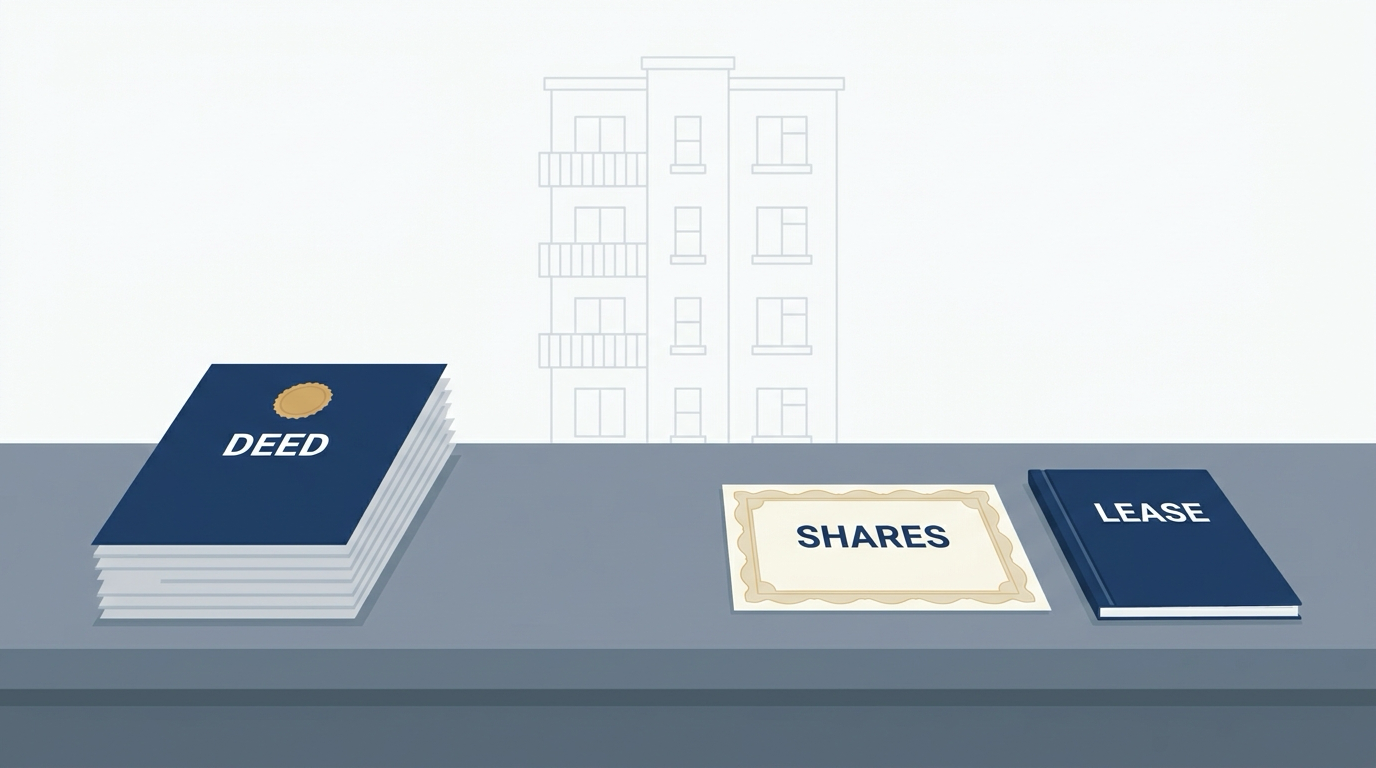
A New York condominium unit is real property and you receive a deed. A co-op is shares in a corporation plus a lease. That one difference changes the documents you receive, what a board can do to your deal, and how much of the building's financial condition you can actually check before closing.
You are looking at two apartments on the same block at roughly the same price. One is a condo and one is a co-op. Then the paperwork arrives, and the two stacks describe two different kinds of ownership. The differences land in the places that decide whether a deal closes.
The expensive version of this mistake is reading the co-op stack the way you would read a condo stack, signing, and finding out afterward that a board can end the transaction without telling you why, or that the maintenance figure you budgeted around includes a share of a building mortgage that comes due in three years. Neither of those is hidden; both sit in documents most buyers skim.
Here is what differs, in the order it will reach you, and what to ask at each step.
1. What You Actually Own, and Why It Changes the Paperwork
A condo buyer gets a deed. A co-op buyer gets a stock certificate and a proprietary lease, the corporation's lease letting you occupy the apartment.
New York condominiums are created under the Condominium Act, at Real Property Law article 9-B, sections 339-d through 339-kk. You buy a defined unit plus an undivided interest in the common elements, and the transaction looks like buying a house: there is a deed, and it gets recorded.
A co-op is a corporation that owns the building. You buy shares in it, and the shares come with a proprietary lease, the document that gives you the right to live in your specific apartment. You are a shareholder and a tenant at the same time, and the corporation is your landlord. That structure is governed by New York's Business Corporation Law together with the terms of the lease itself, rather than by the Condominium Act.
Practically, this is why a co-op purchase produces a stock certificate and a lease instead of a deed, why co-op financing is a share loan rather than a mortgage on real estate, and why the building's corporate financial statements matter to you in a way a condo's do not quite match.
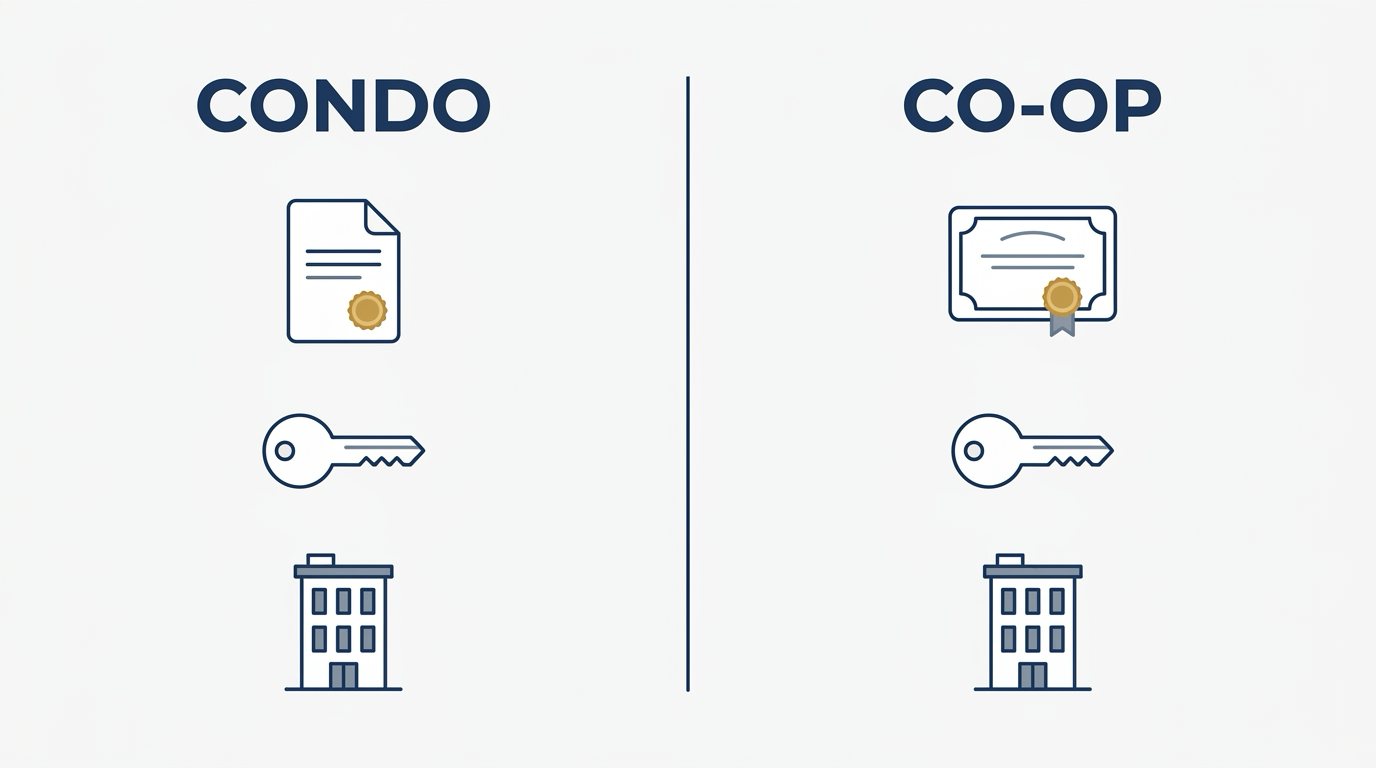
What to do: confirm which one you are buying from the contract rather than from the listing, before you read anything else in the stack.
Get Your CC&Rs Analyzed
Upload your HOA's CC&Rs and get instant analysis of rental restrictions, pet policies, financing red flags, and more. Free. No signup required.
Your first full property report is also free. See what you'll get →
Or get your first full report free →2. The One Document Both of Them Share
Condos and co-ops both file an offering plan with the New York Attorney General. Ask for the plan and every amendment to it, not just the plan.
The offering plan is the disclosure document a sponsor files with the Attorney General before it can sell anything. Under General Business Law §352-e, no offer, advertisement or sale may be made in or from New York until the Attorney General has issued a letter stating the offering has been filed.
The statute's language is written around cooperative interests, so the requirement is often read as a co-op one. It reaches condominiums as well. Real Property Law §339-ee(1) provides that units submitted to the article "shall be deemed to be cooperative interests in realty within the meaning of section three hundred fifty-two-e of the general business law." Both kinds of building have a plan, and in both cases it is the closest thing New York has to a single document describing what you are buying.
The plan alone is not the current picture. Buildings amend their plans, sometimes many times, and an amendment is where a change in the budget, the sponsor's remaining units, or the building's obligations will show up. The New York Attorney General's own buyer guidance is a reasonable place to start if you want to understand what the plan is supposed to contain.
What to do: ask the seller's attorney for the offering plan and all amendments, and ask how many amendments there have been. A building with a long amendment history is not automatically a problem, but the recent ones tell you what has changed lately.
3. What a Board Can Do to Your Deal
A co-op board can reject a buyer without stating a reason, within anti-discrimination law. A condo board's usual option is to buy the apartment.
This is the difference that decides closings, and it is the one most worth understanding before you make an offer.
Co-op boards interview and approve purchasers. The board reviews a package that typically includes tax returns, financial statements, employment verification and reference letters, and it may decline an applicant without explaining the decision. That discretion is not unlimited: it is bounded by federal, state and city anti-discrimination law, which prohibits rejections based on protected characteristics. What it is not bounded by is any general obligation to give you a business reason.
Condo boards generally cannot do that. The one power a condo board has on a resale is the right of first refusal, an option to buy the apartment itself on the same terms as your contract rather than let the sale proceed to you. That right comes from the building's own by-laws rather than from the Condominium Act, so the by-laws are where you confirm it exists; most New York City condominium by-laws include one. It is also a costly power to use, since exercising it means the association has to actually fund the purchase through a special assessment or a loan, and reporting on New York buildings consistently describes boards exercising it rarely for that reason.
The practical consequence for a buyer is about certainty rather than about which structure is better. A condo deal that is signed is usually a deal that will close. A co-op deal has a board step between signing and closing where the answer can be no.
What to do: if you are buying into a co-op, ask your agent to find out what the building's board package requires and what its financial expectations are, before you write the offer. Buildings vary widely on debt-to-income and post-closing liquidity expectations, and those expectations are not published anywhere you can look them up.
4. The Financials, and the Document Only a Co-op Has
A co-op building carries a mortgage of its own. That is why maintenance and a condo's common charges are not the same number measured differently.
The single largest financial difference is the underlying mortgage: a mortgage on the entire building that the co-op corporation owes. Your monthly maintenance covers your share of operating costs plus your share of the debt service on that loan and the building's property taxes. A condo's common charges cover operating costs and reserves, and each owner is billed for their own property taxes separately.
Two maintenance figures that look identical can therefore describe very different situations, and the question that separates them is when the underlying mortgage matures. A building refinancing into a higher rate has a maintenance increase ahead of it that has nothing to do with how well it is run.
The other line worth finding early is the flip tax, which despite the name is a transfer fee the building charges when an apartment changes hands. It is usually paid by the seller, though the terms vary by building and can be negotiated, so it belongs in a contract conversation rather than an assumption. Buildings often use it to replenish reserves.
| What you are looking at | Condominium | Cooperative |
|---|---|---|
| What you receive at closing | A deed to the unit | A stock certificate and a proprietary lease |
| Monthly payment to the building | Common charges; you are billed separately for property taxes | Maintenance, which includes your share of property taxes and of the underlying mortgage |
| Building-level debt | No building mortgage in the co-op sense | Underlying mortgage, with a maturity date worth finding |
| How a board affects the sale | Right of first refusal, where the by-laws provide one | Approval, and it may decline without stating a reason |
| How you finance it | A mortgage on real property | A share loan, with a recognition agreement among you, the lender and the corporation |
One reserve rule is specific to New York City and specific to converted buildings. Under New York City Administrative Code §26-703, a sponsor converting a rental building to co-op or condominium ownership must, within thirty days after the closing of the conversion, establish and transfer a reserve fund "to be used exclusively for making capital repairs, replacements and improvements necessary for the health and safety of the residents." The amount is three percent of the total price, or the alternative calculation in §26-703(b) with a floor of one percent of the total price.
Read the boundaries on that carefully, because it is the easiest thing on this page to over-apply. It is New York City, not New York State. It applies to conversions from rental, not to new construction and not to an ordinary resale years later. And it is a one-time funding obligation on the sponsor at conversion, not an ongoing requirement to keep reserves at a level. New York has no statewide reserve-study mandate comparable to Florida's structural integrity reserve study or California's reserve study requirement, so in most New York buildings the reserve level is a board decision that you evaluate from the financial statements rather than a number the state guarantees.
What to do: ask for the last two years of the building's financial statements, and for a co-op, ask specifically for the maturity date and rate on the underlying mortgage. Our guide to reading association financial statements covers what to look for once you have them.
5. The Building Bill That Is Not in the Listing
NYC buildings over 25,000 square feet face emissions caps that tighten in 2030. The penalty reaches you through maintenance or common charges.
Local Law 97 applies to most New York City buildings over 25,000 square feet and sets annual carbon emissions caps, with limits that tighten in 2030 and again in 2035 and 2040. A building over its cap owes an annual penalty of $268 per ton of carbon dioxide equivalent above the limit. This is a New York City law, so it does not reach a building elsewhere in the state.
Structure does not protect you here. In a co-op the penalty and the capital work to avoid it flow to shareholders through maintenance; in a condo they flow to unit owners through common charges or an assessment. What differs is only which document names the charge.
The Real Estate Board of New York has projected that emissions penalties on New York City property owners could exceed $900 million a year by 2030, with a majority of the buildings projected to exceed the 2030 caps being residential. Those are projections from an industry group rather than measured outcomes, and they are worth reading as an estimate of scale rather than as a forecast for any particular building.
What to do: ask whether the building has had a Local Law 97 assessment done, what its current emissions are against its cap, and what the projected gap is against the 2030 cap. A building comfortably under today's limit can still be well over the one that arrives in 2030, and closing that gap is a capital project somebody pays for.
Three Questions That Cover Most of It
The offering plan with amendments, two years of financials, and the underlying mortgage maturity date tell you more than any other three requests.
- The offering plan and every amendment. Ask how many amendments exist, then read the most recent ones first.
- Two years of financial statements. Look at whether income covers operating expenses, and at what is in reserves relative to the building's known upcoming work.
- For a co-op, the underlying mortgage. The maturity date and rate, because a refinancing in a higher-rate environment is a maintenance increase with a date on it.
None of this is a substitute for having a New York real estate attorney review the full package. Co-op and condo purchases in New York are attorney-driven transactions, and the questions above are meant to make that review more useful to you rather than to replace it.
Frequently Asked Questions
Can a New York co-op board really reject me without giving a reason?
Yes, within limits. A co-op board may decline a purchase application without stating a business reason for the decision. What it cannot do is decline on a basis prohibited by federal, state or New York City anti-discrimination law. If you believe a rejection was discriminatory, that is a question for an attorney rather than something the documents will answer.
Do condos in New York have an offering plan, or is that only for co-ops?
Both have one. General Business Law §352-e requires the plan to be filed with the Attorney General before any offer or sale, and Real Property Law §339-ee(1) provides that condominium units are "deemed to be cooperative interests in realty within the meaning of" that section, which places condominiums inside the same filing regime. Ask for the plan and its amendments in either case.
Why is a co-op's maintenance higher than a comparable condo's common charges?
Usually because the two figures cover different things. Maintenance in a co-op includes your share of the building's property taxes and of the debt service on the underlying mortgage, while a condo owner pays property taxes separately and the common charge does not carry building-level mortgage debt. Comparing the two numbers directly will mislead you unless you add the condo's property taxes back in.
Does New York require buildings to fund reserves?
Not as a general ongoing rule. New York City Administrative Code §26-703 requires a sponsor converting a rental building to co-op or condominium ownership to establish a reserve fund within thirty days after the conversion closes, at three percent of the total price or the alternative calculation in §26-703(b) with a one percent floor. That is a New York City requirement, and it attaches to conversions rather than to new construction or to buildings generally. There is no statewide New York reserve-study mandate comparable to Florida's or California's.
Does Local Law 97 affect co-ops and condos differently?
The obligation is on the building, so the difference is in how the cost reaches you rather than in whether it does. Local Law 97 applies to most New York City buildings over 25,000 square feet and carries an annual penalty of $268 per ton of carbon dioxide equivalent over the building's limit, with caps tightening in 2030, 2035 and 2040. In a co-op the cost arrives through maintenance, and in a condo through common charges or an assessment.
Get Your HOA Documents Analyzed
GoverningDocs analyzes CC&Rs, reserve studies, and meeting minutes, identifying red flags, restrictions, and financial risks so you can buy with confidence. Free. No signup required.
Your first full property report is also free. See what you'll get →
Or get your first full report free →Related Articles
Sources & References
- N.Y. Real Property Law article 9-B (Condominium Act, §§339-d through 339-kk)
- N.Y. Real Property Law §339-ee (condominium units deemed cooperative interests in realty within the meaning of GBL §352-e, at subdivision 1)
- N.Y. General Business Law §352-e (real estate syndication offerings; offering plan filed with the Attorney General before any offer or sale)
- New York Attorney General, Before You Buy a Co-op or Condo (buyer guidance on offering plans)
- N.Y.C. Administrative Code §26-703 (conversion reserve fund; thirty days after closing, three percent of total price or the alternative calculation at (b) with a one percent floor). The chapter applies to conversions filed under GBL §352-eeee per §26-701.
- NYC Accelerator, Local Law 97 (coverage above 25,000 square feet, emissions caps, $268 per ton penalty)
- Real Estate Board of New York (projection that emissions fines could exceed $900 million a year by 2030; an industry-group projection, not a measured figure)
- Fannie Mae Selling Guide B4-2.3-03 (legal requirements for co-op projects, including recognition of the share lender)
Disclaimer: This article is for educational purposes only and does not constitute legal, financial, or real estate advice. It describes New York law, and within New York it distinguishes statewide rules from ones that apply only in New York City. Board practices, proprietary lease terms, flip tax arrangements and financial expectations vary building by building and are not set by statute. Whether any rule described here reaches a particular apartment depends on the full document set and facts this article does not evaluate. Citations are current as of September 2026 and may be superseded. Consult a qualified New York real estate attorney for guidance specific to your situation.