

In This Guide
A Michigan site condo looks like a house in a subdivision but is a condominium unit. The Master Deed sets what you own and what you pay.
If you are buying a detached house in a Michigan development and the listing calls it a "site condo," the home you are touring is a condominium unit in the legal sense. The lot looks like any other lot on the street. What you own, who pays to replace the road and the drainage, and how much of each shared bill lands on you are set by recorded documents most buyers never open.
A review window in a purchase agreement runs in days, and the listing remarks give a monthly fee and little else. The Master Deed is where the real terms sit: the percentage of value that sets your share of expenses, which costs fall on one unit alone, and what the association can change after you close.
This guide goes through those documents in the order a buyer reads them. It draws on the Michigan Condominium Act, the state's reserve rule and Fannie Mae's Selling Guide, and it ends with a list of questions to put to the seller and the association before the review window closes.
Why a Detached House Can Be a Condominium Unit
A site condo is a detached home held as a condominium unit under Michigan's Condominium Act and created by a recorded Master Deed.
Michigan's Condominium Act, MCL 559.101 and the sections that follow, defines a condominium unit in Section 4 as "that portion of the condominium project designed and intended for separate ownership and use, as described in the master deed." Nothing in that definition requires a shared wall, and a project needs only "not less than 2 condominium units." The Act never uses the words "site condo." That phrase is trade vocabulary for a project whose units are detached houses.
A platted subdivision lot is governed by the plat and any recorded covenants, while a site condo unit is governed by the Master Deed and the other condominium documents. The reason is that platted lots are created under a different law, the Land Division Act (MCL 560.101 and the sections that follow), and the Condominium Act's definition of "record" says that the provisions of that Act "do not control divisions made for any condominium project" (MCL 559.110(1)).
To tell which one you are looking at, a Michigan community association law firm blog (the Michigan Community Association Law Blog, Sept. 24, 2026) puts it this way: "If the community was established through a Master Deed and Condominium Subdivision Plan, it is likely a site condominium governed by the Michigan Condominium Act. If it was established through a recorded subdivision plat and restrictive covenants or a declaration, it is likely a platted subdivision."
If the answer to the first question is a Master Deed, the rest of this guide applies to the house you are considering.
The Documents to Ask For and What Each One Tells You
The Master Deed has the bylaws and the condominium subdivision plan attached. The association must keep them available to prospective purchasers.
The Act defines the Master Deed in MCL 559.108 as "the condominium document recording the condominium project to which are attached as exhibits and incorporated by reference the bylaws for the project and the condominium subdivision plan for the project." So one recorded package holds three things.
| Document | What it covers | What a buyer looks for |
|---|---|---|
| Master Deed | The land, which units get exclusive use of each limited common element (a shared item such as a driveway or yard), each unit's percentage of value, and where the building plans are filed (MCL 559.108) | Your unit's percentage of value and the method used to set it; what is assigned to your unit alone |
| Condominium bylaws | How the association runs and funds itself, including the reserve fund language the state's rule requires (R 559.511) | Use restrictions, the reserve provision, the required warning about the reserve minimum |
| Condominium subdivision plan | A survey plan, site plan and utility plan, each unit's size, location and boundaries, and the nature, location and size of the common elements (MCL 559.166) | Which roads, utilities and amenities are shown as common elements, and any item marked "need not be built" |
| Amendments to the Master Deed | Every change recorded since the original | Changes to percentages, unit boundaries or limited common element assignments |
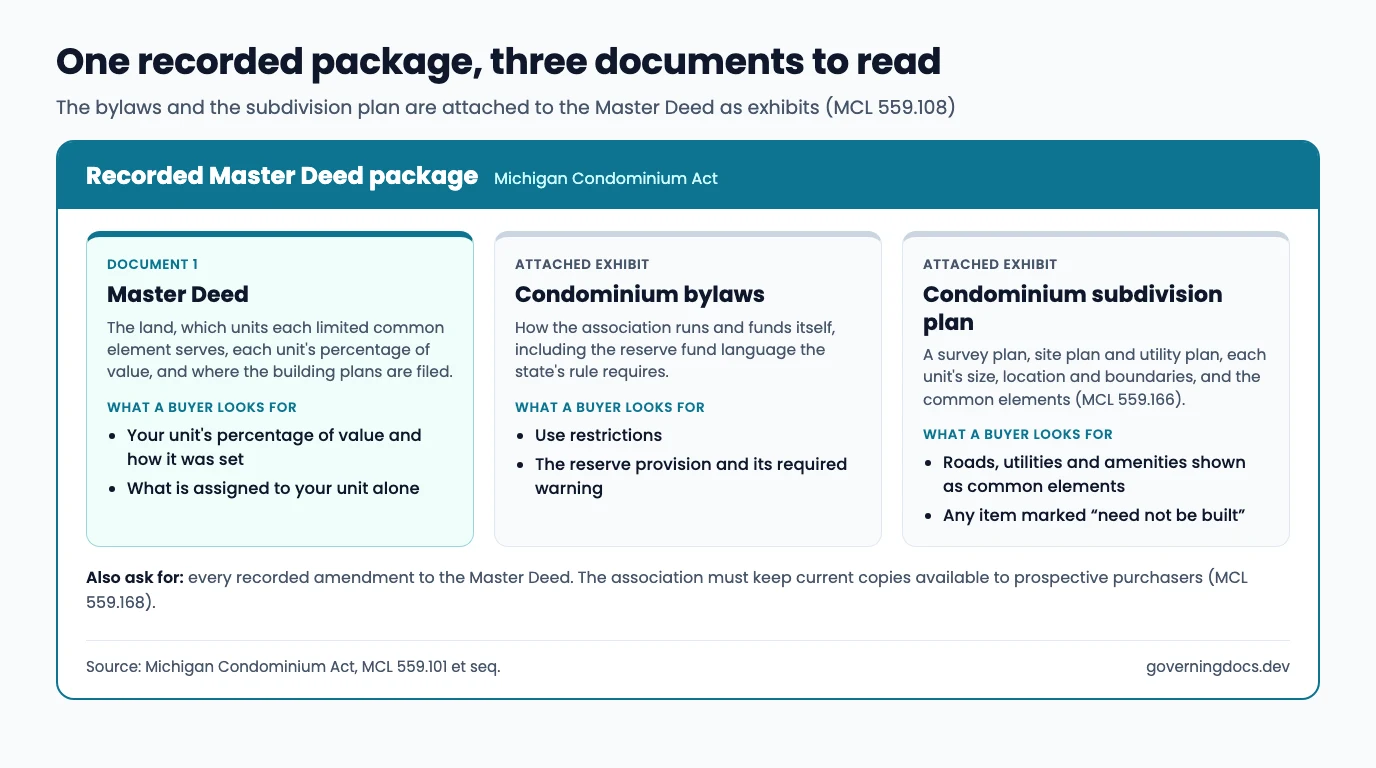
The Act requires the association to "keep current copies of the master deed, all amendments to the master deed, and other condominium documents for the condominium project available at reasonable hours to co-owners, prospective purchasers, and prospective mortgagees" (MCL 559.168). It says "reasonable hours" and sets no delivery deadline, so it helps to ask in writing the day the offer is accepted and note the date.
Money documents are a separate request. The Act's Section 57 makes the books, records and financial statements available to co-owners and their mortgagees, which does not name a buyer, so ask the seller to request the current budget, financial statements and recent meeting minutes. The same section requires an association with annual revenues above $20,000 to have its books audited or reviewed each year, unless a majority of members vote to opt out. Ask which one happened last year.
What the Master Deed Must Say, and What to Read First
Michigan law requires the Master Deed to describe the land, say which units get exclusive use of shared items like a driveway or yard (the law calls these limited common elements), and state each unit's percentage of value.
Section 8 lists what every Master Deed "shall include": an accurate legal description of the land, a statement designating the units served by the limited common elements and defining the rights in them, the percentage of value for the project and for each unit, and the local government where the detailed plans are filed. It may also include "any other matter which is appropriate for the project."
Three terms from the Act carry most of the weight. The common elements are "the portions of the condominium project other than the condominium units" (MCL 559.103(7)). Limited common elements are the part of those "reserved in the master deed for the exclusive use of less than all of the co-owners" (MCL 559.107(2)). The rest are the general common elements (MCL 559.106(5)).
In a house on its own lot, it is tempting to assume the yard and driveway are yours. Whether a yard, driveway or drainage area is part of your unit, a limited common element assigned to you, or a general common element is set by the Master Deed and the plan. The law firm blog quoted above makes the same point: "The answer is not always obvious from the feature's physical location."
The plan has one more useful feature. The Act requires proposed structures and improvements shown in it to be labeled either "must be built" or "need not be built" (MCL 559.166(2)(j)). In a development that is still being finished, check which label sits on the entrance, the roads and the amenities that were part of the sales pitch.
Percentage of Value: How Your Share of the Bills Is Set
Most shared costs are split by each unit's percentage of value, which the Master Deed sets and must explain, so look up yours first.
The Act says the percentages of value "shall total 100% in the project," that a master deed "shall state the method or formula used by the developer in the determination of percentage of value," and that factors the developer may consider include market value, size, location and allocable expenses of maintenance (MCL 559.109(1)). Units can therefore carry different percentages.
The default split is in MCL 559.169(3): common expenses not specially assessed "shall be assessed against the condominium units in proportion to the percentages of value or other provisions as may be contained in the master deed." The words "or other provisions" matter, because the Master Deed can change the split.
Some costs skip the split. Unless the condominium documents say otherwise, the cost of maintaining, repairing or replacing a limited common element "shall be specially assessed against the condominium unit to which that limited common element was assigned" (MCL 559.169(1)). Unusual expenses that benefit fewer than all units can also be assessed to those units, but only "to the extent that the condominium documents expressly so provide" (MCL 559.169(2)). So a bill for something assigned to your unit can land on your unit alone.
Two protections apply after you buy. The method used to set percentages of value (other than for voting) cannot be changed without the consent of each affected co-owner and mortgagee, and a co-owner's unit dimensions or limited common elements cannot be modified without that co-owner's consent (MCL 559.190(4)). Ask the association to show you the Master Deed provision behind your unit's monthly fee.
The Reserve Floor in Michigan
Michigan requires a reserve fund, and its rule sets a minimum of 10% of the annual budget. The bylaws must warn that the minimum may fall short.
The Act requires it in one sentence: MCL 559.205 says "a reserve fund for major repairs and replacement of common elements shall be maintained by the associations of co-owners" and lets the state set minimum standards. The state's rule, Mich. Admin. Code R 559.511, sets the floor: the association "shall maintain a reserve fund which, at a minimum, shall be equal to 10% of the association's current annual budget on a noncumulative basis." The rule limits use of the fund to "major repairs and replacement of common elements," and says the developer is liable for any shortfall in that amount at the transitional control date, the point at which owners unaffiliated with the developer can cast more votes than the developer.
The rule also requires every set of bylaws to carry this statement: "The minimum standard required by this section may prove to be inadequate for a particular project. The association of co-owners should carefully analyze their condominium project to determine if a greater amount should be set aside, or if additional reserve funds should be established for other purposes." A Michigan community association attorney, Kevin Hirzel, wrote in 2019 that "this minimum threshold is often insufficient to fund a major repair or replacement of a common element."
In a site condo, the common elements can include roads, drainage and shared utilities shown in the plan, which are costly to replace. The statute and rule quoted above do not mention a reserve study and do not explain "noncumulative," so ask how the association applies the 10% and whether it has a reserve study. Our guides on reading a reserve study and percent funded show how to compare the balance with what a study says is needed.
Check Your Building's Financial Health
Upload your HOA's reserve study and get instant analysis of percent funded, deferred maintenance, and special assessment risk. Free. No signup required.
Your first full property report is also free. See what you'll get →
Or get your first full report free →Before Closing: The Unpaid-Assessment Statement and the Lien
A buyer is entitled to a written statement of what the seller owes the association. Ask for it at least 5 days before the sale.
On a sale, the Act says unpaid assessments, interest, late charges, fines, costs and attorney fees "shall be paid out of the sale price or by the purchaser in preference over any other assessments or charges of whatever nature," with exceptions for taxes and special assessments owed to the state or a local government and payments due under a first mortgage (MCL 559.211(1)). The association's unpaid charges are also a lien on the unit ahead of most other liens, with exceptions that include tax liens and a first mortgage of record (MCL 559.208(1)).
The buyer's protection is in subsection (2): "A purchaser or grantee is entitled to a written statement from the association of co-owners setting forth the amount of unpaid assessments, interest, late charges, fines, costs, and attorney fees against the seller or grantor," and the buyer is not liable for more than the amount in that statement. The condition is timing. "Unless the purchaser or grantee requests a written statement ... at least 5 days before sale, the purchaser or grantee shall be liable for any unpaid assessments against the condominium unit" plus the collection costs.
This is a rule in the Condominium Act, which is one more reason to confirm early whether the community is a condominium or a platted subdivision.
Who Can Change the Master Deed After You Buy
After closing, the Master Deed can be amended by a vote of 2/3 of co-owners and mortgagees, and some changes need each affected owner's consent.
Under MCL 559.190(2), the Master Deed, bylaws and subdivision plan may be amended, even if the change materially alters owners' rights, with the consent of "not less than 2/3 of the votes of the co-owners and mortgagees." The Act says that threshold "may not be increased by the terms of the condominium documents," and mortgagee ballots not returned within 90 days of mailing count as approval. Owners must be told of a proposed amendment not less than 10 days before it is recorded (MCL 559.190(5)).
An amendment that does not materially change owners' or mortgagees' rights can be made without their consent if the documents reserve that right (MCL 559.190(1)), and a developer can reserve the right to make material changes for specified purposes (MCL 559.190(3)). In a development still being built, read the Master Deed for reserved developer rights and ask for every recorded amendment.
Financing a Site Condo: How Fannie Mae Treats a Detached Unit
Fannie Mae waives its project review for detached condo units, and its Guide names site condos. Other loan conditions still apply.
Fannie Mae's Selling Guide, topic B4-2.1-02 (dated 08/05/2026), lists the detached condo unit among the cases where it does not require a thorough project review. It defines a detached condo as "any condo unit that is completely detached from other condo units in the project" and adds: "Site condos in which the unit owner owns the detached condo unit and the land upon which the unit is built are a type of detached condo. The waiver of project review applies for new and established projects."
The waiver does not cancel everything. The same topic keeps property eligibility, appraisal and insurance requirements, the limit on how much of regular common expense assessments can rank ahead of the mortgage, and the rule that the project not carry an "Unavailable" status in Fannie Mae's Condo Project Manager system. These apply to loans sold to Fannie Mae, and a lender can add its own requirements.
Classification comes first. In B4-2.1-01, Fannie Mae "considers a development to be a condo project any time it is declared or filed as a horizontal property regime in accordance with local statutes," unless local law allows a PUD and the legal documents "specifically state that the project is a PUD." Lenders "must determine if the subject unit is located in a condo or PUD." The Guide does not mention Michigan, so ask your lender how it classifies the project after reading the Master Deed. Our guide to condo and townhouse differences covers the ownership differences buyers often mix up.
A Pre-Offer Checklist for a Michigan Site Condo
Nine questions to put to the seller, the association and the lender while the purchase agreement's review window is still open.
- Is the community created by a recorded Master Deed and condominium subdivision plan, or by a plat with restrictive covenants?
- Can I have the Master Deed, bylaws, subdivision plan and every recorded amendment, in writing, by a stated date?
- Which page of the Master Deed or plan covers the driveway, the yard, the road and the drainage, and who pays to replace each?
- What is my unit's percentage of value, and what method set it?
- Which limited common elements are assigned to my unit, and can their upkeep be charged to my unit alone?
- What is the reserve fund balance, how does the association apply the 10% minimum, and is there a reserve study?
- Was the latest annual audit or review done, or did the members vote to opt out?
- Can the written statement of unpaid assessments be requested now, so it is in hand at least 5 days before the sale?
- How does my lender classify the project, condo or PUD, and does it add requirements beyond Fannie Mae's?
Bring the answers to a Michigan real estate attorney before you remove contingencies, since the Master Deed and the recorded amendments decide how these rules apply to your unit.
Frequently Asked Questions
What is a site condo in Michigan?
A site condo is a detached home held as a condominium unit. The Michigan Condominium Act does not use the term, but it defines a unit as the portion of a project "designed and intended for separate ownership and use, as described in the master deed," with no shared wall required.
How can I tell whether a Michigan home is a site condo or in a platted subdivision?
Look at the recorded documents. A community created by a Master Deed and condominium subdivision plan is likely a site condo governed by the Condominium Act. One created by a recorded plat and restrictive covenants is likely a platted subdivision. A title company can confirm which it is.
What is in a Michigan Master Deed?
By statute it includes a legal description of the land, a statement of which units each limited common element serves, the percentage of value for each unit, and where the detailed building plans are filed. The bylaws and the condominium subdivision plan are attached as exhibits.
How much does a Michigan condo association have to keep in reserve?
The state's rule sets a minimum equal to 10% of the association's current annual budget on a noncumulative basis, and requires the bylaws to warn that the minimum may be inadequate for a particular project. Ask the association how it applies the rule and whether it has a reserve study.
Can I find out what the seller owes the condo association before closing?
Yes. Michigan's Condominium Act entitles a buyer to a written statement of unpaid assessments, interest, late charges, fines, costs and attorney fees owed by the seller. A buyer who does not request it at least 5 days before the sale can be liable for the unpaid assessments.
Will Fannie Mae finance a Michigan site condo?
Fannie Mae's Selling Guide (08/05/2026) waives its project review for detached condo units and names site condos, but insurance, appraisal and other requirements still apply, and the lender decides how to classify the project. Ask your lender before you rely on a particular program.
Read the Master Deed Before Your Review Window Closes
Upload the Master Deed and bylaws to the free CC&R analysis to pull out rental restrictions, pet rules, architectural rules and red flags. Upload a reserve study to see percent funded and special assessment risk. The free tools need no account. A full property report is $39 per property, and your first one is free when you sign up.
Related Articles
Sources & References
- Michigan Condominium Act, 1978 PA 59 (MCL 559.101 et seq.) (Act sections 3, 4, 6, 7, 9, 10, 57, 66, 68, 69, 90, 105, 108 and 111; for example, Act section 108 is MCL 559.208, the assessment lien)
- MCL 559.108, Master deed defined
- MCL 560.101, Land Division Act short title
- Mich. Admin. Code R 559.511, Reserve fund (Cornell Legal Information Institute)
- Site Condominium vs. Platted Subdivision in Michigan (Michigan Community Association Law Blog, Sept. 24, 2026)
- MCL 559.205 and Michigan Admin R 559.511: Is Your Reserve Fund Underfunded? (Michigan Community Association Law Blog, Feb. 15, 2019)
- Fannie Mae Selling Guide B4-2.1-02, Waiver of Project Review (08/05/2026)
- Fannie Mae Selling Guide B4-2.1-01, General Information on Project Standards (08/05/2026)
Disclaimer: This article is for educational purposes only and does not constitute legal, financial, or real estate advice. It describes condominium projects under the Michigan Condominium Act as of October 2026; a community's own Master Deed, bylaws and amendments, other Michigan laws, and lender rules can change how these rules apply. Fannie Mae requirements apply to loans sold to Fannie Mae, and lenders may set stricter requirements. Consult a qualified Michigan real estate attorney for guidance specific to your situation.