

In This Guide
In Indiana, a seller must give an HOA buyer the recorded governing documents and assessment details at least 10 days before closing, and since July 1, 2026 an association cannot charge more than $50 for a resale statement of unpaid assessments.
If you are buying a house in an Indiana subdivision or a unit in a condominium, you are also buying into an association, and the paperwork that describes it tends to arrive late. Suppose your closing is set for the 30th and, on the 18th, you still have not seen the association's budget, its rules or the amount the seller owes it. A buyer who knows the deadlines can use the days left. A buyer who does not can reach the closing table without any of the three.
Indiana sets those deadlines in two places: the Condominium Act and the Homeowners Association Act, plus a disclosure rule in the residential sales disclosure chapter. Four acts passed in 2026 changed the homeowners association rules, most of them on July 1, 2026. This guide explains which law covers which building, what you are owed before closing, what members can inspect, and what changed. Our guide to HOA transfer fees and hidden closing costs covers the fee question across states, and this one covers Indiana condominiums and homeowners associations only.
Which Indiana Law Covers Your Building
The Condominium Act covers condos. The Homeowners Association Act covers subdivision HOAs formed after June 30, 2009, with exceptions.
A condominium exists because its owners recorded a declaration. The Condominium Act applies to property when its owners "submit the property to this article by executing and recording a declaration" ( IC 32-25-1-1). A homeowners association is formed differently. The Homeowners Association Act applies to an association established after June 30, 2009 that is authorized to impose mandatory dues, and to an older association only if a majority of its members, or the number its governing documents require, elect to be governed by the Act ( IC 32-25.5-1-1).
The age line has an exception. The same section lists parts of the Act that apply to every Indiana homeowners association, whether it elected the Act or not. Even an older association must follow its core owner protections, including the special-meeting, records and board-meeting rules, the cap on amendment votes, the rental-vote rule and fine schedules; the full list is in subsection (b) ( IC 32-25.5-1-1(b)). The budget steps in subsections (a) through (d) of the budget section reach the associations the Act covers.
| Building | Main law | When it applies |
|---|---|---|
| Condominium | Condominium Act, IC 32-25 | The owners recorded a declaration |
| Subdivision HOA formed after June 30, 2009 | Homeowners Association Act, IC 32-25.5 | It has authority to impose mandatory dues |
| Subdivision HOA formed before July 1, 2009 | Same Act, in part | Fully if its members elect it; the sections listed in 32-25.5-1-1(b) apply either way |
| Any association, condominium included | Flag rule, IC 32-21-13.5 | Applies to a "property owners association" of any of these kinds |
What to do with this: ask the seller or the title company which statute the association says it follows, and whether an older HOA ever voted to be governed by the Act.
What the Seller Must Hand You 10 Days Before Closing
Ten days before closing, the seller must give an HOA buyer the recorded documents and assessment figures, and the statement fee is capped at $50.
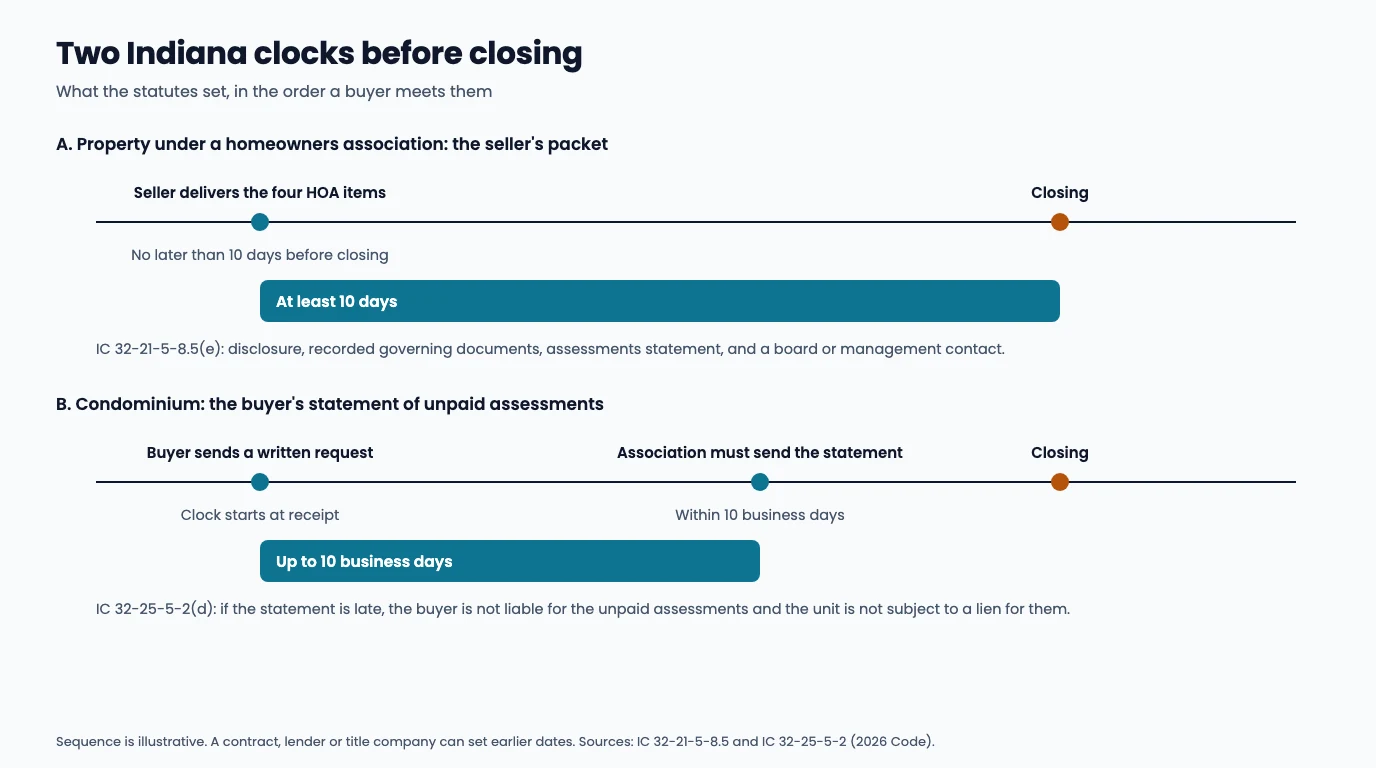
Indiana's disclosure rule for property in a homeowners association says the seller must provide four items "not later than ten (10) days before the sale of the property closes" ( IC 32-21-5-8.5):
- A disclosure that the property is in a community governed by a homeowners association.
- A copy of the recorded governing documents.
- A statement of whether there are assessments and the amount of any assessments.
- The name and the business or home address of a board member, the association's agent, or a person under contract to manage the association.
The rule covers "real property covered by the governing documents of a homeowners association" and uses the Homeowners Association Act's definitions ( IC 32-21-5-8.5 (b) and (c)). That Act defines a homeowners association as an entity organized for the benefit of owners who each own their own house and lot, which the statute words as owning "a dwelling in fee simple" ( IC 32-25.5-2-4). The text does not say whether a condominium association counts, so a condo buyer should use the separate condominium right in the next section and ask the title company which rule applies.
The chapter that holds this rule covers sales of residential real estate with no more than four dwelling units, and it lists transfers it does not cover, such as court-ordered transfers, foreclosure sales and certain transfers within a family ( IC 32-21-5-1).
A late packet does not release the buyer from the association's rules. The statute says failure to provide the documents "does not limit or prevent enforcement of the governing documents by the homeowners association." The section itself gives the buyer no cancellation right, so the contract's review period and a real estate attorney are the places to look when a packet arrives late ( IC 32-21-5-8.5(g)).
The fee for the statement of unpaid assessments changed on July 1, 2026. On a resale or refinance, an association or its agent "may not charge more than fifty dollars ($50) for the statement" ( IC 32-21-5-8.5(f), as amended by HEA 1115). The 2025 Code allowed up to $250.
What to do with this: count back ten days from the closing date and ask the seller or the listing agent for the date each of the four items was sent.
The Condominium Buyer's Statement of Unpaid Assessments
A condo buyer may request a statement of unpaid assessments. If the association takes longer than 10 business days, the buyer is not liable for them.
Condominium buyers have their own statutory right to a number. In an ordinary sale, the association can collect the seller's unpaid pre-sale assessments from either the buyer or the seller, but the buyer is "entitled to a statement" of the unpaid amount and "is not liable for" any unpaid assessments "in excess of the amount set forth in the statement" ( IC 32-25-5-2 (a) and (b)).
The request goes in writing to the last address where the seller paid assessments, or to the association's address on file with the Indiana secretary of state. If the association does not provide "a statement of unpaid assessments not later than ten (10) business days after receipt of the written request," the buyer is not liable for the unpaid assessments and the unit is not subject to a lien for them ( IC 32-25-5-2 (c) and (d)). A lien is the association's legal claim against the unit for unpaid dues. The rule covers an ordinary sale of a condominium unit, which the statute calls a voluntary conveyance, and a foreclosure sale is a separate situation.
Two other condominium rules affect what the statement means. Assessments "shall include the establishment and maintenance of a replacement reserve fund" ( IC 32-25-4-4(c)), and unpaid assessments are a lien on the unit that ranks ahead of other liens except tax liens and the first mortgage ( IC 32-25-6-3). A reserve study shows whether the fund is large enough, and our guide to reading a reserve study walks through the numbers. The Homeowners Association Act has no matching rule that we found: a search of its text in the 2026 Code for the word "reserve" finds only "preserve" in an unrelated sentence. An HOA buyer can ask whether the governing documents or a reserve study address a fund.
What to do with this: send the written request the day the offer is accepted, by a method that records the date, and put the tenth business day on your calendar.
What Members Can Inspect, and What to Ask For Now
HOA members can inspect financial records and minutes on written request, with no search fee, and get 4 days' notice of board meetings.
After closing, an HOA member can ask to inspect "the financial records, including all contracts, invoices, bills, receipts, and bank records," and the minutes of board meetings ( IC 32-25.5-3-3(g)). The request must identify what is wanted "with reasonable particularity." Since July 1, 2026 an association may not charge a fee to search for a record or to copy one requested this way. Before that, a search could cost up to $35 an hour after the first hour, with a $200 cap ( 2025 Code).
Members may attend board meetings, and the board must give "at least four (4) days advance written notice" with an agenda. The board may meet in private to discuss delinquent assessments, and with its lawyer to discuss starting litigation or litigation that is pending or threatened in writing ( IC 32-25.5-3-3(g)). The right has limits: an association need not produce unexecuted contracts, records about contract negotiations or "any records that were created more than two (2) years before the request" (subsection (k)).
Condominium co-owners have a narrower right. The board must keep records of receipts and expenditures for the common areas, and they must be "available for examination by the co-owners at convenient hours of weekdays" ( IC 32-25-8-8).
These rights belong to members, so they start when you own the home. A buyer can still use the same list before closing, because it names the documents worth asking the seller for. Our guide to getting HOA documents before an offer covers how to request them, and the two-year limit on records is a reason to ask for the last two years of minutes now.
What to do with this: ask the seller for the current budget and the last two years of board minutes, and read them for any assessment or fee discussion.
Budgets, Fees and Fines After July 1, 2026
Budgets need member notice, services in your dues cannot be billed again, and fines need a schedule the board adopted first.
A covered homeowners association must prepare an annual budget and give each member the proposed budget, or notice that it is available, plus "a written notice of the amount of any increase or decrease in a regular annual assessment" before the budget meeting ( IC 32-25.5-3-3 (a) to (c)). If too few members attend for the vote to count (a quorum is the minimum number of owners who must take part), the board may adopt a budget up to 100% of the last one. The 2026 budget changes in HEA 1152 allow more only in two cases, and only if the governing documents expressly say so: up to 110% in the first five years after the developer's first sale ( IC 32-25.5-3-3.2), and after that the lesser of 105% or the average Consumer Price Index increase for housing in the Midwest over the prior 12 months ( IC 32-25.5-3-3.3). An association formed before July 1, 2026 whose documents already allowed 110% keeps that right until the documents are amended or renewed after June 30, 2026 ( IC 32-25.5-3-3.1).
Fees are limited too. An association, its agent or its management company "may not charge a homeowner a fee associated with any services that are included in the homeowner's association assessment," such as common-area maintenance, landscaping or security. It may charge for optional services on a board-approved schedule, and an unpaid optional-service fee "does not constitute a lien against the homeowner's property" ( IC 32-25.5-3-3(n)).
Fines need a schedule. An association may fine a member for breaking a covenant only "if the board first adopts a schedule of fines" that lists the violations, the amount for each, any recurring terms and "a maximum aggregate fine amount for any single violation" ( IC 32-25.5-3-12). The schedule must be available to any member on request, and a member must get notice of the violation, the amount and the date before a fine is assessed.
What to do with this: ask for the fine schedule, the optional-service price list and the current budget with its notice of any assessment increase.
The 2026 Acts at a Glance
Four 2026 acts changed Indiana HOA rules. Three took effect on July 1, 2026 and one took effect when it was signed in March.
| Act | Effective | What it changes for a buyer | Where it reaches |
|---|---|---|---|
| HEA 1115 (P.L.155-2026) | July 1, 2026 | Resale statement fee capped at $50; fine schedules required; 4 days' notice with an agenda for board meetings; amendment votes capped at two-thirds; no fee to search for or copy records; no fee for services already in the assessment | Homeowners associations; see IC 32-25.5-1-1(b) |
| HEA 1152 (P.L.53-2026) | July 1, 2026 | Budget limits when a meeting lacks a quorum; no ban on amateur radio antennas; no ban on child care in a single-family home the provider lives in and owns, rents or leases | Homeowners associations; the antenna and child care chapters reach only documents adopted or amended after June 30, 2026 |
| HEA 1150 (P.L.26-2026) | July 1, 2026 | Flag and flagpole protections; no rules that treat vehicles or outdoor equipment differently by fuel source; homeowners associations cannot run license plate readers, with a law-enforcement exception | Flags: any property owners association, condominiums included. Vehicles and readers: homeowners associations, any governing documents |
| HEA 1210 (P.L.157-2026) | On passage, signed March 12, 2026 | Only members who use their property as a homestead vote on rental restrictions | Homeowners associations; a developer is exempt while it owns lots |
The flag rule is the broadest: it bars a property owners association, which the statute defines to include condominium and cooperative associations, from prohibiting display of the United States or Indiana flag, and it lets the association regulate flagpole materials and condition, with at least one flagpole per property allowed in the front yard up to 20 feet ( IC 32-21-13.5-5 and -6). We compared the Condominium Act section by section in the 2025 and 2026 editions of the Indiana Code and found no changed section.
What to do with this: if a rule you care about is on this list, check the date the governing documents were last amended against the effective date in the table.
Rules That Can Change After You Buy
Owners can amend Indiana HOA documents with at most two-thirds consent, and only homestead owners vote on rental limits.
An Indiana homeowners association's documents must let the owners amend them, and may not require consent from "more than two-thirds (2/3) of the owners" or of first mortgage holders eligible to receive notice. Before July 1, 2026 the ceiling was 75% ( 2025 Code). The documents may still require 95% to convey common areas or dissolve the plan ( IC 32-25.5-3-9). Members can also force a vote: if at least 10% sign a written demand, the board "shall hold a special meeting," and the annual meeting notice must now say so and state the number needed ( IC 32-25.5-3-2).
Investors and buyers who plan to rent the home should read the rental rule. Only members who use their property as a homestead (roughly, a home they live in as their own residence; check the statute's definition if the vote matters to your plans) "are eligible to cast a vote" on a prohibition or restriction on renting, and a developer is exempt while it owns lots ( IC 32-25.5-3-11(d) and (e)). The change took effect when HEA 1210 was signed on March 12, 2026, and it applies to votes after that date. The statute does not say what happens to a restriction adopted before then, so ask whether the governing documents already limit rentals.
The other 2026 protections limit what documents adopted after June 30, 2026 can say about amateur radio antennas ( IC 32-25.5-3.4-4) and child care in a single-family home ( IC 32-25.5-3.9-5). The fuel-source rule for vehicles and outdoor equipment ( IC 32-25.5-3.6-3) and the license plate reader ban ( IC 32-25.5-3.8-3) reach governing documents whenever they were adopted.
What to do with this: read the rental, vehicle and amendment sections of the governing documents, and ask when each was last amended.
Questions to Ask Before You Close
These eight questions turn the Indiana statutes into a checklist you can run from the contract, the packet and the closing statement.
- The packet. Did the seller deliver the four disclosure items at least ten days before closing, and on what date?
- The statement. If this is a condominium, did the written request go out, and has the association answered within ten business days?
- The fee. Was any statement of unpaid assessments charged at more than $50?
- The reserve. How large is the reserve fund, and when was the last reserve study?
- The budget. Does the proposed budget come with a notice of any assessment increase?
- The fines. Has the board adopted a fine schedule, and what is the maximum for any single violation?
- The rentals. Do the governing documents limit rentals, and when was that last amended?
- The minutes. What do the last two years of board minutes say about assessments, repairs and disputes?
If you want a second set of eyes on the packet before you call an attorney, our free tools for CC&Rs, reserve studies and meeting minutes point to the pages behind each finding. For specific questions about your contract, a deadline or a statement, an Indiana real estate attorney can read the documents and advise on your situation.
Frequently Asked Questions
How many days before closing must an Indiana seller give HOA documents to the buyer?
At least ten days. Indiana Code 32-21-5-8.5 says the seller must provide a disclosure that the property is in a homeowners association community, a copy of the recorded governing documents, a statement of whether there are assessments and their amount, and the name and address of a board member, agent or management contact, "not later than ten (10) days before the sale of the property closes." The text covers property under a homeowners association's governing documents and does not say whether a condominium association counts. A missed delivery does not stop the association from enforcing its documents.
What can an Indiana HOA charge for a statement of unpaid assessments on a resale?
No more than $50 since July 1, 2026. Indiana Code 32-21-5-8.5(f) says that on a resale or refinance, an association or its agent "may not charge more than fifty dollars ($50) for the statement." Under the 2025 Code the limit was $250. The same law covers property under a homeowners association's governing documents; the text does not say whether it reaches a condominium association.
Does an Indiana condo buyer get a statement of unpaid assessments?
Yes, on written request. Under Indiana Code 32-25-5-2, a condominium buyer in an ordinary sale (the statute says voluntary conveyance, meaning not a foreclosure) is entitled to a statement of the seller's unpaid assessments and is not liable for more than the statement shows. If the association does not send the statement within ten business days after the request, the buyer is not liable for the seller's unpaid assessments and the unit is not subject to a lien for them (a lien is the association's legal claim against the unit for unpaid dues).
Does Indiana require an HOA or condo association to keep a reserve fund?
For condominiums, yes in the assessment rule: Indiana Code 32-25-4-4(c) says assessments "shall include the establishment and maintenance of a replacement reserve fund." The Homeowners Association Act text we read (Indiana Code 32-25.5) has no reserve-fund requirement that we found, because a search of it for the word "reserve" finds only "preserve" in an unrelated sentence, so a buyer in an HOA should ask whether the governing documents or a reserve study address one.
Can an Indiana HOA fine me?
Only after the board adopts a schedule of fines. Indiana Code 32-25.5-3-12, effective July 1, 2026, requires the schedule to list the violations, the amount of each fine, any recurring terms and a maximum aggregate fine for any single violation. The schedule must be available to any member on request, and the member must get notice of the violation, the amount and the date before a fine is assessed.
What changed in Indiana HOA law in 2026?
Four 2026 acts changed the Homeowners Association Act and related rules. HEA 1115 (P.L.155-2026) capped the resale statement fee at $50, required fine schedules, set four days' notice for board meetings, and lowered the amendment ceiling to two-thirds. HEA 1152 changed budget rules and added antenna and child care protections. HEA 1150 added flag, vehicle fuel-source and license plate reader rules. HEA 1210 limited votes on rental restrictions to members who use their property as a homestead. All but HEA 1210 took effect July 1, 2026. A comparison of the 2025 and 2026 Code found no change to the Condominium Act.
Get Your CC&Rs Analyzed
Upload your HOA's CC&Rs and get instant analysis of rental restrictions, pet policies, financing red flags, and more. Free. No signup required.
Your first full property report is also free. See what you'll get →
Or get your first full report free →Related Articles
Sources & References
- Indiana Code 32-21-5-8.5 (2026 Code) (seller's HOA disclosures; $50 statement fee cap)
- Indiana Code 32-21-5-8.5 (2025 Code) (prior $250 statement fee cap)
- Indiana Code, Title 32, Article 25 (Condominiums) (applicability, unpaid-assessment statement, reserve fund, lien, records)
- Indiana Code, Title 32, Article 25.5 (Homeowners Associations) (applicability, records, budgets, fees, fines, amendments, rental votes)
- Indiana Code 32-21-13.5 (flags) (property owners association flag rule)
- House Enrolled Act 1115 (2026) (P.L.155-2026; homeowners association governance; effective July 1, 2026)
- House Enrolled Act 1150 (2026) (P.L.26-2026; flags, vehicles, license plate readers; effective July 1, 2026)
- House Enrolled Act 1152 (2026) (P.L.53-2026; budgets, antennas, child care; effective July 1, 2026)
- House Enrolled Act 1210 (2026) (P.L.157-2026; homestead votes on rental restrictions; signed March 12, 2026)
Disclaimer: This article is for educational purposes only and does not constitute legal, financial, or real estate advice. Indiana statutes change, and the sections cited are the 2026 edition of the Indiana Code as of October 21, 2026 and may be amended. This article covers Indiana condominiums and homeowners associations; cooperatives, older associations that have not elected the Homeowners Association Act and communities governed by other statutes may follow different rules. Consult a qualified Indiana real estate attorney for guidance specific to your situation.