

In This Guide
In an April 2025 national survey, 93% of community associations reported a property and casualty premium increase at their last or current renewal. What that increase cost an individual owner ranged from under $100 a year to more than $2,000. The difference is a board decision about which pocket the money comes from.
1. The Association's Number Is Not Your Number
93% of associations saw a premium increase at renewal. What it cost each owner depended on which funding route the board chose.
Your association's master insurance premium went up. You know this because the board said so, in a budget letter or at a meeting or in the one-line explanation attached to a bill you were not expecting. What the letter usually does not say is why the increase reached you the way it did.
The premium is one number. What you pay is a different number, and the gap between them is not small. In the Foundation for Community Association Research's April 2025 snap survey of 509 respondents across 39 states, 93% reported that their property and casualty premium increased at the last or current renewal. Asked how much that increase cost per homeowner per year, 34% said under $100 and 31% said $101 to $500. But 8% said $501 to $1,000, 4% said $1,001 to $2,000, and another 4% said more than $2,000.
Those associations were buying insurance in the same market. The spread comes from somewhere else: how big the building is, what it is worth, what the carrier demanded, and above all which funding route the board chose. The same premium increase can show up as a permanent bump in your monthly assessment, a one-time bill, a quiet reduction in what the association sets aside for the roof, or nothing at all this year.
This guide walks the four routes, what each one feels like from the owner's side, and which documents let you see which one your board used. If you want the board's side of the same problem, the companion piece on what an insurance carrier reviews at renewal covers the file the underwriter actually reads. For why the market moved in the first place, see the condo insurance crisis and what it means for your mortgage. For the whole picture in one place (master policy, HO-6, flood and lender rules), start with the complete guide to HOA insurance.
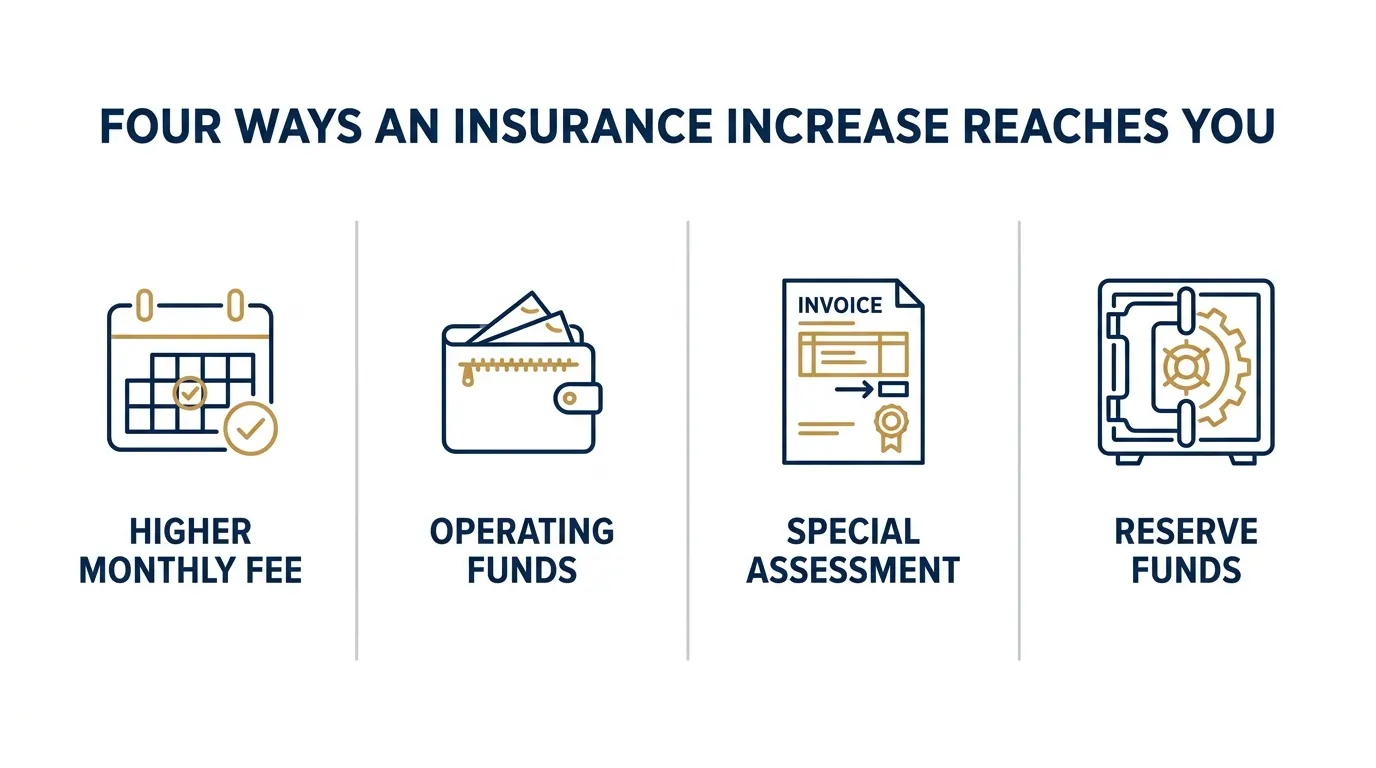
2. The Four Ways a Premium Increase Reaches You
Boards fund insurance increases by raising regular assessments (71%), using operating funds (50%), special assessments (31%), or reserves (21%).
The same April 2025 survey asked how the premium increase was funded. Respondents could select more than one answer, so the shares total more than 100%.
| Funding route | Share | What the owner sees |
|---|---|---|
| Increase regular assessments | 71% | A higher monthly fee that becomes the new baseline for every future year |
| Operating funds | 50% | No change this year, paid for by spending less on something else |
| Special assessment | 31% | A separate bill, often due in a lump sum or over a short schedule |
| Reserve funds | 21% | Nothing visible, and a larger repair bill in a later year |
| Contingency funds | 9% | Nothing visible, and less cushion for the next surprise |
| Line of credit or bank loan | 6% | Nothing this year, plus interest carried by the association |
Two of these routes are visible and two are not, and that distinction matters more than the percentages. Raising the regular assessment and levying a special assessment both announce themselves. They arrive with notice requirements, they generate questions at meetings, and owners can see exactly what happened.
Drawing on operating surplus, contingency funds, or reserves announces nothing. The premium got paid, the fee stayed flat, and the cost moved into a future year where it will be harder to trace back to the insurance renewal that caused it. An owner who sees no fee increase after a hard renewal has not necessarily avoided the cost. They may simply not have been billed for it yet.
3. The Budget Line That Tells You Which One
Florida requires insurance as its own budget expense classification. California requires an annual summary showing each policy limit and deductible.
You do not have to ask the board what happened. In both of the largest condominium states, the answer is in a document the association is already required to hand you.
Florida: the proposed budget, fourteen days ahead
Under Fla. Stat. §718.112(2)(e)1, at least 14 days before the budget meeting the board must hand deliver, mail, or electronically transmit to each unit owner a notice of the meeting and a copy of the proposed annual budget. That copy is not a summary. Under §718.112(2)(f)1, the proposed budget "must be detailed and must show the amounts budgeted by accounts and expense classifications, including, at a minimum, any applicable expenses listed in s. 718.504(21)."
That cross-reference is the useful part. The list in §718.504(21) breaks operating expenses into named classifications, and insurance is one of them, sitting on its own line alongside administration, management fees, maintenance, taxes, and security. So a Florida condominium owner receives, two weeks before adoption, a document in which the insurance number is broken out rather than buried. Set this year's proposed budget next to last year's and the change in that one line is the number you were looking for.
California: the annual budget report
California gets at it from the other direction. Cal. Civ. Code §5300 requires the association to distribute an annual budget report 30 to 90 days before the end of its fiscal year, and that report must include a summary of the association's property, general liability, earthquake, flood, and fidelity insurance policies. For each policy, the summary shows the name of the insurer, the type of insurance, the policy limit, and the deductible where applicable. An association may satisfy this by copying the declaration page and distributing it with the report. The report must also state any anticipated special assessments.
A California owner therefore gets the two numbers that decide their exposure, every year, without asking for them. Worth noting precisely: the statute lists insurer, type, limit, and deductible. It does not require the expiration date, which is the one item you may still have to request.
What the line looks like when it moves
For a sense of scale, the HOA Leadership Network surveyed its member boards in the Minneapolis and St. Paul metro in August 2024 and reported insurance climbing from 26.9% of the operating budget in 2022 to 34.4% in 2024, with the average per-unit master premium going from $837 to $1,436 over the same period.
Treat those figures as an illustration rather than a national benchmark. The survey drew 74 responses from 750 members, a 9.6% response rate, from a self-selected advocacy network in one metro area. Of the responding communities, 74% were townhome associations and 13% were condominiums, and 60% had fewer than 50 housing units. The value is in the shape of the movement, not the precision of the number: when insurance is approaching a third of an operating budget, it stops being a line item the board can absorb quietly.
4. When It Arrives as a Special Assessment
Florida's 115% substitute-budget trigger expressly excludes insurance premiums. California requires member approval above 5% of expenses.
Thirty-one percent of associations in the 2025 survey used a special assessment for at least part of the increase. This is the route most likely to produce a dispute, and both states put procedural conditions on it.
In Florida, Fla. Stat. §718.112(2)(c)1 provides that written notice of a meeting at which a nonemergency special assessment will be considered "must be mailed, delivered, or electronically transmitted to the unit owners and posted conspicuously on the condominium property at least 14 days before the meeting." The notice has to state the estimated cost and describe the purposes for the assessment. Both the delivery and the posting are required, and the notice has to be specific about what the money is for.
Florida also has a size mechanism for the regular budget, and for this particular topic it has a hole in it. Under §718.112(2)(e)2.a, if a board proposes an annual budget requiring assessments that exceed 115% of assessments for the preceding fiscal year, it must simultaneously propose a substitute budget stripped of discretionary expenditures that are not required to be in the budget, give 14 days notice of the meeting, and let owners consider it. A substitute budget is adopted if approved by a majority of all voting interests, unless the bylaws set a higher percentage. If owners do not adopt it, the board's original proposal may be adopted.
The hole is in the next subparagraph. Under §718.112(2)(e)2.b, the determination of whether assessments exceed 115% "shall exclude any authorized provision for required reserves for repair or replacement of the condominium property; anticipated expenses of the association which the board does not expect to be incurred on a regular or annual basis for the repair, maintenance, or replacement of the items listed in paragraph (g); and insurance premiums."
Insurance premiums are excluded from that computation by name. So a Florida condominium budget can rise steeply on the strength of an insurance renewal without ever triggering the substitute-budget requirement, because the part of the increase that caused it does not count toward the 115% test. A separate rule in §718.112(2)(e)2.c applies where the developer controls the board: in that case assessments may not exceed 115% of the prior year's without approval by a majority of all voting interests.
California adds a size threshold of a different kind. Under Cal. Civ. Code §5605(b), without approval of members casting a majority of votes at a meeting or election, the board may not impose a regular assessment more than 20% greater than the preceding fiscal year's, and may not impose special assessments that in the aggregate exceed 5% of the budgeted gross expenses for that fiscal year.
Read that as a trigger rather than a ceiling. Nothing in the section prohibits a larger increase. It changes who gets to decide: above the threshold, the decision moves from the board to the membership.
There is an exception. Cal. Civ. Code §5610 lets a board impose an increase without member approval in three enumerated emergency situations: an extraordinary expense required by court order, an extraordinary expense necessary to operate, repair, or maintain the development where a threat to personal health or safety or another hazardous condition is discovered, and an extraordinary expense necessary to repair or maintain the development "that could not have been reasonably foreseen by the board in preparing and distributing the annual budget report." For that third category the board must pass a resolution containing written findings about the necessity of the expense and why it was not reasonably foreseeable, and distribute those findings with the notice of assessment.
The written findings are the part worth knowing about, because they are a document you can read. Whether any particular assessment satisfies the statute is a question for a community association attorney, not something to settle from a blog post or a board meeting. Separately, Cal. Civ. Code §5615 requires individual notice of any increase in regular or special assessments not less than 30 nor more than 60 days before the increased assessment becomes due.
5. The Deductible Someone Chose On Your Behalf
29% of associations reported high deductibles or per-unit deductibles being forced by the insurer at their last renewal.
A premium is what the association pays every year. A deductible is what it pays when something happens, and it is the quieter half of the same negotiation. In the April 2025 survey, 29% of respondents said high deductibles or per-unit deductibles were forced by the insurer at the last or current renewal, against 64% who said they were not.
"Forced by the insurer" is doing real work in that sentence. It describes an association that did not choose a higher deductible to save money but was offered no other terms. Either way the effect on the owner is the same: more of the first dollars of any loss land inside the association, and from there they reach owners through the assessment mechanism, which is exactly what a unit owner's loss assessment coverage is meant to catch. The gaps in that coverage are their own subject, covered in the HO-6 loss assessment gap most condo owners never see.
A deductible chosen for premium relief can also run into secondary-market limits that have nothing to do with the association's own analysis, which is where a renewal decision quietly becomes a resale problem. That mechanism, and the statutory constraints on how a Florida board sets deductibles in the first place, are covered in what your insurance carrier is about to ask your board. For California owners, the deductible is one of the four items §5300 puts in front of you every year.
6. Reserves Are the Quietest Route
21% of associations funded a premium increase from reserves. Florida now blocks that route for associations required to obtain a SIRS.
Twenty-one percent of associations funded the increase from reserve funds. On the owner's statement, that route is invisible. There is no fee change, no special assessment notice, no meeting. The premium was paid out of money that was set aside to replace the roof.
The cost has not gone away. It has been converted from an insurance expense this year into a component-replacement shortfall in a later year, at which point it will arrive as a special assessment that looks unrelated to insurance. This is the single strongest reason for an owner to read the reserve balance alongside the insurance line rather than one at a time.
Florida has partially closed this route. For a budget adopted on or after December 31, 2024, Fla. Stat. §718.112(2)(g)2.b provides that the members of a unit-owner-controlled association that must obtain a structural integrity reserve study may not determine to provide no reserves, or less reserves than required, for the items listed in paragraph (g). The statute carves out one case: members of an association operating a multicondominium may still do so if an alternative funding method has been approved by the division. The scope is otherwise specific and worth stating carefully. It attaches to that budget adoption date, to associations required to obtain a SIRS, and to the statutory component categories in paragraph (g), rather than to reserves in general.
One more finding from the 2025 survey belongs here. 88% of responding communities had a reserve study, and 21% had an insurable value appraisal. Most associations can tell you what it costs to replace the roof. Far fewer can tell you what it costs to rebuild the building, which is the number the master policy limit is supposed to be built on. You can put a reserve study through the free reserve study analyzer to see how the funding picture reads before the next renewal lands on it.
7. What the 2026 Soft Market Does and Does Not Change
Global commercial rates fell 6% in Q2 2026, the eighth consecutive quarter of decreases. Associations meet that market only at their own renewal date.
The market has turned. Marsh's Q2 2026 index put global commercial insurance rates down 6% on average, the eighth consecutive quarter of decreases, with property rates down 12%. Marsh attributes the decline to abundant capacity and strong insurer competition, supported by insurer profitability, surplus capital, lower reinsurance costs, and higher investment returns. United States rates moved less, with the overall composite down 2% in Q2 after a 1% decline in Q1.
Note what that streak counts. The eighth-consecutive-quarter figure describes the composite rate, not property specifically. Property fell 12% in Q2 and 9% in Q1, but the consecutive-quarter count is a composite measure.
Two things keep a softening market from showing up on your statement. The first is mechanical: property policies run annual terms, so an association does not meet the market continuously. It meets the market once, on its renewal date, and a building renewing in February is pricing a different market than one renewing in August.
The second is that a falling average is not a falling price for everyone. Marsh's own commentary on the quarter reports that "risk differentiation continued to increase, with underwriting outcomes increasingly driven by exposure quality and risk management." A softer market rewards buildings that can document their condition and prices the rest on what the file shows. Which brings the question back to the documents, and to what the carrier reads at renewal.
Frequently Asked Questions
My HOA said insurance went up, but my fee did not change. Where did the money come from?
Probably from a source that does not appear on your statement. In the Foundation for Community Association Research's April 2025 survey, 50% of associations funded a premium increase from operating funds, 21% from reserve funds, and 9% from contingency funds. None of those produce a visible change to a monthly assessment in the year they happen. The reserve route in particular converts an insurance cost this year into a component replacement shortfall later, so a flat fee after a hard renewal is worth checking against the reserve balance rather than taken as good news.
Can my HOA charge a special assessment for an insurance premium increase?
Thirty-one percent of associations in that survey used a special assessment for at least part of an increase, and both major condominium states put conditions on it. In Florida, §718.112(2)(c)1 requires written notice of the meeting at which a nonemergency special assessment will be considered to be mailed, delivered, or electronically transmitted to unit owners and posted conspicuously on the property at least 14 days before the meeting, stating the estimated cost and describing the purposes. In California, §5605(b) requires approval by members casting a majority of votes before special assessments in the aggregate exceed 5% of budgeted gross expenses for the fiscal year. Whether a specific assessment was properly levied depends on the association's governing documents and circumstances, and is a question for a community association attorney.
How do I find out how much my association's insurance actually costs?
In Florida, §718.112(2)(e)1 requires the board to deliver a copy of the proposed annual budget to each unit owner at least 14 days before the budget meeting, and §718.112(2)(f)1 requires that budget to show amounts by accounts and expense classifications including, at a minimum, the applicable expenses listed in §718.504(21). Insurance is a named classification in that list, so it appears on its own line. In California, §5300 requires an annual budget report distributed 30 to 90 days before the fiscal year ends, including a summary of the association's property, general liability, earthquake, flood, and fidelity policies showing the insurer, type of insurance, policy limit, and deductible.
Can a board pay an insurance increase out of reserves?
Twenty-one percent of associations in the April 2025 survey reported doing so. Florida has narrowed it: for a budget adopted on or after December 31, 2024, §718.112(2)(g)2.b provides that members of a unit-owner-controlled association that must obtain a structural integrity reserve study may not determine to provide no reserves or less reserves than required for the items listed in paragraph (g), except that members of an association operating a multicondominium may do so if an alternative funding method has been approved by the division. That rule is tied to the budget adoption date, to associations required to obtain a SIRS, and to those statutory component categories rather than to reserves generally. What any particular association may do depends on its governing documents and state law, so an attorney should review a specific situation.
Insurance rates are falling in 2026. Why did my association's premium still go up?
Two reasons. Property policies run annual terms, so an association prices against the market on its renewal date rather than continuously, and a building renewing early in the year met different conditions than one renewing late. Beyond timing, Marsh reported for Q2 2026 that "risk differentiation continued to increase, with underwriting outcomes increasingly driven by exposure quality and risk management." A market average falling 6% is not a discount applied to every building. Associations that can document condition and maintenance are positioned differently from those that cannot.
Get Your HOA Documents Analyzed
GoverningDocs analyzes CC&Rs, reserve studies, and meeting minutes, identifying red flags, restrictions, and financial risks so you can buy with confidence. Free. No signup required.
Your first full property report is also free. See what you'll get →
Or get your first full report free →Related Articles
Sources & References
- Foundation for Community Association Research, Insurance Coverage Trends in Community Associations (April 2025) (509 respondents across 39 states; 93% premium increase at renewal, funding-route split, per-homeowner cost brackets, forced deductibles, reserve study and insurable value appraisal shares)
- Fla. Stat. §718.112 (14-day special assessment notice with estimated cost and purpose, 14-day delivery of the proposed annual budget, the 115% substitute-budget requirement and its express exclusion of insurance premiums from the computation, budget detail by expense classification, reserve no-waiver rule for budgets adopted on or after December 31, 2024 with the multicondominium alternative-funding exception)
- Fla. Stat. §718.504(21) (estimated operating budget expense classifications, insurance as a named line item)
- Cal. Civ. Code §5300 (annual budget report distributed 30 to 90 days before fiscal year end, insurance summary showing insurer, type, policy limit and deductible, anticipated special assessments)
- Cal. Civ. Code §5605 (20% regular assessment and 5% aggregate special assessment member-approval thresholds)
- Cal. Civ. Code §5610 (three enumerated emergency situations, board resolution with written findings)
- Cal. Civ. Code §5615 (individual notice not less than 30 nor more than 60 days before an increased assessment becomes due)
- Insurance Journal, July 23, 2026 (Marsh Q2 2026 Global Insurance Market Index: composite down 6%, eighth consecutive quarter, property down 12%, US down 2%, risk differentiation commentary)
- Marsh, Q2 2026 Global Insurance Market Index (abundant capacity and competition, insurer profitability, surplus capital, lower reinsurance costs, higher investment returns)
- HOA Leadership Network, 2024 HOA Insurance Survey Results (November 2024) (Minneapolis and St. Paul metro, 74 of 750 members responding, per-unit premium and share-of-operating-budget series)
Disclaimer: This article is for educational purposes only and does not constitute legal, financial, insurance, or real estate advice. Assessment procedures, notice requirements, and reserve rules vary by state and by an association's governing documents, and they change over time. Nothing here evaluates whether any particular assessment, budget, or funding decision was properly adopted. Survey findings describe responding associations and are not representative of all communities. Citations are current as of July 2026 and may be superseded. Consult a qualified community association attorney for guidance specific to your situation.