
In This Guide
A new board inherits a declaration it did not negotiate. Some of the clauses in it are on a statutory clock, and at least one may already be void by operation of law. Neither fact is visible from the clause itself.
The board takes over. Somebody hands across a binder, or a login, or a cardboard box. The declaration inside was drafted by the developer's counsel to protect the developer, recorded before a single owner had a vote, and signed by every buyer who has closed since.
Most new boards read it for the first time when a problem starts. By then the useful question is no longer what the document says. It is whether the clause still binds anyone, and whether the window to do something about it is still open.
Those are different questions, and the document answers neither. Reading a clause tells you what it claims. Its status depends on the state statute sitting behind it and, in one case, on how many months have passed since turnover. Below are seven places where the gap between what a developer-drafted declaration claims and what it can actually do tends to be widest.
One scope note. The rules below come from Florida, California and Colorado, three states whose statutes or high courts have addressed these particular clauses directly. They are not national. Where a rule is named, the state is named with it. Whether any of it reaches a particular association depends on that association's documents and its own state's law, which is a question for a community association attorney rather than an article.
1. The 18-Month Clock Most New Boards Never Hear About
Florida deems certain developer-era purchase and lease obligations ratified unless owners reject them within 18 months of electing a board majority.
This is the most time-sensitive item on the list, which is why it goes first.
Under Fla. Stat. §718.302(2), a grant, reservation or contract made before owners elect a majority of the board, which requires the association to purchase condominium property or to lease condominium property to another party, is "deemed ratified unless rejected by a majority of the voting interests of unit owners other than the developer within 18 months after unit owners other than the developer elect a majority of the board of administration."
Read the mechanism carefully, because it runs the opposite direction from most protections. Nothing has to happen for the obligation to survive. Silence ratifies it. A board that spends its first eighteen months on landscaping complaints and a leaking valve has not preserved its position, it has spent it.
The subsection carries an exception that has to be read alongside it. It does not apply to a grant or reservation in a declaration where persons other than the developer, the developer's heirs, assigns, affiliates, directors, officers or employees are granted the right to use the condominium property, so long as those persons are obligated to pay at least a proportionate share of the cost associated with that property. So the 18-month rule is narrower than "any developer-era deal." It reaches the ones where the association is on the hook to buy or to lease out.
The practical step is a date, not a legal conclusion: find the month owners first elected a board majority, add eighteen, and see whether that date has passed.
2. Contracts Signed Before You Had a Vote
Florida requires developer-era management arrangements to be fair and reasonable, and lets 75% of non-developer voting interests cancel them.
Separate from the 18-month rule, §718.302(1) covers a different category: any grant or reservation made by a declaration, lease or other document, and any contract made by an association before owners assumed control, that provides for operation, maintenance, or management of the association or of property serving the unit owners.
Two things attach to that category. First, the statute says such an arrangement "shall be fair and reasonable." That is a standard written into the statute, not a matter of taste. Second, it may be canceled. Where the association operates one condominium and owners have assumed control, cancellation is by concurrence of the owners of at least 75 percent of the voting interests other than those owned by the developer.
The structure gets more complicated for associations operating more than one condominium, and for shared recreational property serving several associations, which cannot be canceled until owners have assumed control of all the associations it serves. If your community is a multi-condominium or shares amenities, the applicable paragraph is not the simple one.
What makes this worth checking early is that a management agreement written during developer control was negotiated by one party with itself on both sides of the table. The statute anticipates exactly that, which is why the fairness standard is in the text.
3. The Turnover Audit the Developer Pays For
Florida requires an independent CPA audit at the developer's expense covering the association from incorporation through turnover.
Boards routinely leave this one on the table, usually because nobody told them it existed.
§718.301(4) requires the developer, at turnover, to deliver the association's property and records at the developer's expense. The list runs long: the recorded declaration and all amendments, articles, bylaws, minute books, rules, resignations of developer-seated directors, association funds, tangible personal property with an inventory, plans and specifications, and the contractor and subcontractor list.
The item to focus on is §718.301(4)(c), the financial records. They must be audited by an independent certified public accountant, covering the period from the association's incorporation (or from the last audit, if there have been annual ones). The statute then says what the audit is for, and this is the sentence that matters: the accountant examines supporting documents and records including cash disbursements and paid invoices to determine if expenditures were for association purposes, and the billings, cash receipts and related records "to determine that the developer was charged and paid the proper amounts of assessments."
That is a statutory audit of the developer's own assessment payments, paid for by the developer. Section 718.301(4) allows the financial records to arrive up to 90 days after turnover, so a board that hears nothing in month four has a concrete, dated thing to ask about.
4. The Assessment Excusal With an Expiration Date
Florida caps how long a declaration may excuse a developer from assessments on unsold units, and the outer limit is a countable date.
Developer-drafted declarations commonly excuse the developer from paying assessments on unsold units. Florida permits this, but not open-endedly, and the boundary is arithmetic rather than argument.
§718.116(9)(a)1 allows a declaration to excuse a selling developer from assessments on unsold units for a stated period, provided the developer pays common expenses incurred during that period which exceed the regular periodic assessments charged to other owners. Then comes the limit: "The stated period must terminate no later than the first day of the fourth calendar month following the month in which the first closing occurs of a purchase contract for a unit in that condominium."
There is a second, different route at §718.116(9)(a)2. A developer may instead be excused for as long as it guarantees to purchasers that assessments will not exceed a stated dollar amount and pays any common expenses above that amount. That guarantee may sit in the purchase contract, declaration, prospectus, or a written agreement with a majority of non-developer owners, and it may be extended for further stated periods.
These are two distinct mechanisms with different obligations attached, and a declaration will typically use one. Identifying which one your document uses, and then finding the date of the first closing, turns an abstract clause into a checkable fact.
5. Preconditions on Suing the Builder
California voids declaration provisions that impose preconditions or developer vetoes on a board's construction defect claims, retroactively.
Many developer-drafted declarations condition any construction defect claim on a membership vote, or give the developer a say in whether the claim proceeds. In California, that category of clause was addressed directly by statute.
Cal. Civ. Code §5986(b) provides that the governing documents shall not impose any preconditions or limitations on the board's authority to commence and pursue a claim, civil action, arbitration, prelitigation process or other legal proceeding against a declarant, developer or builder. It then names the two most common forms and disposes of them: any limitation or precondition, "including, but not limited to, requiring a membership vote as a prerequisite to, or otherwise providing the declarant, developer, or builder with veto authority over" such a proceeding, "is unenforceable, null, and void."
Three details do real work here.
- It reaches back. Subdivision (d) applies the section "to all governing documents, whether recorded before or after the effective date," so a declaration recorded in 1998 is covered.
- Developer-affiliated directors are cut out of the decision. Under subdivision (a), if the board includes members appointed by or affiliated with the declarant, developer or builder, the authority to commence and pursue proceedings is "vested solely in the nonaffiliated board members."
- Owners can reinstate a limitation themselves. Subdivision (c) preserves such a provision if it is adopted solely by the nondeclarant-affiliated members, through the normal amendment requirements. The statute removes the developer's version, not the association's ability to choose one.
The clause is still printed in the recorded document. It is worth being precise about what that means: printing is not the same as operating. The text does not remove itself when a statute voids it.
6. The Arbitration Clause Sitting Right Next to It
California's statute voiding defect-claim preconditions expressly leaves arbitration provisions alone, and courts have enforced them.
Here is where a reasonable reading of section 5 goes wrong. Having voided preconditions and vetoes, §5986 stops short of the arbitration clause, and it says so.
§5986(e): "Nothing in this section shall affect any other obligations of an association contained in Title 7 (commencing with Section 895) of Part 2 of Division 2, or any other provision in the covenants, conditions, and restrictions of the association related to arbitration or other alternative dispute resolution procedures."
So the membership-vote precondition is void and the binding-arbitration requirement in the same article of the same declaration is untouched. Those two clauses can sit on the same page with different legal status.
California courts had already reached the arbitration question. In Pinnacle Museum Tower Assn. v. Pinnacle Market Development (US), LLC (2012) 55 Cal.4th 223, the California Supreme Court held that a developer could compel a condominium association to arbitrate construction defect claims under an arbitration provision recorded in the CC&Rs, reversing lower courts that had found the provision unconscionable.
Colorado reached a comparable destination by a different route. In Vallagio at Inverness Residential Condominium Assn. v. Metropolitan Homes, Inc., 2017 CO 69, the declaration required construction defect claims to go to binding arbitration and provided that the arbitration provisions could not be amended without the declarant's written consent. Owners voted to remove the arbitration requirement without obtaining that consent. The Colorado Supreme Court, affirming the court of appeals, held the consent-to-amend provision valid and enforceable and rejected the argument that it violated CCIOA, which made the attempted removal ineffective and left the arbitration agreement in force.
A common shorthand holds that California's 2019 legislation overturned Pinnacle. Subdivision (e) is the reason that is not right, and it is the kind of detail that decides whether a board is reading its own document correctly.
7. The Clause That Decides Whether You Can Fix Any of This
Declarant consent-to-amend clauses can survive turnover. Colorado's supreme court enforced one against owners who amended without that consent.
Every flag above assumes a board could eventually amend its way out. The amendment article is what determines whether that assumption holds, and it is the clause developer-drafted declarations protect most carefully.
Vallagio is the cautionary version. The owners followed their amendment procedure, voted, and removed the arbitration requirement. Because they had not obtained the declarant's written consent, which the declaration required for that particular provision, the amendment did not take effect and the association was held to arbitration anyway.
Two things are worth separating when reading your own amendment article. There is the general amendment threshold, the percentage of voting interests needed to change the declaration at all. And there is the possibility of carve-outs: specific provisions that carry a higher threshold, or require declarant consent, or are said to be unamendable. Those carve-outs are usually attached to exactly the clauses a new board would most want to change.
For the mechanics of reading an amendment through before a vote, see how to read a CC&R amendment before voting on it.
What to Pull, and in What Order
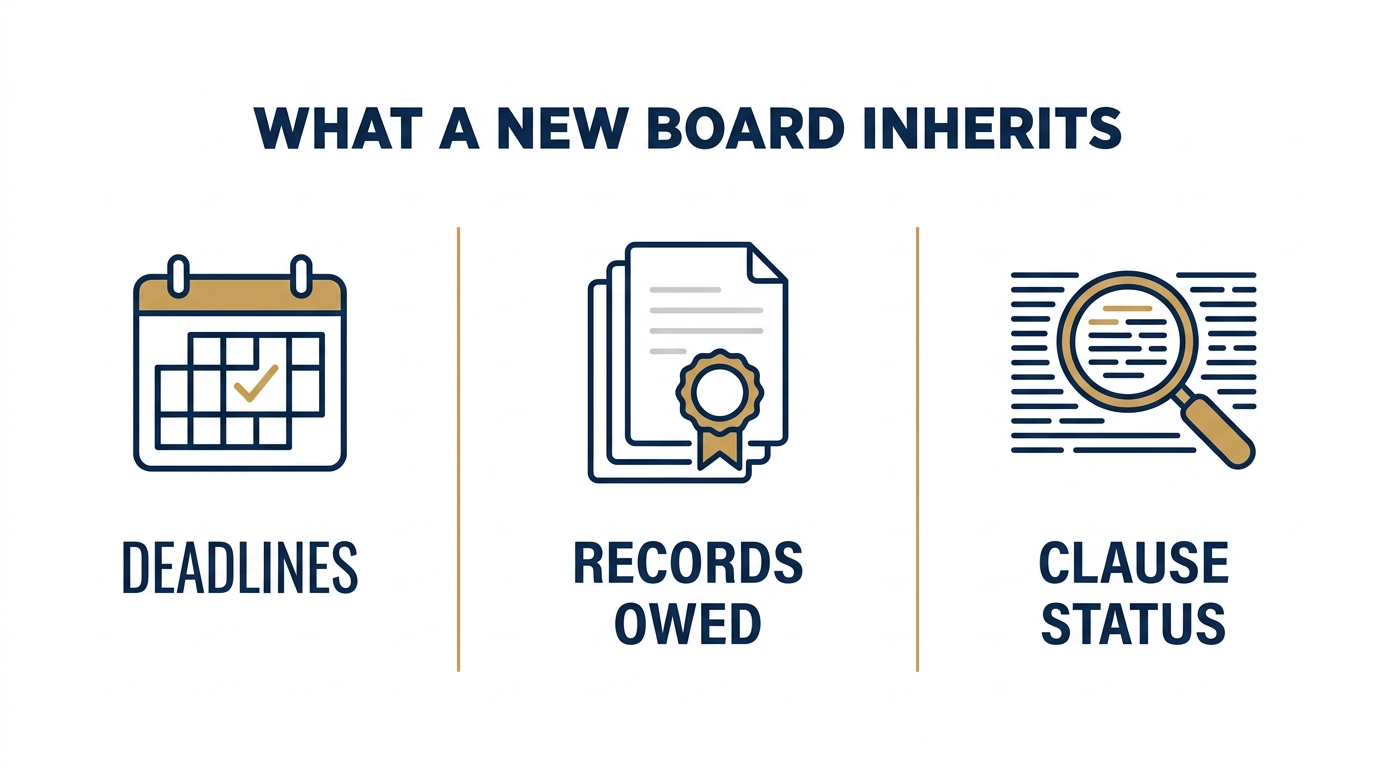
Start with the dated items, because those are the ones that stop being available. Deadlines first, then records you are owed, then clause status.
The ordering principle is recoverability. Deadlines first, then documents you are owed, then clauses whose status you need to establish.
- The date owners first elected a board majority. It sets the 18-month clock in Florida and it is the reference point for most turnover obligations.
- The recorded declaration and every amendment. Not the sales-office copy. The recorded one, with the full amendment history, since an amendment may have already changed a clause you are about to research.
- The turnover audit and the records list. If the audit never arrived, that is itself the finding.
- Any obligation to purchase or lease. These are the ones a clock runs against.
- The management and maintenance agreements in force at turnover, with their dates and terms.
- The amendment article, read for carve-outs rather than just the headline percentage.
Then take the list to a community association attorney in your state. The point of the reading is not to decide the legal questions. It is to arrive with the specific clauses and dates already identified, which is a materially different conversation from arriving with a box.
If your community is still in the developer-control phase rather than past turnover, the relevant issues are different ones, and they are covered in HOA red flags in developer-controlled boards.
Frequently Asked Questions
Can a new board just rewrite the developer's CC&Rs?
Only through the amendment procedure in the declaration itself, and that procedure may be harder than the headline percentage suggests. Developer-drafted declarations often place carve-outs on specific provisions, requiring a higher threshold or the declarant's written consent. In Vallagio at Inverness Residential Condominium Assn. v. Metropolitan Homes, Inc., 2017 CO 69, the Colorado Supreme Court, affirming the court of appeals, held a declarant consent-to-amend provision valid and enforceable and rejected the argument that it violated CCIOA, so an amendment adopted without that consent was ineffective. Whether a given amendment article permits a particular change is a question for a community association attorney.
What is the 18-month rule in Florida condominium turnover?
Fla. Stat. §718.302(2) provides that a grant, reservation or contract made before owners elect a majority of the board, which requires the association to purchase condominium property or to lease condominium property to another party, is deemed ratified unless rejected by a majority of the voting interests of unit owners other than the developer within 18 months after owners elect that majority. The subsection does not apply to a grant or reservation where persons other than the developer or its affiliates are granted use rights and are obligated to pay at least a proportionate share of the associated cost.
Is the developer required to provide an audit at turnover?
In Florida, yes. Fla. Stat. §718.301(4)(c) requires the association's financial records to be audited by an independent certified public accountant covering the period from incorporation, or from the last audit if annual audits were performed, and §718.301(4) places the cost on the developer. The statute directs the accountant to examine cash disbursements and paid invoices to determine whether expenditures were for association purposes, and billings and cash receipts to determine that the developer was charged and paid the proper amounts of assessments. The financial records may be delivered up to 90 days after turnover.
Can our CC&Rs require a membership vote before the board sues the builder?
Not in California. Cal. Civ. Code §5986(b) makes any limitation or precondition on the board's authority to pursue a claim against a declarant, developer or builder unenforceable, null and void, naming membership-vote prerequisites and developer veto authority specifically. Subdivision (d) applies this to all governing documents whether recorded before or after the section took effect. Subdivision (c) preserves such a provision if the nondeclarant-affiliated members adopt it themselves through the normal amendment process. Other states treat these provisions differently.
Did California's law invalidate arbitration clauses in developer CC&Rs?
No, and this is a common misreading. Cal. Civ. Code §5986(e) states that nothing in the section affects any provision in the CC&Rs related to arbitration or other alternative dispute resolution procedures. So a membership-vote precondition can be void while a binding-arbitration requirement in the same declaration remains in force. In Pinnacle Museum Tower Assn. v. Pinnacle Market Development (US), LLC (2012) 55 Cal.4th 223, the California Supreme Court held that a developer could compel an association to arbitrate construction defect claims under an arbitration provision in recorded CC&Rs.
Get Your CC&Rs Analyzed
Upload your HOA's CC&Rs and get instant analysis of rental restrictions, pet policies, financing red flags, and more. Free. No signup required.
Your first full property report is also free. See what you'll get →
Or get your first full report free →Related Articles
Sources & References
- Fla. Stat. §718.302 (fair and reasonable standard for developer-era operation, maintenance and management arrangements; 75% cancellation thresholds; 18-month deemed-ratification rule for purchase and lease obligations and its use-rights exception)
- Fla. Stat. §718.301 (transfer of association control; turnover triggers; records and property the developer must deliver at its own expense; independent CPA turnover audit and its assessment-verification purpose; 90-day window for financial records)
- Fla. Stat. §718.116(9) (developer excusal from assessments on unsold units, outer limit tied to the first closing, and the alternative guarantee mechanism)
- Cal. Civ. Code §5986 (board authority to pursue claims against a declarant; preconditions and veto authority void; nonaffiliated directors; retroactive application; arbitration and ADR carve-out)
- Pinnacle Museum Tower Assn. v. Pinnacle Market Development (US), LLC (2012) 55 Cal.4th 223 (enforceability of a CC&R arbitration provision against a condominium association in construction defect litigation)
- Vallagio at Inverness Residential Condominium Assn. v. Metropolitan Homes, Inc., 2017 CO 69 (declarant consent-to-amend provision held valid and enforceable; amendment without consent ineffective)
Disclaimer: This article is for educational purposes only and does not constitute legal, financial, or real estate advice. Turnover procedures, developer obligations, and the enforceability of declaration provisions vary by state and by an association's governing documents, and they change over time. Nothing here evaluates whether any particular clause is enforceable, whether a deadline has run in a specific community, or whether any claim should be pursued. Case law is summarized for general illustration and may have been limited or distinguished by later decisions. Citations are current as of August 2026 and may be superseded. Consult a qualified community association attorney for guidance specific to your situation.